How Is Technology Changing Competitive-Exam Preparation?
From online mocks and analytics to AI tutors and adaptive revision, technology is changing how aspirants learn, practise and prepare for competitive exams.
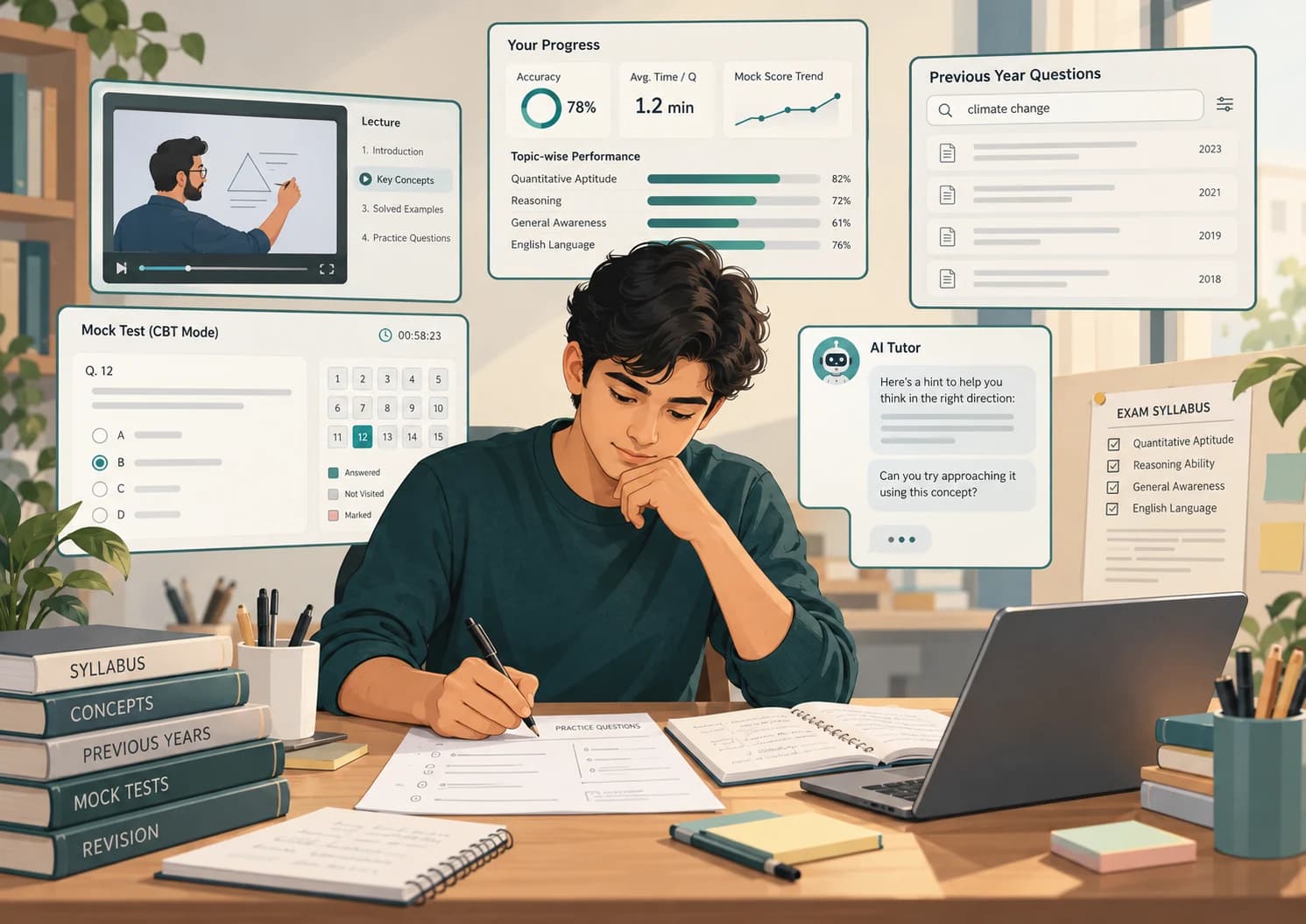
Competitive-exam preparation used to be built around a fairly predictable set of tools: textbooks, coaching notes, classroom lectures, previous-year papers and a few full-length mock tests close to the exam.
Those tools still matter.
What has changed is everything around them.
A student preparing today can watch a recorded lecture at 1.5× speed, attempt a timed mock on a phone, see which topics consumed the most time, generate ten extra questions on a weak concept, ask an AI tutor for a different explanation and compare performance across weeks without maintaining a paper spreadsheet.
Preparation is becoming more continuous, measurable and personalised.
That does not automatically make it better.
Technology can also create new problems: endless content, poor-quality questions, false confidence from dashboards, distraction, overdependence on AI and the temptation to optimise for predicted questions instead of understanding the syllabus.
So the real change is not simply that competitive exams have “gone digital.”
It is that technology is changing how aspirants learn, practise, measure weaknesses and decide what to do next.
Recorded classes broke the link between learning and location
The first major change was simple but powerful: a student no longer needed to be physically present in a coaching centre to access a lecture.
Recorded courses, live online classes and government platforms made instruction portable.
A student in a smaller town can now study from teachers located elsewhere, replay a difficult explanation and choose among multiple instructors for the same subject.
Government initiatives have also pushed this model. PM e-VIDYA, for example, brings together digital, online and broadcast education resources. Its competitive-exam section has included IITPAL lectures for JEE and NEET preparation as well as NTA's practice platform.
This changes the economics of access.
Previously, getting a particular teacher could require moving to Kota, Delhi, Hyderabad or another coaching hub.
Now the lecture can move to the student.
Recorded learning gives the student control
A classroom moves at one speed.
Recorded content does not.
You can:
- pause a derivation;
- replay one step;
- skip material you already know;
- slow down a difficult explanation;
- increase playback speed during revision; and
- return to the exact topic months later.
That control is especially useful when an exam syllabus is large and different students have different weak areas.
But recorded content creates a new responsibility.
When lectures become unlimited, watching can replace studying.
Ten hours of video completion is not the same as ten hours of learning.
The useful question is not:
“How many lectures did I finish?”
It is:
“What can I now solve or recall without the lecture?”
Mock tests are becoming part of preparation, not just final revision
Technology has also changed when students take tests.
In a traditional preparation cycle, full mock exams might appear mainly in the final stage.
Digital systems make testing cheap enough to use throughout preparation.
A student can attempt:
- topic tests;
- chapter tests;
- sectional tests;
- previous-year questions;
- mixed revision sets;
- full-length mocks; and
- exam-interface simulations.
This matters because competitive exams test more than subject knowledge.
They also test:
speed, question selection, time allocation, accuracy, stamina and decision-making under pressure.
For computer-based examinations, familiarity with the interface itself matters.
The National Testing Agency provides online mock-test facilities specifically so candidates can familiarise themselves with computer-based test processes. UGC-NET, for example, is conducted in CBT mode, and JEE Main also uses computer-based testing for major papers.
Not every competitive exam uses the same format—NEET (UG), for example, continues to involve OMR-based response sheets—so preparation should reproduce the actual format of the exam being taken.
A mock test now produces much more than a score
Suppose two students both score 120 marks.
On paper, they look identical.
An analytics system can reveal very different problems.
Student A
- knew most concepts;
- attempted too many risky questions;
- lost marks through negative marking;
- spent too long on difficult questions.
Student B
- managed time well;
- had high accuracy;
- left an entire high-weightage topic weak.
The same score needs two different study plans.
This is where digital test analytics becomes useful.
A well-designed platform can track:
- accuracy by topic;
- average time per question;
- attempted vs skipped questions;
- careless errors;
- difficult vs easy-question performance;
- score trends;
- revision gaps; and
- performance under full exam timing.
NTA's National Test Abhyas has itself used the language of personalised reports, advanced analytics and adaptive learning for competitive-exam practice.
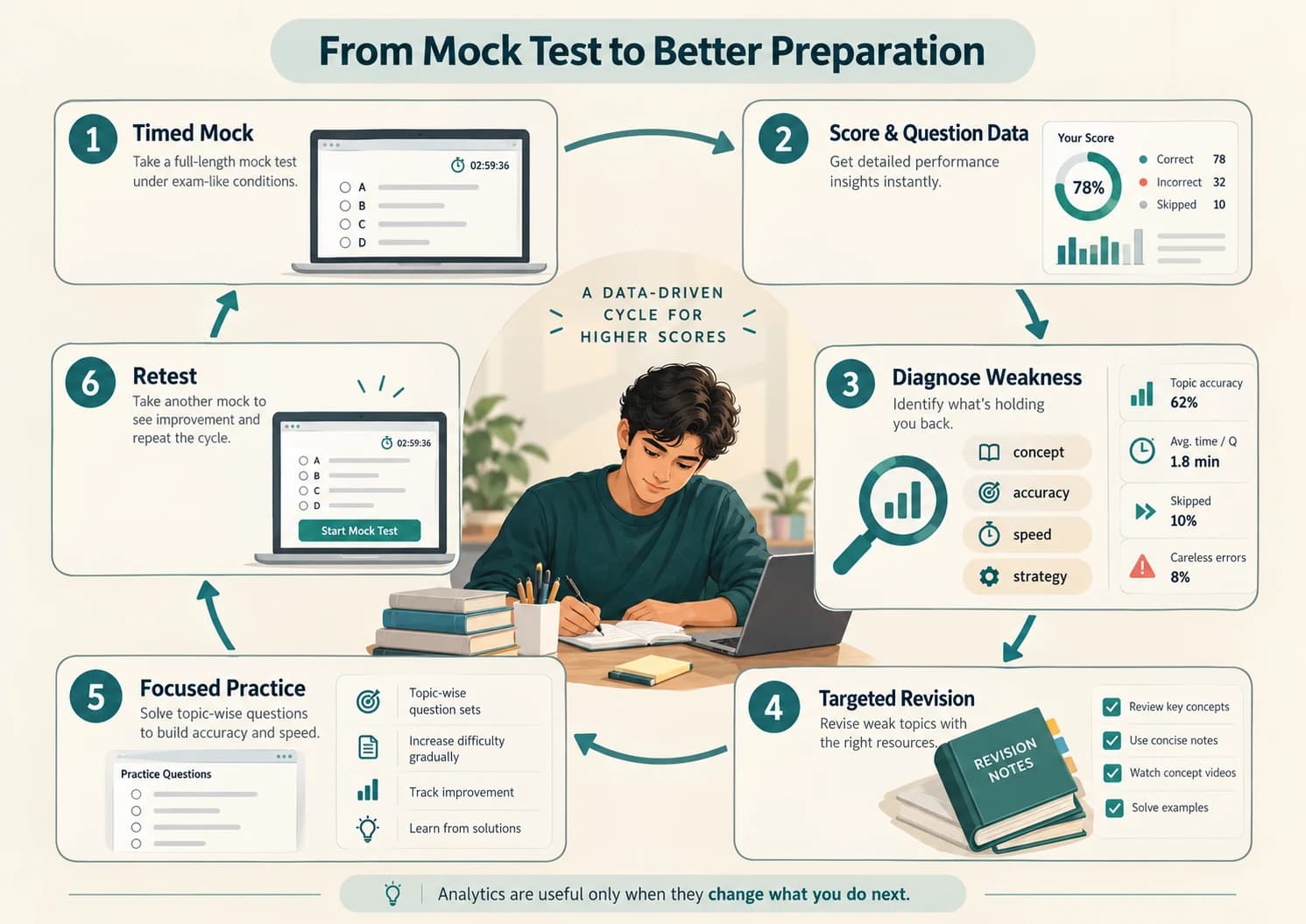
The important change is that preparation can become a feedback system:
Test → diagnose → revise → retest
rather than:
Study everything → take exam → discover weaknesses too late.
The biggest opportunity is personalised revision
In a classroom, everyone may receive the same homework.
Technology can create a different sequence for every student.
Suppose you are preparing for a computer-science exam.
Your test history shows:
- 90% accuracy in DBMS;
- 84% in operating systems;
- 68% in computer networks;
- 42% in compiler design.
A sensible revision system should not spend equal time on all four subjects.
It should direct more practice toward compiler design while still scheduling enough DBMS review to prevent forgetting.
This is the idea behind adaptive learning.
The system uses information about previous performance to decide what should come next.
Modern AI can extend this further by generating explanations, questions and hints at different difficulty levels.
A 2025 systematic review of AI-based personalised learning examined 125 studies published between 2015 and mid-2025 and found a rapidly expanding research base around personalised and adaptive learning systems.
The promise is significant.
But personalisation is only as good as the data and decisions behind it.
If a system concludes that you are “weak in probability” because of five badly written questions, the recommendation may be useless.
Analytics should inform judgment, not replace it.
AI tutors can turn a static doubt into a conversation
Before conversational AI, a student stuck on one line of a solution had limited options.
Search another book.
Find another video.
Ask a teacher later.
Post the question in a forum.
An AI tutor can respond immediately.
For example:
“Why is this recurrence O(n log n) instead of O(n²)?”
Then:
“Show me using a recursion tree.”
Then:
“Give me a similar question but don't show the solution.”
Then:
“Here is my answer. Where did I go wrong?”
That sequence is much closer to tutoring than ordinary search.
The OECD's 2026 Digital Education Outlook concludes that generative AI can support learning when it is used with clear pedagogical intent. It also warns that simply outsourcing cognitive work to AI can improve the immediate output without producing genuine learning.
That distinction is critical for exam preparation.
AI is most useful when it gives hints, not when it takes the test for you
There are two ways to use an AI system.
Productive use
You attempt a problem.
You get stuck.
AI gives a hint.
You try again.
It identifies the misconception.
You solve a related question independently.
Unproductive use
You paste every question.
AI solves it.
You read the solution.
You feel that the chapter is complete.
Only the first workflow prepares you for an exam where the AI will not be sitting beside you.
Aspirants should therefore use AI primarily for:
- alternative explanations;
- doubt clarification;
- additional examples;
- question generation;
- guided hints;
- oral quizzing;
- error analysis; and
- revision planning.
The final proof of learning should still be independent performance under exam conditions.
Previous-year papers have become easier to analyse
Technology has also changed the role of previous-year questions.
They are no longer merely collections of old papers.
Digital databases allow students to filter questions by:
- topic;
- year;
- difficulty;
- question type;
- frequency;
- accuracy; and
- time taken.
This helps answer useful questions:
Which parts of the syllabus repeatedly appear?
Which topics produce my lowest accuracy?
Am I slow because the topic is difficult or because my method is inefficient?
There is one danger here.
Historical frequency is useful for prioritisation.
It is not a guarantee of future questions.
Aspirants can overfit to trends in the same way a statistical model can overfit old data.
If a topic remains in the official syllabus, “it has not appeared recently” is not a reliable reason to ignore it completely.
Technology should help allocate effort, not turn preparation into prediction gambling.
Online communities changed doubt-solving and information flow
Preparation is also more social than it used to be.
Students can join discussion groups, study communities, live streams and forums where they exchange:
- doubts;
- study strategies;
- exam experiences;
- resource recommendations;
- memory techniques; and
- updates.
This can reduce the isolation of self-study.
It can also create one of the biggest sources of wasted time.
Exam communities often mix useful information with rumours:
“The exam date will definitely change.”
“This topic has been removed.”
“This source says the cut-off will be 145.”
“Everyone is getting 180 in this mock.”
For exam dates, eligibility, syllabus, pattern, answer keys and application rules, the official exam authority should remain the primary source.
Community discussion is useful for interpretation.
It should not replace official information.
Digital preparation makes progress more visible
Paper-based preparation often hides progress.
A student may know that they studied for six hours but not whether the six hours improved performance.
Digital systems can make learning more measurable.
Useful metrics include:
- PYQs attempted;
- accuracy percentage;
- mock-test score;
- average question time;
- weak topics;
- revision intervals;
- error categories; and
- score trend.
This can improve planning.
But dashboards can also become another form of procrastination.
If you spend 40 minutes designing a perfect tracker for a two-hour study session, the tracking system is winning.
A metric is useful only if it changes a decision.
For example:
Observation: Accuracy in probability is 52%.
Decision: Revise conditional probability tomorrow and solve 30 targeted questions.
Without the decision, the 52% is just decoration.
Technology can make preparation cheaper—but not equally accessible
Digital learning can reduce some barriers.
A student may access free lectures, government resources, low-cost test series and digital question banks without relocating.
PM e-VIDYA explicitly describes digital programmes such as SWAYAM, DIKSHA and competitive-exam resources as tools for widening access.
But online access is not automatically equal access.
Students still differ in:
- device quality;
- internet reliability;
- quiet study space;
- ability to pay for premium platforms;
- digital literacy; and
- access to human guidance.
UNESCO's guidance on generative AI also emphasises equity, privacy and the need for human-centred implementation.
Technology can reduce geographical inequality while creating new differences between students who know how to use digital tools strategically and those who are simply surrounded by more content.
The new problem is no longer lack of resources—it is choosing among them
An aspirant preparing twenty years ago might have struggled to find enough material.
Many students today have the opposite problem.
Five teachers for the same topic.
Three test series.
Thousands of YouTube videos.
Several Telegram channels.
Two AI assistants.
Multiple PDF collections.
An unlimited question bank.
This can feel productive because there is always one more resource to discover.
But competitive exams reward mastery, not resource collection.
A stable preparation system usually needs surprisingly few core tools:
one main learning source
one reliable question source
previous-year questions
a mock-test system
an error/revision method
official exam updates
AI can sit on top of that system.
It should not turn the system into ten more tabs.
Technology has made error analysis more important
One of the most valuable changes is the ability to classify mistakes.
After a mock, do not merely record:
Question 37 — wrong.
Ask why it was wrong.
A useful error log might use categories such as:
Concept error — you did not understand the idea.
Recall error — you knew it but could not retrieve it.
Calculation error — the method was correct but arithmetic failed.
Reading error — you misread a condition or word.
Strategy error — you spent too long or chose the wrong question.
Guessing error — you took unnecessary risk.
Technology can automate part of this classification, but the learner should still inspect the mistake.
Two wrong answers can need completely different fixes.
The goal of analysis is not to produce a sophisticated report.
It is to prevent the same mistake from appearing in the real exam.
What technology cannot change
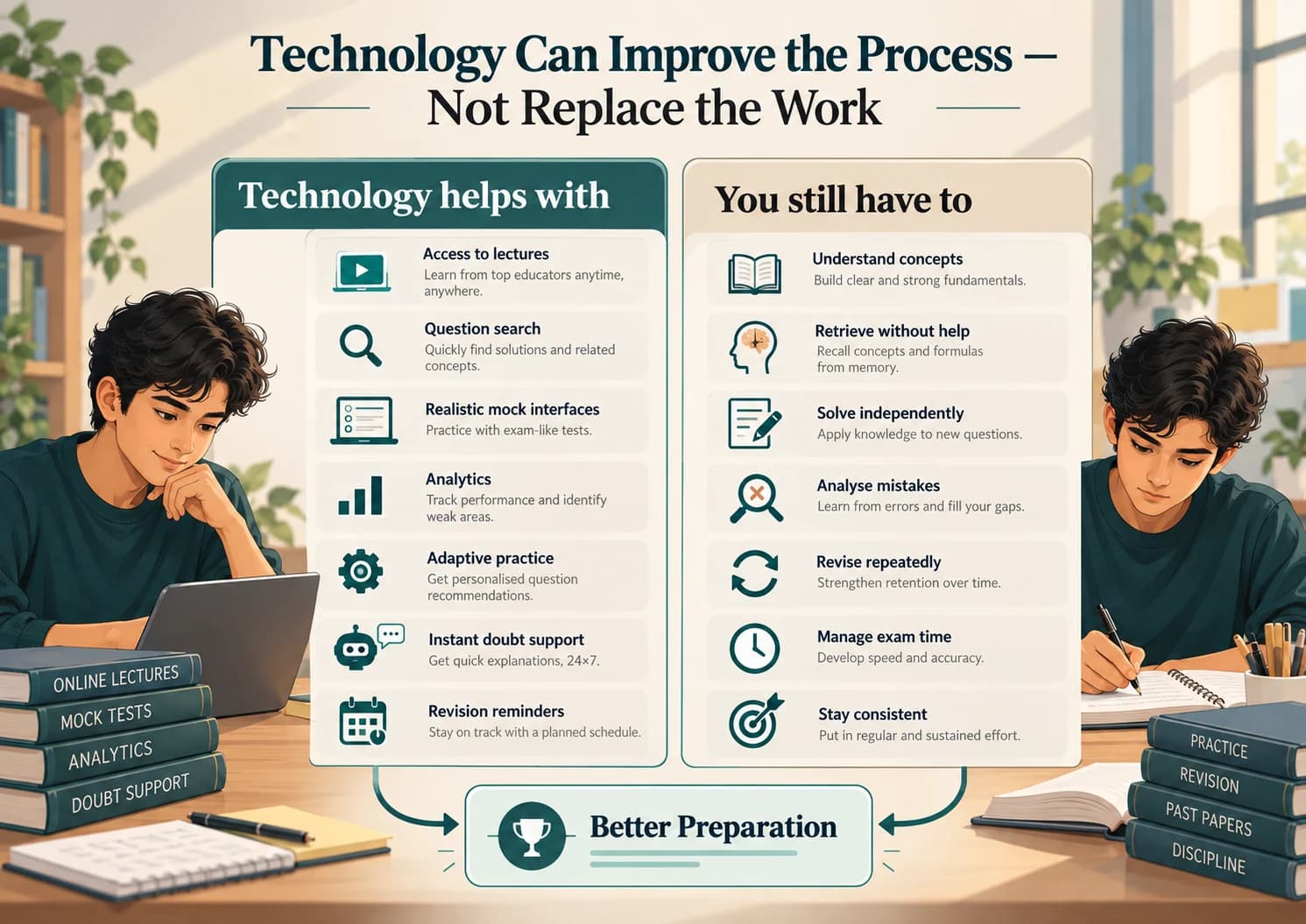
The tools are new.
Several principles are not.
You still need to understand the syllabus.
You still need to recall information without help.
You still need to solve enough questions.
You still need to revise material before it is forgotten.
You still need to practise under time pressure.
You still need sleep, concentration and consistency.
And on exam day, you still need to make decisions yourself.
A beautifully personalised dashboard cannot compensate for weak fundamentals.
An AI tutor cannot compensate for never solving questions independently.
A thousand recorded lectures cannot compensate for avoiding revision.
Technology can make the feedback loop faster.
It cannot remove the need for deliberate practice.
A modern competitive-exam preparation loop
A sensible technology-assisted workflow might look like this:
1. Start with the official syllabus and exam pattern
Build preparation around what is actually tested.
Do not let an app decide the syllabus.
2. Learn one defined topic
Use a book, lecture or structured course.
3. Attempt questions without help
Use topic questions and previous-year problems.
4. Analyse the errors
Identify whether the problem is knowledge, recall, speed or strategy.
5. Use technology selectively
Use an AI tutor for a stubborn doubt.
Use analytics to find a weak topic.
Use a video when a process is hard to visualise.
Use a question bank for targeted practice.
6. Reattempt later
Do not assume that understanding the solution once means the weakness is fixed.
7. Take full mocks regularly
Practise the actual format, timing and decision pressure of the exam.
8. Adjust the plan from evidence
Your next week's schedule should reflect what your performance reveals.
The cycle becomes:
Learn → practise → test → diagnose → revise → retest
That is where technology is most powerful.
Not because it studies for you.
Because it can shorten the time between making a mistake and discovering exactly what to do about it.
The competitive advantage is increasingly how well you use the tools
Most aspirants now have access to more information than they could possibly finish.
That changes the nature of preparation.
The advantage is no longer simply having the largest pile of notes or knowing about the most coaching resources.
It is being able to choose the right resource, practise independently, interpret performance data and ignore everything that does not improve the next attempt.
Technology can give you lectures on demand, realistic mocks, detailed analytics, adaptive question sets and a tutor that answers at midnight.
Those are powerful advantages.
But the exam still measures what you can retrieve, solve and decide when the support is removed.
The smartest use of technology is therefore not to make preparation effortless.
It is to make your effort more accurately directed.