Can Technology Replace a Teacher? What AI Can Do—and What Still Requires Humans
AI can tutor, explain, personalise practice and reduce teacher workload. But teaching also requires judgment, relationships, motivation and human responsibility.
Imagine a student who can ask a tutor any question at 2 a.m.
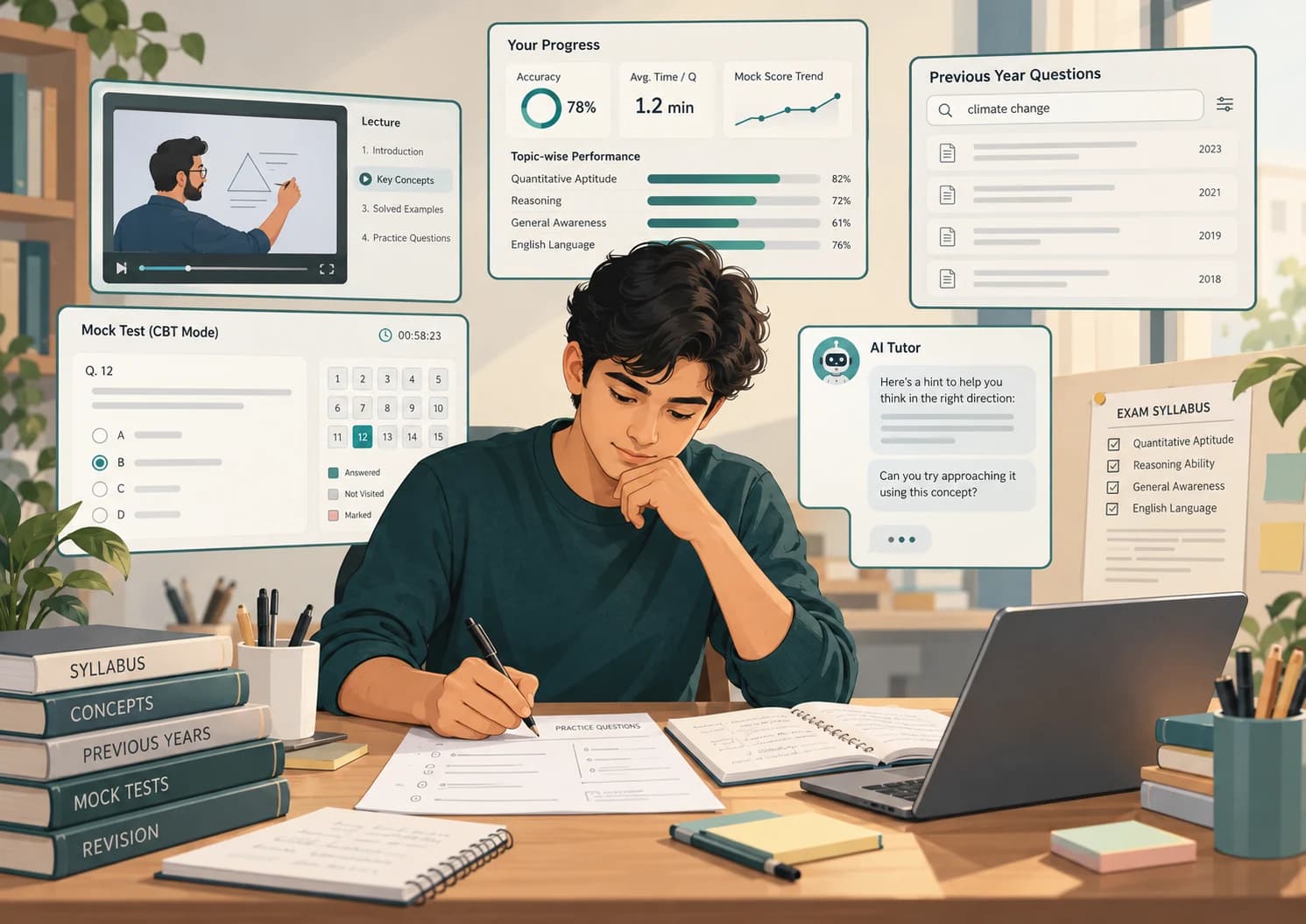
The tutor never gets tired. It can explain the same concept five different ways, create ten practice questions in seconds, translate the explanation into another language and give immediate feedback after every answer.
That no longer sounds futuristic. Modern AI systems can already do much of it.
So does education still need teachers?
Yes—but the interesting reason is not simply that “humans are better.”
Teaching is not one task. It is a bundle of very different jobs: explaining ideas, diagnosing misconceptions, designing activities, motivating students, judging when to intervene, managing a classroom, protecting children, assessing progress, building confidence and deciding what is worth learning in the first place.
AI is becoming surprisingly capable at some of those jobs.
Others depend on human relationships, responsibility, context and judgment in ways that current technology does not replace.
The better question is therefore not:
“Can AI replace a teacher?”
It is:
“Which parts of teaching can AI do well, which parts can it support, and which parts should remain human-led?”
AI can already behave like a patient personal tutor
One of AI's strongest educational uses is individual explanation.
A student can ask:
“Why does dividing by a fraction mean multiplying by its reciprocal?”
If the first answer does not help, the student can ask for:
- a simpler explanation;
- a visual analogy;
- a worked example;
- a version for a ten-year-old;
- a more technical explanation; or
- another problem to practise.
A classroom teacher with 35 students cannot provide unlimited one-to-one explanations to everyone at once. An AI tutor can also adjust the pace: a fast learner can move ahead, while another student can ask for repeated explanations privately.
That on-demand, individual interaction is one reason AI tutoring is attracting so much attention.
A 2025 randomized controlled trial in a Harvard undergraduate physics course found that students using a specially designed AI tutor achieved larger short-term learning gains, in less time, than students receiving an active-learning classroom lesson on the material tested.
That is an impressive result.
But it is important to understand what the study does—and does not—show.
The AI tutor was not simply an unrestricted chatbot told to “teach physics.” Researchers deliberately designed its prompts, supplied detailed solutions, controlled the order of multi-part problems and built pedagogical principles into the system.
In other words, effective AI teaching required a lot of human teaching expertise behind the AI.
AI can generate almost unlimited practice
Teachers spend considerable time producing exercises, examples, quizzes and alternative explanations.
Generative AI can create these quickly.
For example, a mathematics teacher can ask for:
- five easy quadratic-equation questions;
- five medium questions;
- three problems containing common student mistakes;
- a mixed revision quiz; and
- hints for each problem without revealing the final answer.
A language learner can practise conversation.
A programming student can ask for debugging exercises.
A history student can be questioned on causes and consequences rather than simply memorising dates.
This makes AI particularly useful for low-stakes practice.
The important phrase is low stakes.
Generated questions and answers can still contain errors. Teachers or students need ways to verify important material, especially in technical subjects.
AI can produce quantity effortlessly.
Quality still needs supervision.
Immediate feedback is another major strength
Feedback is most useful when it arrives while the learner still remembers what they were trying to do.
AI can respond immediately.
Suppose a student solves an algebra problem incorrectly.
A useful AI tutor does not have to say only:
Wrong. The answer is 12.
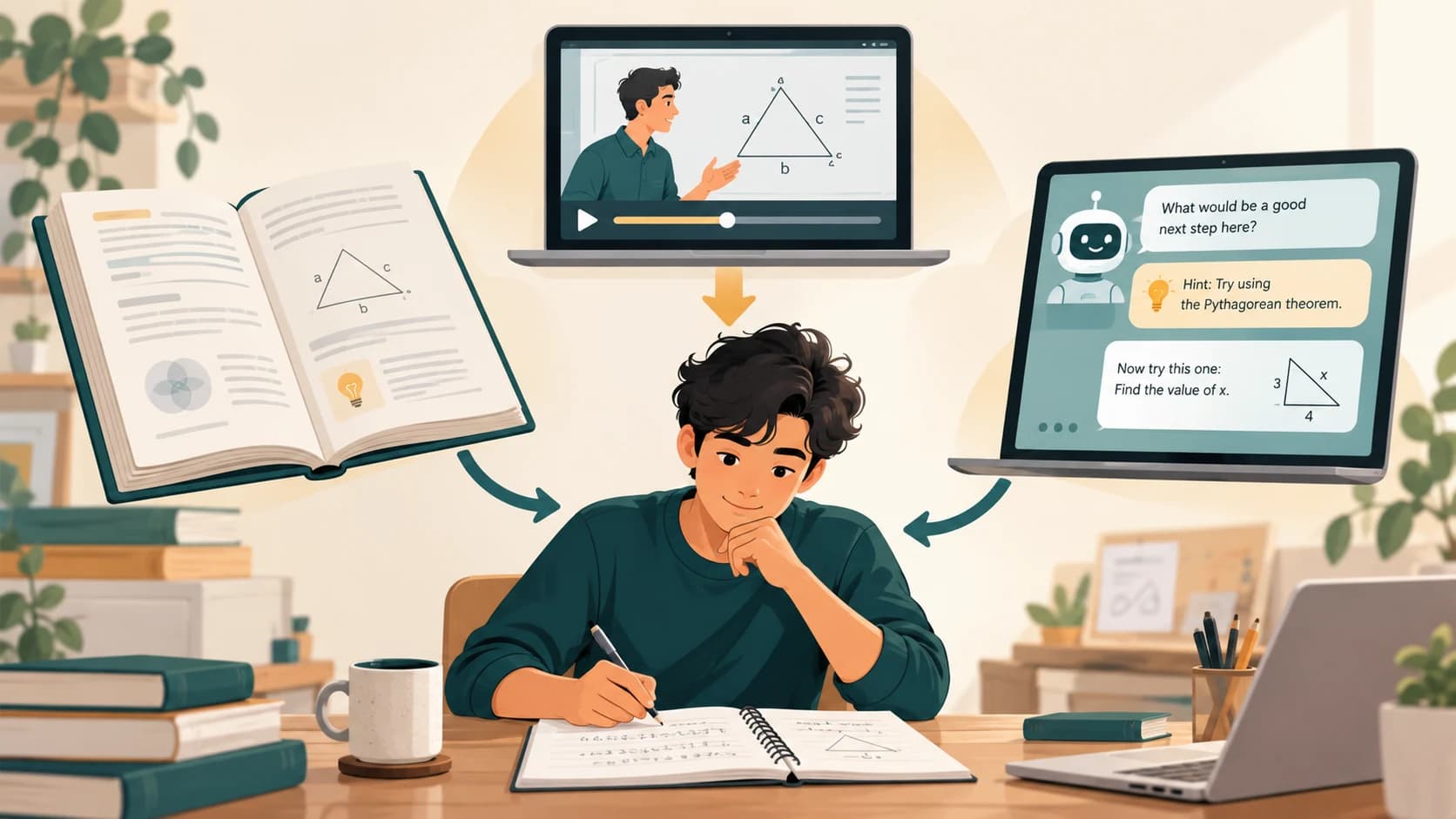
It can identify the likely misconception, give a smaller hint and let the student try again.
That can create a productive loop:
Attempt → feedback → retry → explanation → new attempt
Traditional software could already provide automated feedback, but generative AI makes the interaction much more flexible because students can respond in natural language.
This is one area where AI can extend what a teacher is able to provide at scale.
A teacher can then use those patterns to intervene where human instruction is most valuable.
AI can help personalise learning—but “personalised” needs qualification
AI systems can adjust explanations, examples and question difficulty based on a student's responses.
If a learner understands the definition of photosynthesis but repeatedly confuses chlorophyll with chloroplasts, an AI tutor can spend more time on that distinction.
If another student already understands it, the system can move ahead.
This kind of adaptation is useful because real classrooms contain students at very different levels.
However, educational personalisation is much bigger than selecting the next question.
A system may know that a student answered four fractions questions incorrectly.
A good teacher may also know that:
- the student normally understands fractions;
- they had a difficult morning;
- they are afraid to answer publicly;
- they recently changed schools;
- a particular explanation worked last week;
- they learn better when paired with a specific classmate; or
- today's errors reflect anxiety rather than lack of knowledge.
AI can personalise from the data it receives. A teacher understands a learner through an ongoing social relationship and a wider context.
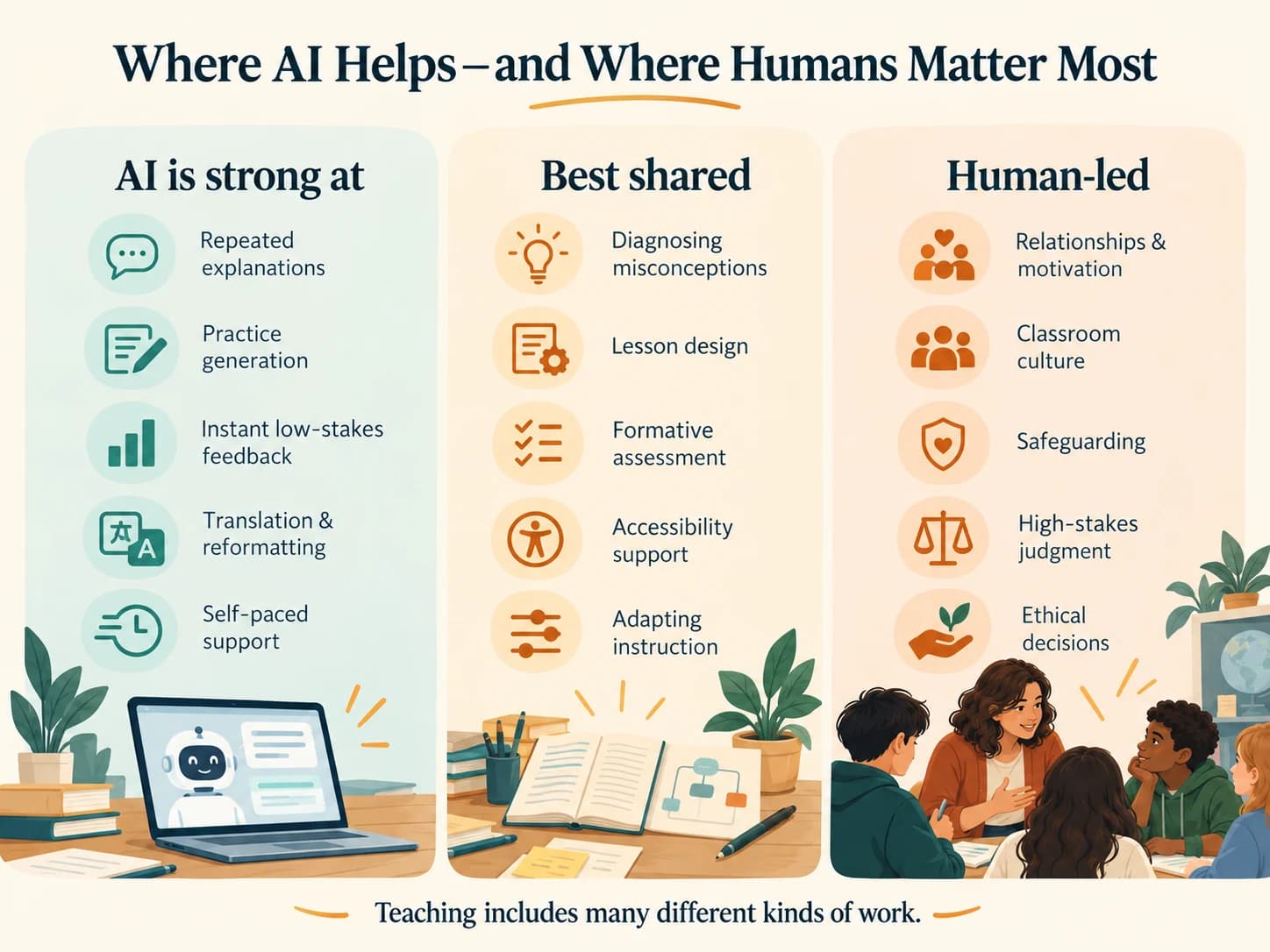
AI can reduce some of the work around teaching
The technology may have its biggest near-term impact not by replacing classroom teaching, but by removing some of the work surrounding it.
Teachers are already using generative AI to help with tasks such as:
- drafting lesson plans;
- creating worksheets;
- producing examples at different difficulty levels;
- adapting reading materials;
- generating quiz questions;
- rewriting instructions more clearly;
- translating or simplifying text;
- preparing parent communications; and
- creating first drafts of rubrics or feedback.
A 2025 survey published by England's Department for Education found that among teachers who reported using generative AI, lesson and curriculum resources and lesson planning were among the most common uses.
Generated material should not simply be delivered unchanged. A worksheet may contain factual errors, poor wording, inappropriate difficulty or examples that do not fit the local curriculum.
A safer workflow is:
AI drafts → teacher reviews → teacher adapts → students use
If AI saves teachers time on repetitive preparation, that time can potentially be redirected toward activities technology handles less well.
AI can make educational material more accessible
This is an important capability that is sometimes overshadowed by chatbot discussions.
AI systems can help convert information between formats:
- text to speech;
- speech to text;
- translation;
- simplified explanations;
- captions;
- alternative reading levels;
- summaries;
- image descriptions; and
- customised practice.
Used carefully, these tools can make learning materials more accessible to students with different language backgrounds or disabilities.
UNICEF's current guidance on AI and children specifically identifies accessibility and learning support as important opportunities.
Again, the technology is most useful when accessibility needs are identified and supervised by people who understand the learner.
Automation should expand access, not decide by itself what a child needs.
So what still requires a human teacher?
This is where the word teacher becomes much larger than “person who gives explanations.”
An explanation can be generated.
A teaching relationship has to be built.
A teacher notices what the student does not say
A student rarely announces:
“I have stopped asking questions because I now believe I am bad at mathematics.”
A teacher may notice it.
They can see changes in participation, effort, confidence, friendships, body language and classroom behaviour.
These signals are imperfect even for humans, but teachers operate inside the social environment where they occur.
A chatbot sees the inputs the student provides to it.
Those are not the same thing.
Motivation is not just personalised content
AI can praise a student.
It can say:
“Good effort. Try again.”
But human encouragement can carry a different meaning because it comes from someone who knows the learner and has witnessed their progress.
A teacher can remember that a student who solved today's problem could not do it three weeks ago.
They can set expectations, show disappointment without humiliation, celebrate improvement, challenge excuses and decide when a student needs pressure versus support.
Education is partly about knowledge.
It is also about becoming the kind of person who persists when the answer is not immediate.
That development happens socially.
Research repeatedly links supportive teacher-student relationships with engagement, motivation and school adjustment.
Teachers manage groups, not just individuals
AI tutoring often imagines education as one learner interacting with one tutor.
A classroom is a community.
A teacher has to decide:
- who should work together;
- when discussion is productive;
- when one student is dominating;
- whether disagreement is becoming disrespectful;
- when the whole class needs to stop and revisit an idea;
- when silence means concentration and when it means confusion; and
- how to create a culture in which students are willing to make mistakes.
These are forms of social orchestration.
They matter because students learn from each other as well as from teachers.
Classroom discussion can expose competing ideas, force students to explain reasoning and teach them how to listen to perspectives they did not generate themselves.
An AI tutor optimising an individual conversation does not automatically create that social learning environment.
Teachers decide what counts as a good answer
Generative AI can evaluate many responses and provide useful formative feedback.
But assessment is not merely matching an answer against a model.
Consider an essay.
A teacher may judge whether the student:
- built an original argument;
- understood the question;
- used evidence responsibly;
- improved since the previous assignment;
- took an intellectually interesting risk; or
- appears not to have written the work themselves.
Some of these judgments can be supported by technology.
Delegating them entirely to an AI system raises questions about accuracy, bias, transparency and accountability.
UNICEF's 2025 guidance on AI and children specifically cautions against using AI without appropriate human involvement for critical educational decisions, including some high-stakes assessment.
The higher the consequence of the decision, the stronger the case for meaningful human responsibility.
AI can be confidently wrong
This is one of the most important limitations in education.
Generative AI can produce fluent explanations that contain false information.
The danger is that the error may sound convincing, while the learner may be the person least able to recognise it.
The Harvard physics-tutor study mentioned earlier dealt with this problem directly. The researchers supplied detailed step-by-step solutions and constrained the system partly because unrestricted model output could hallucinate or mishandle complex problems.
The OECD's 2026 Digital Education Outlook makes a similar point: AI tutors show real promise, but factual accuracy and pedagogical design cannot be assumed simply because the conversation sounds intelligent.
Teachers can also make mistakes. The difference is that AI can generate incorrect material at scale and with unusual fluency, so verification and accountability matter.
AI can help students complete work without helping them learn
This may be the most subtle risk.
Suppose a student is assigned an essay.
They give the topic to an AI system.
The AI generates an outline, then the argument, then the examples, then the final paragraphs.
The student submits an excellent-looking essay.
What did the student learn?
Possibly very little.
The OECD Digital Education Outlook 2026 draws an important distinction: improving performance on a task with generative AI does not automatically produce learning.
Learning often requires the difficult part: recalling information, struggling with a problem, choosing between ideas, making mistakes and revising reasoning before seeing the answer.
If AI removes all of that friction, it can produce a better product while producing a weaker learner.
A good teacher therefore has to decide not only where AI can help, but also where students need to do the thinking themselves.
Children also need adults to carry responsibility
Schools have responsibilities far beyond academic explanation, including safeguarding, bullying, privacy, inclusion, wellbeing, family communication, special educational needs and serious decisions affecting a child's future.
An AI system can provide information related to some of these issues.
It should not become the person ultimately responsible for them.
This is why organisations such as UNESCO and UNICEF consistently frame educational AI around human agency, human oversight and child rights.
The critical question is:
Who is accountable if the response causes harm?
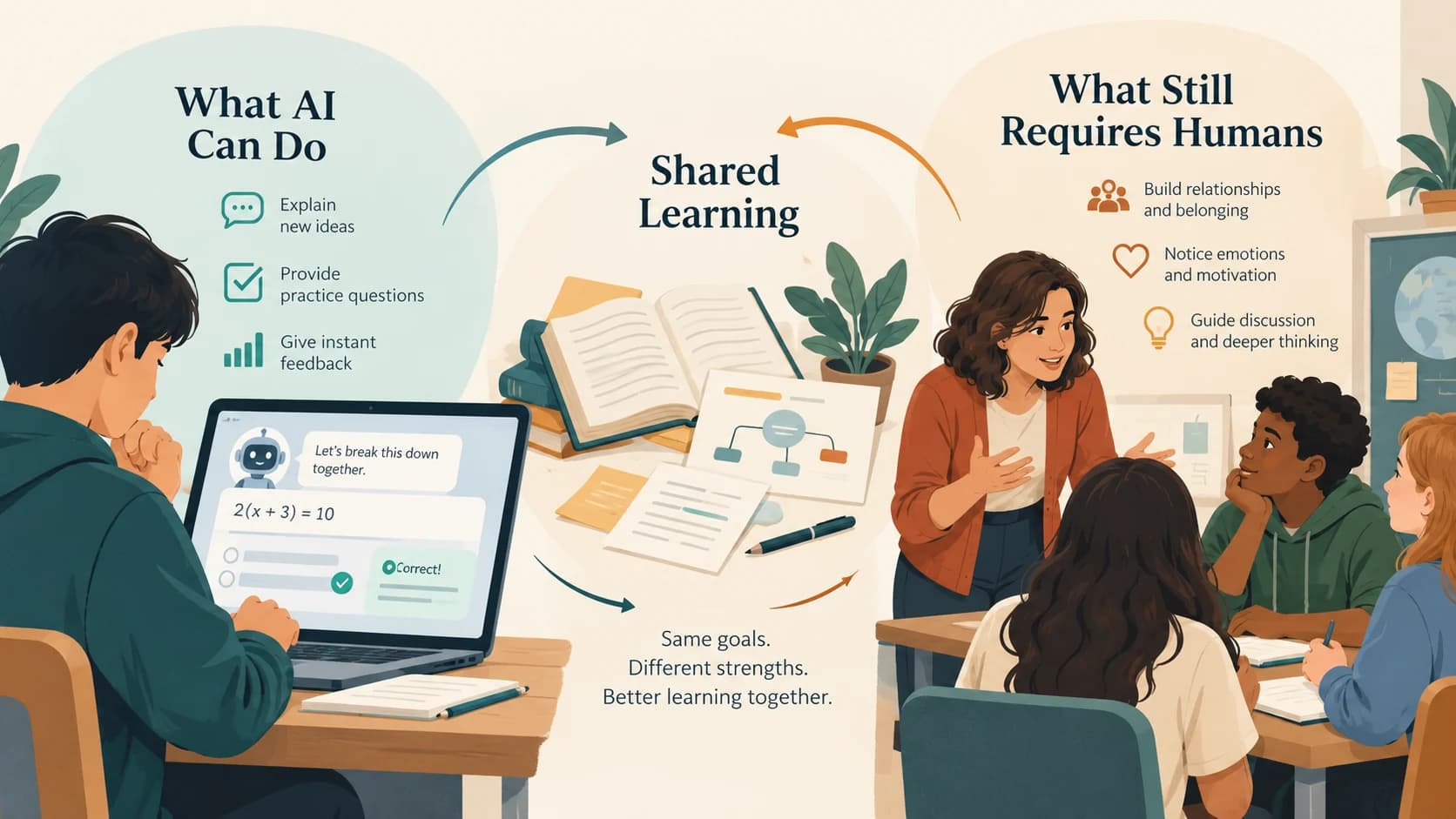
The strongest model may be teacher + AI, not teacher vs AI
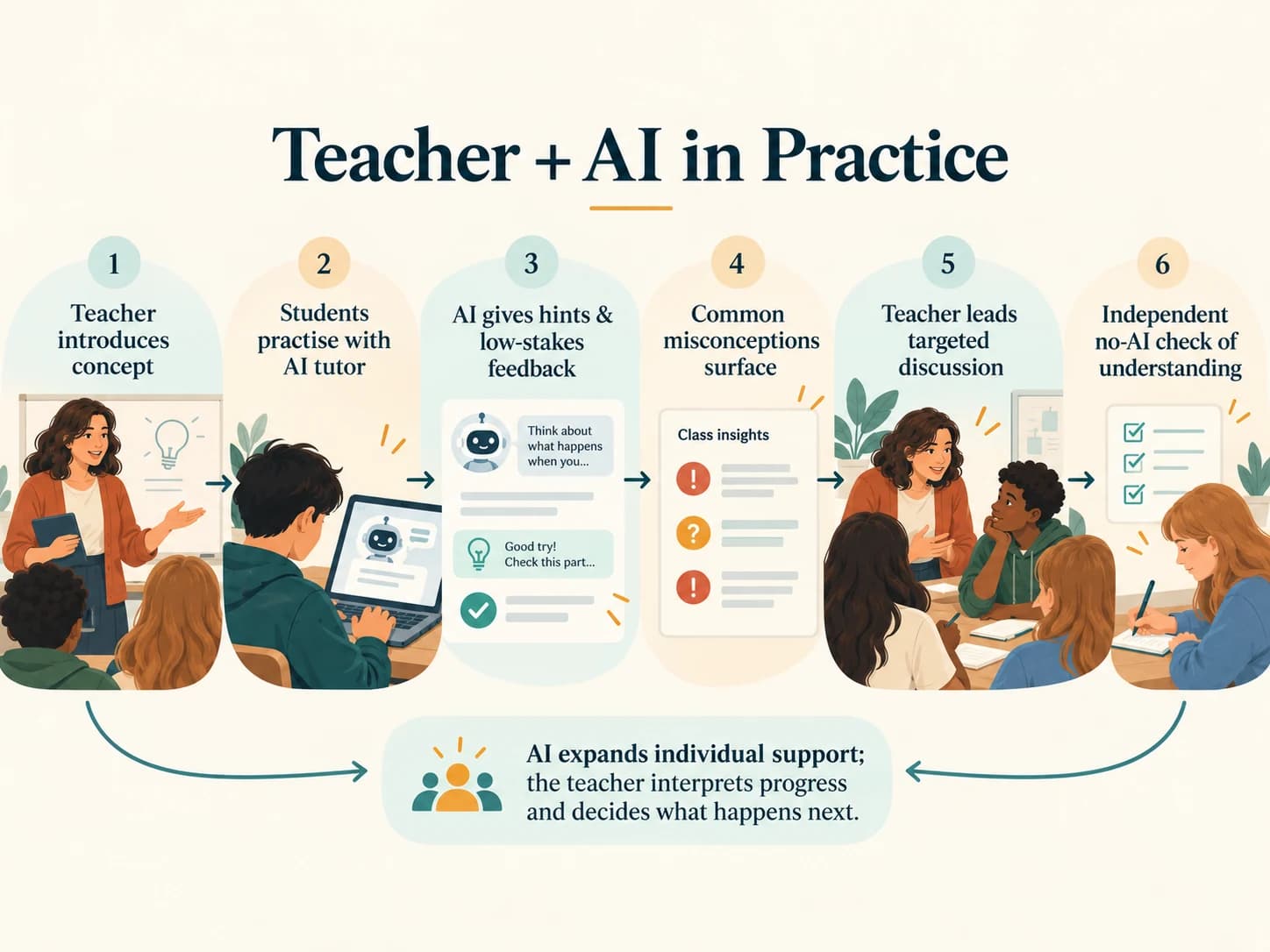
The most productive use of AI in education may be division of labour.
AI handles scale
AI is good at tasks such as:
- generating additional practice;
- providing instant low-stakes feedback;
- explaining concepts repeatedly;
- adapting difficulty;
- translating and reformatting content;
- drafting materials; and
- being available outside school hours.
Teachers handle judgment and direction
Teachers are better positioned to:
- decide what students should learn;
- diagnose problems in context;
- motivate and challenge learners;
- build relationships;
- manage classroom culture;
- organise discussion and collaboration;
- protect students;
- make consequential judgments; and
- decide when AI should not be used.
Both can work together
A teacher might introduce a concept to the class.
Students then use an AI tutor for individual practice.
The system identifies common errors.
The teacher sees the patterns, brings the class together and addresses the misconception through discussion.
Students complete a final problem without AI to demonstrate independent understanding.
The AI expands individual support; the teacher decides what that support is for.
The teacher's role may change precisely because AI becomes better
If AI can answer routine questions instantly, producing answers may become a smaller part of teaching.
Other parts may become more important:
asking good questions
designing worthwhile tasks
teaching students how to verify information
helping students recognise weak reasoning
building AI literacy
creating discussion
protecting independent thinking
knowing when not to use technology
UNESCO's AI Competency Framework for Teachers reflects this shift. It treats AI literacy, ethics, pedagogy and human-centred decision-making as competencies teachers themselves increasingly need.
The teacher of the future may use more AI, not less.
It changes where human expertise is most valuable.
So, can AI replace a teacher?
If by teacher you mean:
“A system that explains content, answers questions and creates exercises,”
then AI can already perform a meaningful part of that role.
In some carefully designed tutoring situations, it may even outperform conventional instruction on specific learning tasks.
But if teacher means:
“A responsible adult who understands learners in context, builds relationships, creates a learning community, makes ethical and pedagogical judgments, motivates students and takes responsibility for consequential decisions,”
then current AI is not an equivalent replacement.
The distinction matters because education is not simply the transfer of information.
If information delivery were the whole job, textbooks, search engines and recorded lectures would already have replaced teachers.
They did not.
AI makes information and individual tutoring dramatically more powerful.
The likely future is therefore not AI instead of teachers.
It is education in which teachers who know how to use AI can provide forms of support that neither a teacher working alone nor an AI system working alone can provide as effectively.
The technology can answer more questions.
Humans still have to decide which questions are worth asking—and what kind of person the education is meant to help a student become.