Why Does Teaching Something to Someone Else Improve Your Own Understanding?
Teaching forces you to retrieve, organise and explain knowledge. Learn why explaining something to another person can deepen your own understanding.

You can read a chapter twice and feel that you understand it.
Then someone asks:
“Can you explain it to me?”
Suddenly the gaps appear.
You know the definition, but not why it works. You remember the formula, but cannot explain when to use it. You thought the idea was clear until you had to turn it into a sequence another person could follow.
That uncomfortable moment is one reason teaching can be such a powerful way to learn.
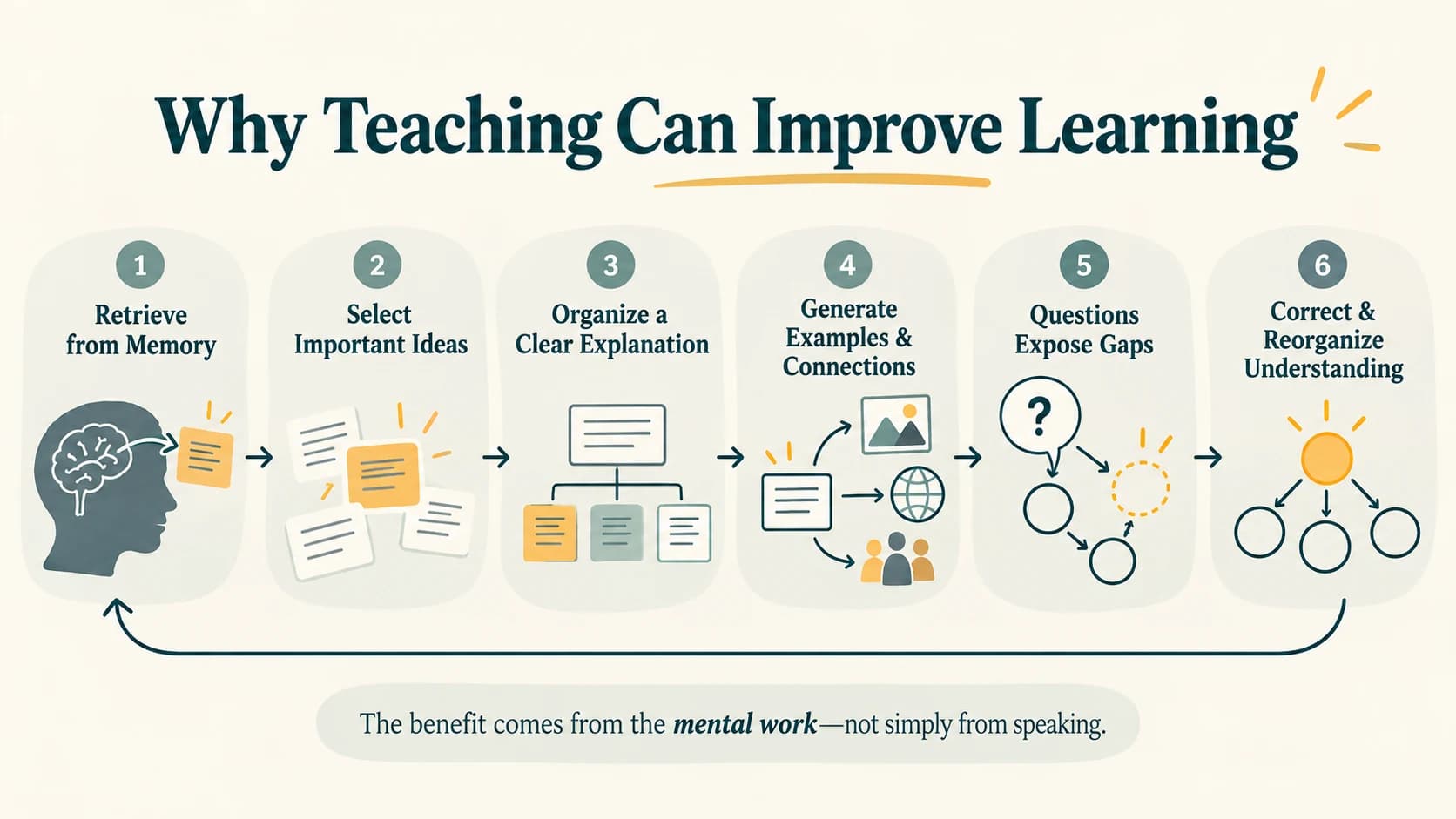
When you teach, you cannot rely only on recognition. You have to retrieve information, organise it, connect ideas, choose examples and notice what you do not understand.
Psychologists often describe this family of effects as learning by teaching. A related idea, sometimes called the protégé effect, is that people may learn more carefully when they expect their knowledge to be used to help someone else.
But there is an important qualification.
Simply talking at another person does not automatically produce deep understanding. The benefit depends on what the teaching forces you to do mentally.
The useful question is not:
“Does teaching magically improve memory?”
It is:
“What does preparing and explaining for someone else make your brain do differently?”
Teaching forces you to retrieve instead of merely recognise
This is probably the most important mechanism.
When you reread a page, the information is in front of you.
You may look at a sentence and think:
“Yes, I know that.”
But recognising an idea when you see it is easier than producing it from memory.
Teaching changes the task.
If you close the book and explain photosynthesis to someone else, you now have to retrieve:
- what the process is;
- where it happens;
- what inputs are required;
- what outputs are produced; and
- how the parts connect.
Retrieval itself is a powerful learning activity.
A large body of research on retrieval practice shows that actively recalling information strengthens later retention more effectively than simply restudying the same material in many situations.
Teaching naturally creates retrieval opportunities because you need to bring the information back into working memory before you can explain it.
That is one reason explaining from memory is more useful than reading your notes aloud.
Preparing to teach changes how you study
The benefit can begin before any teaching happens.
In experiments, students who expected that they would later teach material often studied it differently from students who expected only to take a test.
One influential study found that learners expecting to teach later produced more complete and better-organised recall of text material, even though they never actually taught anyone.
Why?
If you expect to explain something, you are more likely to ask questions such as:
What is the main idea?
How do these points connect?
What would I explain first?
What example would make this easier to understand?
That is a different way of reading from simply trying to remember enough facts for a test.
The expectation of teaching can push you toward organisation.
And organised knowledge is easier to retrieve than a collection of disconnected details.
Teaching forces you to build a coherent explanation
Suppose you are learning why seasons occur.
You may remember several facts:
- Earth orbits the Sun.
- Earth is tilted.
- Days are longer in summer.
- Sunlight arrives at different angles.
Knowing those statements individually is not the same as understanding the mechanism.
To teach the topic, you need a causal chain:
Earth's axis is tilted → as Earth orbits the Sun, each hemisphere receives different angles and durations of sunlight → the amount of solar energy changes → seasons result.
That explanation requires you to organise facts into a model.
Researchers call activities such as explaining, summarising and drawing generative learning because learners have to actively make meaning rather than only receive information.
A 2024 study comparing students who explained a science lesson to themselves or to others with students who restudied the material found better retention for the explanation groups. Explaining to others also produced stronger transfer performance than restudying in that experiment.
The important part is not speaking aloud by itself.
It is constructing the explanation.
Explaining exposes the illusion of understanding
Teaching is also a diagnostic tool.
Before explaining, you may feel confident because the material looks familiar.
Then you try to teach it:
“A database index makes searching faster because...”
And you stop.
You realise that you know what an index does but cannot explain how it reduces the amount of data that must be searched.
This is valuable.
Your confidence has just become more accurate.
In learning science, this is related to metacognition: your ability to judge what you know and what you do not know.
Passive review can hide gaps because the correct information is constantly available.
Explanation removes some of that support.
When you get stuck, the weakness becomes visible.
That gives you a much better question to take back to the book, teacher or AI tutor.
Instead of:
“I don't understand indexes.”
you now know:
“I don't understand why a B-tree lets the database avoid scanning every row.”
That is a much more useful learning problem.
A learner's question can reveal weaknesses you never noticed
Real teaching adds something self-explanation does not always provide: another mind.
You explain an idea.
The other person asks:
“But why?”
You answer.
They ask:
“What would happen if that condition changed?”
Now you have to go beyond the explanation you rehearsed.
Questions can expose assumptions that seemed obvious to you.
For example, you teach someone:
“Higher interest rates can reduce inflation because borrowing becomes more expensive.”
They ask:
“Why would expensive borrowing reduce prices?”
Now you have to connect the missing steps:
higher borrowing costs → less borrowing and spending/investment → lower demand pressure → potentially slower price growth, among other channels.
The question forces elaboration.
This is one reason interactive teaching can be especially useful: the learner's confusion creates new tests of your own mental model.
Teaching makes you simplify without oversimplifying
To teach well, you need to choose what matters.
Imagine explaining the internet to a beginner.
You could mention:
IP addresses, DNS, routing protocols, TCP, fibre-optic cables, data centres, HTTP, TLS, packets, routers and autonomous systems.
All of those may be relevant.
But presenting everything at once would be a terrible explanation.
Teaching forces you to decide:
What is essential now?
What can wait?
What order makes sense?
Which technical term needs explanation?
This kind of selection improves your own understanding because it forces you to distinguish the core idea from supporting detail.
If you cannot simplify a concept without making it wrong, you may not yet understand its structure well enough.
That does not mean every idea should be reduced to a slogan.
Good teaching preserves the important relationships while removing unnecessary complexity.
Examples test whether you understand the principle
A powerful explanation usually needs an example.
And examples are harder to create than they look.
Suppose you have memorised:
“Opportunity cost is the value of the next-best alternative forgone.”
Now teach it.
You might say:
“If you spend two hours watching a movie instead of studying, the opportunity cost is the most valuable alternative use of those two hours.”
To create that example correctly, you need to understand what the definition really means.
Generating a new example is therefore a test of transfer.
Can you use the idea outside the exact example you originally learned?
If yes, your knowledge is becoming more flexible.
If no, you may have memorised the wording without understanding the concept.
The audience changes how you think about the material
Teaching is not only about remembering information.
It also requires you to model the learner.
You ask yourself:
What does this person already know?
Which part will confuse them?
Which analogy will help?
Should I explain the technical term first?
That introduces a social dimension to learning.
Research on learning by teaching suggests that even explaining to a fictitious or non-interactive audience can sometimes help, although results are not uniform.
Some studies have found that oral explanations to an imagined learner outperform restudy, while written explanations do not always show the same benefit.
This matters because it shows that "teach someone" is not one single cognitive activity.
Explaining naturally, creating a video lesson, writing an explanation, teaching an interactive partner and reading prepared notes can place very different demands on the learner.
Does the other person actually need to be there?
Not necessarily.
You can use the same principle even when studying alone.
Try teaching:
- an empty chair;
- an imaginary beginner;
- a voice recorder;
- your camera;
- a whiteboard;
- an AI acting as a confused student; or
- yourself.
The key is to remove the safety net.
Do not simply read from your notes.
Close them and explain from memory.
Then inspect what happened.
Where did you hesitate?
Where did you use vague phrases such as “basically” because you did not know the mechanism?
Which example failed?
Which question could you not answer?
That is where the learning opportunity is.
Why explaining to yourself can work too
You do not always need a student.
Self-explanation is a well-established learning technique in which you explain material or problem-solving steps to yourself.
For example, while solving an equation you might say:
“I am subtracting 4 from both sides because I want to isolate the term containing x, and doing the same operation to both sides preserves equality.”
This is much better than mechanically copying the next line of a worked example.
Research reviews have generally found that self-explanation can improve learning, although the effect depends on the task and the quality of the explanation.
And that leads to an important limitation.
Teaching only helps when the explanation requires real thinking
It is possible to “teach” without learning much.
Imagine giving a presentation while reading every sentence directly from slides.
You are technically explaining to an audience.
But you may be doing very little retrieval, organisation or generation.
Compare that with explaining the same topic from a blank whiteboard.
The second task forces much more mental work.
A 2022 meta-analysis of students creating teaching materials found a positive overall learning effect, but it was relatively modest and varied with how the teaching activity was designed. Creating audiovisual or visual materials performed better in the studies analysed than simply producing text, and having unrestricted access to source material could reduce some of the retrieval demands.
Research on non-interactive teaching reaches a similar conclusion: results depend on the way teaching is performed.
So the useful rule is:
The more the teaching makes you retrieve, organise, explain and respond, the more learning potential it has.
Bad explanations can also reinforce mistakes
There is another danger.
If you misunderstand a concept and repeatedly explain your incorrect version, you can practise the mistake.
Teaching is not automatically self-correcting.
Suppose you incorrectly believe:
“The seasons happen because Earth is closer to the Sun in summer.”
If you confidently teach that explanation several times without feedback, repetition alone does not turn it into correct knowledge.
That is why good learning-by-teaching includes a verification step.
After explaining:
- check the textbook;
- compare with authoritative material;
- ask a knowledgeable teacher;
- inspect a worked solution; or
- use another reliable source.
Explanation produces hypotheses about what you understand.
Feedback tells you whether those hypotheses are correct.
A simple way to use teaching as a study technique
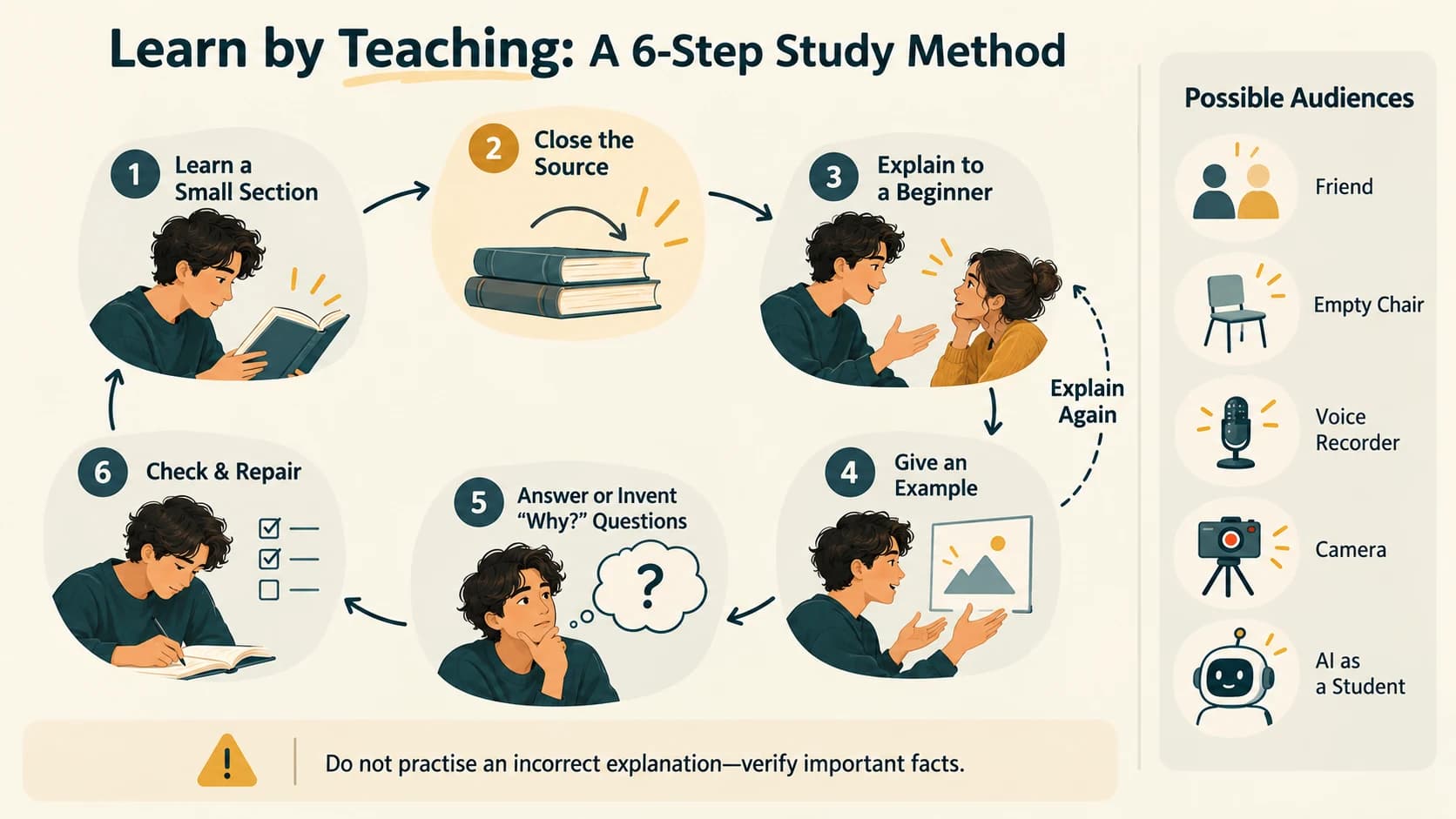
You do not need a formal classroom.
Try this six-step method.
1. Learn a small section
Study one concept rather than an entire chapter.
For example:
What is virtual memory?
2. Close the source
Do not teach with the book open.
Removing the source forces retrieval.
3. Explain it to a beginner
Imagine the listener has basic background knowledge but does not know the concept.
Use plain language.
4. Give an example
For virtual memory, explain what might happen when a program needs more memory than the available physical RAM.
5. Invite or invent questions
Ask:
Why is this needed?
What happens behind the scenes?
What is the limitation?
How is it different from RAM?
If another person is available, let them ask the questions.
6. Check and repair
Return to the source.
Find what was missing or incorrect.
Then explain the difficult part again without looking.
The loop becomes:
Learn → retrieve → explain → get challenged → find gaps → correct → explain again
That is a much richer learning activity than rereading the chapter three more times.
You do not need to become a teacher for every topic
Learning by teaching is useful, but it should not become another rigid rule.
Some information can be learned efficiently through practice questions, flashcards, worked examples, reading or direct problem solving.
Explaining every tiny fact would be slow.
Use teaching where understanding matters most:
- difficult concepts;
- processes with several steps;
- cause-and-effect relationships;
- topics you keep forgetting;
- ideas that sound familiar but remain vague;
- exam questions requiring explanation; and
- material you need to apply rather than merely recognise.
For a list of ten isolated dates, retrieval practice may be enough.
For explaining why the French Revolution happened, teaching is much more useful because you have to organise causes, relationships and consequences.
The real power of teaching is that it turns knowledge into something you must produce
While reading, the material can carry you.
While watching a lecture, the instructor can carry you.
When teaching, you have to carry the explanation.
You retrieve what you know.
You organise it.
You discover gaps.
You create examples.
You respond to questions.
You correct mistakes.
And in doing all of that, you transform knowledge from something that merely looks familiar into something you can actually use.
That is why trying to teach a concept can feel harder than rereading it.
The difficulty is not a flaw.
It is often the point.
If you want to know whether you really understand something, try explaining it clearly to someone who does not.
The moment they ask “Why?” is often where your own learning begins.