Why Does Sleep Matter So Much for Learning and Memory?
Learn how sleep helps the brain encode new information, consolidate memories and prepare for learning—and why all-nighters can work against you.

If you have an exam tomorrow, an extra three hours of studying can feel more useful than three extra hours of sleep.
You are awake. You are reading. You are solving questions. Sleep, by comparison, looks like nothing is happening.
But from the brain's point of view, learning does not stop when you close the book.
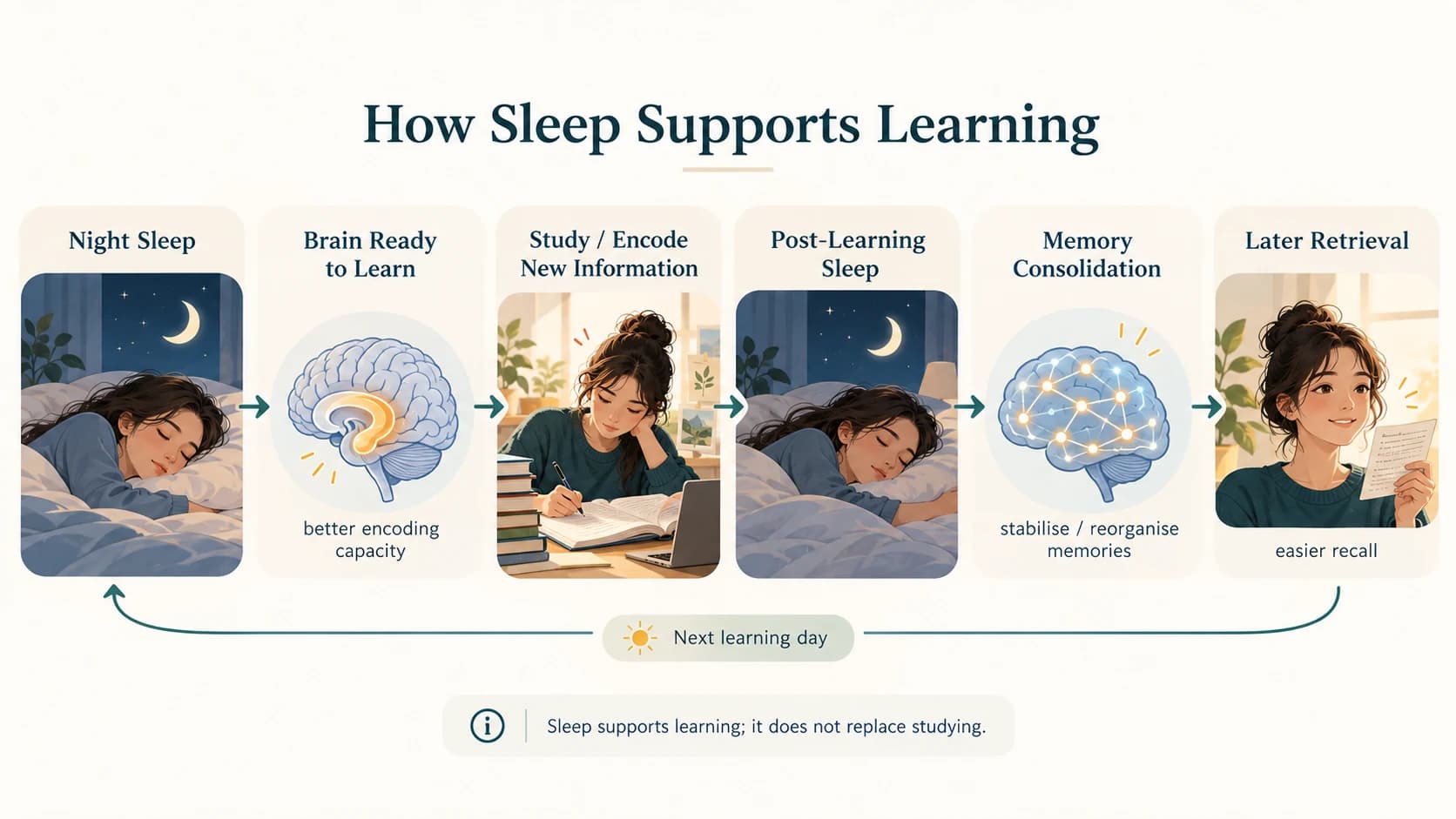
Sleep helps in two different directions. Before learning, it helps prepare the brain to take in new information. After learning, it helps stabilise, reorganise and strengthen parts of what you have already learned.
That is why losing sleep can hurt twice: you may learn less effectively the next day, and material studied before the lost sleep may be remembered less well later.
Sleep is not a substitute for studying. You cannot sleep on a chapter you never learned and expect to know it in the morning.
But studying and sleeping are not competing activities in the way they first appear.
For memory, they are parts of the same process.
Learning does not end when the study session ends
When you first learn something, the new memory is not instantly stored in a finished, permanent form.
Imagine learning a new concept in economics, a vocabulary list or the steps of an algorithm.
At first, that memory is relatively fragile. It can be disrupted, confused with other information or simply forgotten.
Over time, the brain changes the way that information is represented and stored. This broad process is called memory consolidation.
Sleep is one of the important periods during which this offline processing occurs.
Research on sleep and memory has shown that newly acquired information can be reactivated and reorganised during sleep, helping some memories become more stable and easier to retrieve later.
So a study session is better thought of as the beginning of memory formation, not the end of it.
Sleep helps before you learn
Most discussions about sleep and memory focus on what happens after studying.
But the previous night's sleep matters before the textbook is even opened.
One reason involves the hippocampus, a brain structure that plays a major role in forming many kinds of new episodic and associative memories.
Human brain-imaging studies have found that sleep deprivation before learning can reduce normal hippocampal activity during memory encoding and lead to poorer later memory.
A large meta-analysis of sleep-deprivation studies reached the same broader conclusion: total sleep deprivation before learning harms the ability to remember newly encountered material.
This means an all-nighter does not merely make you sleepy during the exam.
It can reduce how effectively you learn the next day's material in the first place.
Think of it as arriving for a study session with a memory system that is less prepared to encode what you are trying to teach it.
Sleep also helps after you learn
Now suppose you study while well rested.
The information is encoded, but it is still vulnerable to interference and forgetting.
Sleep after learning gives the brain an opportunity to process those newly formed memories without the constant stream of new information that arrives during waking life.
Decades of laboratory research have found that sleep after learning can benefit later memory for many kinds of information and skills.
A meta-analysis covering roughly five decades of research found that total sleep deprivation after learning had a detrimental effect on later memory. The effect was not identical across every memory task, and the authors noted limitations in the research literature, but the overall pattern supports an important role for post-learning sleep.
In practical terms, the sequence matters:
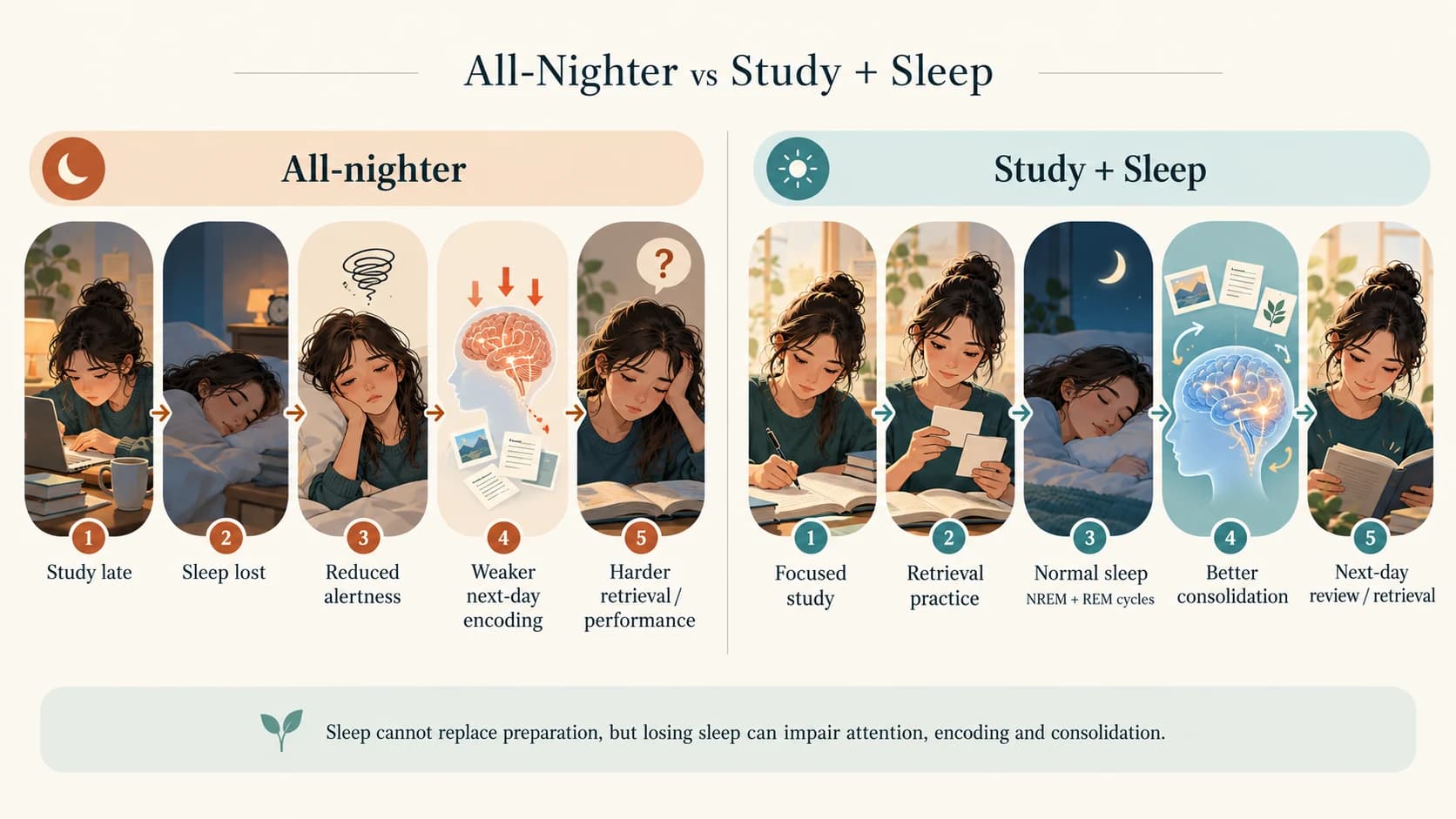
Learn → sleep → retrieve later
can work differently from:
Learn → stay awake all night → keep exposing yourself to new information → retrieve later
Sleep does not merely protect memories by stopping you from studying something else. Evidence suggests that active neural processes during sleep contribute to consolidation.
What is the brain doing while you sleep?
Sleep is not one uniform state.
Across the night, the brain cycles repeatedly through non-REM (NREM) and REM sleep.
According to the U.S. National Heart, Lung, and Blood Institute, a sleep cycle typically repeats every roughly 80 to 100 minutes, with about four to six cycles during a normal night.
NREM sleep includes three stages. Stage 3 is often called deep sleep or slow-wave sleep.
REM sleep is the stage associated with rapid eye movements and vivid dreaming, although dreaming is not limited exclusively to REM.
The proportions also change through the night. More deep NREM sleep tends to occur earlier, while REM sleep becomes more prominent later.
That matters because researchers think different features of sleep participate in memory processing in complementary ways.
Deep NREM sleep and the replay of memories
One influential explanation is called active systems consolidation.
Very roughly, newly learned information that depends strongly on the hippocampus is repeatedly reactivated during sleep.
During deep NREM sleep, several patterns of brain activity—including slow oscillations, sleep spindles and brief hippocampal sharp-wave ripples—can coordinate this reactivation.
Researchers propose that this interaction helps redistribute or reorganise memories across hippocampal and cortical networks.
The idea is not that your brain literally plays back an exact video recording of the day's events.
Memory is more selective and reconstructive than that.
Instead, patterns related to recent experiences can be reactivated in ways that help stabilise useful information and integrate it with existing knowledge.
This is one reason researchers often describe sleep as an active state for memory rather than simply a period when the brain switches off.
What about REM sleep?
Popular explanations sometimes divide memory too neatly:
NREM stores facts. REM stores skills and emotions.
The evidence is not that simple.
Both NREM and REM sleep appear to participate in memory processing, and the importance of particular sleep stages can vary with the kind of material, timing of learning and experimental task.
Research reviews suggest strong evidence for NREM processes in strengthening recently learned memories, while REM may contribute to processes such as memory integration, refinement, emotional processing and plasticity.
The safest conclusion is not that one sleep stage is "the memory stage."
It is that a normal night contains a sequence of biologically different sleep states that appear to make complementary contributions.
Cutting the night short can therefore remove more than just total minutes of sleep. Because deep sleep is more concentrated earlier and REM more heavily represented later, shortening sleep can also change the mixture of sleep stages you obtain.
Why an all-nighter can feel productive even when it is not
All-nighters have one obvious advantage: they create more waking hours.
If you stay awake from midnight to 5 a.m., you have five extra hours in which you can read or practise.
That is real.
But the calculation is incomplete.
You also have to ask:
- How efficiently are you learning during those hours?
- What will happen to attention the following day?
- How well will new information be encoded?
- What consolidation opportunity are you giving up?
- How well will you retrieve the information during the exam?
Sleep deprivation affects attention as well as memory. A tired student can spend more time rereading, making errors or losing track of what a problem is asking.
So the choice is not necessarily:
5 hours of study vs 5 hours of doing nothing.
It may be closer to:
more low-quality study now + impaired learning and attention later
versus
less study time + a better-rested brain that can learn and retrieve more effectively.
That does not mean sleep can rescue poor preparation.
If you have not learned the material, sleep cannot manufacture the missing knowledge.
But once studying has happened, sacrificing the entire night is often a poor trade.
Sleep can help protect memories from interference
Imagine you learn one list of foreign-language words and immediately begin learning another similar list.
The second list can interfere with the first.
This is a common feature of memory: newly learned material competes with other information.
Sleep creates a period in which the brain is not continuously encoding the same volume of new external information.
But its role goes beyond simple isolation.
Sleep-related consolidation appears to strengthen some memories so they become more resistant to later interference.
This helps explain why sleeping after learning can sometimes produce better recall than spending an equivalent interval awake.
One classic study with high-school students found that vocabulary learned before sleep was remembered better than material followed by a comparable waking interval.
The exact benefit varies by task, but the underlying lesson is useful: what happens after studying can affect how well the studying survives.
Sleep does not preserve everything equally
Another misconception is that sleep simply "saves" everything you experienced during the day.
It does not.
Most of what happens to you will never become a strong long-term memory.
Research suggests that sleep-related consolidation can be selective. Information that is emotionally important, relevant to future goals, strongly encoded or explicitly marked as worth remembering may receive different treatment from trivial details.
That is actually useful.
A memory system that stored every detail with equal strength would quickly become overwhelmed.
Learning is partly about deciding what matters.
Good studying helps make that selection clearer by using attention, organisation, retrieval practice and meaningful connections before sleep ever begins.
Sleep works on what the waking brain gives it.
Can a nap help?
Sometimes.
Research on daytime naps has found benefits for memory consolidation in a range of tasks, although the size and type of benefit vary with age, nap duration, sleep stages and the kind of learning involved.
Reviews in healthy adults have found evidence that naps can support declarative memory, and studies have also found benefits for some motor and procedural tasks.
That does not mean a short nap is equivalent to a full night's sleep.
A normal night gives you repeated cycles of NREM and REM sleep, while a brief nap may contain only some stages.
A nap can be useful when it fits your schedule, but it is better thought of as a possible supplement to adequate nighttime sleep rather than a reliable replacement for it.
How much sleep does a student need?
Sleep needs vary with age.
Current public-health guidance cites approximately:
- 9–12 hours per 24 hours for children aged 6–12
- 8–10 hours for teenagers aged 13–17 or 13–18, depending on the guideline wording
- 7 or more hours per night for most adults aged 18–60
These are population-level recommendations, not a promise that everyone feels identical after the same number of hours.
Sleep quality and regularity matter too.
A person who spends eight hours in bed but wakes repeatedly may not receive the same restorative sleep as someone with more continuous sleep.
For students, the practical point is not to chase one magical number. It is to recognise that routinely cutting sleep to create more study time can undermine the cognitive abilities the studying depends on.
The timing of studying and sleep matters
You do not need to study every subject immediately before bed.
Memory consolidation happens across longer periods and repeated sleep opportunities.
But there is a useful principle here:
Do not treat the hours after learning as irrelevant.
If you learn important material and then repeatedly sacrifice sleep, you are removing one of the conditions that normally supports later memory.
For exam preparation, this argues for spreading learning across days rather than compressing everything into one final night.
Spacing gives you multiple opportunities for:
study → retrieval → sleep → revisit
instead of a single exhausting cycle of:
study everything → skip sleep → exam
A better study-and-sleep strategy
For most students, sleep works best as part of a larger learning system.
Learn actively
Do not rely only on rereading.
Use retrieval practice, solve questions, explain concepts without notes and identify what you cannot yet recall.
The better the information is encoded during waking study, the better material the brain has to work with later.
Spread difficult material across several days
Spacing reduces the amount you must learn in one sitting and gives memories repeated opportunities to be retrieved and reconsolidated.
Review important ideas before stopping
A short retrieval session near the end of study can reveal the material you actually know and the parts that still need attention.
Protect the night before important learning
Sleep is not only for remembering yesterday.
It helps prepare you to learn tomorrow.
This matters if the next day includes classes, revision or an exam that requires new problem solving.
Do not use caffeine as a replacement for sleep
Caffeine can temporarily reduce feelings of sleepiness and improve alertness for some people.
It does not reproduce the memory-processing functions of sleep.
Feeling more awake is not the same as having obtained the sleep your brain missed.
Sleep is part of studying, even when the book is closed
The most useful change in perspective is simple.
Studying puts information into the learning system.
Sleep helps that system prepare for more information and process some of what is already there.
A well-rested brain can encode new experiences more effectively. After learning, sleep provides conditions in which memories can be reactivated, stabilised and reorganised. Across repeated NREM and REM cycles, different neural processes contribute to that work.
That does not make sleep a shortcut.
You still have to understand the chapter, solve the problems and practise retrieving what you learned.
But once you have done that work, closing the book and sleeping is not abandoning the learning process.
It is continuing it in a different state.