Why Can You Watch a Three-Hour Movie but Struggle to Study for 30 Minutes?
Why can you watch a long movie but lose focus while studying? Learn how attention, cognitive effort, reward, memory and distractions explain the difference.
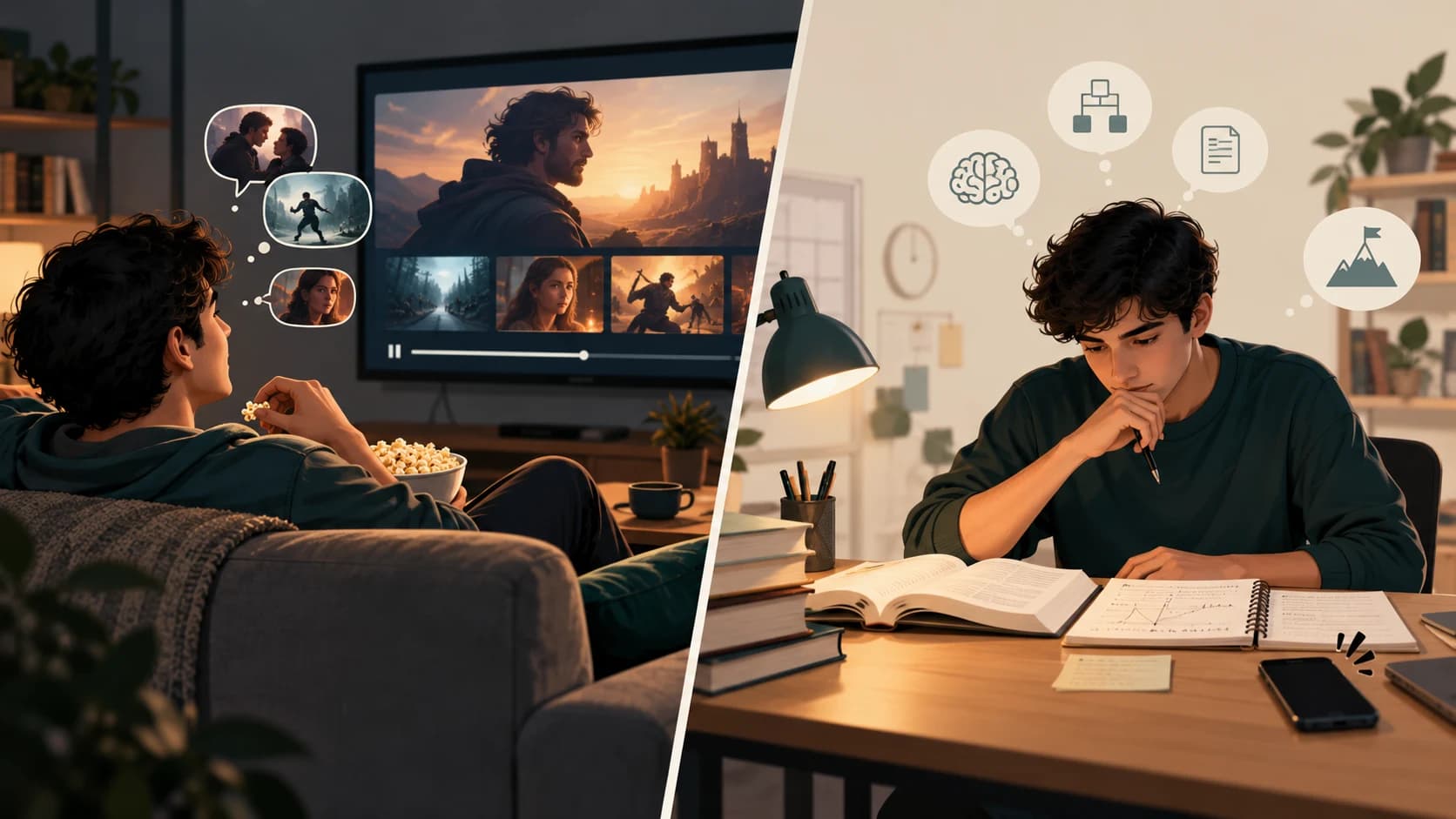
You sit down to study and, within ten minutes, your mind is somewhere else.
Then later that evening, you watch a two-and-a-half-hour movie without checking the clock.
It is tempting to conclude that your attention span is poor or that you simply lack discipline. But that explanation misses what is actually different about the two activities.
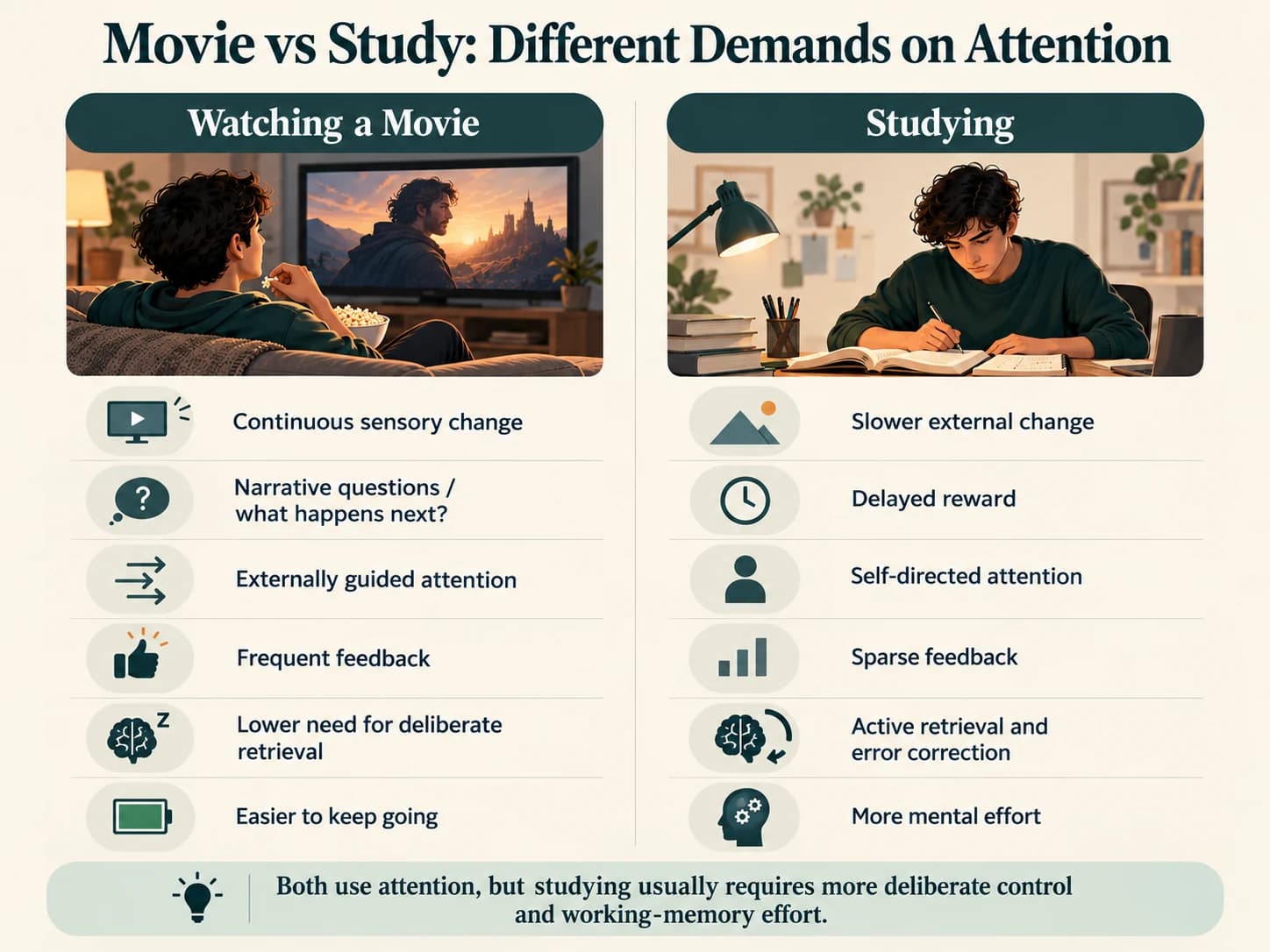
Watching an engaging movie and studying from a textbook place very different demands on attention, memory, motivation and mental effort.
A movie is designed to keep supplying you with reasons to continue: movement, dialogue, music, suspense, emotional consequences and constant changes in what you see and hear.
Studying often does the opposite. The reward is delayed, the information can be difficult, and you have to actively decide what matters, hold ideas in working memory, connect them to what you already know and retrieve them later.
So the puzzle is not really:
“Why can I concentrate on a movie but not on studying?”
It is:
“Why does one activity make sustained attention easier while the other requires me to actively maintain it?”
That difference explains a lot.
Watching a movie is not the same attentional task as studying
Both require attention, but they use it differently.
A well-made film continuously guides your attention from one event to the next. Directors use framing, cuts, movement, faces, dialogue, sound, music and changes in visual intensity to influence what viewers notice.
Research using film as a sustained-attention stimulus has shown that narrative and cinematic techniques can shape attention over long periods. The screen is constantly giving your brain a new event to process.
Studying is usually much less externally guided.
A textbook page may look almost identical for several minutes. A mathematics problem does not automatically tell you which step to attempt next. A lecture recording may require you to decide which point is important enough to note down.
The student has to provide more of the control.
A complex film can still be intellectually demanding, and an interesting subject can hold attention extremely well. The key difference is that entertainment is usually designed around continuous engagement, while learning often requires self-directed cognitive work.
A movie keeps asking, “What happens next?”
Narratives naturally create unfinished questions.
Will the character escape?
Who is lying?
What caused the accident?
Why did someone behave that way?
Those unanswered questions give the next scene immediate value.
Curiosity matters because information itself can become rewarding when it resolves uncertainty or advances understanding. Research on curiosity and intrinsic motivation shows that novelty, surprise and the expectation of learning something can influence attention and memory.
Good entertainment uses this repeatedly.
A scene creates uncertainty.
The next scene gives some information but introduces another question.
The story keeps moving.
Studying often has a much weaker short-term reward structure.
If you are preparing for an exam two months away, reading page 142 may not produce any obvious payoff right now.
The benefit is real, but delayed.
Your brain therefore faces an unequal choice:
Movie: interesting event now.
Study: effort now, benefit later.
Humans often treat cognitive effort as a cost when deciding what to do. Recent research on effort-based decision-making describes motivation partly as a comparison between the expected value of an outcome and the effort needed to obtain it.
This helps explain why opening a difficult chapter can feel heavier than starting entertainment.
Studying uses working memory much more aggressively
One major difference is working memory.
Working memory is the limited mental workspace you use to hold and manipulate information while doing a task.
Consider learning recursion in programming.
You may need to keep several things active at the same time:
- what the function currently does;
- what the base case is;
- what happens during the recursive call;
- how the call stack changes; and
- how the result returns through previous calls.
If too many unfamiliar pieces have to be handled at once, the task becomes mentally demanding.
Cognitive load theory is built around this basic problem: working-memory capacity is limited, so learning can suffer when the demands placed on that system become excessive.
Now compare that with a straightforward movie scene.
You still interpret characters and events, but much of the relevant information is supplied continuously through images, voices and context. You usually do not need to deliberately memorise every line for an exam tomorrow.
Studying asks more than:
“Can you follow this?”
It may ask:
“Can you understand this, remember it, connect it with earlier material, solve a problem with it and reproduce it later without looking?”
That is a much more demanding job.
Learning often feels harder precisely when it is working
This creates an interesting problem.
Some of the most effective learning methods do not feel especially easy.
Retrieval practice is a good example.
Instead of rereading a definition five times, you close the book and try to recall it yourself.
That feels harder.
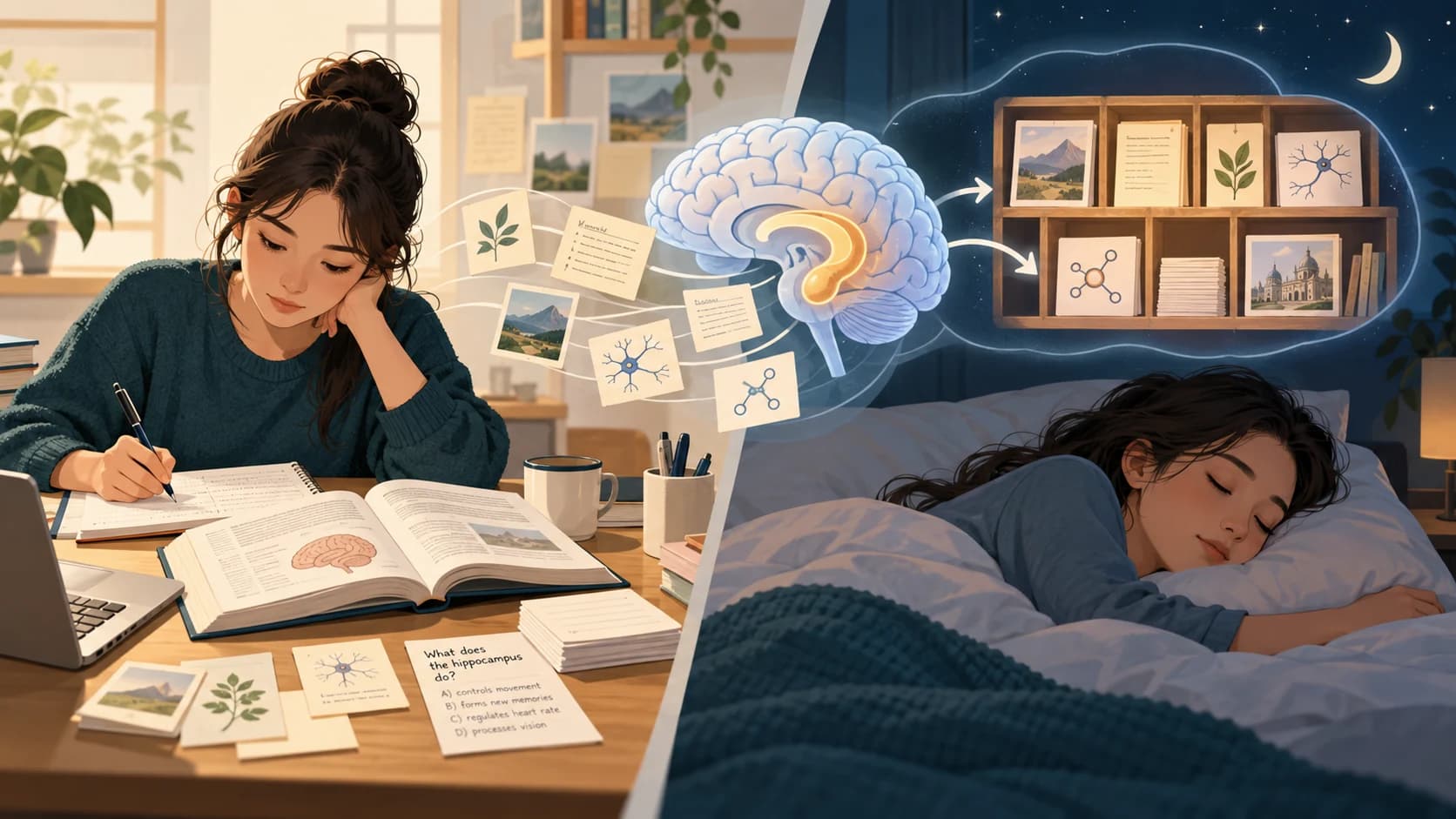
But research consistently finds that retrieving information from memory can strengthen later retention. Reviews of learning techniques have repeatedly identified practice testing or retrieval practice and distributed practice as particularly useful methods.
This creates a mismatch between feeling fluent and actually learning. Rereading can feel comfortable because the material becomes familiar, while recalling without looking exposes gaps. That harder feeling can give you much better information about what you actually know.
A 2025 study of students' learning-strategy knowledge found something revealing: many students were aware of effective techniques such as retrieval practice and spacing, yet reported avoiding them partly because of the extra effort, time, anxiety and planning they required.
So difficulty during studying is not always evidence that you are bad at studying.
Sometimes it is evidence that you have moved from passive exposure into actual learning.
Movies provide frequent feedback; studying often does not
Entertainment tells you constantly whether you are following.
A joke makes sense.
A mystery clue connects.
A character reaches a destination.
A conflict gets resolved.
You receive small pieces of feedback every few seconds or minutes.
Studying can contain long stretches with almost no feedback.
You may read ten pages and have no idea how much you retained.
You may spend twenty minutes solving a problem and only then discover that your first assumption was wrong.
That uncertainty makes effort harder to sustain.
Active study methods can therefore make the task more interactive as well as improve learning.
Instead of:
Read chapter for one hour
try:
Read one concept → close notes → explain it from memory → check answer → correct mistakes
Now the study session contains a short feedback loop.
You know what you are trying to do, whether you succeeded and what comes next.
That resembles the structure that keeps many other activities engaging.
Studying creates more opportunities for mind-wandering
Attention naturally fluctuates.
It does not remain at one fixed intensity for hours.
A 2025 meta-analytic review found that mind-wandering tends to become more frequent as people spend longer on a task. Research in educational settings has also linked mind-wandering with poorer comprehension and learning.
This matters because many study activities have long periods of low external change.
If you are reading dense text, the physical scene may barely change while your mind has endless alternatives:
What should I eat later?
Did someone message me?
What if I fail the exam?
What happened yesterday?
Should I check one video?
A movie competes with those thoughts by continuously changing what is happening in front of you.
Studying often leaves more space for internal distractions unless you actively bring attention back.
That is why simply sitting at a desk for three hours is not the same as studying effectively for three hours.
Your phone changes the competition
A textbook is no longer competing only with your own thoughts.
It is competing with a device containing messaging, short videos, news, games, music and social media—each available within seconds.
Even a notification can be disruptive.
Experimental work has found that receiving a phone notification can impair performance on an attention-demanding task even when the person does not actually pick up the phone.
Research on smartphone use and academic performance is more nuanced than the claim that “phones destroy attention.” Not every study finds large causal effects, and general phone use is not the same as off-task use during learning.
But one pattern is sensible and well supported: switching away from learning creates competition for limited attention.
The practical problem is often not a complete inability to focus for 30 minutes. It is the repeated decision to continue studying or switch to something easier. Every visible alternative creates another opportunity to leave.
The starting problem may be bigger than the attention problem
People often say:
“I cannot study for an hour.”
But the hardest part may be the first five minutes.
“Study physics” is vague.
It does not specify where to begin, how much to cover or when the task is complete.
Vague tasks create friction because the brain has to plan before it can even start doing the work.
Compare these:
Study operating systems.
and
For the next 25 minutes, learn process states and then answer five questions without notes.
The second task has a boundary.
You know:
- what to study;
- how long to work;
- what output to produce; and
- how to tell whether you understood it.
This lowers the amount of decision-making required during the session.
Motivation often improves after starting because progress becomes visible.
Waiting to “feel motivated” before beginning reverses that process.
Why forcing yourself to sit for three hours can backfire
If you can watch a three-hour movie, it may seem reasonable to demand three hours of uninterrupted studying.
But equal duration does not mean equal cognitive demand.
Three hours of dense problem-solving can require much more controlled mental effort than three hours of following an enjoyable story.
Attention also becomes less stable over time.
For many students, several focused study blocks with breaks will produce better learning than one long session in which the final hour consists mostly of rereading while mentally absent.
There is no scientifically universal “perfect” study-block length such as exactly 25, 45 or 50 minutes.
Different tasks and people vary.
A practical starting point is to choose a block short enough that you are willing to begin—perhaps 20 to 40 minutes—then adjust based on the task and your ability to stay genuinely engaged.
The goal is repeated periods of high-quality learning, not simply sitting longest.
How to make studying easier to sustain
You cannot turn every textbook into a thriller, and you do not need to.
But you can change the structure of studying so that your brain has fewer reasons to escape.
Give every session a concrete target
Do not write:
Study DBMS.
Write:
Understand normalization up to 3NF, solve four examples, then explain the difference between 2NF and 3NF without notes.
A clear finish line reduces uncertainty.
Study in questions, not pages
Instead of asking:
How many pages did I read?
ask:
What can I answer now that I could not answer before?
Questions create information gaps, which give reading a purpose.
Before a section, turn the heading into a question.
If the heading says Deadlock Prevention, ask:
What conditions cause a deadlock, and how can a system prevent them?
Now you are reading to find an answer rather than merely moving your eyes across text.
Use retrieval every few minutes
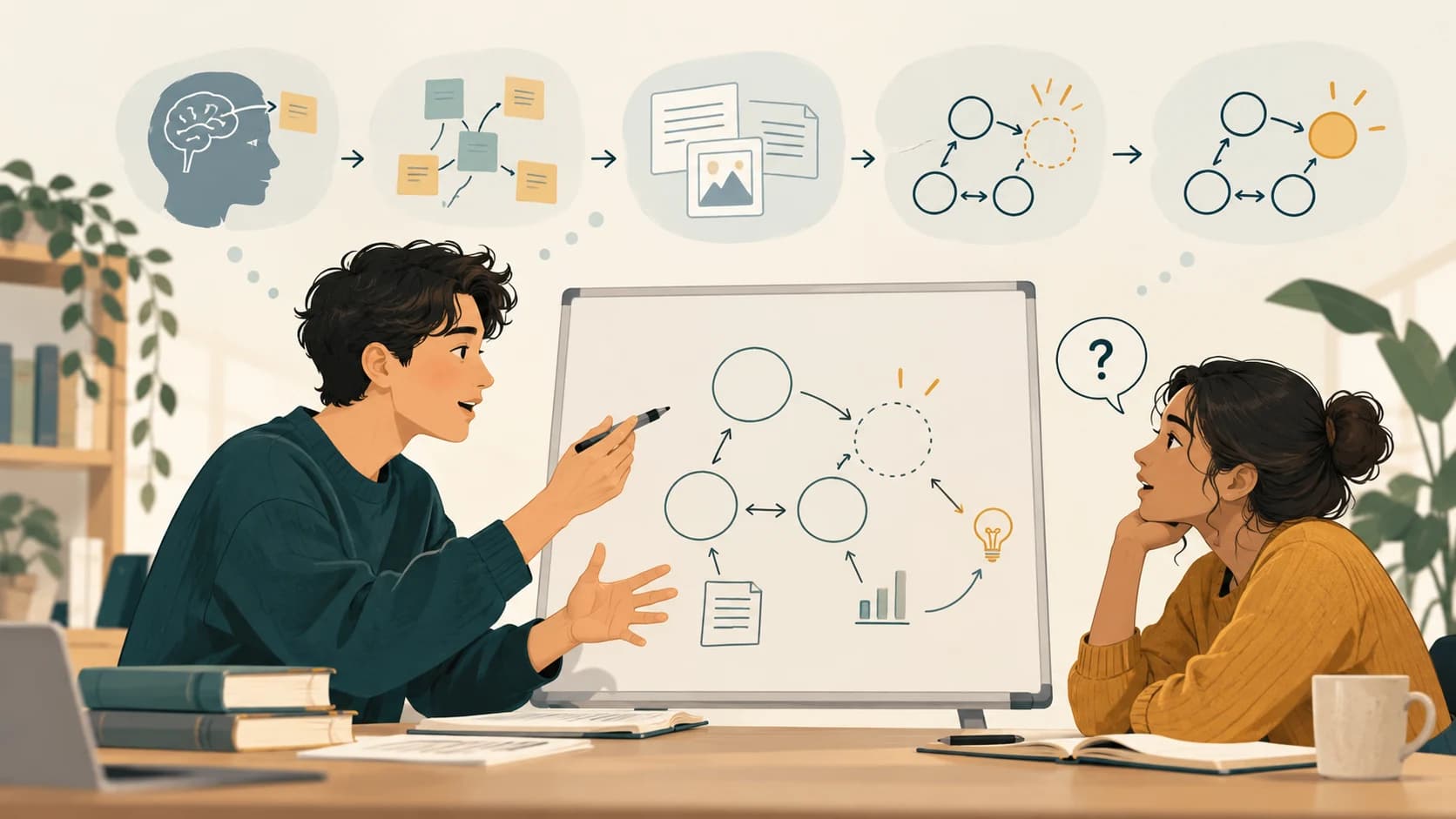
After learning a small section, look away and reconstruct it.
Write the steps.
Explain the idea aloud.
Solve a question without the example beside you.
Then check.
Retrieval practice gives the session repeated goals and repeated feedback while improving retention.
Research also suggests that retrieval can be effective when it is interspersed throughout learning rather than postponed until one large test at the end.
Make distractions require effort
Do not rely entirely on willpower.
Put the phone out of reach.
Disable non-essential notifications.
Close unrelated browser tabs.
Use full-screen mode.
If a distraction requires standing up, walking across the room and unlocking another device, you have changed the economics of the choice.
The study task became easier to continue, while the distraction became slightly harder to access.
That small difference can matter repeatedly during a session.
Keep difficulty in the useful range
A task that is far too easy becomes boring.
A task that is far beyond your current knowledge becomes frustrating.
If a chapter feels impossible, reduce its size.
Learn the prerequisite concept.
Use a worked example.
Solve an easier version first.
The goal is not to remove all difficulty. It is to remove unnecessary difficulty so your effort goes into understanding rather than confusion.
Make progress visible
Movies make progress obvious: you are 40 minutes into a story.
Studying often hides it.
Create visible units:
- 12 questions completed;
- 3 concepts recalled correctly;
- 2 weak topics identified;
- 1 practice set finished.
Progress itself becomes feedback.
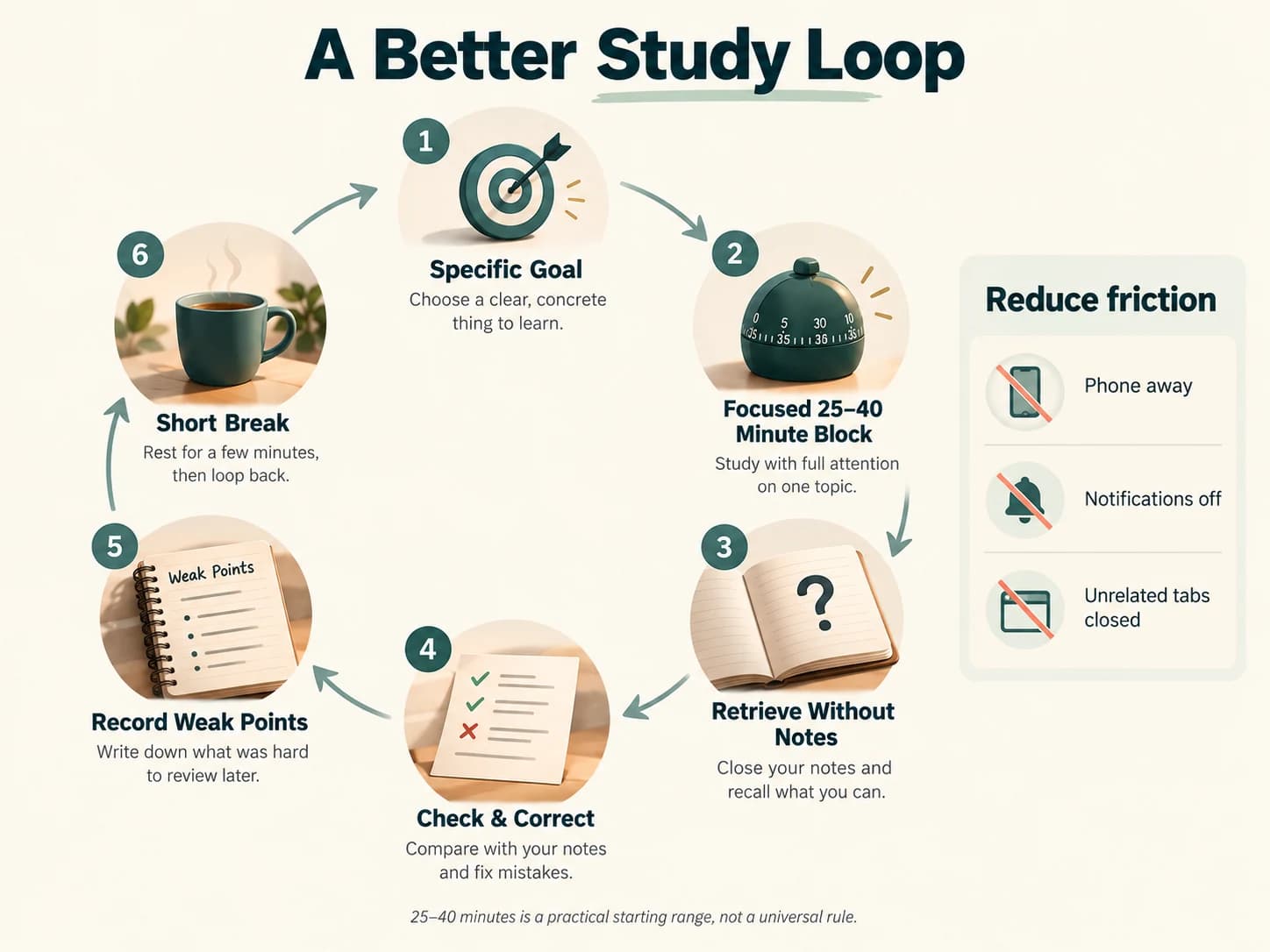
A better study loop
A practical study session can look like this:
1. Pick one specific outcome
Example: “Learn how virtual memory translates logical addresses.”
2. Work for one focused block
Choose a realistic period such as 25–40 minutes.
3. Retrieve without looking
Write or explain the main idea from memory.
4. Check and correct
Compare your answer with the source.
5. Record what is still weak
Do not pretend confusion has disappeared.
6. Take a short break
Then begin the next defined block.
This creates a cycle:
Goal → effort → retrieval → feedback → progress
That is far easier to sustain than:
Open book → read indefinitely → hope something stays in memory.
You probably do not have one fixed “attention span”
The fact that you can watch a long movie is useful evidence.
It shows that your attention can remain engaged for long periods under the right conditions.
The problem is usually not that you possess a 20-minute tank of attention that permanently empties.
Attention depends on the task, your interest, difficulty, fatigue, environment, expectations, competing distractions and the amount of mental control required.
Someone may struggle with a chapter and then spend two hours debugging code or researching a topic they care about. Attention is selective.
The real goal is not to make studying feel like entertainment
A movie is designed to carry your attention.
Studying often requires you to carry it yourself.
That difference will never disappear completely.
And that is fine.
Learning something difficult should sometimes feel effortful because you are changing what you can understand, remember or do.
The solution is not to wait until studying becomes as immediately enjoyable as a favourite movie.
It is to design study sessions so that effort has structure:
a clear question, a manageable challenge, limited distractions, active retrieval, quick feedback and visible progress.
Then thirty minutes stops feeling like an undefined period of resistance.
It becomes one completed piece of learning.
And once one block is finished, starting the next one becomes much easier.