Can AI Detectors Really Identify AI-Written Content? What Students and Professionals Should Know
Can AI detectors tell who wrote a text? Understand detection scores, false positives, research findings, and fair ways to verify authorship.
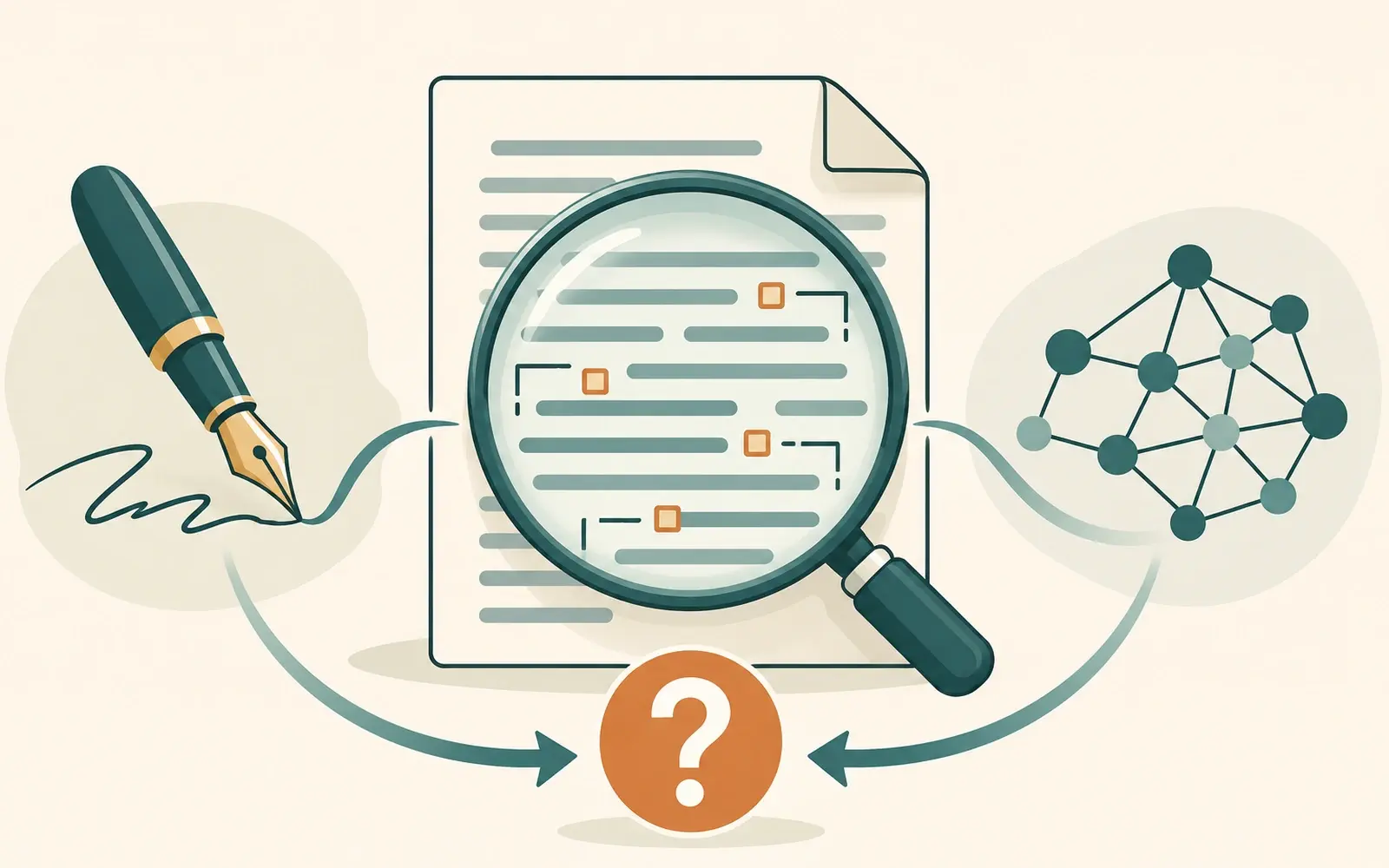
Imagine spending three evenings writing an assignment, revising the introduction, checking the references and finally submitting it. The next day, someone tells you that an AI detector has marked much of your work as machine-written.
You know you wrote it. The software appears to disagree.
Or consider the reverse: a report produced largely by an AI chatbot passes through a detector without attracting suspicion. Both situations reveal the same problem. An AI-writing detector makes an inference from the finished text; it does not directly observe who wrote it.
That does not make every detector useless. Some can identify certain AI-generated passages under particular testing conditions. But a result that is useful for screening text is not automatically strong enough to establish misconduct, dishonesty or authorship.
To understand what these tools can—and cannot—tell us, we need to examine how they work, what their scores mean, and what independent studies have actually found.
What Does an AI-Writing Detector Look For?
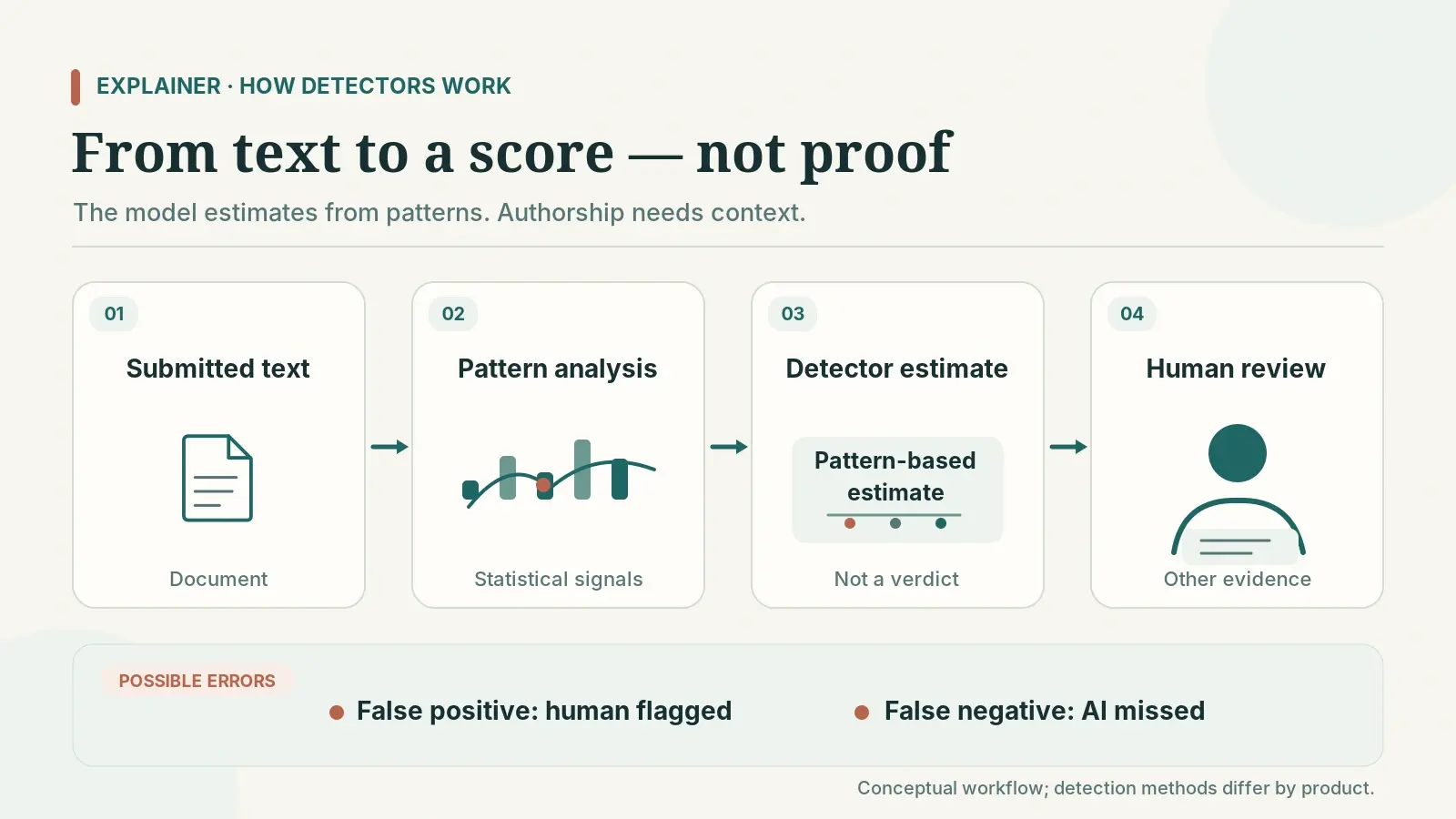
An AI-writing detector typically receives a passage and attempts to classify it as human-written, AI-generated or somewhere between those categories. Unlike a teacher watching a student write, it usually has only the submitted words to examine.
The detector may use several techniques, depending on its design.
Statistical patterns in language
Language models learn relationships between words and predict plausible sequences of text. Some detectors search for statistical patterns associated with those predictions, including how predictable a sequence of words appears to be.
One term often used here is perplexity: roughly, a measure of how surprising a text is to a particular language model. Lower perplexity means that model finds the sequence more predictable. Another commonly discussed idea is burstiness, or variation in features such as sentence length and predictability.
These are not fingerprints. A straightforward explanation, a legal notice, a laboratory report or an essay written in a second language may also be highly predictable. Meanwhile, AI-generated text can contain varied sentences and unusual word choices. A signal that separates two groups in a research dataset may not reliably identify the author of a new document.
Classifiers trained on examples
Other detectors train machine-learning classifiers using samples labelled as human-written or AI-generated. They learn combinations of features that help distinguish those examples and apply the learned patterns to new submissions.
This approach can work well when the new material resembles the training and evaluation data. Trouble arises when the topic, genre, language, editing process or underlying AI model changes. A detector evaluated on English essays generated by one model has not necessarily demonstrated comparable accuracy on technical reports, translated writing or output from newer models.
Some systems combine multiple approaches. Their exact designs are often proprietary, so an outside reader may not know every signal contributing to the score. For context on how chatbots create text in the first place, see What Actually Happens After You Send a Prompt to an AI Chatbot?.
What about an invisible AI watermark?
Researchers have developed methods for inserting detectable statistical signals into text during generation. Such techniques are different from guessing authorship purely from writing style: they aim to leave a deliberate signal in eligible generated output.
But there is no universal watermark embedded in everything written by AI. A watermark has to be implemented by a participating generator, and its detectability depends on the method, the available text and subsequent editing. It is therefore incorrect to assume that a conventional AI detector can simply discover a hidden tag proving ChatGPT or another service wrote a paragraph.
What Does a 90% AI-Detection Score Actually Mean?
A displayed percentage feels scientific. It can also be easy to misunderstand.
Suppose a service labels a document “90% AI.” There are at least two very different interpretations:
- Interpretation A: The software estimates that about 90% of the eligible passage resembles AI-generated writing.
- Interpretation B: There is a 90% probability that the document's author used AI.
These are not interchangeable. Neither interpretation should be assumed without reading that tool's own documentation and understanding how its score was validated.
For example, Turnitin's AI Writing Report documentation explains its percentage as the portion of qualifying prose text identified by its model as likely AI-generated or AI-modified. It is separate from the similarity score. It is not a verified probability that a particular student cheated.
Turnitin also does not show a precise percentage or highlights when its estimated AI detection falls between 1% and 19%, displaying an asterisk instead because of increased false-positive concerns in that range. That threshold is a vendor-specific reporting practice, not a universal rule governing all detectors. Turnitin's tool has eligibility requirements and does not assess every kind of text with equal reliability.
The important question is not simply, “What score did I get?” It is: What outcome was this score designed to estimate, and how often is that estimate wrong on writing like mine?
Two Ways a Detector Can Be Wrong
To evaluate AI detection, we must distinguish two errors.
| Outcome | What happened | Why it matters |
|---|---|---|
| False positive | Human-written text is flagged as AI-written | A genuine author may face unfair suspicion or accusation. |
| False negative | AI-generated text is classified as human-written | Undisclosed AI use may go undetected. |
No single accuracy percentage fully describes both risks. A detector can reduce false positives by becoming more cautious, but that caution may also cause it to miss more AI-written passages.
Why even a small false-positive rate matters
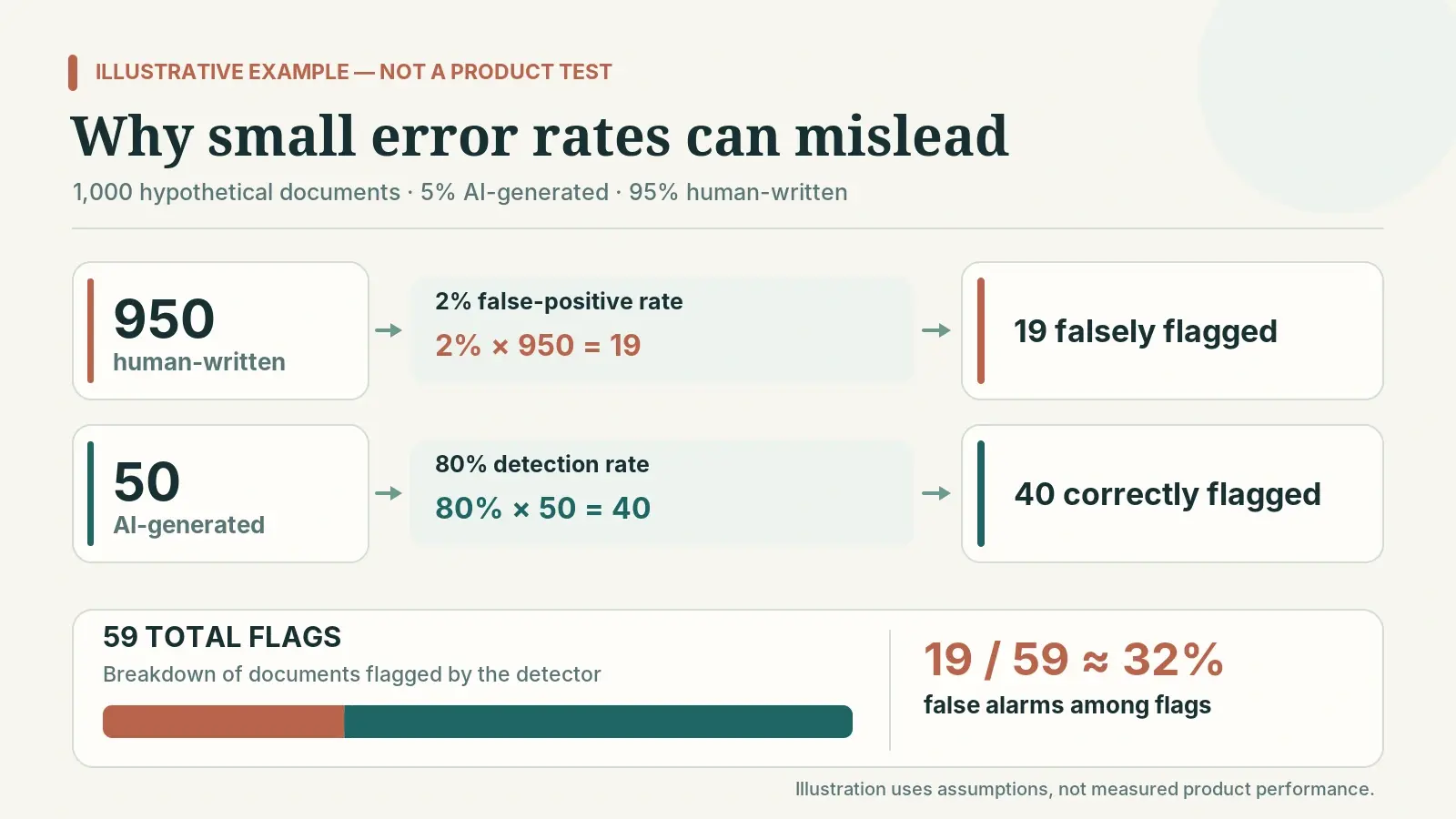
Consider a hypothetical example, not the measured performance of any product.
An institution examines 1,000 documents. Suppose 50 are predominantly AI-generated and 950 are genuinely human-written. Imagine a detector identifies 80% of the AI documents and incorrectly flags 2% of the human documents.
The results would be:
- 40 correctly flagged AI documents (80% of 50).
- 19 incorrectly flagged human documents (2% of 950).
- 59 flagged documents in total.
In this scenario, 19 of 59 flags—about 32%—are false alarms, even though the false-positive rate among human documents is only 2%.
The lesson is about base rates: when the thing you are trying to detect is relatively uncommon, even a seemingly small false-positive rate can account for a meaningful share of all flags. If the underlying proportion of AI-written documents changes, the share of false alarms changes too.
This calculation does not tell us which real-world detector is best. It shows why a percentage, viewed without its testing conditions and the population being examined, should not be treated as a verdict.
What Does Independent Research Say About AI Detectors?
The evidence is mixed—and that is a more useful finding than declaring every detector either completely reliable or completely broken.
Early research identified serious weaknesses
A 2023 study published in Patterns examined seven detectors using human-written English essays. Across the tested detectors, essays by non-native English writers were misclassified as AI-generated at an average rate of approximately 61%. The authors argued that writing which appears statistically predictable can be unfairly penalised.
This was an important demonstration of a fairness risk. It was not a measurement of the false-positive rate of every modern detector, nor a reason to assume today's tools all behave identically.
That same year, OpenAI withdrew its own experimental AI-text classifier on 20 July 2023, citing low accuracy. OpenAI's published evaluation had found that the tool identified 26% of AI-written texts as “likely AI-written” while incorrectly classifying 9% of human-written texts that way. These figures describe that retired classifier, not the present performance of all AI-detection products.
A 2025 research paper in the Findings of NAACL tested several detection approaches on unfamiliar models and domains. Under some conditions, the percentage of AI text successfully detected while limiting false positives to 1% fell as low as zero. The result illustrates why accuracy on familiar benchmarks may not survive changes in the testing environment.
Newer studies find both improvements and persistent limitations
Research published in 2026 shows why the discussion should remain open rather than frozen around early tools.
In a controlled study of 160 academic papers, researchers compared GPTZero, Pangram, Copyleaks and Turnitin across fully human-written, fully AI-generated, hybrid and AI-modified material. Pangram performed particularly well in parts of that experiment. On the 40 fully human-written papers, Pangram, Copyleaks and Turnitin produced no false-positive classifications, while GPTZero produced a small number. But performance varied sharply across the different AI-writing categories and the models used to create them.
That zero-false-positive result is encouraging for those 40 samples. It cannot establish that those tools never falsely flag human work. Nor did the researchers have verified authorship for the separate set of real-world theses they also examined. The authors advised treating detection as one element of a broader assessment rather than sole proof in consequential decisions.
Another 2026 study of 192 texts, including English-as-a-foreign-language student work and hybrid writing, reported differences between the tools it examined and lower reliability in some genres. Together, these studies show that which tool is tested, on which text, at what threshold and against which generator are essential questions.
Research findings also have a shelf life. AI models, editing tools and detector versions change. An impressive benchmark from one year should not be copied forward as a universal performance guarantee.
Why Can Human-Written Text Be Flagged as AI?
A detector does not know whether you wrote a sentence after careful thought, copied it from a chatbot or arrived at similar wording independently. It only sees signals in the text.
Several ordinary writing situations can produce patterns that a detector associates with machine output.
Clear, conventional or formal writing
Many writers are taught to use logical transitions, complete sentences, neutral phrasing and consistent structure. These are also common features of language-model output.
A standard explanation of a scientific process may contain little room for surprising language. Two honest students following the same question and terminology can produce stylistically similar answers without copying one another or using AI.
Writing in a second language
A writer with a limited or carefully controlled English vocabulary may prefer familiar sentence structures. The 2023 Patterns study found that such predictability could contribute to false-positive decisions in the detectors it tested.
That does not prove every current product is biased against every multilingual writer. It does mean that fairness testing must include the actual languages, proficiency levels and genres of the people being assessed.
Editing, translation and standardized templates
Professional proofreading can make writing more uniform. Translation can alter its rhythm and vocabulary. Business reports, cover letters, research abstracts and policy documents often follow established formats. None of these characteristics independently establishes AI authorship.
A 2026 EMNLP industry-track study compared 135,389 pairs of non-native English academic manuscripts and their professionally edited versions. With the document content and authorship held together within each pair, differences in editorial style affected detector responses in ways that varied by method. That is evidence of a style confound, not proof that every form of editing always increases an AI score.
A further complication is that some tools can be used legitimately for spell-checking or language assistance, depending on the rules governing the work. A detector cannot necessarily determine whether a polished sentence began with a human idea, an AI suggestion or a mixture of both.
Why Can AI-Generated Text Escape Detection?
The opposite mistake is equally important: a low detector score does not establish human authorship.
AI writing may be revised by a person, incorporated into a human draft or created by a model whose output differs from the detector's training examples. Some documents contain only a small AI-written passage within a much longer human-written text. Others contain too little eligible prose for a meaningful assessment.
In practice, detectors face a moving target. A classifier that recognises common patterns from one generation of language models may be less effective on a newer system or a different writing domain. This is why the 2025 NAACL evaluation examined out-of-domain performance rather than relying on one familiar test set.
It would be a mistake to turn these limitations into a promise that AI-written material is undetectable. Some systems do catch some generated content effectively. The point is narrower and more defensible: passing a detector does not prove that a person wrote the text, just as failing one does not prove that AI did.
AI Assistance and AI Authorship Are Not the Same Thing
A simple human-versus-machine label can hide a complicated writing process.
Consider five examples:
| Writing process | What the final text might contain | What determines whether it is acceptable? |
|---|---|---|
| A person writes without generative AI | Human-authored ideas and sentences | Normal authorship and citation rules. |
| A person writes, then uses grammar or spelling assistance | Predominantly human writing with corrections | Whether the specific tool and level of editing are permitted. |
| A person uses AI to brainstorm but researches and writes independently | Human prose influenced by AI-assisted planning | Assignment, employer or publisher disclosure rules. |
| A person substantially rewrites an AI-generated draft | Mixed contributions difficult to separate from text alone | The permitted level of AI involvement and required acknowledgment. |
| A person submits AI output as entirely their own work | Predominantly generated prose | Whether that use is authorized and truthfully disclosed. |
The same final document may not reveal which process occurred. More importantly, AI use is not automatically misconduct. An institution might prohibit generative assistance on one assignment, permit it with attribution on another and explicitly require it for a third.
For professional writing, the rules may be set by an employer, client, journal or contract. A detector cannot read those rules from the prose itself, and a technically accurate flag cannot decide whether a policy was violated.
Is AI Detection the Same as Plagiarism Detection?
No. The two systems answer different questions.
Traditional plagiarism or similarity software searches for overlap with identifiable source material. A similarity result can direct a reviewer toward a specific publication or previously submitted document. The overlap still needs interpretation: legitimate quotations, references and common phrases can generate matches.
AI-writing detection generally tries to infer how text was produced, without necessarily identifying an original source or a traceable act of copying. Australia's Tertiary Education Quality and Standards Agency (TEQSA) specifically warns that an AI score alone is insufficient evidence for an allegation of misconduct.
An essay can be original but AI-generated. A human-written essay can contain plagiarised passages. A document can also be both original and written with permitted AI assistance. These are distinct questions that deserve distinct review.
What Should Students Do If an AI Detector Flags Their Work?
A flag can be stressful, but reacting by repeatedly changing your wording to satisfy random detectors is not a reliable solution. There is no trustworthy universal “safe score,” and changing wording solely to manipulate a detector may itself create problems under an institution's rules.
A more useful approach is to make your actual writing process explainable.
- Read the assignment policy first. Determine whether AI brainstorming, spelling tools, translation, paraphrasing or drafting are allowed and whether disclosure is required. Keep a copy of the instructions that applied when you submitted.
- Preserve genuine work records. Where available, retain outlines, notes, source annotations, dated drafts and the document's version history. These can help establish how your work developed; none is an automatic certificate of authorship.
- Check your sources. Be prepared to show where important claims, quotations, data and references came from. Verify that citations actually exist and support your arguments.
- Ask what the flag means. If questioned, request the report, the institution's policy, the passages of concern and the procedure for explaining or challenging the allegation.
- Explain your process calmly and specifically. Discuss your argument, decisions, revisions and evidence. If you used an AI tool, describe that use truthfully and distinguish permitted assistance from prohibited substitution.
- Use the institution's review or appeal process where necessary. A fair review should consider the full evidence and give you a meaningful opportunity to respond, rather than treating a detector score as conclusive.
Do not fabricate draft histories or claim that work was fully independent if it was not. Authentic evidence is valuable precisely because it reflects what actually happened.
Cornell University's academic integrity guidance cautions against relying on automatic detectors for allegations and recommends clearly stated expectations and meaningful conversations about student work.
What Should Professionals, Writers and Editors Know?
A false accusation can affect a student. It can also damage a freelancer's reputation, a journalist's relationship with an editor or an employee's standing at work.
Professionals should distinguish three concerns that sometimes get mixed together: whether AI was used, whether that use was permitted, and whether the finished work meets quality and integrity requirements.
An organization might legitimately require original human analysis, forbid uploading confidential information to public AI services or demand disclosure of AI-assisted drafting. Those are enforceable process requirements. A detector score by itself cannot demonstrate all three.
Useful professional practices include documenting substantive research, retaining revision history where appropriate, checking sources and factual claims, and agreeing on AI-assistance expectations before work begins. Editors should evaluate the accuracy and originality of the work itself, rather than assuming that polished prose is suspicious.
There is also a privacy consideration: do not paste unpublished manuscripts, student records, client information or confidential business documents into an unfamiliar public detector without checking institutional authorization, terms and data-handling rules. TEQSA specifically warns that unapproved third-party detector use may create privacy, intellectual-property or IT-policy issues.
How Should Teachers and Employers Use Detector Results?
A detector may sometimes help identify material worth closer examination. But its appropriate use depends on the stakes, the tested reliability of the specific tool and the fairness of the surrounding process.
A defensible review should separate an automated signal from a finding of wrongdoing. That means checking the applicable AI-use rules, allowing the author to respond, examining genuine process evidence and avoiding assumptions based solely on style, language background or one score. Reviewers should also be prepared to consider evidence that contradicts their initial suspicion.
This distinction is reflected in the vendors' own guidance. Turnitin tells educators that its AI report should be treated as one data point, not a definitive answer. TEQSA likewise advises caution and additional evidence.
For high-stakes decisions, a university or employer should be able to answer practical questions about any detector it relies upon: Was the system evaluated on comparable writing? What false-positive rates were observed? Has the model changed since the evaluation? How are ambiguous results handled? Who makes the final decision, and can the affected person challenge it?
Without answers, an attractive score is poor procedural protection.
Can Authorship Be Verified More Reliably in the Future?
There are promising directions beyond trying to guess authorship from writing style.
A writing platform could preserve authenticated revision histories or trusted records of how a document was produced. In some settings, content provenance systems and deliberate generation-time markers may provide additional evidence. Interviews, supervised work, project notes and source trails can also make a person's contribution easier to assess.
None is a universal answer. Revision history can be incomplete, access controls matter, and a record of edits does not reveal every source of ideas. Statistical watermarks are not present in all generated text and may have limitations after transformation. Even an authentic record may establish a document's history without resolving whether a particular use of AI was allowed.
The strongest approach is likely to combine clear rules, traceable work processes, appropriate technical signals and fair human evaluation, with stronger evidence required when the consequences are greater.
The Bottom Line
AI detectors can sometimes identify AI-like writing, but they cannot consistently prove who authored a document from its text alone. Their effectiveness varies across tools, datasets, genres, languages, editing processes and generations of AI models. Newer research shows improvements in some controlled settings alongside persistent blind spots.
For students, the practical protection is to understand the rules, do the work honestly and preserve a genuine record of the process. For professionals, it is to establish expectations, protect confidential material and verify the substance of what gets published. For teachers and employers, it is to treat a flag as a reason for careful inquiry—not as a substitute for evidence.
The useful question is not simply “Does this sound like AI?” It is “What do we actually know about how this work was produced, and what rules apply?”
Sources and Further Reading
The sources below were used for the technical explanation, evidence review and practical guidance. Their findings describe the specific tools and conditions studied; they are not timeless guarantees of detector performance.
- Turnitin, Using the AI Writing Report — meaning of the AI-writing percentage, supported prose, reporting thresholds and limitations.
- Turnitin, How should I review the AI Writing report? — interpretation and human review.
- Liang et al. (2023), GPT detectors are biased against non-native English writers, Patterns — evaluation of linguistic bias in a specific early detector set.
- OpenAI (2023), New AI classifier for indicating AI-written text — retired classifier and historical performance figures.
- Tufts, Zhao and Li (2025), A Practical Examination of AI-Generated Text Detectors for Large Language Models, Findings of NAACL — out-of-domain detection and false-positive trade-offs.
- Hadra, Cambridge and Mesbah (2026), Evaluating the accuracy and reliability of AI content detectors in academic contexts, International Journal for Educational Integrity — study of 192 texts, genres and language-learning contexts.
- Van Vlasselaer, Van Droogenbroeck and Spruyt (2026), Who wrote this? Evaluating the reliability of AI detection tools in higher education, International Journal for Educational Integrity — controlled comparison of four tools using 160 known-origin texts.
- Park, Jeong and Kim (2026), Style as a Confound: False Positives in AI Detection of Non-Native Academic Writing, EMNLP Industry Track — comparison of original and professionally edited academic manuscripts.
- Cornell University, AI & Academic Integrity — institutional guidance on detection limits, expectations and assessment.
- Tertiary Education Quality and Standards Agency (Australia), Detecting plagiarism of AI-generated text in student assessments — distinctions between similarity and AI detection, evidence and privacy considerations.