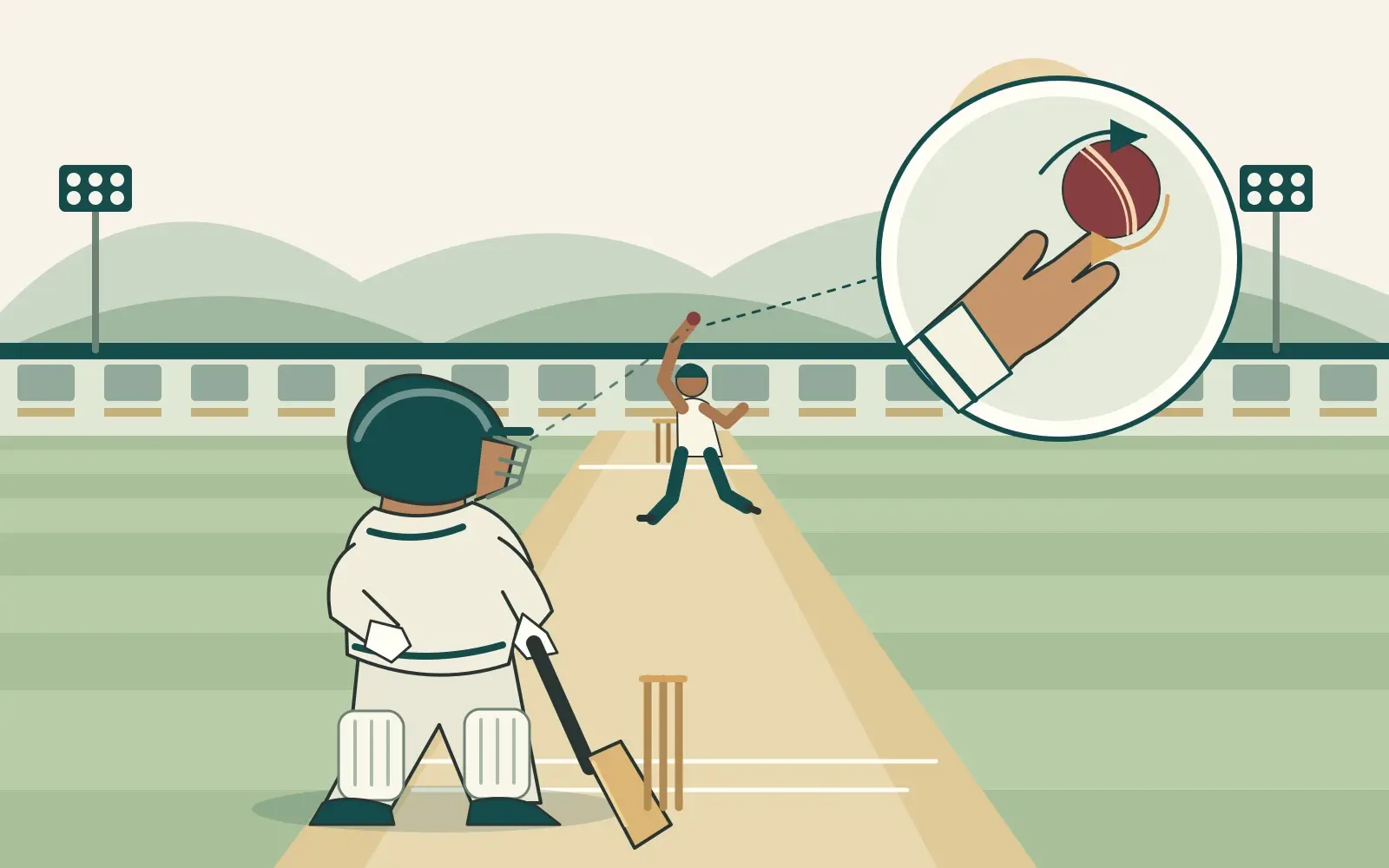
Cricket Fielding Positions Explained: How Captains Set Fields for Different Batters
Understand cricket fielding positions, attacking and defensive fields, powerplay restrictions and how captains adapt their tactics to different batters.
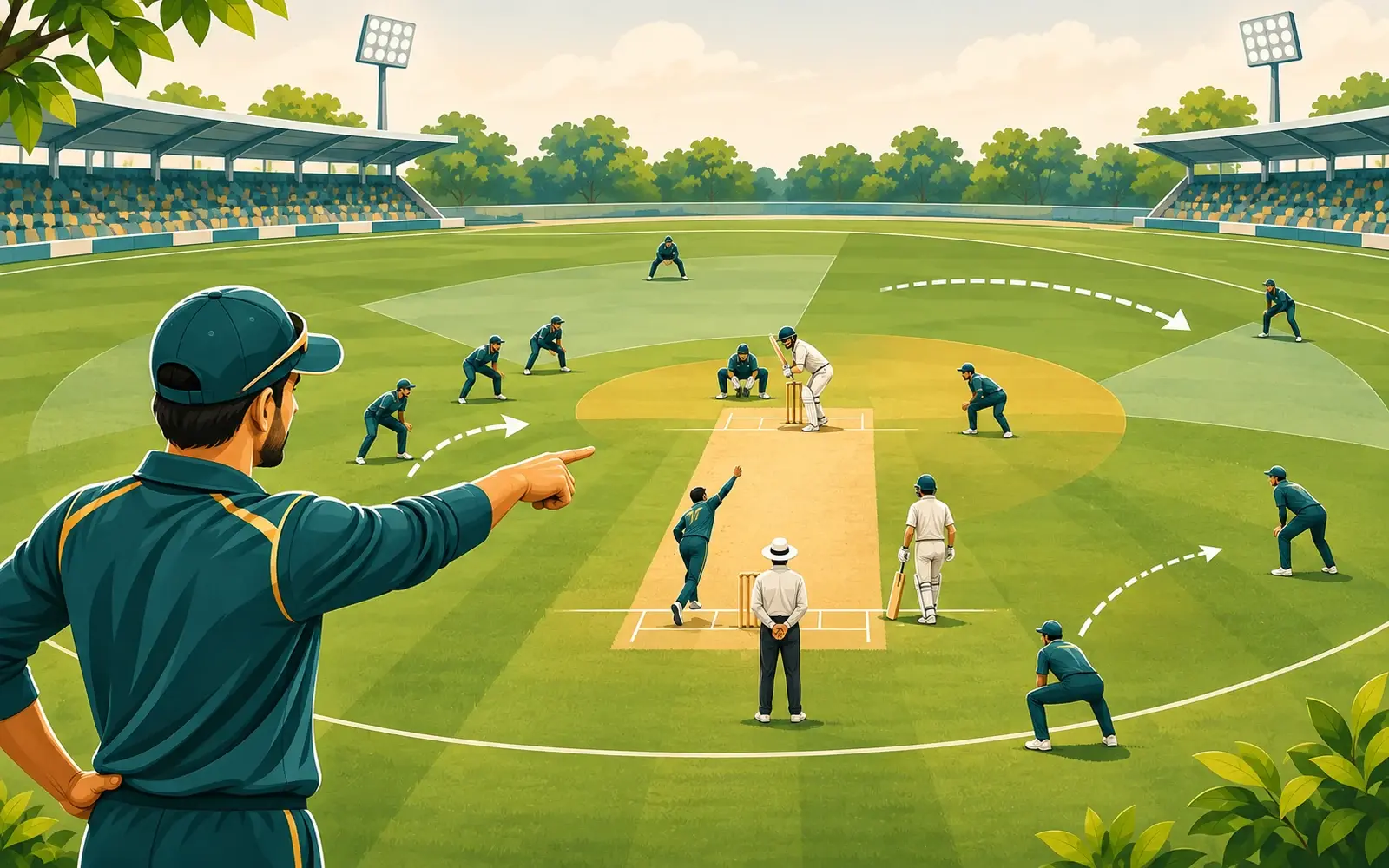
A fast bowler beats a batter outside off stump. The captain immediately calls another fielder into the slips. A few overs later, the same captain sends someone to deep square leg and asks the bowler to change length. When a left-handed batter arrives, several fielders move again.
These changes are not simply reactions to the previous delivery. Every fielder occupies space that could have been used somewhere else. Putting someone near the boundary may prevent a four but concede an easy single. Adding a slip may create a catching opportunity but leave a gap through the covers.
A cricket field is therefore a visible expression of a bowling strategy. To understand why captains set different fields for different batters, look at the likely shot, the intended delivery and the price of leaving another area unprotected.
Understanding the field: off side, leg side and distance
A full fielding team has eleven players, including the bowler and wicketkeeper. That normally leaves nine other fielders for the captain to position.
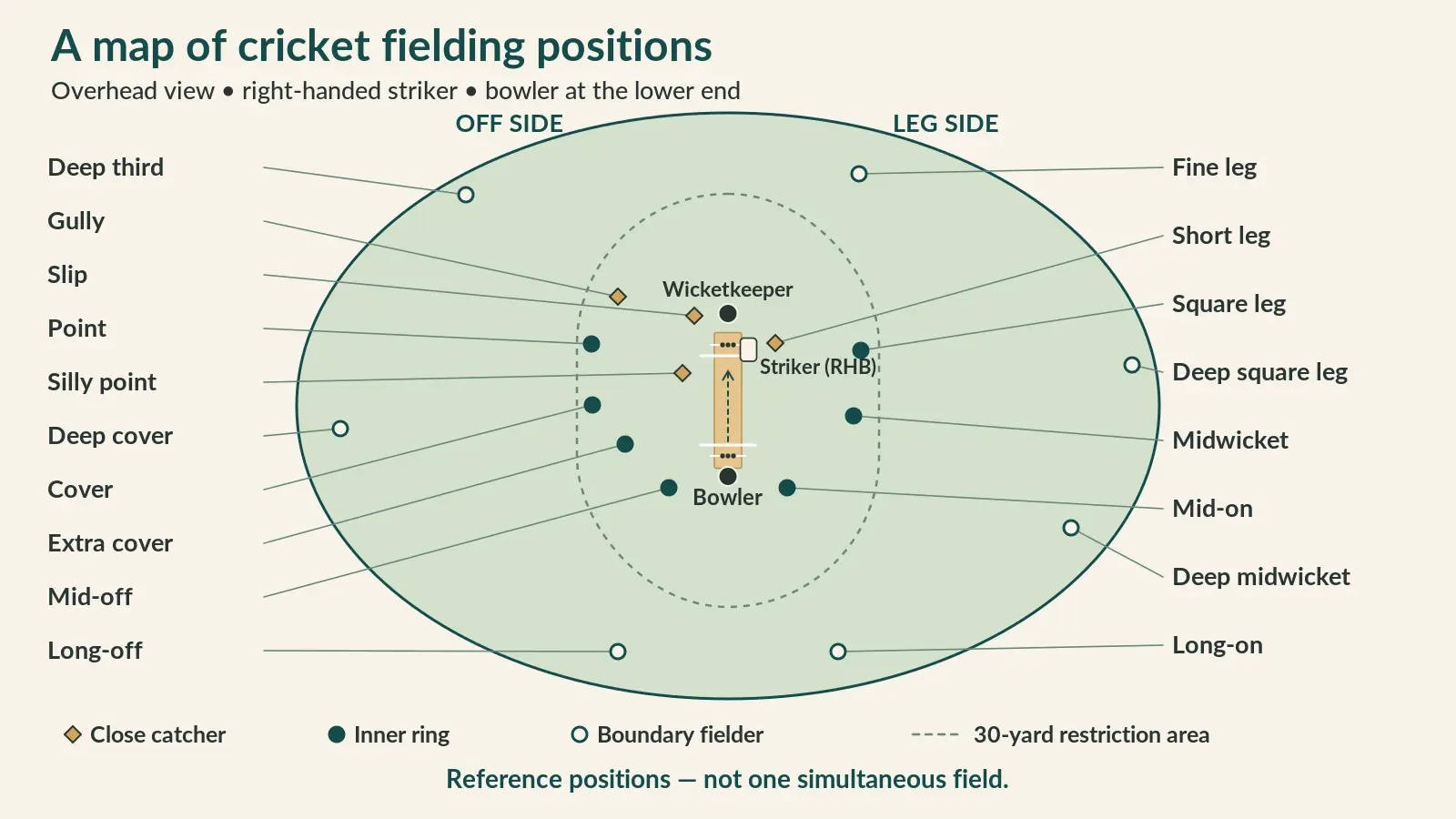
The names of cricket fielding positions are relative to the striker, not fixed geographical points on the ground. The off side is the side the batter faces in a conventional batting stance; the leg side, also called the on side, is the side behind the batter's body. For a left-handed striker, these sides reverse relative to a right-hander facing from the same end.
A position also has a direction and a distance. Square positions are roughly to the side of the striker; fine positions are closer to the line behind the wicket; straight positions are towards the bowler's end. A deep fielder is generally further from the batter, while a short or silly position is close.
The following names describe approximate regions rather than painted spots. Captains regularly move a fielder several metres without changing the position's name.
| Position | Location and typical purpose |
|---|---|
| Slip and gully | Off side behind the batter; catch edges, particularly against pace bowling |
| Point and backward point | Square or slightly behind square on the off side; intercept cuts and back-foot shots |
| Cover and extra cover | In front of square on the off side; stop drives and singles |
| Mid-off and mid-on | Relatively straight in front of the batter; intercept straight drives on the off and leg sides |
| Midwicket | In front of square on the leg side; stop flicks and leg-side drives |
| Square leg and fine leg | Square or behind square on the leg side; intercept pulls, glances and other deflections |
| Deep third (third man) | Near the off-side boundary behind square; cover edges, guides and late cuts |
| Long-off and long-on | Straight boundary positions; protect against lofted drives |
| Deep cover, deep midwicket and deep square leg | Boundary protection for drives, slog-sweeps and pulls respectively |
| Short leg and silly point | Very close catchers on the leg and off sides; collect bat-pad chances and defensive mistakes |
The wicketkeeper's location also matters. Standing back gives room to react to fast deliveries and edges. Standing up to the stumps against suitable bowling can create stumping opportunities and restrict the batter's freedom to advance.
Three jobs a captain needs the field to perform
Create dismissal opportunities
An attacking field deliberately places players where mistakes are likely to produce catches. In a Test match with a moving new ball, several slips and a gully can be more useful than boundary protection. On a turning pitch, a spinner might instead want short leg, silly point and a slip.
Not every wicket depends on a catcher: bowling the batter or trapping them leg before wicket (LBW) requires different execution. A field can still contribute indirectly by restricting easy scoring and encouraging a riskier shot.
Stop singles and build pressure
An inner ring of fielders can make routine shots unproductive. If point, cover and midwicket are alert, a batter may struggle to rotate the strike. Repeated dot balls raise the required scoring rate during a chase and can isolate a less comfortable partner.
Ring fielders should not all stand at identical distances. A quick batter may exploit a fielder who is too deep, whereas a powerful hitter can punish one who is too close to react. The speed of the outfield and the individual fielder's anticipation matter.
Protect the boundary
Boundary fielders are valuable when the cost of conceding a four or six is high. But retreating everyone who is legally allowed to go back may open a series of easy singles and twos. A defensive field can therefore be ineffective if the batting side needs only a modest scoring rate.
The best balance changes with the match. Attacking and defensive are useful descriptions, not two mutually exclusive formations. A captain can retain a slip while defending selected boundaries.
How a batter's strengths change the field
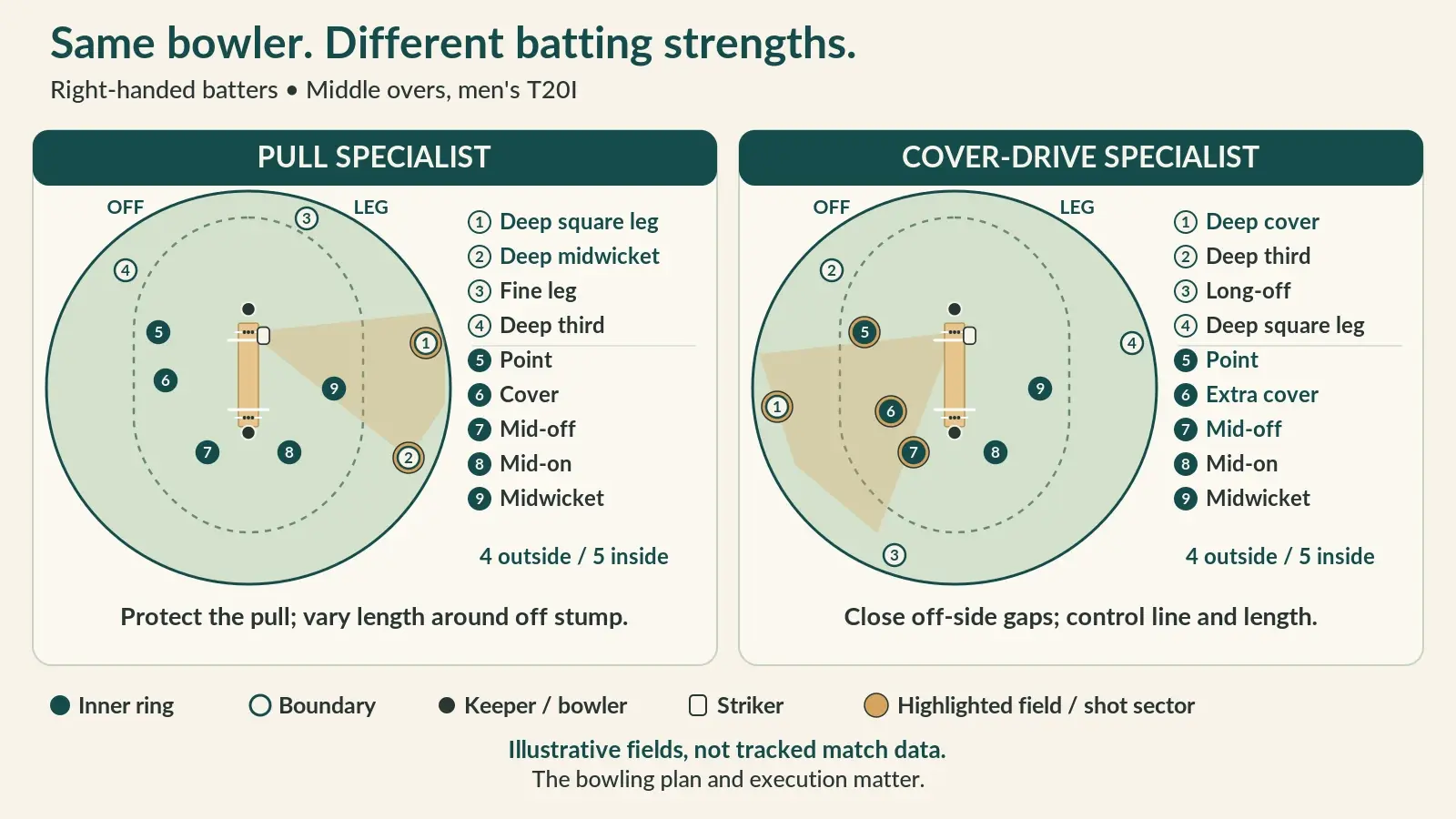
Imagine two right-handed batters facing the same fast bowler during the middle overs of a T20 match. One is especially comfortable pulling short balls towards square leg; the other prefers driving through cover.
Against the pull specialist, a captain might protect deep square leg and deep midwicket while asking the bowler to attack an uncomfortable length outside off stump. The boundary riders offer insurance against the batter's preferred shot or a deliberate short-ball variation. The bowler should not repeatedly feed the hitter's strongest stroke just because someone is stationed there.
Against the cover-drive specialist, the captain might strengthen the off-side ring, move a boundary rider to deep cover and ask the bowler to deliver a controlled line around off stump, at a length that makes a free drive difficult. If a fuller delivery is part of the plan, the field offers protection against the likely scoring route.
Both approaches require leaving some areas less protected. The aim is to influence shot selection: deny the easy option and make the batter manufacture a less comfortable stroke.
When to block a strength and when to invite it
Protecting the batter's favourite area is not always the answer. If a particular stroke is frequently played in the air, the captain may position a catcher for it and deliberately offer a delivery that invites the shot. A spinner may tempt a batter to hit over mid-on, with long-on available to take a mis-hit. Alternatively, the captain may bring mid-on up, inviting a lofted stroke over the infield but accepting the risk of a boundary.
The decision depends on whether the bowler can create a difficult version of that stroke, not simply on how many runs the batter has scored there previously.
A batter's scoring pattern also depends on bowling type. Someone who attacks off-spin through midwicket may prefer cutting a fast bowler through point. A captain needs information about the specific matchup, not just a general reputation.
Why the field must match the bowler
An excellent field for one delivery can be a poor field for another.
A swing bowler attacking the outside edge needs catchers in the likely edge corridor. A bowler attempting wide yorkers at the death may favour deep cover, deep point and deep third. A short-ball plan is more likely to require protection at deep square leg or fine leg, depending on the line and intended shot.
Against spin, the direction of the stock ball, its bounce and the batter's use of the feet become important. A right-arm off-spinner turning the ball into a right-hander might use a short leg for inside-edge or bat-pad chances. A right-arm leg-spinner turning it away may value an off-side slip. Both can use other close catchers, and variations may reverse the expected direction.
A captain must also recognise the bowler's actual control. An ambitious wide-yorker field is risky if the bowler regularly misses towards the pads. A simpler plan that the bowler can reproduce under pressure is often preferable to a theoretically attractive formation that depends on perfect accuracy.
Experienced bowlers sometimes deliberately break the pattern. In a 2016 interview reported by Cricket Australia, Ravichandran Ashwin described bringing mid-on and mid-off into the infield and then using flight when batters anticipated a flatter ball. The field was part of the deception. Such a bluff can work because batters read the field before committing to an attacking stroke; it can also backfire if they anticipate correctly.
What the laws allow: powerplays and other restrictions
Captains cannot place all nine fielders wherever they like. The ICC's fielding clauses define additional restrictions for different formats.
One important rule across conventional international formats limits the number of fielders, excluding the wicketkeeper, behind the striker's popping crease on the leg side to two at delivery. Men's ODI and T20I conditions also limit the number of leg-side fielders to five at delivery. Exceeding the applicable placement limits can result in a no-ball.
Limited-overs games introduce further restrictions through the fielding circle. In standard men's international white-ball cricket, the 30-yard restriction area consists of two semicircles joined by parallel lines, rather than a perfect circle centred on the middle of the pitch.
| Format and phase (full-length innings) | Maximum fielders outside the restriction area |
|---|---|
| Men's ODI: overs 1–10 | 2 |
| Men's ODI: overs 11–40 | 4 |
| Men's ODI: overs 41–50 | 5 |
| Men's T20I: overs 1–6 | 2 |
| Men's T20I: overs 7–20 | 5 |
| Test cricket | No equivalent powerplay limit |
These are the ordinary phase limits documented in the ICC's men's ODI and T20I fielding provisions, not a universal rule for every competition. Women's cricket, domestic tournaments, rain-shortened innings and in-match slow-over-rate penalties can have different or tighter restrictions. Consult the applicable playing conditions for a specific match.
A captain normally changes positions between deliveries. Significant unfair repositioning after the ball comes into play is restricted, although legitimate adjustments and movement responding to a developing stroke are allowed under the relevant laws and conditions. Fielders other than the bowler must also respect restrictions on encroaching onto the pitch.
Why fields change across Tests, ODIs and T20s
In Tests, the number of overs is not fixed in the same way as in limited-overs cricket. Taking wickets is usually central to winning, so captains may accept occasional boundaries to keep catchers around the bat. But when saving a Test or protecting a target late on the final day, priorities can change sharply.
In ODIs, captains work through three field-restriction phases. Early movement can justify slips even when open areas are vulnerable. During the middle overs, a ring that limits singles can complement spin or pace changes. The final phase permits more boundary protection, although the number of wickets in hand influences how aggressively batters attack.
In T20s, the value of each delivery is amplified by the short innings. A set batter scoring rapidly may justify boundary protection, whereas a newly arrived batter might be challenged with a tight ring or a catcher. But a new specialist finisher can be dangerous immediately; the captain should not assume everyone needs time to settle.
A simple example shows how the chase changes the field. If the opposition needs 12 from six balls, avoiding boundaries may be the main objective. If it needs four from six with one wicket remaining, conceding a single on every ball loses the match; a closer field and a wicket-taking plan may make more sense. These are hypothetical situations, not universal instructions.
The factors that television viewers often miss
A field diagram can make two grounds look identical when they are not. The pitch may sit off-centre, making one square boundary significantly shorter than the other. A captain may ask a bowler to direct hitting towards the longer side and place the best boundary catcher there, while guarding the shorter side against errors.
Wind can affect lofted shots; a fast outfield makes a slightly misplaced infield position more expensive. Dew can reduce a spinner's grip and make the intended delivery less reliable. The captain may also need to hide a slower fielder from heavily targeted zones, or put a strong throwing arm where batters are likely to attempt two.
When a right-hander and left-hander alternate strike, copying the same field mechanically is not always appropriate. The off and leg sides reverse, but the boundary distances, bowler's angle and individual scoring preferences do not necessarily mirror one another. Captains may use versatile positions that require only small changes, saving time without abandoning the plan.
How data helps, and what it cannot tell a captain
A wagon wheel plots the directions in which a batter scores. Combined with video, delivery line and length, bowling type and dismissal information, it can help identify recurring scoring areas and potential catching opportunities. But a scoring map alone does not show every failed shot, dot ball or fielding position. It describes what happened in past conditions, not necessarily what will happen next.
A 2026 exploratory study by Dhanur Bhardwaj and colleagues identified 21 recurring field configurations using T20 international tracking data. Some configurations were associated with differences in scoring and dot-ball outcomes, but none had a statistically significant association with wickets in that analysis. The results support studying fields systematically without proving that one formation causes better results in every match.
The captain still needs judgement. A sample of deliveries may reflect the quality of a bowler, the match phase or the opposition rather than the field alone. What looks statistically promising may also be impractical for the players available.
How to read a captain's plan while watching cricket
Before the bowler starts, identify the striker's off and leg sides. Notice the close catchers, the inner-ring gaps and the boundary riders. Then ask which delivery would make that arrangement sensible and which shot the captain appears willing to concede.
Watch the next few deliveries instead of judging from one outcome. A bowler might repeatedly attack a particular channel, gradually change pace or move a batter across the crease. If a boundary comes from an unintended ball, the field may not be the main problem. If the batter repeatedly finds the same gap against well-executed deliveries, the plan may need changing.
Ultimately, field placement is a negotiation between opportunity and risk. A captain cannot cover the entire ground; the skill is to make the most likely or most damaging scoring options difficult while keeping credible routes to a wicket. Reading the relationship between field, bowler and batter makes cricket's quieter moments between deliveries just as interesting as the shots themselves.
Sources and Further Reading
- ICC — Playing Conditions directory: format-specific rules and applicable editions.
- ICC — Men's Test Match Clause 28: The Fielder: general fielding limitations.
- ICC — Men's ODI Match Clause 28: fielding area and phase restrictions.
- ICC — Men's T20I Match Clause 28: powerplay and leg-side limits.
- ICC — October 2026 playing-condition changes: recent rule changes; check the current full edition for competition-specific application.
- MCC — About the Laws of Cricket: the laws and their editions.
- Bhardwaj et al. (2026) — An exploratory study to identify field-setting strategies and evaluate the impact of fielding tactics on team performance in T20 international cricket: peer-reviewed analysis of field configurations and outcomes.
- Cricket Australia — Ashwin's tactical approach to T20 bowling (2016): first-person account of field-setting deception.
- Cricket Australia — Maxwell's approach to captaincy (2019): batter matchups, boundary geometry and tactical adjustments.
- Cricket Australia — Faulkner on the battle of the bluff (2016): the relationship between field and delivery choice.