Net Run Rate in Cricket: How to Calculate NRR With Real Match Examples
Learn how net run rate (NRR) is calculated in cricket using real IPL and World Cup examples, including all-out innings, successful chases and DLS adjustments.

In the final stretch of a cricket tournament, winning is sometimes not enough. A team may need to win by a particular number of runs, complete a chase before a particular over, or hope that another team's result improves its qualification chances. These calculations are usually driven by a column in the points table called net run rate (NRR).
The 2024 Indian Premier League (IPL) provided a memorable example. Royal Challengers Bengaluru (RCB) and Chennai Super Kings (CSK) finished with 14 points each, but RCB qualified for the playoffs because of its superior NRR. Understanding why requires more than subtracting the two teams' scores in their final match.
The basic formula is simple. The complications arise when a team is bowled out early, finishes a chase with balls remaining, plays matches of different lengths or encounters rain. Using actual IPL and World Cup results, this article explains how to calculate NRR correctly and interpret what it means for qualification.
What is net run rate in cricket?
Net run rate measures the difference between a team's scoring rate and the scoring rate of its opponents across the relevant matches of a competition. It expresses that difference in runs per over, rather than total runs or wickets.
A positive NRR means the team has scored faster than its opponents on an aggregate basis under the applicable calculation rules. A negative NRR means the opponents have scored faster. A zero NRR indicates equal aggregate rates, not necessarily an equal number of wins and defeats.
NRR is primarily a standings and tie-breaking measure in limited-overs cricket. It is different from both the current run rate, which describes an innings so far, and the required run rate, which describes how quickly a chasing team must score to reach its target.
The order of tie-breakers depends on the tournament. For example, the ICC Men's T20 World Cup 2026 playing conditions, clauses 16.10.4 and 16.10.7, use number of wins and then NRR to separate teams level on points. The Super Eights begin with fresh standings, so first-round NRR does not carry forward in that event.
The net run rate formula
NRR = (Total runs scored ÷ Total eligible overs faced) − (Total runs conceded ÷ Total eligible overs bowled)
The first fraction describes the team's aggregate batting rate. The second describes the aggregate rate at which opponents score against it. Here, eligible overs means the overs counted under the NRR rules, which do not always equal the actual overs played.
For a simple example, suppose Team A scores 180 in 20 overs and Team B replies with 160 in 20 overs.
- Team A batting rate = 180 ÷ 20 = 9.000.
- Team A rate conceded = 160 ÷ 20 = 8.000.
- Team A's net rate for this match alone = 9.000 − 8.000 = +1.000.
- Team B's corresponding figure = −1.000.
In a competition, both teams would add the relevant runs and overs to their existing totals. These single-match figures should not be confused with the updated tournament standings.
Cricket overs are not decimal numbers
A scorecard reading 18.4 overs means 18 completed overs and four valid balls. It does not mean 18.4 in decimal notation. Under the standard six-ball over, this is 112 balls, or 18 + 4/6 = 18.6667 overs.
Similarly, 41.2 overs means 248 balls, or 41⅓ overs. An over ends after six valid balls in normal play; wides and no-balls add runs but do not count as valid deliveries in the over. See clause 17 of the ICC playing conditions.
The safest calculation method is to store overs as whole numbers of valid balls, then calculate the rate as runs multiplied by six and divided by balls. Retain full precision until the final NRR is displayed, usually to three decimal places.
Real example 1: India vs Sri Lanka — the all-out rule
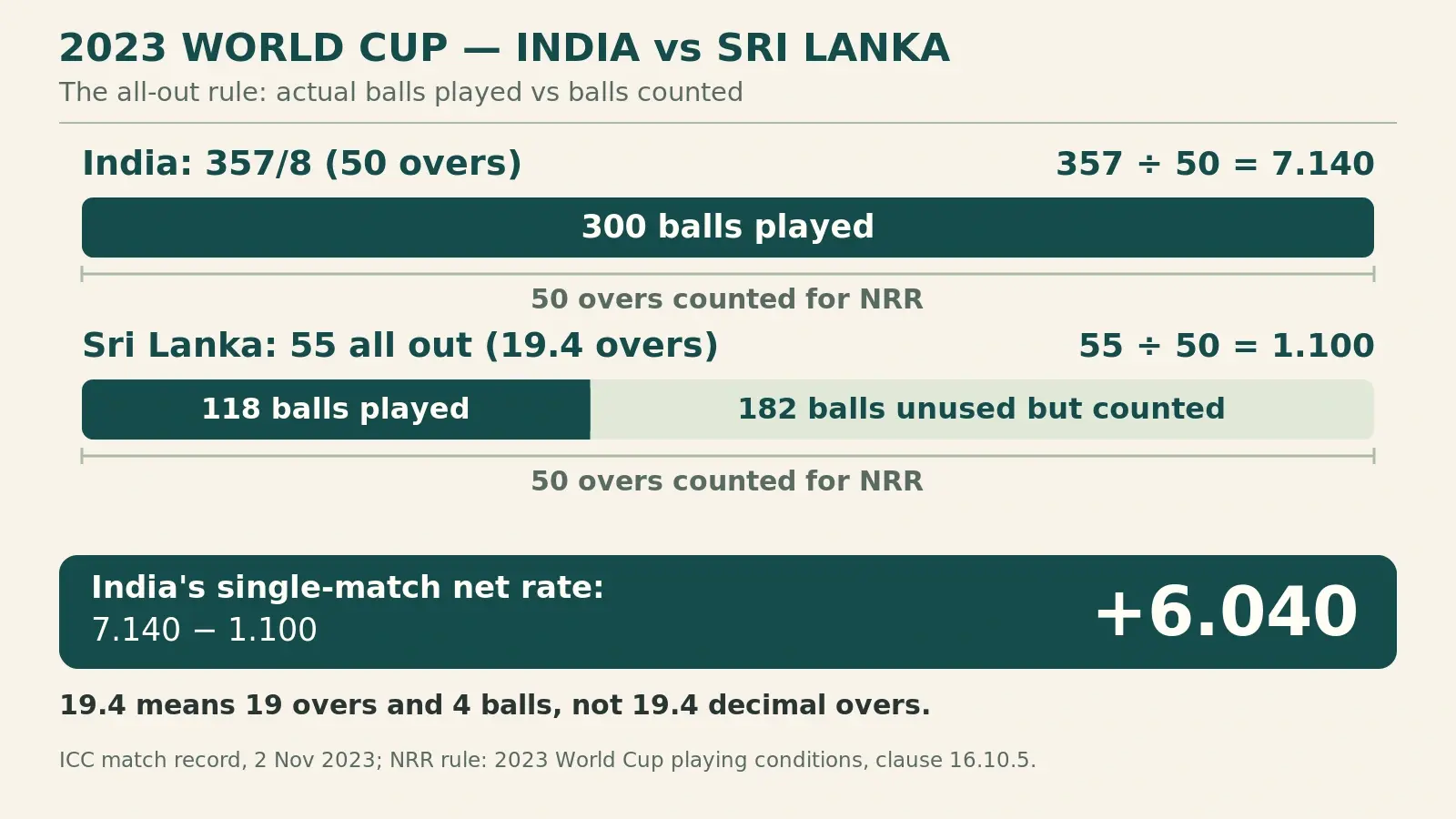
On 2 November 2023, India played Sri Lanka in the ODI World Cup in Mumbai. India posted 357/8 in 50 overs. Sri Lanka were dismissed for 55 in 19.4 overs, resulting in an Indian victory by 302 runs. The ICC match record and full scorecard establish the innings figures.
Sri Lanka's actual innings run rate is 55 ÷ 19⅔, or about 2.797 runs per over. But that is not the rate used for NRR.
Under the all-out rule, a dismissed team is charged its entire permitted allocation. Sri Lanka had a 50-over allocation, so the calculation uses 50 overs, even though India bowled only 118 valid balls.
| Calculation | India | Sri Lanka |
|---|---|---|
| Runs scored | 357 | 55 |
| Actual overs | 50.0 | 19.4 |
| Overs counted for NRR | 50 | 50 |
| NRR scoring rate | 7.140 | 1.100 |
| Single-match net rate | +6.040 | −6.040 |
This prevents a team from improving its statistical scoring rate simply by losing all its wickets before using the available deliveries. India receives the benefit of restricting Sri Lanka to a low total, even though the match ended early.
If an innings has been officially reduced to 35 overs, the equivalent all-out denominator is 35, not the original 50. The applicable allocation matters.
Real examples 2 and 3: a successful chase and aggregate NRR
India's first two games at the same 2023 World Cup show why batting second can improve NRR and why the tournament calculation must use cumulative totals.
India vs Australia, 8 October 2023
Australia made 199 all out in 49.3 overs in Chennai. India reached 201/4 in 41.2 overs, winning by six wickets. The match scorecard confirms the figures.
Australia's innings counts as 50 overs because it was all out. India's successful chase, however, counts as the actual 248 valid balls it needed. It is not charged for the remaining 52 balls that were never required.
India's batting rate = 201 × 6 ÷ 248 = 4.862903...
Australia's NRR scoring rate = 199 ÷ 50 = 3.980.
India's single-match net rate = 4.862903... − 3.980 = +0.883 (rounded).
Notice that the calculation uses India's final score of 201, not the winning target of 200. Runs actually credited in the scorecard matter; a winning boundary can take the total beyond the minimum required.
India vs Afghanistan, 11 October 2023
Afghanistan scored 272/8 in 50 overs in Delhi. India chased the target, finishing at 273/2 in 35 overs. India won by eight wickets, with 15 overs unused. The ICC match report and scorecard document the result.
India's single-match net rate = (273 ÷ 35) − (272 ÷ 50) = 7.800 − 5.440 = +2.360.
Combining the two matches correctly
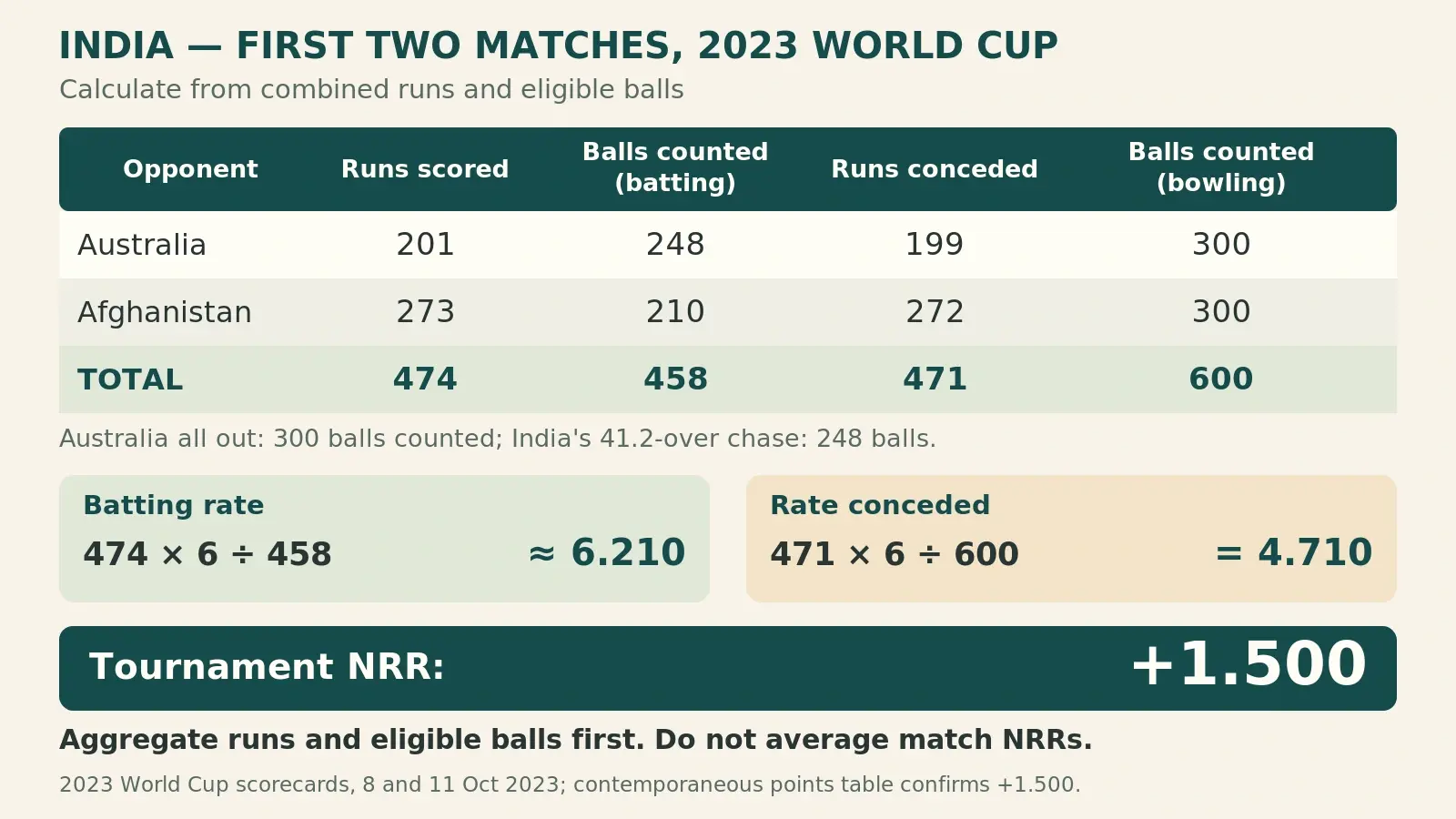
The standings after the Afghanistan game did not simply average +0.883 and +2.360. Instead, India accumulated the following totals:
| Match | India runs | India balls counted | Opponent runs | Opponent balls counted |
|---|---|---|---|---|
| Australia | 201 | 248 | 199 | 300 |
| Afghanistan | 273 | 210 | 272 | 300 |
| Total | 474 | 458 | 471 | 600 |
India's aggregate batting rate = 474 × 6 ÷ 458 = 6.209606...
India's aggregate rate conceded = 471 × 6 ÷ 600 = 4.710.
Tournament NRR = 6.209606... − 4.710 = +1.500 (rounded).
This matches India's NRR reported in contemporary points-table coverage after those two matches.
A simple average of the separate match figures would produce approximately +1.621 instead, which is incorrect. Each innings contributes its runs and eligible overs to the corresponding aggregate. The batting and bowling rates may therefore have different effective weights from match to match.
What happens when rain brings DLS into the calculation?
The Duckworth–Lewis–Stern (DLS) method adjusts a target or determines a result in interrupted matches. NRR serves a different purpose: it compares performance across the competition. The rules specify adjustments to the figures used for NRR when DLS applies, so that teams are not judged simply on the basis of unequal innings lengths.
Under the 2023 ODI World Cup conditions (clause 16.10.5) and the 2026 T20 World Cup conditions (clause 16.10.7), there are two principal cases:
- If a revised chase is completed, the first team's NRR entry uses the final winning target minus one, over the second team's revised allocation. For example, a revised target of 151 from 15 overs produces a first-team entry of 150 from 15 overs. The chasing innings uses its own eligible figures.
- If rain ends play but DLS establishes a result, the first team's entry uses the chasing team's par score at that moment and the same number of overs as the chasing side has faced.
These adjustments are for the standings calculation only. They do not rewrite the official batting scorecard.
Real example 4: Pakistan vs New Zealand, 4 November 2023
New Zealand scored 401/6 in 50 overs in Bengaluru. Pakistan reached 200/1 in 25.3 overs before rain ended play. The ICC match report records Pakistan's victory by 21 runs under DLS.
Since Pakistan were 21 runs ahead, the par score at abandonment was 179. New Zealand's NRR entry is therefore 179 from 25.3 overs, not 401 from 50 overs. Pakistan's entry is 200 from 25.3 overs.
With 25.3 overs equal to 153 balls, Pakistan's single-match net rate is (200 − 179) × 6 ÷ 153 = +0.824 (rounded). New Zealand's figure has the opposite sign.
This illustrates why comparing the original first-innings score with an incomplete chase can give a misleading answer. A match abandoned without an official result normally contributes neither runs nor overs to NRR, even if some cricket was played and both teams receive a points-table point.
Real example 5: how NRR decided IPL 2024 qualification
On 18 May 2024, RCB scored 218/5 in 20 overs against CSK. Chennai replied with 191/7 in 20 overs. RCB won by 27 runs, generating a single-match net rate of (218 − 191) ÷ 20 = +1.350.
However, the playoff question was more demanding than simply winning. CSK entered the match with the stronger cumulative NRR. According to the official IPL match report, Chennai needed to reach 201 to qualify even if it lost. RCB therefore needed to restrict CSK to 200 or fewer after posting 218. It succeeded.
| Final league position | Team | Wins | Points | NRR |
|---|---|---|---|---|
| 4 | RCB | 7 | 14 | +0.459 |
| 5 | CSK | 7 | 14 | +0.392 |
The 2024 IPL playing conditions placed NRR after points and wins. The final values above are documented in contemporary reporting.
RCB's +1.350 for the final match was not its league NRR. The final +0.459 incorporated its entire league record. This is why qualification margins vary depending on the previous matches, the opposition and whether a team bats first or second.
How teams can improve their net run rate
Teams batting first can improve their position by building a competitive total and restricting their opponents. With an unchanged allocation, bowling a team out cheaply is particularly valuable. Teams chasing can improve their batting rate by reaching the target in fewer deliveries, provided they do not sacrifice the win itself.
A team that wins by a narrow margin may improve its NRR only slightly, or even see an already excellent tournament NRR decline. Conversely, a losing team may improve a very poor cumulative NRR if the defeat is less damaging than its previous results. The outcome of one match does not determine the direction of the aggregate on its own.
Consider two hypothetical successful chases of a target of 161 in a T20 match. Reaching 161 in 20 overs produces a batting rate of 8.050, whereas reaching the same total in 16 overs produces 10.0625. Against an opponent that scored 160 in 20 overs, the net figures for those matches would be +0.050 and +2.0625 respectively. Both wins can earn the same points, but they contribute different runs-and-balls totals to the standings.
Analysts calculate qualification scenarios by starting with existing runs and eligible balls for both sides, adding hypothetical match outcomes, then comparing the resulting NRR at full precision. A displayed NRR alone is insufficient to reconstruct all the underlying totals. If the two competing teams are playing one another, the proposed result changes both sets of totals, which makes the qualification calculation a moving comparison rather than a fixed required run rate.
Avoid these common calculation mistakes
- Treating 19.4 overs as 19.4 in decimal arithmetic instead of 118 balls.
- Using actual overs for a side dismissed early, or charging a successful chase for unused overs.
- Averaging separate match net rates rather than aggregating runs and eligible overs first.
- Including a washout without a result, or ignoring the special DLS treatment when a result is achieved.
- Including Super Over runs and balls in competitions such as the 2026 ICC Men's T20 World Cup, where they are explicitly excluded.
Always use the rules for the particular event and stage. Exceptional cases such as forfeits have specific provisions. NRR is not a universal measure of team quality: it does not directly account for venue difficulty, opposition strength or the number of wickets remaining in a successful chase. Its purpose is to provide a consistent statistical tie-breaker under defined competition rules.
The bottom line
Net run rate becomes much easier to understand once you separate actual overs played from overs that count in the calculation. Apply any event-specific adjustments, particularly for all-out innings and rain-affected results, then add the appropriate runs and balls across matches. Convert them into two aggregate scoring rates and subtract.
When a commentator says a team must win by a certain margin or chase a target within a specific number of overs, the calculation is not arbitrary. It is the same NRR formula applied to the possible outcomes and the teams' existing records.
Sources and further reading
- ICC Men's T20 World Cup 2026 playing conditions, clauses 16.10 and 17 — competition-specific ranking, NRR and valid-delivery rules.
- ICC Men's Cricket World Cup 2023 playing conditions, clause 16.10.5 — rules applicable to the historical ODI examples.
- ICC men's ODI result and NRR provisions — general explanation of DLS-related adjustments; consult event-specific conditions for application.
- ICC 2023 World Cup: India's route to the final — context for India's opening matches.
- ICC 2023 World Cup: Pakistan's DLS victory — rain-affected match result.
- BCCI: IPL 2024 playing conditions, clauses 16.10 and 16.12 — league ranking and NRR provisions.
- IPL 2024: RCB vs CSK official scorecard — real qualification match.