Duckworth–Lewis–Stern (DLS) Method Explained: How Are Revised Targets Calculated in Rain-Affected Cricket Matches?
Understand how the DLS method calculates revised cricket targets using overs and wickets, with worked examples, par scores and the 2023 IPL final.
Imagine a team scoring 300 runs in 50 overs. Rain arrives, and its opponent is allowed only 30 overs to chase. Should the new target be 181, since 30 overs represent 60% of the original allocation? Or should it be higher because the chasing team can attack from the beginning without having to preserve its wickets for a full 50-over innings?
Now imagine that the rain arrives during the chase instead. A team with eight wickets in hand is in a very different position from one with only four, even if both have scored exactly the same number of runs.
The Duckworth–Lewis–Stern (DLS) method accounts for these differences. It does not simply divide runs by overs. It adjusts the target according to the relative scoring opportunities available to each batting side.
Here is how that works, how to interpret the numbers on a live scoreboard, and how to calculate a revised target using the published Standard Edition of the method.
What is the DLS method?
DLS is a statistical method used to revise targets and, when necessary, determine results in interrupted limited-overs cricket. It applies to formats such as One Day Internationals (ODIs) and Twenty20 cricket under the relevant competition's playing conditions. Interruptions may result from rain, unsafe ground conditions or other causes that reduce the available playing time.
The original method was developed by statisticians Frank Duckworth and Tony Lewis and first used in international cricket in 1997. A computer-based Professional Edition followed in 2003. Steven Stern subsequently refined the modelling to better represent contemporary scoring patterns, leading to the DLS name in 2014. The developers' retrospective in Significance describes these developments.
Earlier rain rules often relied on the average run rate or selected overs from the first innings. Their weakness was that the number of balls faced does not tell us how much scoring potential a batting side has used. A team can be ahead on run rate yet close to being bowled out.
DLS tries to compensate for lost scoring opportunities rather than predict the exact score a team would have made without rain.
The two resources that matter: overs and wickets
A batting side needs both deliveries to face and batters who can continue the innings. DLS represents their combined scoring potential as a percentage of a reference full 50-over innings.
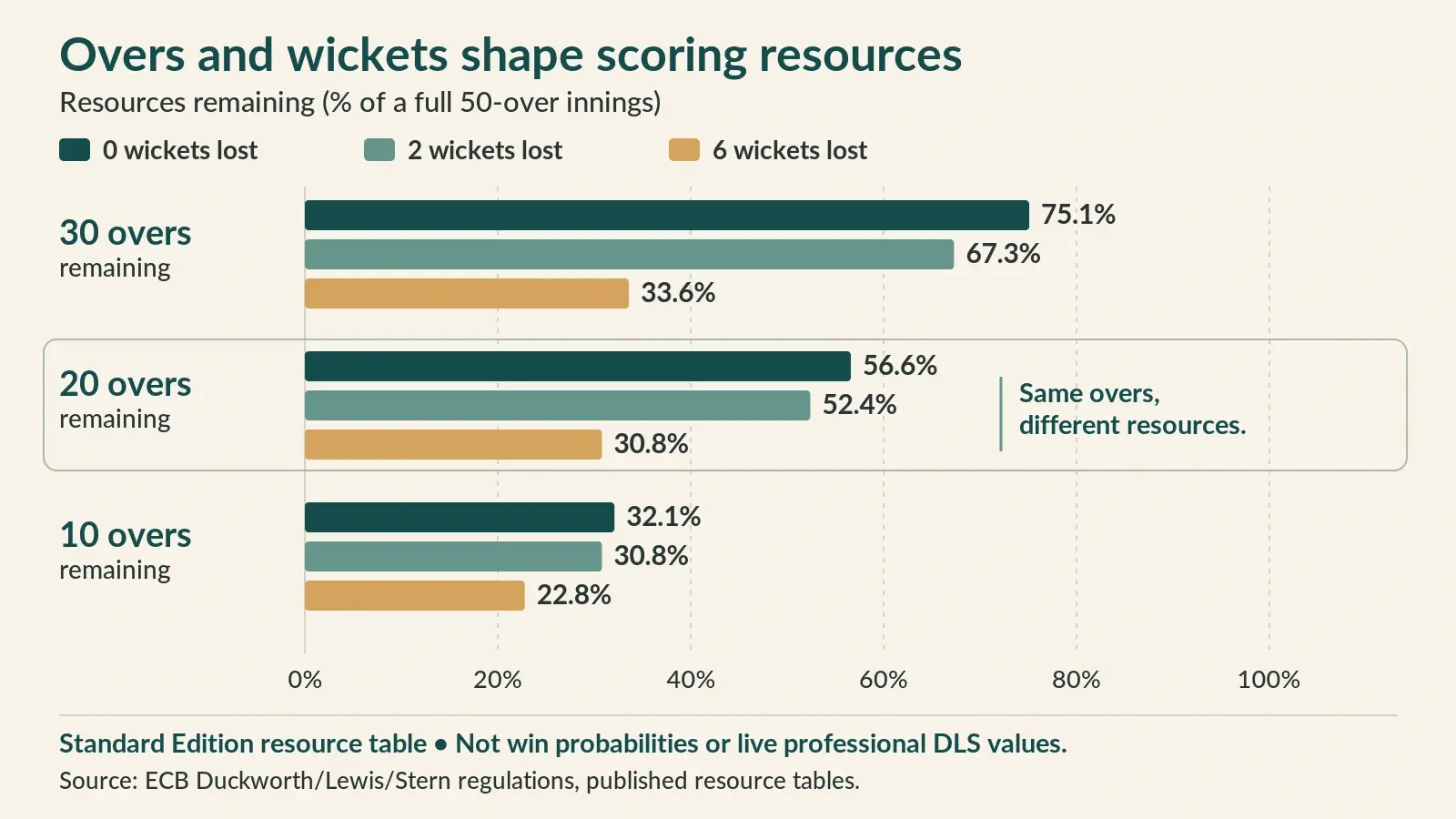
Consider two teams with 20 overs still available. One has lost two wickets, while the other has lost six. The first can take more risks, knowing it has batting depth to spare. The second has fewer chances to recover from another dismissal. Their remaining resources are therefore different, even though their time at the crease is identical.
The published Standard Edition resource table, available in the ECB's DLS regulations, illustrates this relationship:
| Overs remaining | 0 wickets lost | 2 wickets lost | 6 wickets lost |
|---|---|---|---|
| 30 | 75.1% | 67.3% | 33.6% |
| 20 | 56.6% | 52.4% | 30.8% |
| 10 | 32.1% | 30.8% | 22.8% |
These are selected values from the historical public table, not win probabilities or live professional DLS values. They are all expressed relative to a full 50-over innings. A complete 20-over innings therefore begins with 56.6% on this particular scale, rather than 100%. Both sides use the same reference, so their relative opportunities can still be compared.
Notice that halving the remaining overs does not necessarily halve the resources. With two wickets lost, the figure drops from 52.4% to 30.8% when the remaining allocation falls from 20 to 10 overs. With six wickets lost, the same reduction takes it from 30.8% to 22.8%. The overs removed have less expected scoring value for the side with fewer wickets available.
At either extreme, no overs left or no wickets left means no further scoring opportunity. The resource percentage is about potential runs, not how much time is left on a clock.
How revised targets are calculated
Three quantities are particularly important:
- S: The actual total scored by Team 1, the side batting first.
- R1: The total scoring resources made available to Team 1 during its innings.
- R2: The total scoring resources made available to Team 2, the chasing side.
When Team 2 has fewer resources than Team 1, the published Standard Edition uses this calculation:
Par score = round down (S × R2 / R1)
Revised target to win = par score + 1
Rounding down means discarding the fractional part, not rounding to the nearest whole run. If the calculation gives 225.9, the par score is 225 and the target is 226.
The resources made available for an innings are not necessarily the resources remaining at the current moment. The first measures the batting opportunity as a whole; the second measures the portion still unused. When an interruption removes overs, the scoring opportunity lost is the resource value before the interruption minus its value after the interruption, using the same wickets-lost count at both points.
The examples below use the Standard Edition so the arithmetic can be reproduced from a public table. The modern DLS software uses more sophisticated resource modelling, so its official targets need not match these numbers.
Example 1: Rain before the chase begins
Suppose Team 1 scores 300 in its full 50-over allocation. During the interval, rain reduces Team 2's innings to 30 overs, before it has faced a ball.
Team 1 had 100% of the reference resources. Team 2 begins with 75.1%, according to the Standard Edition table.
- Par score = round down (300 × 75.1 / 100) = 225.
- Revised target = 226 runs from 30 overs.
A simple proportional calculation would instead produce a target of 181. Why is the resource-based target higher? The second team knows from its first delivery that it can spend its entire batting depth over 30 overs. Team 1 had to plan its batting over 50 overs.
The revised target is lower than the original 301, but the required scoring rate is higher: approximately 7.53 runs per over instead of 6.02. This is not inherently a mathematical error; the shorter innings can support a different batting strategy.
Example 2: Rain during the chase
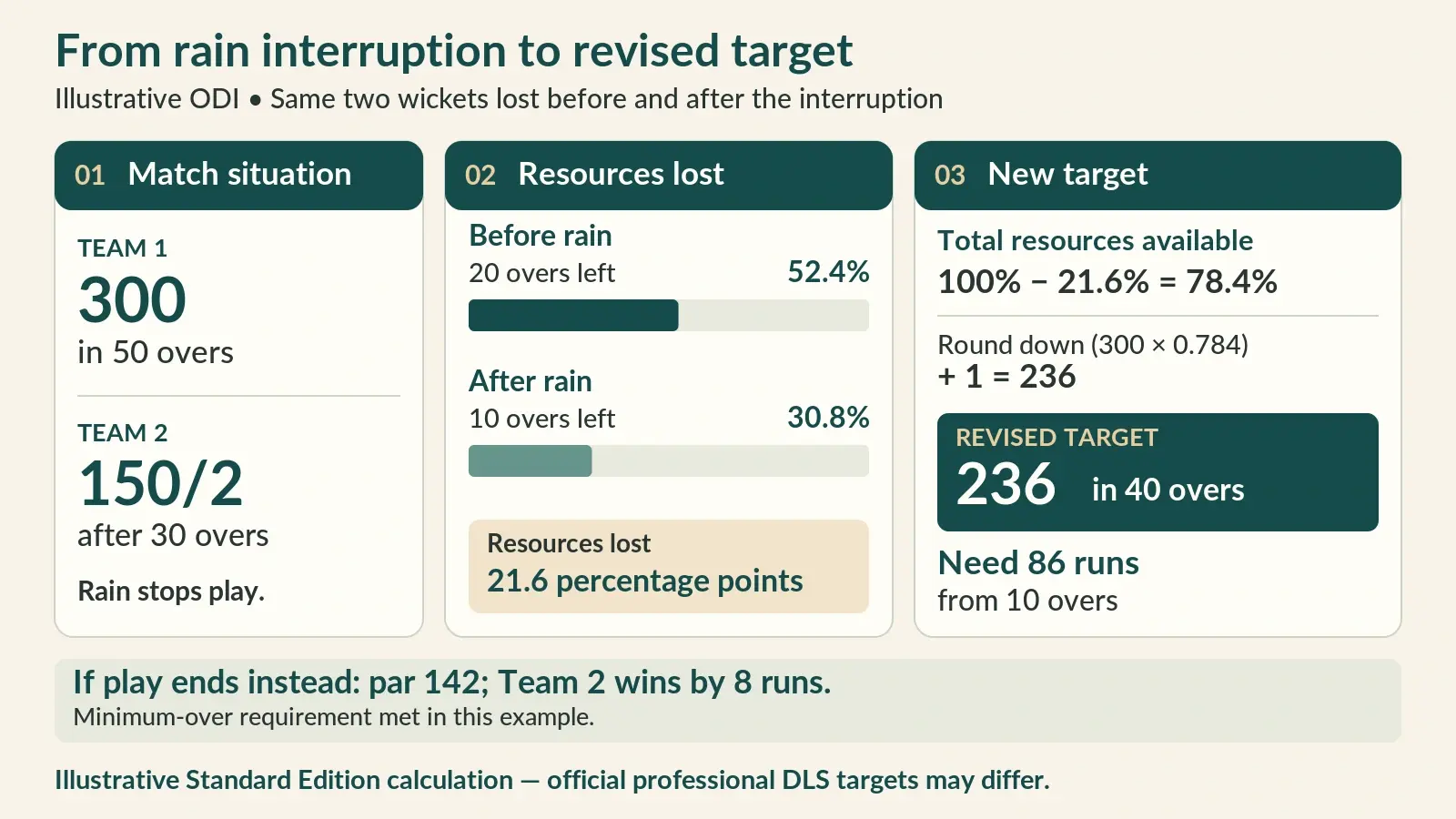
Suppose the same 300-run first innings is followed by a chase originally allocated 50 overs. Team 2 reaches 150/2 after 30 overs. Rain then removes 10 of its remaining 20 overs, so its revised allocation is 40 overs in total.
Using the table:
| Calculation stage | Resource value |
|---|---|
| Remaining before interruption: 20 overs, 2 wickets lost | 52.4% |
| Remaining after interruption: 10 overs, 2 wickets lost | 30.8% |
| Resources removed by rain | 21.6 percentage points |
| Total resources available to Team 2: 100 − 21.6 | 78.4% |
The revised par total is the whole-number part of 300 × 0.784, which is 235. The new target is 236 runs in 40 overs. Since 150 runs are already on the board, Team 2 needs another 86 from 10 overs.
If the team had instead been 150/6 at the same interruption, the resources lost would be 30.8 − 22.8 = 8 percentage points. Its revised target would be 277, leaving 127 to score from 10 overs.
That seemingly harsh difference reflects the fact that a side already six wickets down had less scoring potential to lose when the overs were removed. Rain should not erase the competitive consequences of earlier dismissals.
What if the chasing team has more resources?
Sometimes Team 1 starts expecting a full innings but is forced to finish early. Team 2 may then have a shorter innings too, yet possess greater overall scoring opportunity because it knows its limit before batting.
For instance, suppose Team 1 is 200/2 after 30 overs when rain ends its innings. It has lost the remaining 52.4% of its original resources, leaving R1 = 47.6%. Team 2 receives 30 overs with all wickets available, so R2 = 75.1%.
In this situation, the Standard Edition uses a separate rule. It adds an allowance for the extra resources based on G50, a reference average first-innings total. Using the ECB regulations' example reference of 245 for the relevant level of men's cricket:
Revised target = round down [200 + (75.1 − 47.6) × 245 / 100] + 1 = 268.
The professional DLS approach instead scales the score in proportion to the modelled resource ratio when the chasing side has more resources. Do not apply the Standard Edition's G50 adjustment to a professional calculation or treat 245 as a universal competition setting.
DLS par score versus revised target
These two scoreboard figures answer different questions.
A revised target tells the chasing side how many runs it needs to win within its newly allocated innings. A live par score tells us the score that would be sufficient for a tie if the match ended at that instant and the competition's conditions permit a result.
Return to Example 2, but suppose the rain never stops. At 150/2 after 30 overs, Team 2 would forfeit all 52.4% of its remaining resources. The resource available for the shortened innings would be 47.6%. The Standard Edition par score would be round down (300 × 0.476) = 142.
| Score at abandonment | Result against a par of 142 |
|---|---|
| 141 | Team 1 wins by 1 run |
| 142 | Tie on DLS, subject to applicable tie-break rules |
| 143 | Team 2 wins by 1 run |
| 150 | Team 2 wins by 8 runs |
A team winning an abandoned chase on DLS is generally described as winning by runs, not by its wickets in hand. If the match resumes and it reaches a revised target normally, the usual wickets-based winning margin applies.
The live par changes with deliveries and dismissals. It is not the same as the required run rate, nor does being ahead on par guarantee victory if play continues.
How many overs are needed for a DLS result?
DLS does not automatically produce an official winner whenever rain starts. Competition rules establish the minimum batting opportunity required for a valid result.
In ordinary international limited-overs matches, the familiar minimums are 20 overs per side in an ODI and five overs per side in a T20I. Exceptions apply when an innings ends earlier through dismissal of the side or a successful chase. If the minimum opportunity is not met and no applicable exception applies, a washout ordinarily produces no result.
Tournament conditions can differ. The 2026 Men's T20 World Cup playing conditions specified a higher minimum of ten overs for the chasing side in semi-finals and the final, unless a result was reached earlier. Reserve days and tie-break arrangements are also competition-specific. Check the ICC's playing conditions directory for the relevant event and edition.
DLS is not the usual mechanism for deciding rain-interrupted Test matches. Those matches have a different innings structure and can end in a draw.
The 2023 IPL final: DLS in action
On the reserve day of the 2023 IPL final in Ahmedabad, Gujarat Titans scored 214/4 from 20 overs against Chennai Super Kings. Rain interrupted the chase, and Chennai received a revised target of 171 from 15 overs. CSK reached 171/5, winning by five wickets under DLS, as recorded in the IPL's official match centre.
The original target was 215, requiring 10.75 runs per over. The revised target required 11.4 per over. The final therefore illustrates how rain can reduce the number of runs required while increasing the required rate.
Simply multiplying 214 by 15/20 would produce a target of 161, ten runs fewer than the actual official target. That calculation ignores the resource model and the interruption during the chase. The official 171 is a recorded result, not a number derived from our Standard Edition examples.
Why online DLS calculators may disagree
The publicly accessible resource table is useful for understanding the method, but it is not a complete reproduction of the current professional system. Stern's 2016 research paper describes refinements for modern scoring rates. The model adapts the shape of resource relationships to the scoring context rather than relying on a single fixed set of percentages for every match. The ICC also periodically reviews scoring data, as documented in its 2018 DLS update announcement.
Calculator inputs matter too. Cricket notation treats 19.4 overs as 19 overs and four legal balls, not 19.4 decimal overs. Multiple interruptions must be entered in sequence. Inaccurate wickets, missed interruptions or an incorrect original allocation can change the result.
For an official match, use the target announced by the match officials. A public table or a third-party calculator is an educational tool unless it implements the authorised model and correct match inputs.
Is DLS always fair?
No rain rule can recreate the match that would have happened. DLS is a statistical compromise, not a personalised simulation of each remaining batter against each available bowler. It cannot fully account for a particular finisher, a deteriorating pitch, dew, unusually short boundaries or tactical choices that would have been different had rain been predicted accurately.
The method also aims to balance run-scoring resources rather than guarantee identical winning probabilities before and after an interruption. Those are different objectives, especially when a long chase becomes a very short one.
Nevertheless, the resource approach is more informative than a straight run-rate adjustment because it recognises the value of wickets and the changing pace of an innings. When watching a rain-threatened chase, pay attention to the score, wickets lost, overs remaining, live par and minimum overs required for a result. Together, they explain why the target moves as it does, even when the arithmetic behind the official software remains out of sight.
Related reading: how DLS affects tournament net run rate.
Sources and Further Reading
- ICC — Duckworth Lewis Stern methodology and Standard Edition materials
- ECB — Duckworth/Lewis/Stern regulations, Standard Edition formulas and ball-by-ball resource tables, sections 2–7 and resource tables.
- ICC — Playing conditions directory; see clauses 13 and 16 of applicable ODI/T20I conditions.
- ICC — Men's T20 World Cup 2026 playing conditions, clauses 13.7 and 16.1.
- ICC — DLS system update, 2018.
- Duckworth, Lewis and Stern — Cricket's Raining Champion: Two Decades of Duckworth–Lewis (and Stern), Significance, 2019.
- Steven E. Stern — The Duckworth-Lewis-Stern method: extending the Duckworth-Lewis methodology to deal with modern scoring rates, Journal of the Operational Research Society, 2016.
- IPL — Chennai Super Kings vs Gujarat Titans, 2023 final, official match details.