How Batters Read Spin Bowling: Picking the Googly, Carrom Ball and Other Variations
Learn how cricket batters read a spinner's wrist, fingers, release and ball flight to identify googlies, carrom balls and other deceptive deliveries.
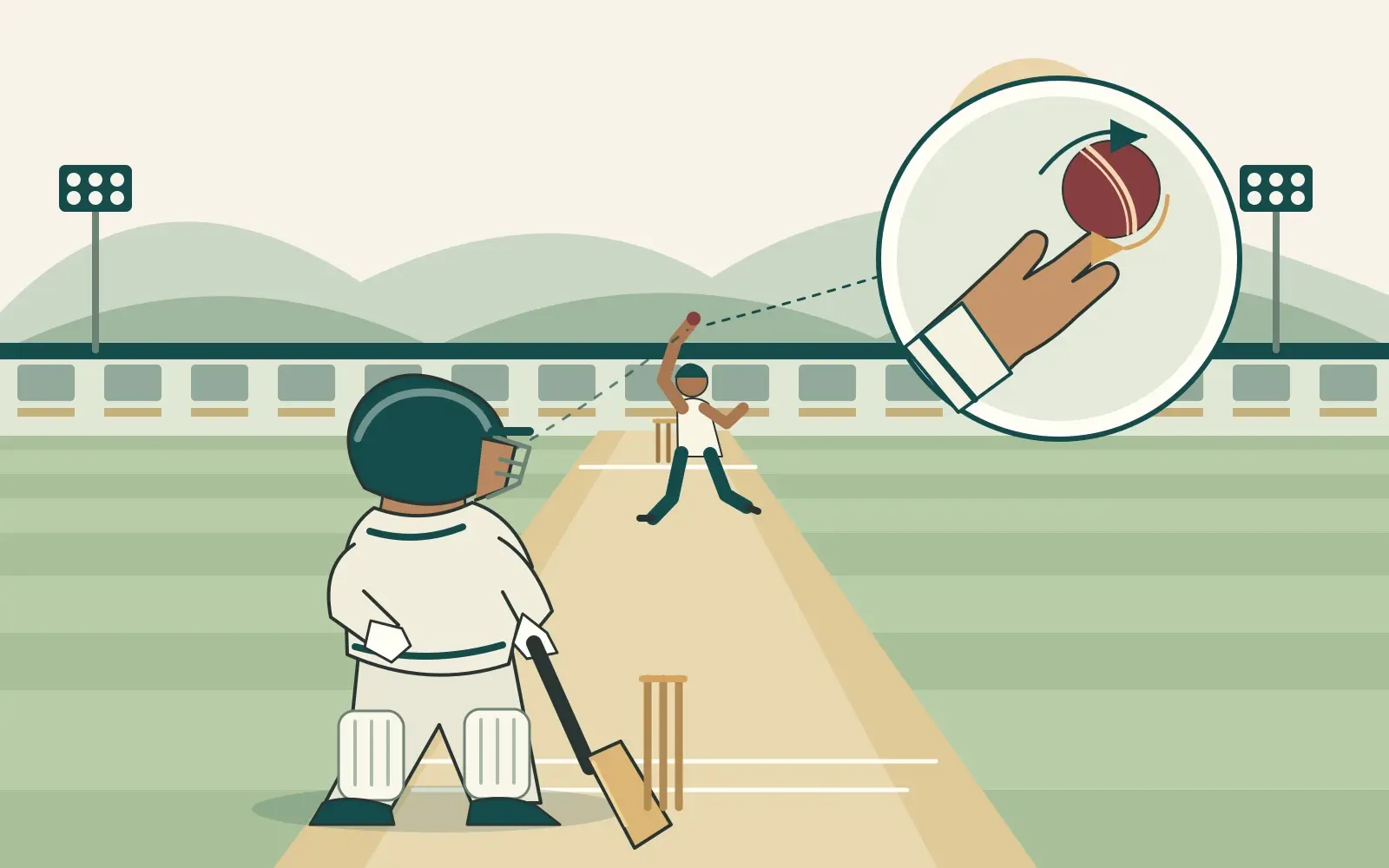
A leg-spinner bowls two deliveries with almost identical run-ups and arm speeds. The first turns away from a right-handed batter. The second comes back towards the stumps and beats the inside edge. From the television replay, the difference in wrist position may seem obvious. From the crease, recognising it is considerably harder.
When commentators say a batter has picked the googly from the hand, they mean the batter has recognised information about the delivery before it pitches, often before it has travelled very far. That early information helps the batter prepare the feet, body and bat for the likely path of the ball.
But reading spin is not simply memorising what a bowler's hand looks like. It is a process of anticipation, observation and adjustment. A batter can identify the variation correctly and still be beaten by its length, drift or bounce.
What does reading the bowler's hand actually mean?
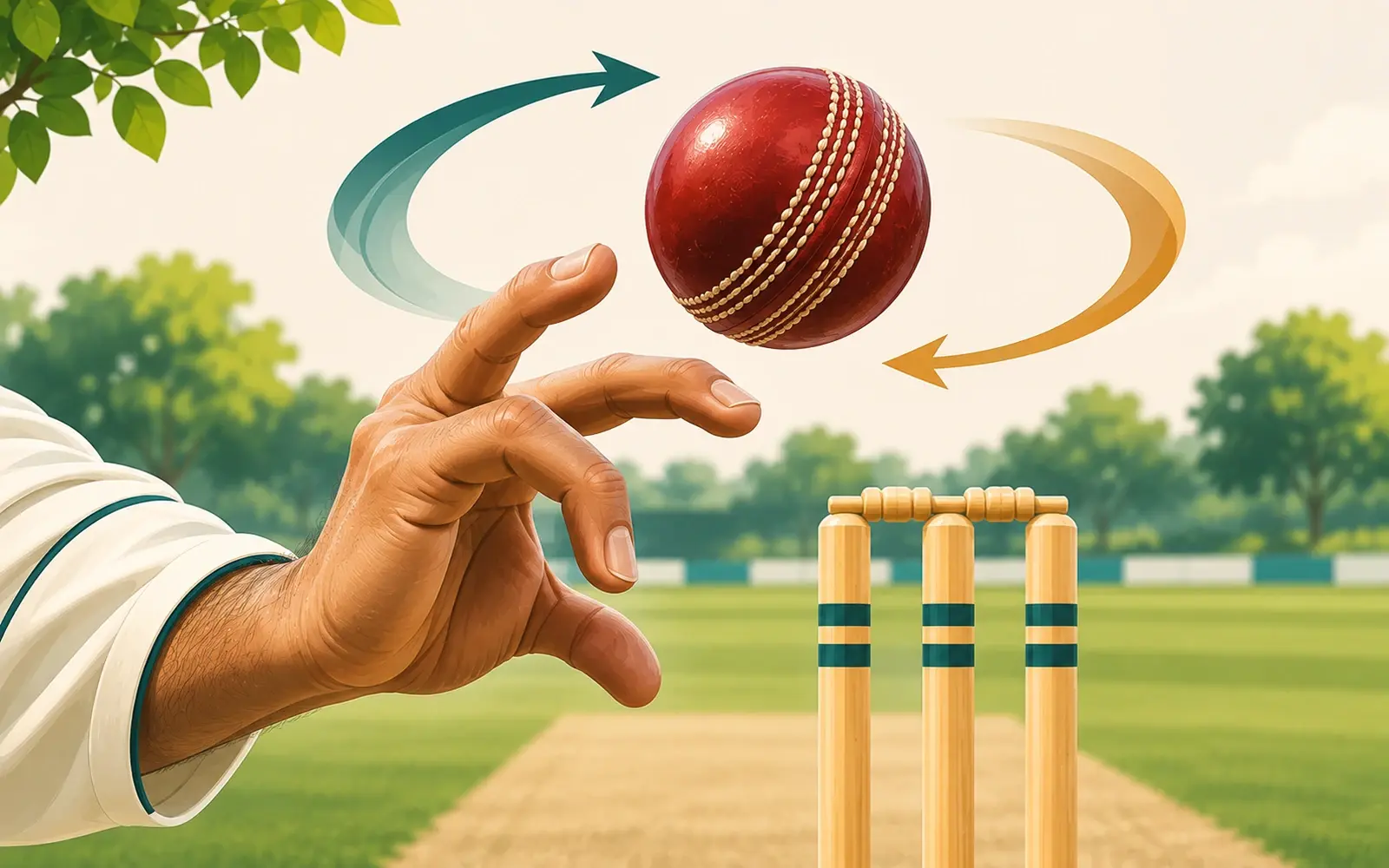
A spinner applies rotation to the ball through coordinated movements of the arm, wrist and fingers. Altering these movements can change the axis of rotation, speed and direction of spin. The batter attempts to recognise the visible consequences of those changes.
The useful reference is the bowler's stock delivery: the ball they normally rely on. A right-arm leg-spinner's stock leg-break generally turns from leg to off against a right-handed batter, while a right-arm off-spinner's stock off-break generally turns from off to leg. Variations can reverse that direction, reduce sideways turn or alter flight and bounce.
Research by Müller, Abernethy and Farrow, published in 2006, examined how cricketers of different skill levels anticipated deliveries from swing and spin bowlers. By selectively hiding parts of the action and stopping video at different moments, the researchers found that highly skilled batters could exploit certain early hand and arm cues that less-skilled participants did not use effectively 1. Earlier research on wrist-spin delivery discrimination also reported better recognition among more expert batters 2.
This does not mean experts consciously identify each finger movement. With experience, the combination of familiar movements can become recognisable as a pattern, much as an experienced driver recognises that another vehicle is about to turn without explicitly analysing every change in its position.
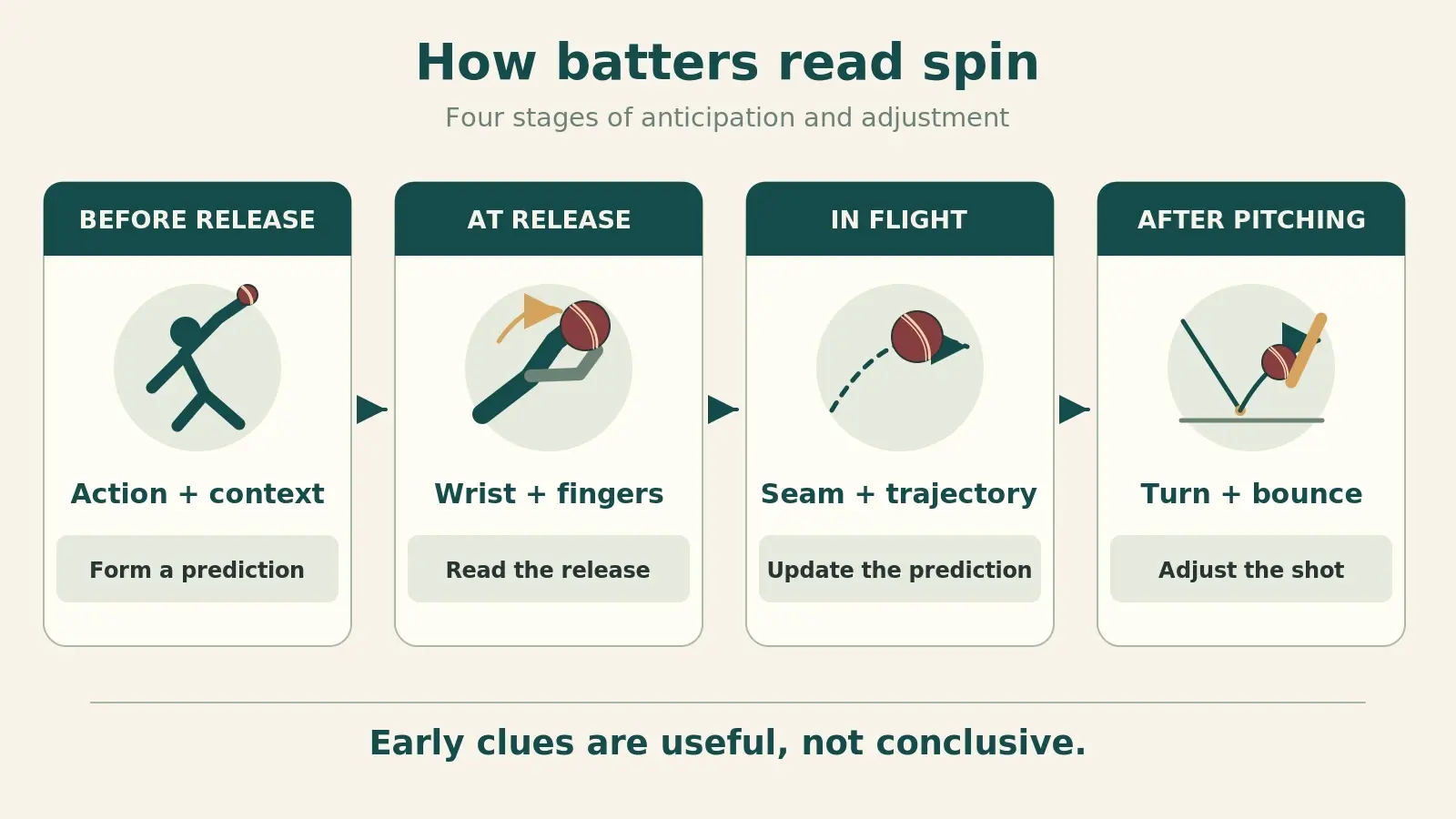
The information available at different stages of a delivery
Before release: establish the likely delivery
The bowler's run-up, arm path, position on the crease and previous deliveries provide context. A batter may recognise that a particular spinner changes the arm angle when attempting a variation, or that the bowler prefers a googly against left-handers.
These are clues about probabilities, not proof. Bowlers deliberately preserve similarities between their stock ball and variations. A batter who assumes that a particular field setting or run-up guarantees a specific delivery becomes vulnerable to deception.
At release: watch the wrist and fingers together
The orientation of the hand, the degree of wrist rotation and the way the fingers impart spin can help distinguish deliveries. For a leg-spinner, the wrist position is often especially informative. For a finger-spinner, the difference between a conventional rolling action and a flicking release may matter more.
Rather than moving the eyes between individual fingers, the batter should develop familiarity with the overall release action. Research on expert anticipation has shown that forcing attention to switch between isolated visual cues can interfere with effective recognition 3.
In flight: update the prediction
The seam's apparent orientation, initial trajectory, speed and subsequent curvature may reinforce or challenge the first impression. A ball with more topspin may dip more sharply than expected. Sidespin can contribute to lateral drift. The seam may also wobble, and a rapidly spinning ball is not always easy to interpret from the batter's viewing angle.
The seam is not the spin axis itself. Instrumented-ball research shows that cricket deliveries occupy a continuum of rotation axes rather than perfectly separated categories 4. A single seam appearance cannot reliably identify every delivery.
After pitching: make the final adjustment
The surface influences how much the ball grips, turns, skids or bounces. Even correctly identified spin can behave differently on successive pitches or different parts of the same pitch. The batter still needs to respond to the actual ball rather than remain committed to the original prediction.
Studies of batting gaze have documented anticipatory eye movements towards likely bounce and contact locations 5. Much of this research concerns faster bowling; it helps explain predictive vision generally, but does not establish an exact eye-movement schedule for every spin delivery.
How to recognise a googly from a leg-spinner
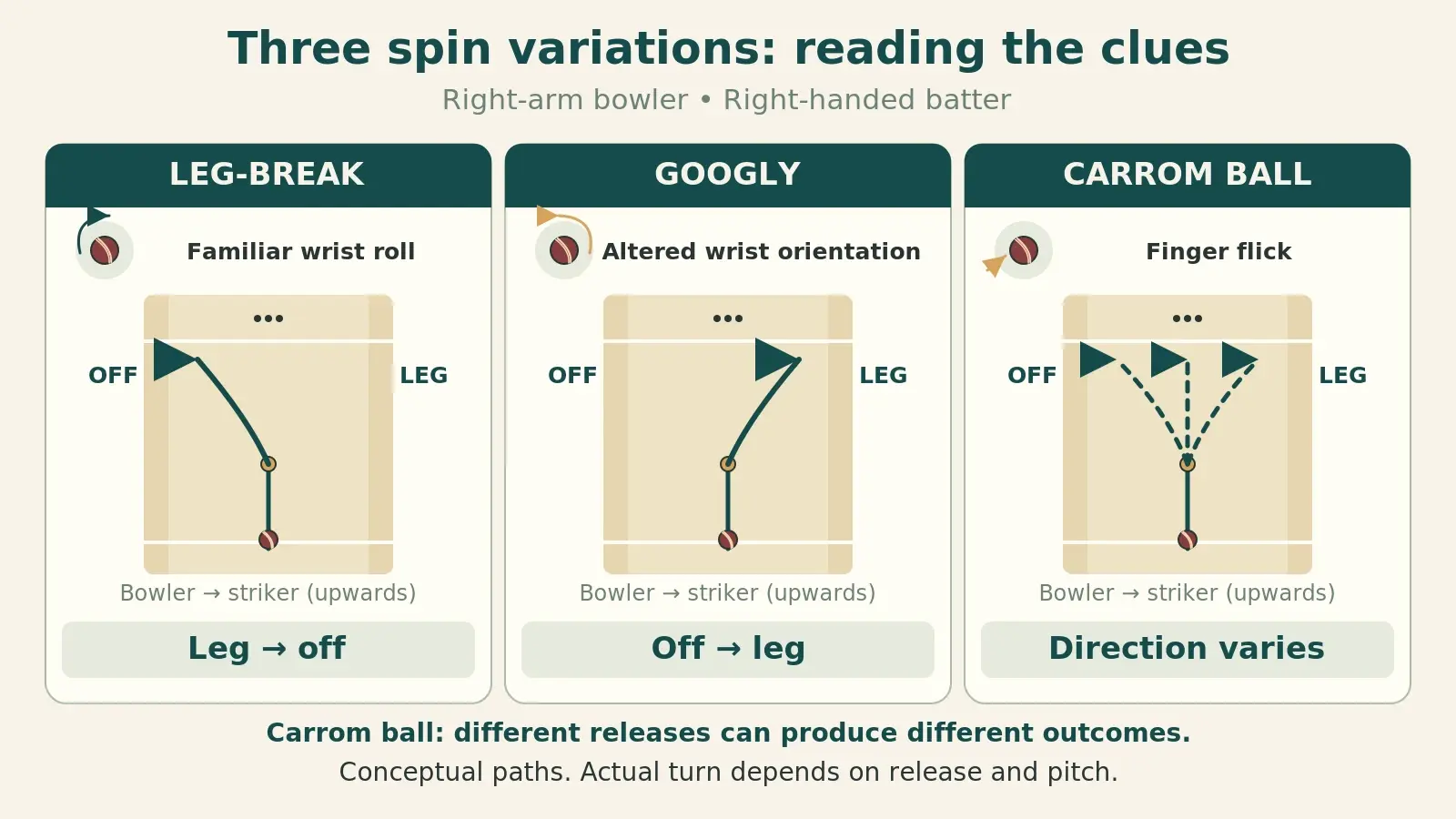
The conventional right-arm leg-break is produced through a wrist-spin action in which the ring finger plays an important role in imparting rotation. It normally moves from the right-handed batter's leg side towards the off side after pitching.
For the googly, or wrong'un, the bowler changes the hand and wrist orientation so that the resulting sideways turn is reversed. A classic clue is that more of the back of the bowling hand becomes visible towards the batter near release. The precise appearance depends on the bowler's action and the viewing angle.
Suppose a right-handed batter has faced several leg-breaks pitching around middle and off stump. If the batter expects another ball to turn away, they may prepare to play outside the line of the stumps. A googly on a similar initial line can instead turn in, bringing bowled and LBW into play.
Recognising the changed wrist position helps the batter avoid automatically following the expected leg-break. But the appropriate response still depends on length and line. A full googly may be played forward with a straight bat; a shorter one may be played from the back foot. Neither shot is compulsory merely because the delivery is a googly.
For a left-arm wrist-spinner, the usual directions are reversed against the same right-handed batter: the stock ball generally turns into the batter and the wrong'un generally turns away. The same variation name does not imply the same direction across bowling hands.
Why the carrom ball is particularly difficult to read
A conventional off-break uses the fingers to roll the ball into rotation. A common carrom-ball technique instead supports the ball between the thumb and other fingers while a bent middle finger straightens to flick it out. Ajantha Mendis popularised this approach in modern international cricket, and Ravichandran Ashwin subsequently developed his own versions 6.
The flick may be visible near release, particularly when contrasted with the bowler's regular off-break. But unlike the classic googly relative to a leg-break, the name carrom ball describes a release technique rather than one guaranteed direction of turn.
A right-arm spinner can use a carrom-style release to produce a ball that moves away from a right-hander, while alternative grips and release orientations can produce different behaviour, including a ball that largely holds its line. Ashwin has also used a reverse-carrom variation, as documented in analysis of his bowling against Australia in September 2023 7.
The challenge is therefore twofold. First, recognise that the release differs from the conventional off-break. Second, interpret the probable rotation and subsequent flight. Spotting the flick alone is insufficient.
This distinction matters when a batter shapes for a shot too early. If every carrom-ball release is treated as a ball turning away, a spinner who can make a similar-looking release behave differently has an immediate tactical opportunity.
Recognising other spin variations
The following are conventional cues and tendencies, not a universal visual identification key. Directions assume a right-handed batter and right-arm bowling unless otherwise specified.
| Delivery | Possible release clue | Typical behaviour |
|---|---|---|
| Leg-break | Familiar wrist roll and ring-finger action | Turns leg to off |
| Googly | Altered wrist orientation; back of hand often more visible | Turns off to leg |
| Off-break | Familiar finger roll | Turns off to leg |
| Doosra | Modified wrist, forearm and finger action compared with stock off-break | Intended to turn leg to off |
| Carrom ball | Distinct finger flick | Direction depends on release |
| Top-spinner | More forward rotation than the stock side-spinning ball | More dip and potentially extra bounce; less lateral turn |
| Flipper | Squeezing or clicking release involving thumb and fingers | Backspin; can skid or stay lower |
| Slider | Altered release with reduced sidespin or a backspin component in some versions | Often less turn or a skidding trajectory |
| Arm ball | Less conventional off-break rotation; sometimes seam presented more upright | Often continues along the delivery angle, with possible swing |
Different bowlers and coaching traditions use some of these names differently. A study using instrumented cricket balls identified continuous transitions between spin types, illustrating why rigid categories have limitations 4. The practical goal is to predict how the ball will behave, not necessarily to give every delivery the correct technical name.
How a batter converts recognition into a shot
Picking the variation solves only one part of the problem. A batter must also judge where the ball will pitch, how high it might bounce and whether the intended stroke offers a reasonable margin for error.
For a full ball, reaching towards the pitch with a balanced forward movement can reduce the distance over which the ball turns after bouncing. For a sufficiently short ball, moving back may provide more time to respond to its actual movement. The danger is becoming stranded between those positions, especially when the ball dips and lands shorter than expected.
If the batter is unsure of the variation, a controlled stroke with the full face of the bat, played close to the body where appropriate, can be preferable to a speculative cross-batted shot. Protecting the stumps matters particularly when the alternative delivery might come back in. This is a risk-management option, not an instruction to defend every uncertain ball.
Cricket Namibia's coaching guidance and Jonny Bairstow's batting discussion for the ECB emphasise adapting shot selection to the spin and managing risk 89. An experienced player can deliberately hit against the turn when the length, field and match situation justify it. Playing with the spin is a useful default, not an absolute rule.
What real matches reveal about deception
Mujeeb Ur Rahman against Virat Kohli, IPL 2018
On 13 April 2018, Mujeeb dismissed Kohli while playing for Kings XI Punjab against Royal Challengers Bangalore. The ICC's contemporary report identified the delivery as a googly released from the back of the hand 10.
Mujeeb's repertoire included off-spin, googlies and carrom balls. Against such a bowler, a batter cannot safely rely on one stock action and one opposite-turning delivery. The incident illustrates the value of having multiple possibilities within a familiar-looking action. It does not establish precisely which visual cue Kohli perceived or missed; that cannot be inferred from a scorecard or replay alone.
Ashwin and the problem of naming a variation
At an ICC press conference on 4 November 2021, Ashwin explained that he had developed subtle changes to release angles and seam positions. He also rejected the description of the delivery that dismissed Gulbadin Naib the previous day as a carrom ball 11.
His account is revealing because it comes from the bowler himself. Even informed observers may misclassify a delivery when several release techniques look similar. For the batter, the more important task is recognising whether the ball is likely to turn in, move away, skid or dip.
How to train the skill of reading spin
The aim of practice is to connect a visible movement with what the ball subsequently does. Simply watching a compilation of spectacular wickets makes the outcome memorable but may not train anticipation.
A progressive approach can help:
- Learn the reference action. Watch repeated stock deliveries from a safe batter's-eye position, then compare them with one known variation. Focus on differences near release.
- Use video prediction. Stop a clip at release and record your prediction of turn direction. Play the clip, compare the result and repeat with randomly ordered deliveries. A second attempt with early flight visible helps identify which cues were useful.
- Practise with a partner. Begin with controlled underarm spin using a soft practice ball at a safe distance. Progress to overarm bowling in nets with suitable protective equipment and coaching.
- Combine recognition with footwork. Have a spinner vary both length and delivery type. Score recognition separately from shot execution: correctly naming a googly is not the same as playing it well.
Video-based visual-perceptual training combined with movement practice has shown benefits in an experimental cricket anticipation study, although its results do not establish an identical improvement for every spinner-specific drill 12. The sequence above is a practical application of that general idea, not a scientifically validated training programme with guaranteed results.
For example, a batter might identify eight of ten variations correctly but misjudge the length of three. The next practice session should address length and movement, rather than only spending more time recognising the grip.
Why even international batters get it wrong
A bowler can disguise changes in wrist position, use similar arm speeds or alter the release late. Lighting, distance, unfamiliar actions and a partially concealed grip can make useful cues difficult to see. Match pressure can also encourage early commitment to an attacking stroke.
Context is valuable but potentially misleading. One study of skilled batters found that its participants relied strongly on contextual information in the particular video task used, rather than showing effective anticipation from movement cues 13. Different studies, participants and task designs therefore should not be reduced to the claim that experts always read the hand perfectly.
A batter does not have to eliminate uncertainty. The more realistic objective is to make an informed early prediction while preserving enough flexibility to correct it.
The bottom line
Reading a googly, carrom ball or other variation begins with understanding the bowler's normal action. The wrist and fingers provide early evidence, ball flight refines the prediction, and bounce reveals the actual response of the surface.
The best batters combine that information with sound length judgement, adaptable footwork and shot selection. They do not need to name every delivery. They need to recognise enough about its likely behaviour to play the ball that arrives, rather than the one they expected.
Sources and Further Reading
- Müller, Abernethy & Farrow — How do world-class cricket batsmen anticipate a bowler's intention? (2006)
- Cricket bowling deliveries and the discrimination ability of professional and amateur batters (2000)
- Expertise and the spatio-temporal characteristics of anticipatory information pick-up from complex movement patterns
- Identification of Spin Bowling Deliveries with an Advanced Smart Cricket Ball (Sensors, 2024)
- Mann et al. — The Head Tracks and Gaze Predicts: How the World's Best Batters Hit a Ball (2013)
- Cricbuzz — How Ashwin developed his carrom ball
- The Indian Express — Two variations of carrom ball: Ashwin against Australia (2023)
- Cricket Namibia — The Art of Batting Against Spin
- ECB — Jonny Bairstow's tips for batting against spin
- ICC — First Gayle, now Kohli: Mujeeb ur Rahman's stocks on the rise (2018)
- ICC — Ravichandran Ashwin pre-match press conference, 4 November 2021
- Visual-perceptual training with motor practice of the observed movement pattern improves anticipation in emerging expert cricket batsmen
- Sources of information pick-up for anticipation by skilled cricket batsmen