Wrist Spin vs Finger Spin: How Do Leg-Spinners, Off-Spinners and Mystery Spinners Differ?
Understand wrist spin, finger spin and mystery spin in cricket, how leg-breaks and off-breaks turn, and how googlies, drift and dip deceive batters.
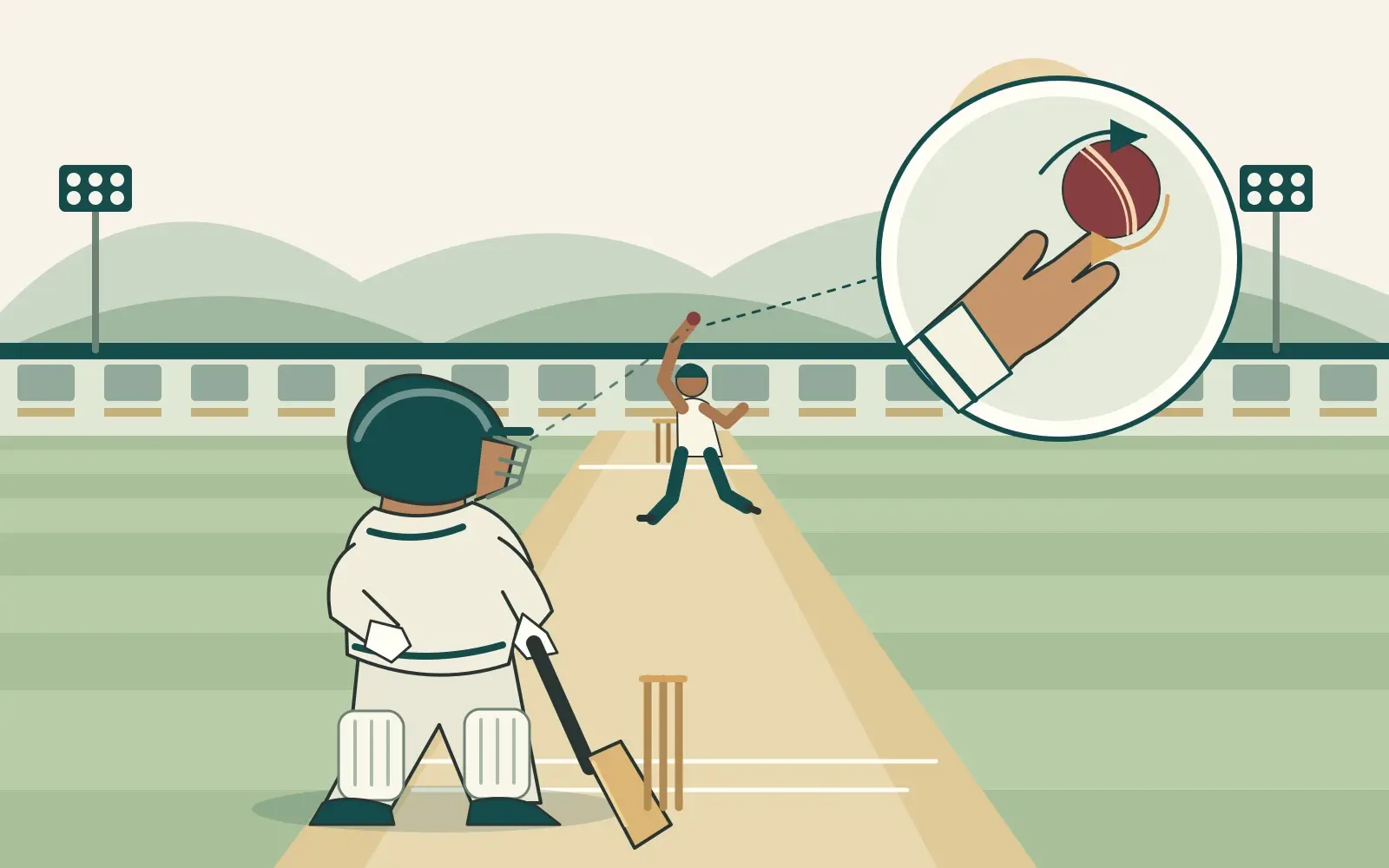
A leg-spinner delivers a ball that turns sharply away from a right-handed batter. An off-spinner bowls at a similar pace, but the ball turns towards the batter instead. A mystery spinner appears to repeat the same action and produces two deliveries that behave completely differently.
What separates these bowlers is not simply how much they turn the ball. The way they impart rotation, the direction of that rotation, the flight of the ball and the batter's ability to recognise the delivery all matter.
Wrist spin and finger spin are two broad families of bowling technique. Leg-spin and off-spin are familiar forms of those techniques, while mystery spin describes a style of deception that can overlap with either family. Understanding that distinction makes it easier to appreciate why a spinner can be dangerous even on a pitch that offers relatively little turn.
Wrist spin vs finger spin: the fundamental difference
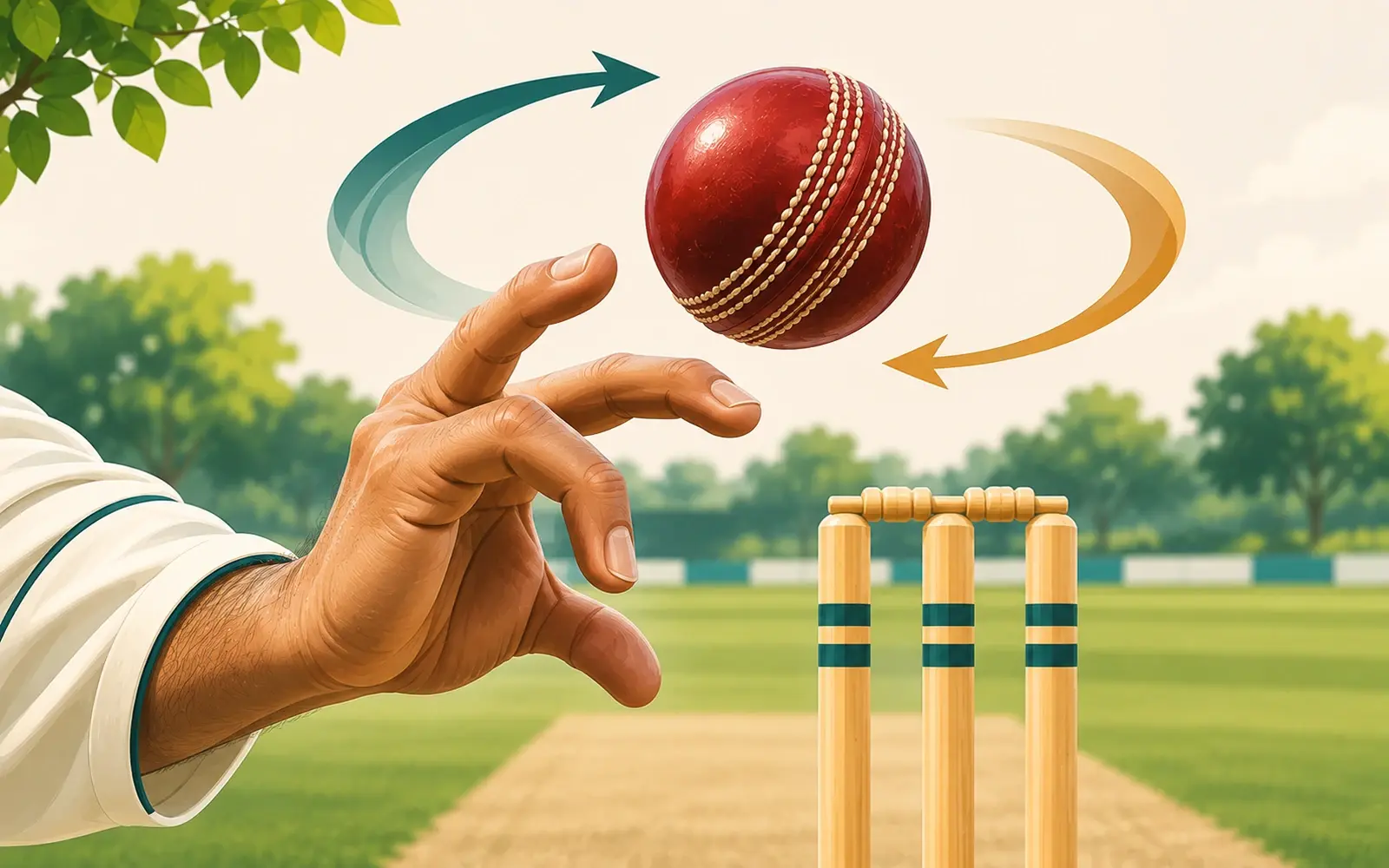
Every spin bowler tries to apply a twisting force, or torque, to the cricket ball before releasing it. This produces rotation around an axis. The direction of that axis and the rate of rotation influence the ball's flight and what happens when it lands.
In conventional finger spin, the fingers play a prominent role in rolling the ball out of the hand. In wrist spin, wrist and forearm movement help produce the characteristic rotation, with the fingers providing the final leverage. Both techniques use the entire bowling action, not one isolated joint.
A typical right-arm off-spinner uses a grip with the index and middle fingers separated around the seam and applies much of the final spin through the index finger. A conventional right-arm leg-spinner commonly uses the ring finger to help impart rotation as the wrist and forearm move through release. Individual grips and actions vary.
Sports biomechanics research has identified differences in release mechanics and spin characteristics between the two families. It does not follow that all wrist-spinners produce more turn, or that every finger-spinner has better control. Accuracy, spin axis, pace and surface interaction are separate aspects of performance.
The four main types of spin bowling
The first trap in understanding spin is assuming that finger spin always turns in and wrist spin always turns away. The bowling arm matters just as much as the release family.
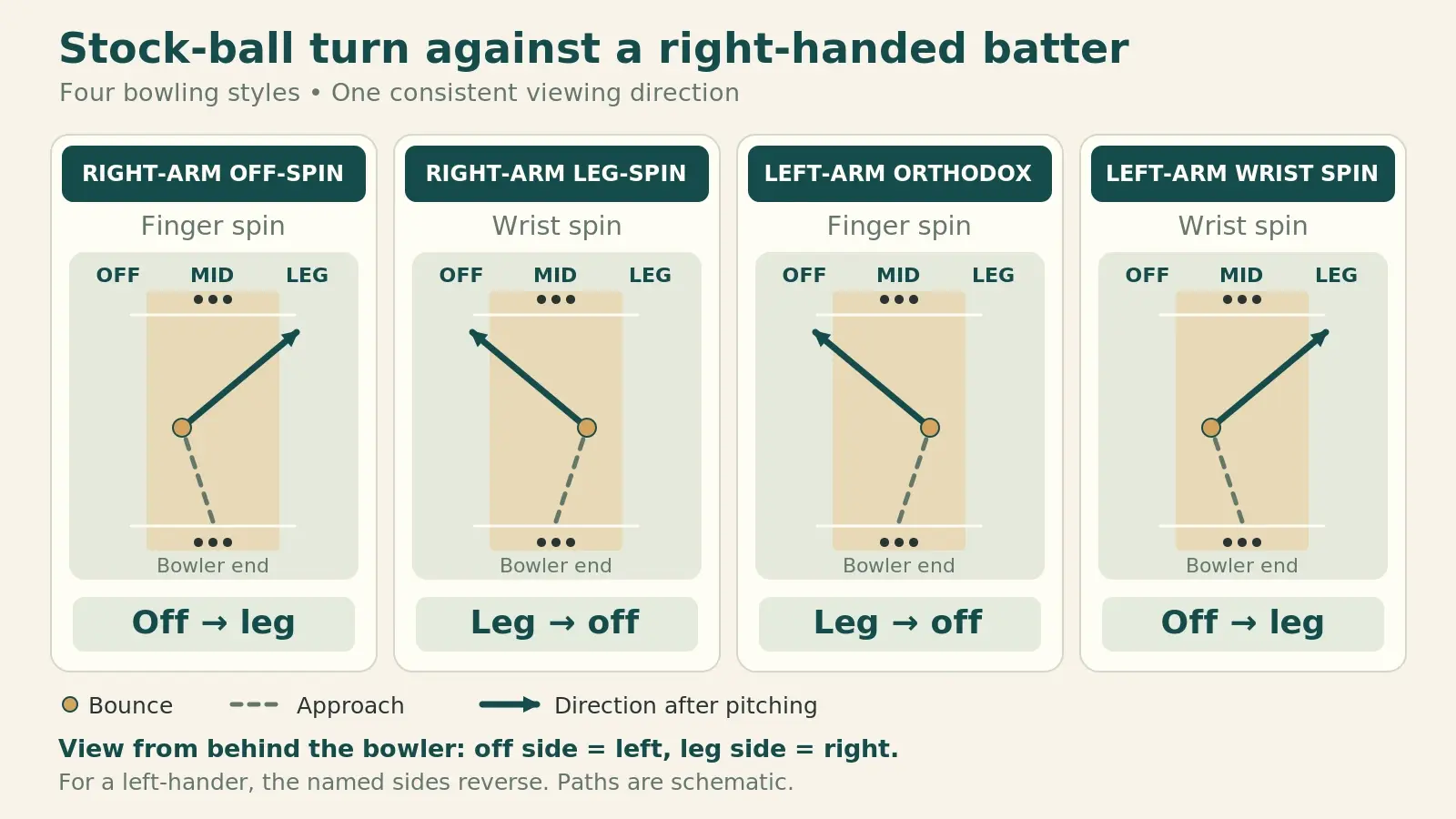
The following table describes conventional stock deliveries against a right-handed batter. The stock ball is the delivery around which a bowler builds their usual attack.
| Bowling style | Technique | Typical turn against a right-hander | Example bowlers |
|---|---|---|---|
| Right-arm off-spin | Finger spin | Off side to leg side (in) | Ravichandran Ashwin, Nathan Lyon |
| Right-arm leg-spin | Wrist spin | Leg side to off side (away) | Shane Warne, Yuzvendra Chahal |
| Slow left-arm orthodox | Finger spin | Leg side to off side (away) | Ravindra Jadeja, Daniel Vettori |
| Left-arm wrist spin | Wrist spin | Off side to leg side (in) | Kuldeep Yadav, Tabraiz Shamsi |
For a left-handed batter, the off and leg sides exchange positions. Consequently, a right-arm off-spinner's stock ball generally turns away from a left-hander, while a right-arm leg-spinner's stock ball generally turns in.
The physical rotation produced by the bowler has not changed; the batter's orientation has. This is why descriptions such as clockwise and anticlockwise are unhelpful unless the viewing direction is specified. And a ball that turns in can still finish outside off stump if it starts far enough outside it.
Two bowlers can therefore produce similar directions of turn with very different actions. Jadeja and Chahal can both turn their stock ball away from a right-hander, while Ashwin and Kuldeep can both turn theirs towards that batter. Their release angles, pace, bounce and available variations can nevertheless create entirely different problems.
How spin changes the ball before and after pitching
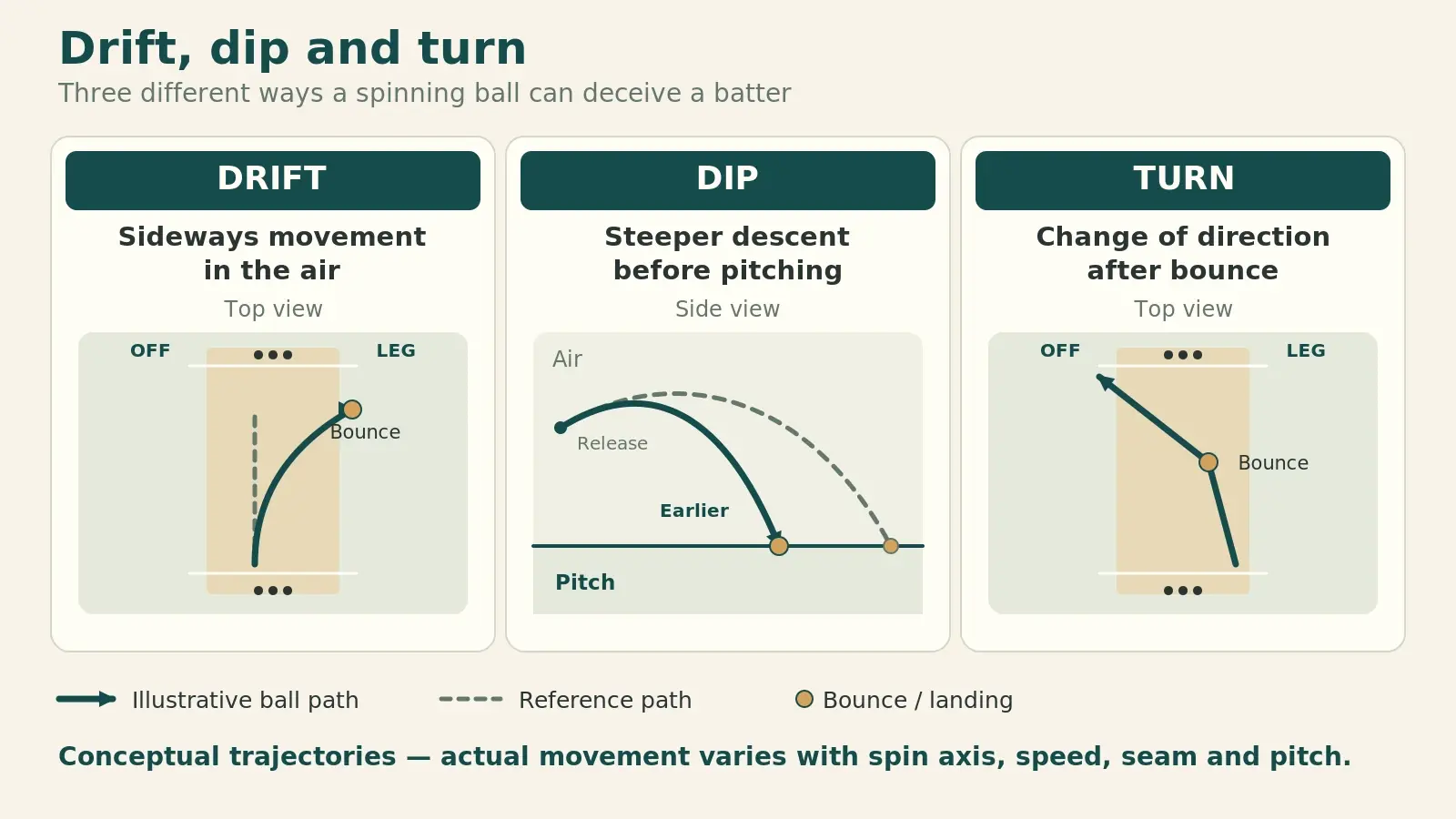
A spinning delivery does not have to wait until it hits the pitch to deceive a batter. There are three distinct effects to watch for.
Drift: sideways movement in the air
Rotation changes the airflow around the ball. The resulting aerodynamic force can have a sideways component, bending the trajectory before the ball lands. This is commonly associated with the Magnus effect, although seam orientation and the ball's surface also influence aerodynamic behaviour.
A leg-break may drift towards the leg side of a right-handed batter before turning towards the off side after pitching. This creates a two-stage change in direction. The batter who moves to meet the apparent original line may have to adjust before and after the bounce.
Drift is not identical to the amount of post-bounce turn. It depends on the spin axis, rotation, speed and aerodynamic conditions.
Dip: a steeper descent towards the pitch
Topspin is a forward-rotation component that can produce a downward aerodynamic force during flight. Along with gravity, it can make the ball descend more sharply than the batter expects.
Imagine a batter stepping forward to drive a delivery that appears comfortably full. If the ball dips and lands shorter than anticipated, the batter may be unable to reach it with the intended bat position. The resulting shot can produce a catch, a missed ball or a stumping opportunity.
The bowler does not need extravagant sideways turn to create this uncertainty. Even a predominantly overspun delivery can be troublesome.
Turn and bounce: interaction with the surface
Once the ball lands, friction, deformation and seam contact influence the change in its speed and direction. Side-spin can contribute to lateral deviation, while topspin can help produce a more awkward or higher bounce in suitable conditions.
The pitch is part of the mechanism. A dry, worn surface may provide more opportunity for the ball to grip; a damp or dew-affected surface can change the grip available. Hardness, cracks, rough patches, seam contact and the delivery's landing angle also matter.
A higher spin rate is therefore not a guarantee of a larger turning angle. A bowler who varies pace and axis intelligently can create more difficulty than someone relying only on maximum revolutions.
The deliveries that make spinners unpredictable
A batter cannot safely assume that every ball from a leg-spinner will be a leg-break or every ball from an off-spinner an off-break. Variations change the expected rotation, trajectory or bounce without necessarily changing the bowler's overall action very much.
Common wrist-spin variations
- Leg-break: The usual right-arm wrist-spinner's delivery, tending to turn from leg towards off against a right-hander.
- Googly: The wrong'un reverses the expected direction of turn. A right-arm wrist-spinner's googly generally turns into a right-handed batter. Kuldeep's left-arm googly generally turns away from one.
- Top-spinner: A greater forward-spin component favours dip and potentially extra bounce, often with less sideways turn than a stock leg-break.
- Flipper: A classic backspinning variation, often released using a squeezing action of the fingers. It may skid through with a lower bounce than expected and relatively little sideways deviation.
- Slider: A name used for variations that typically turn less than the stock leg-break and can go relatively straight. Bowlers use different grips and spin-axis combinations, so not every slider behaves identically.
Common finger-spin variations
- Off-break: The conventional right-arm finger-spinner's stock delivery, tending to turn into a right-hander.
- Arm ball: A variation intended to follow the delivery line more closely rather than produce the usual off-break; some versions can also move in the air.
- Doosra: A delivery associated with off-spinners that turns the other way from the conventional off-break.
- Carrom ball: A flicking release involving the fingers, often the middle finger and thumb. It can produce different directions of spin depending on grip and release; a right-arm version can be used to turn away from a right-hander.
Notice that the direction alone does not identify the delivery. A right-arm googly and a conventional off-break may both turn towards a right-hander, but they are produced differently. Similarly, a carrom ball that turns away is not necessarily a conventional leg-break.
An unusual action is also not automatically illegal. The ICC's international bowling-action assessment focuses on the amount of elbow extension during the specified release phase, with a 15-degree tolerance. Wrist movement and an already bent elbow are not, on their own, proof of throwing. A spectator cannot reliably establish legality from a single replay.
What is a mystery spinner?
Mystery spin is not a third anatomical family alongside finger spin and wrist spin. It is a useful description for bowlers whose deliveries are especially difficult to distinguish before the ball arrives.
Some employ unusual grips or flicking releases. Others use familiar variations but disguise them exceptionally well. A bowler can also mix methods, or vary the spin axis and seam presentation without producing enormous sideways movement.
The mystery can come from several things: similar arm speed across deliveries, subtle changes in finger or wrist position, changes in pace and trajectory, or an unexpected difference in how the ball bounces. A batter who has correctly identified an incoming ball may still mistime a shot if its length or bounce is different from what they anticipated.
Sunil Narine is a well-known example of mystery spin in limited-overs cricket. Varun Chakaravarthy demonstrates another dimension of the style. After returning to India's T20I team against Bangladesh in October 2024, Varun explained that he had spent more than two years shifting his emphasis from side-spin to overspin. At the 2025 Champions Trophy, he took 5/42 against New Zealand in the group stage, helping India win by 44 runs.
Those figures are a historical example of a successful spell, not a controlled experiment proving that overspin alone caused his success. Changes in accuracy, preparation, match conditions and tactics can all contribute. His development nevertheless illustrates why the axis of rotation matters even when the bowler is already capable of turning the ball both ways.
Mystery is also not permanent. Teams analyse video, practise against similar bowlers and improve their ability to recognise releases. A spinner still needs a reliable stock ball and control when opponents become familiar with the variations.
Why leg-spinners and off-spinners are used differently
A right-arm leg-spinner facing a right-handed batter can use the stock ball to threaten the outside edge, then bring the googly back towards the stumps and pads. The batter must cover both possibilities, which creates an attractive wicket-taking combination. But a poorly controlled leg-break can also become a short ball or full toss that is easier to attack.
A finger-spinner may use a repeatable line and length to limit scoring options, then exploit a batter's attempt to force the pace. Against a left-hander, a right-arm off-spinner's stock turn away can make the outside edge a useful target. Against a right-hander, the same spinner can attack the stumps, inside edge or close catchers on the leg side.
These are tendencies, not fixed roles. A finger-spinner can be an attacking wicket-taker, and a wrist-spinner can be extremely economical. Bowling from around the wicket, using the crease differently and adjusting length can change the matchup considerably.
In Test cricket, repeated deliveries can establish a threat over many overs. The bowler can exploit developing rough, use close catchers and invite the batter to make a mistake. In ODIs, controlling the middle overs while breaking partnerships often becomes important. In T20s, boundaries, field restrictions, batter matchups and the need to protect particular areas can make pace variation and defensive accuracy especially valuable.
A captain choosing between two spinners should therefore consider who is batting, the field, pitch, match situation and each bowler's actual skills rather than treating the bowling category as a ranking.
A classic example: Shane Warne's Ball of the Century
In the 1993 Ashes Test at Old Trafford, Shane Warne delivered a leg-break to Mike Gatting that became one of cricket's most famous balls. As the ICC's historical account describes, the ball drifted, landed well outside leg stump and turned back to hit off stump.
The delivery is a memorable demonstration of how the initial line, airborne movement and turn after pitching can combine. A batter preparing to protect the leg-side line can be beaten by a ball that crosses towards off stump. Warne did not need to bowl a googly for this particular dismissal: the conventional leg-break itself was devastating.
It is worth remembering the delivery's exceptional nature. It does not establish a normal turning distance for wrist-spin bowling, and there is no need to assign an invented angle or spin rate to appreciate it.
How to recognise spin while watching cricket
The next time a spinner bowls, watch the sequence rather than only the result of the delivery.
First, identify the bowling arm and the batter's handedness. Then observe the release in slow motion if available. Look for the orientation and movement of the fingers, wrist and seam, rather than relying on the bowler's run-up or a single camera angle. Follow the ball's path through the air and note where it pitches. Finally, compare its direction just before bouncing with its direction afterwards.
A ball starting wide and finishing at the stumps may have turned sharply, but it may also have arrived from a different release angle. A delivery that stays straight may be deliberate variation, insufficient grip or simply a stock ball that did not turn much. One delivery is rarely enough to distinguish these explanations confidently.
When watching multiple balls from the same bowler, changes become more visible. The stock delivery provides a baseline, while variations reveal how the bowler alters rotation, pace and trajectory to disrupt the batter's judgement.
The real difference
Finger spin and wrist spin are methods of producing rotation; the bowling arm helps determine the usual direction of the stock ball. Mystery spin is about making the next delivery hard to anticipate, regardless of which technique produces it.
The best way to understand spin bowling is to separate release mechanics, flight and bounce. The batter must solve all three in a fraction of a second. A spinner who controls those elements and disguises changes can be effective without possessing the biggest turning delivery on the field.
Related reading: how batters read a spinner’s release.
Sources and further reading
- Cricket Namibia: Bowling Off Spin — coaching explanation of conventional finger-spin grip, release and direction.
- Beach et al.: The kinematic differences between off-spin and leg-spin bowling in cricket (2016) — biomechanical differences between the two techniques.
- Does performance level affect initial ball flight kinematics in finger and wrist-spin cricket bowlers? (2017) — release velocity, revolutions and spin-axis measurements.
- Identification, Taxonomy and Performance Assessment of Type 1 and Type 2 Spin Bowling Deliveries with a Smart Cricket Ball (2023) — delivery classification and spin mechanics.
- Investigation of Reverse Swing and Magnus Effect on a Cricket Ball Using Particle Image Velocimetry (2020) — aerodynamic effects of rotation.
- Leg Spin or Off Spin? Orthodox or Unorthodox? An examination of bowling–batting match-ups in elite T20 cricket (2025) — handedness and tactical matchups.
- ICC: Harbhajan Singh bats for finger-spinners and ICC: Kohli, Pollard explain revival of finger spin in T20s — player perspectives on tactical roles and variations.
- ICC: Illegal Bowling Actions — international elbow-extension assessment.
- ICC: Shane Warne's Ball of the Century turns 25 — historical account of the 1993 Gatting dismissal.
- The Indian Express: Varun Chakaravarthy on his shift from side-spin to overspin (October 2024) — bowler's own explanation of his technical changes.
- ICC: India triumph against New Zealand in the 2025 Champions Trophy and ICC: New Zealand's reflections before the final — match result and Varun's bowling figures.
- ICC: Kuldeep Yadav player profile and ICC: Sunil Narine player profile — examples of left-arm wrist spin and mystery spin.
- ICC: Preview — spinners give India confidence in third Test — Jadeja's left-arm orthodox technique.