Does a Higher Megapixel Count Really Mean a Better Camera?
More megapixels can capture extra detail, but they do not guarantee better photos. Learn how sensor size, lenses, pixel binning and processing matter.
One smartphone advertises a 12MP camera.
Another says 50MP.
A third proudly displays 200MP on the specification sheet.
The obvious conclusion seems to be:
200MP must be dramatically better than 12MP.
After all, 200 is a much larger number.
But camera quality does not work that way.
Megapixels measure one particular characteristic of a camera: how many pixels make up the captured image. More pixels can provide more spatial detail, especially in good light, and they can give you much more freedom to crop an image later.
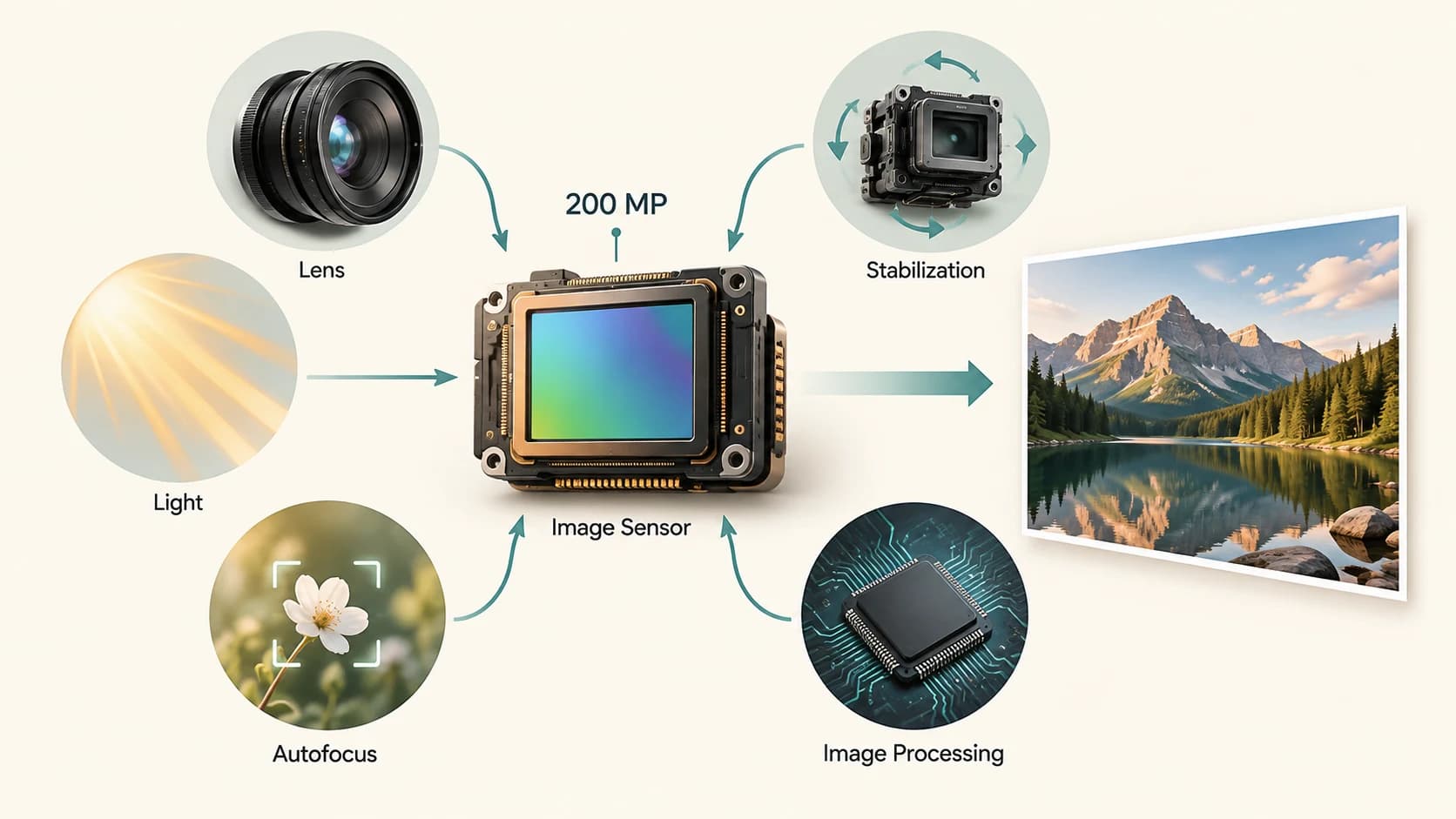
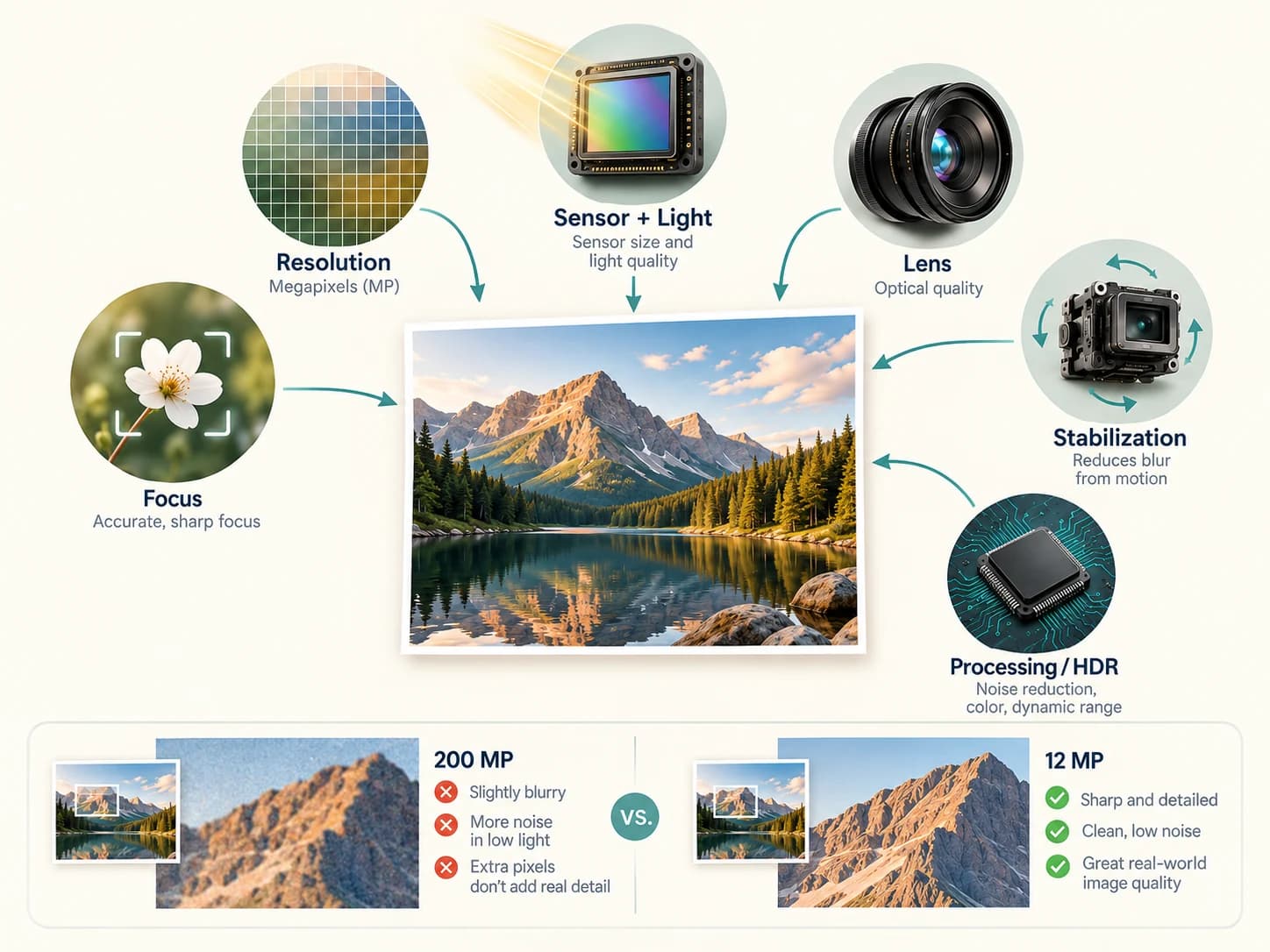
But megapixels tell you surprisingly little about other things that determine whether a photograph actually looks good:
- how much light the sensor captures
- how much noise is present
- how well the lens resolves detail
- whether the subject is in focus
- whether camera shake is controlled
- how much highlight and shadow information is preserved
- how effectively the phone processes the image
That is why a well-designed 12MP or 24MP camera can sometimes produce a better-looking photograph than a poorly designed 50MP or 200MP one.
Megapixels matter.
They simply aren't a camera-quality score.
What Is a Megapixel?
A digital photograph is made from tiny picture elements called pixels.
One megapixel means approximately:
1 million pixels
A 12MP image therefore contains roughly 12 million pixels.
A 48MP image contains roughly 48 million.
A 200MP image contains roughly 200 million.
If a camera produces a 4000 × 3000 image:
4000 × 3000 = 12,000,000
or about:
12 megapixels
The key word here is resolution.
A higher-resolution image can represent more separate points across the scene.
That can preserve finer texture such as:
- hair
- leaves
- fabric
- brickwork
- distant lettering
- fine architecture
But there is an important mathematical detail.
Four Times the Megapixels Does Not Mean Four Times the Detail Across the Image
Suppose one camera captures:
12MP
and another captures:
48MP
The second image contains four times as many pixels overall.
But those extra pixels are spread across both the width and height.
A roughly 12MP 4:3 photograph might be around:
4000 × 3000
A 48MP 4:3 photograph is roughly:
8000 × 6000
The pixel count increased fourfold.
The linear resolution only doubled.
This matters because a specification such as 200MP sounds enormously larger than 12.5MP.
And it is: 200MP contains sixteen times as many pixels.
But in each dimension, that is roughly a fourfold increase, not sixteenfold.
That is still useful.
It simply isn't as dramatic as the headline numbers can make it appear.
When More Megapixels Really Do Help
Higher resolution is not merely marketing.
There are several situations where it has genuine value.
You want to crop heavily
Imagine photographing a bird that occupies only the middle of the frame.
If you captured the image at high resolution, you can remove much of the surrounding scene while still leaving enough pixels for a useful final photograph.
Google has used exactly this idea for smartphone zoom. Its Pixel camera system has used the central portion of a high-resolution sensor to create a closer view while retaining useful output resolution. On the Pixel 7 generation, for example, Google described using the inner crop of a 50MP main sensor to create a 12.5MP 2x image.
Higher-resolution phone sensors from Samsung use similar in-sensor cropping techniques for certain zoom levels.
More megapixels therefore give a camera something extremely useful:
room to crop.
You want very large prints
A photograph printed very large needs enough resolution to avoid visibly running out of detail when viewed closely.
More megapixels give a photographer more flexibility for:
- posters
- large wall prints
- commercial work
- detailed publishing
- aggressive reframing
For ordinary phone-screen viewing, the difference may be much harder to notice.
The scene contains fine detail
Landscapes, architecture and highly textured subjects can benefit from additional resolution when:
- lighting is good
- focus is accurate
- the camera is steady
- the lens can resolve the detail
That final condition matters enormously.
The Lens Has to Deliver Detail Before the Sensor Can Record It
Imagine placing a 200MP sensor behind a blurry piece of glass.
Would you get a highly detailed image?
No.
You would get a very high-resolution recording of a blurry image.
Before light reaches the sensor, it has to pass through the camera lens.
The lens determines how sharply the scene can be projected onto the sensor.
Real lenses have limitations involving:
- optical sharpness
- distortion
- chromatic aberration
- flare
- corner performance
- aperture
- manufacturing tolerances
If the lens cannot resolve extremely fine detail, adding more pixels eventually produces diminishing returns.
The same is true if the image is slightly out of focus.
Or if your hand moved during the exposure.
A 200MP sensor cannot recover detail that never reached it sharply in the first place.
The Sensor's Physical Size Matters Too
Now consider two cameras.
Both are 50MP.
Camera A places those 50 million pixels on a relatively large sensor.
Camera B fits the same number onto a much smaller sensor.
Those are not equivalent imaging systems.
A physically larger sensor has more area available to collect incoming light.
Sony Semiconductor Solutions explains that increasing image-sensor size can allow larger pixels and greater light capture, contributing to improved sensitivity and lower noise.
This is one reason simply comparing:
50MP vs 50MP
does not tell you which camera is better.
You also need to ask:
How large is the sensor?
What Is Pixel Size?
An image sensor is divided into millions of light-sensitive sites.
Manufacturers often describe their spacing using micrometres, written as µm.
For example, a sensor might advertise individual pixels of:
- 0.6 µm
- 0.8 µm
- 1.2 µm
A larger light-sensitive area can generally collect more photons during the same exposure.
That can improve the signal available relative to noise.
Nikon notes in its explanation of digital noise that larger pixels can provide lower noise than smaller ones, while Sony's mobile-sensor documentation similarly emphasizes light collection, signal capacity and low-light noise as key sensor-design concerns.
But this creates a smartphone engineering problem.
The phone cannot contain an endlessly large sensor.
If manufacturers want to fit more pixels onto roughly the same sensor area, the individual pixels generally have to become smaller.
Samsung states this trade-off explicitly: within mobile-size constraints, increasing pixel count can require smaller pixel dimensions, reducing the area available to each pixel for collecting light.
That sounds as though high-megapixel sensors must always be worse in low light.
Modern cameras have several ways around that problem.
Pixel Binning: Why a 200MP Camera Often Produces a 12.5MP Photo
This is one of the most confusing parts of smartphone camera specifications.
You buy a phone with a:
200MP camera
Take a normal photograph.
Then inspect the file and discover that it is only:
12.5MP
Nothing is broken.
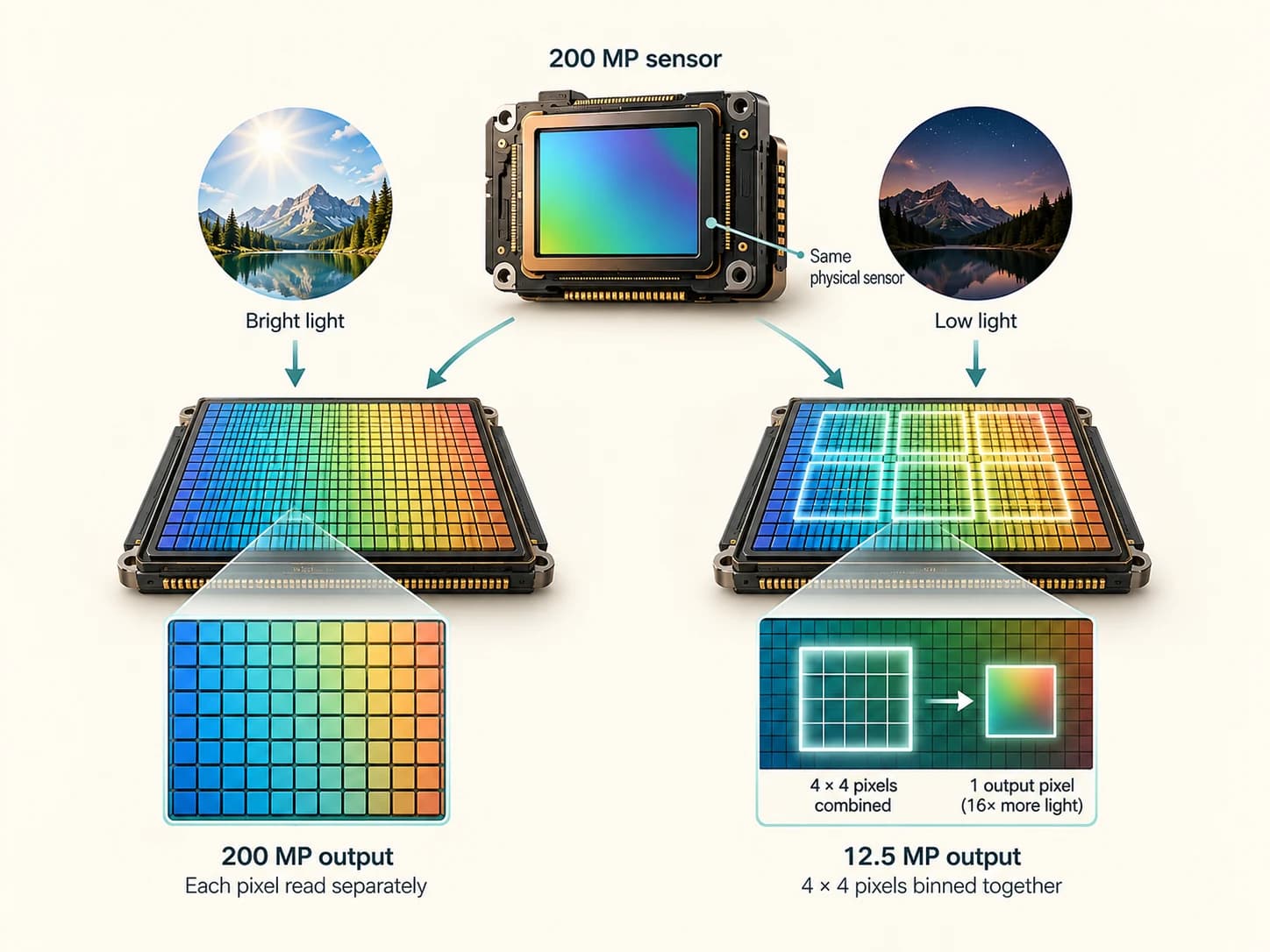
The sensor is often using pixel binning.
Instead of treating every small pixel independently in the final output, the camera groups neighbouring pixels together.
For example:
4 pixels → 1 output pixel
or:
16 pixels → 1 output pixel
Samsung's 200MP mobile sensors can combine sixteen neighbouring pixels so that a 200MP sensor produces a 12.5MP image in low-light-oriented modes.
Conceptually:
200MP sensor
↓
groups of 16 pixels combined
↓
12.5MP output
The goal is to use the dense sensor differently depending on conditions.
In bright light, the camera can use very high resolution to capture fine detail.
In lower light, groups of pixels can work together to create a cleaner lower-resolution image.
Apple uses a related quad-pixel approach. Its 48MP iPhone sensors can combine groups of four sensor pixels for lower-resolution captures optimized for normal photography and low-light performance.
Pixel Binning Does Not Physically Turn Small Pixels Into Big Ones
The terminology can be misleading.
Four 0.7 µm physical pixels do not physically fuse into one giant semiconductor pixel when the lights go down.
The physical sensor layout remains unchanged.
What changes is how data from neighbouring sensing sites is read, combined and processed.
So phrases such as:
“acts like a larger pixel”
are useful shorthand.
They should not be interpreted as the sensor physically changing its construction.
The benefit comes from combining information.
Why Not Use the Full 200MP All the Time?
If more resolution is available, why not always use it?
Because maximum resolution comes with trade-offs.
Larger files
A high-resolution image contains much more image data.
Depending on format and compression, that can mean considerably larger files.
More storage is consumed.
Uploads take longer.
Editing can require more memory and processing power.
More processing
The phone has to read and process a much larger amount of sensor data.
Samsung's work on high-resolution remosaic processing specifically addresses the memory and latency involved in converting high-resolution sensor data into finished images.
Less benefit in poor light
If the scene is dark, individual small pixels may receive relatively few photons.
A lower-resolution binned mode can be more useful than insisting on maximum spatial resolution.
Motion matters more
High-resolution detail is only useful when the scene and camera are sufficiently stable.
A person's moving hand, a running child or slight camera shake can destroy the fine detail that a 200MP mode was supposed to preserve.
That is why full-resolution modes are often most useful for:
- daylight landscapes
- architecture
- static subjects
- situations where cropping is expected
rather than automatically being the best setting for every photograph.
Modern Phones Often Deliberately Output Fewer Megapixels
The final photograph does not have to match the sensor's native resolution.
This is a crucial point.
A phone can use:
48MP sensor data
to create a:
24MP photograph
or a:
12MP photograph
while combining information from multiple exposures and processing stages.
Apple's current high-resolution capture pipeline illustrates this approach. Its 24MP photo processing combines a lower-resolution multi-frame HDR result with higher-resolution sensor information rather than simply saving every native sensor pixel directly.
The best output resolution is therefore not necessarily:
whatever the largest number on the box says.
The camera system may deliberately choose a lower resolution because it gives the processing pipeline more flexibility.
Computational Photography Complicates the Megapixel Question
Traditional thinking assumes:
press shutter → sensor captures image → save photograph
Modern smartphone photography is much more complicated.
A phone may capture several frames with different:
- exposures
- timings
- noise characteristics
Then software can align and combine them.
The processing system may apply:
- HDR
- noise reduction
- sharpening
- colour correction
- tone mapping
- motion detection
- face processing
- super-resolution
- lens correction
Google describes its Pixel camera pipeline as combining sensor hardware with HDR processing, remosaicing and computational zoom techniques.
That means two phones using sensors with the same megapixel count can produce visibly different photographs because their image-processing pipelines are different.
Dynamic Range Can Matter More Than Resolution
Imagine photographing someone standing in front of a bright sunset.
The scene contains:
very bright sky
and
much darker face
A camera with poor dynamic range may force you to choose.
Expose for the sky, and the face becomes dark.
Expose for the face, and the sky becomes white.
A better imaging system can preserve information across both.
This property is called dynamic range.
Sony's modern mobile sensors use technologies specifically designed to increase saturation capacity, reduce noise and preserve more information across bright and dark areas. Its current sensor documentation treats dynamic range and low-light signal quality as major image-quality characteristics independent of resolution.
A photograph with slightly fewer pixels but better highlight and shadow information can easily look better than a higher-resolution image with blown-out skies and noisy shadows.
Low-Light Performance Is a Signal Problem
Photography fundamentally depends on collecting light.
In bright sunlight, a camera has plenty of photons to work with.
At night, there are far fewer.
The camera then has to distinguish a weak useful signal from electronic and statistical noise.
This is why modern sensor engineering focuses on things beyond pixel count.
Sony, for example, has developed mobile sensor structures intended to improve charge capacity, dynamic range and noise performance even while maintaining relatively small pixel dimensions.
So the simplistic rule:
large pixels good, small pixels bad
is not sufficient either.
Sensor technology matters.
Pixel structure matters.
Electronics matter.
Processing matters.
The important lesson is simply that megapixel count alone does not describe any of these things.
Autofocus Can Matter More Than an Extra 100 Megapixels
Suppose Camera A has:
200MP
but misses focus slightly.
Camera B has:
50MP
and nails focus precisely.
Which photograph contains more useful subject detail?
Very often, Camera B.
A photograph must actually be sharp at the subject before extra resolution becomes useful.
Modern image sensors therefore devote significant engineering to autofocus.
Sony's mobile sensor designs, for example, include all-pixel phase-detection autofocus technologies intended to provide dense focus information across the sensor.
The specification sheet may advertise megapixels in enormous type.
Autofocus performance can matter more when the subject is moving.
Stabilization Matters for the Same Reason
Every tiny movement of the camera changes where details fall on the sensor.
At high resolution, small amounts of shake can erase the fine detail those extra pixels are supposed to capture.
Smartphones therefore use combinations of:
- optical image stabilization
- sensor-shift stabilization
- electronic stabilization
- multi-frame alignment
A sharp 12MP image contains more useful visual information than a motion-blurred 50MP image.
Again, pixel count only tells you the maximum sampling resolution.
It does not guarantee that the camera actually captured that much meaningful scene detail.
What About Video?
Megapixel numbers can be even more misleading if your main interest is video.
A 4K video frame is:
3840 × 2160
which is about:
8.3 megapixels
An 8K frame is:
7680 × 4320
or about:
33.2 megapixels
So a 200MP sensor contains far more pixels than are required simply to create an 8K output frame.
Those additional sensor pixels can still be useful.
They can support:
- cropping
- digital stabilization
- different readout modes
- oversampling
- zoom
But a 200MP specification does not mean video will automatically look better than video from a 50MP sensor.
Video quality also depends heavily on:
- sensor readout speed
- processing
- dynamic range
- overheating
- autofocus
- stabilization
- compression
- rolling shutter
Why Can a 12MP Camera Beat a 50MP Camera?
Imagine these two hypothetical phones.
Phone A
- 12MP
- excellent lens
- larger sensor
- accurate autofocus
- strong stabilization
- good dynamic range
- sophisticated image processing
Phone B
- 50MP
- weaker lens
- smaller sensor
- poor autofocus
- weak low-light performance
- aggressive sharpening
Phone B has more pixels.
Phone A can still produce better photographs.
This does not prove 12MP is somehow inherently superior to 50MP.
It proves that resolution is only one component of image quality.
When Should You Actually Care About Megapixels?
Megapixels deserve more attention when you:
Crop frequently
Wildlife, sports and distant subjects can benefit from extra resolution.
Print very large
Higher resolution gives more freedom when producing large detailed prints.
Photograph highly detailed static scenes
Landscapes, buildings and product photographs can benefit when lighting and optics are good.
Use in-sensor zoom
High-resolution smartphone sensors can create useful intermediate zoom levels by cropping the central region while retaining adequate output resolution.
Need editing flexibility
Extra resolution gives photographers more freedom to straighten, crop and reframe later.
For ordinary social-media images, messaging, snapshots and phone-screen viewing, the practical benefit can be much smaller.
What Specifications Should You Look at Besides Megapixels?
There is no single replacement number that tells you everything.
But if you are comparing camera systems, look at the whole package.
| Specification or feature | Why it matters |
|---|---|
| Megapixels | Potential resolution and cropping flexibility |
| Sensor size | Influences total light-gathering potential |
| Pixel architecture | Affects sensitivity, noise and dynamic range |
| Lens quality | Determines how much real optical detail reaches the sensor |
| Aperture | Influences how much light reaches the sensor |
| Autofocus | Determines whether the subject is actually sharp |
| Optical stabilization | Reduces blur from hand movement |
| HDR performance | Helps preserve highlights and shadows |
| Image processing | Controls noise reduction, colour, sharpening and multi-frame fusion |
| Telephoto / ultrawide lenses | Provide genuinely different optical perspectives |
And even these specifications cannot completely describe the result.
Two manufacturers can take similar hardware and tune their cameras very differently.
Real sample photographs still matter.
Should You Shoot at 12MP, 50MP or 200MP?
If your phone offers multiple resolution modes, there is no universally correct setting.
Use the normal default mode for most photography
The manufacturer usually selects this mode to balance:
- detail
- noise
- HDR
- speed
- storage
- low-light performance
On a high-resolution phone, that may mean a binned 12MP, 12.5MP or 24MP output.
Try full resolution in bright light
A 48MP, 50MP or 200MP mode can be useful when:
- the scene is well lit
- the subject is relatively still
- you want maximum detail
- you expect to crop later
Samsung describes its high-resolution mobile sensors as operating at full resolution when enough light is available while using pixel-binning modes in darker conditions.
Do not assume maximum resolution is automatically maximum quality
Look at the actual result.
A cleaner, better exposed and better processed lower-resolution image may be preferable.
The Better Question Is Not “How Many Megapixels?”
A megapixel number answers a useful question:
How many pixels can this sensor or image contain?
It does not answer:
How good is this camera?
For that, you need to know how the whole imaging system works.
A high megapixel count can provide genuine advantages.
It can preserve more detail.
It can make cropping much more practical.
It can enable useful sensor-based zoom.
And in the right conditions, it can produce extraordinarily detailed photographs.
But the sensor still needs good light.
The lens still has to resolve the scene.
The autofocus still has to hit the subject.
The camera still has to remain stable.
And the processor still has to turn raw sensor measurements into a convincing photograph.
So does a higher megapixel count mean a better camera?
Not by itself.
It means the camera has the potential to record more spatial samples.
Whether those extra pixels become extra useful detail depends on almost everything else in the camera.