Why Do Smartphones Have Multiple Cameras Instead of One Excellent Camera?
Learn why phones use separate main, ultrawide and telephoto cameras, how optical zoom works, and why one excellent camera cannot easily replace them all.
Turn over a modern smartphone and you may see two, three or even more camera circles.
That raises an obvious question.
Why not take all the money, space and engineering effort spent on those cameras and build one extremely good camera instead?
Traditional cameras manage to cover many situations with a single image sensor. Attach a zoom lens and the same camera can photograph a wide landscape, a person across the room or a distant bird.
Why can't a smartphone do the same?
The answer is mostly about optics and space.
A phone is only a few millimetres thick. A conventional zoom lens needs physical distance between optical elements, and those elements must move if the lens is going to change focal length. Smartphones have very little room for that mechanism.
So manufacturers use another solution:
several small cameras, each designed for a different optical job.
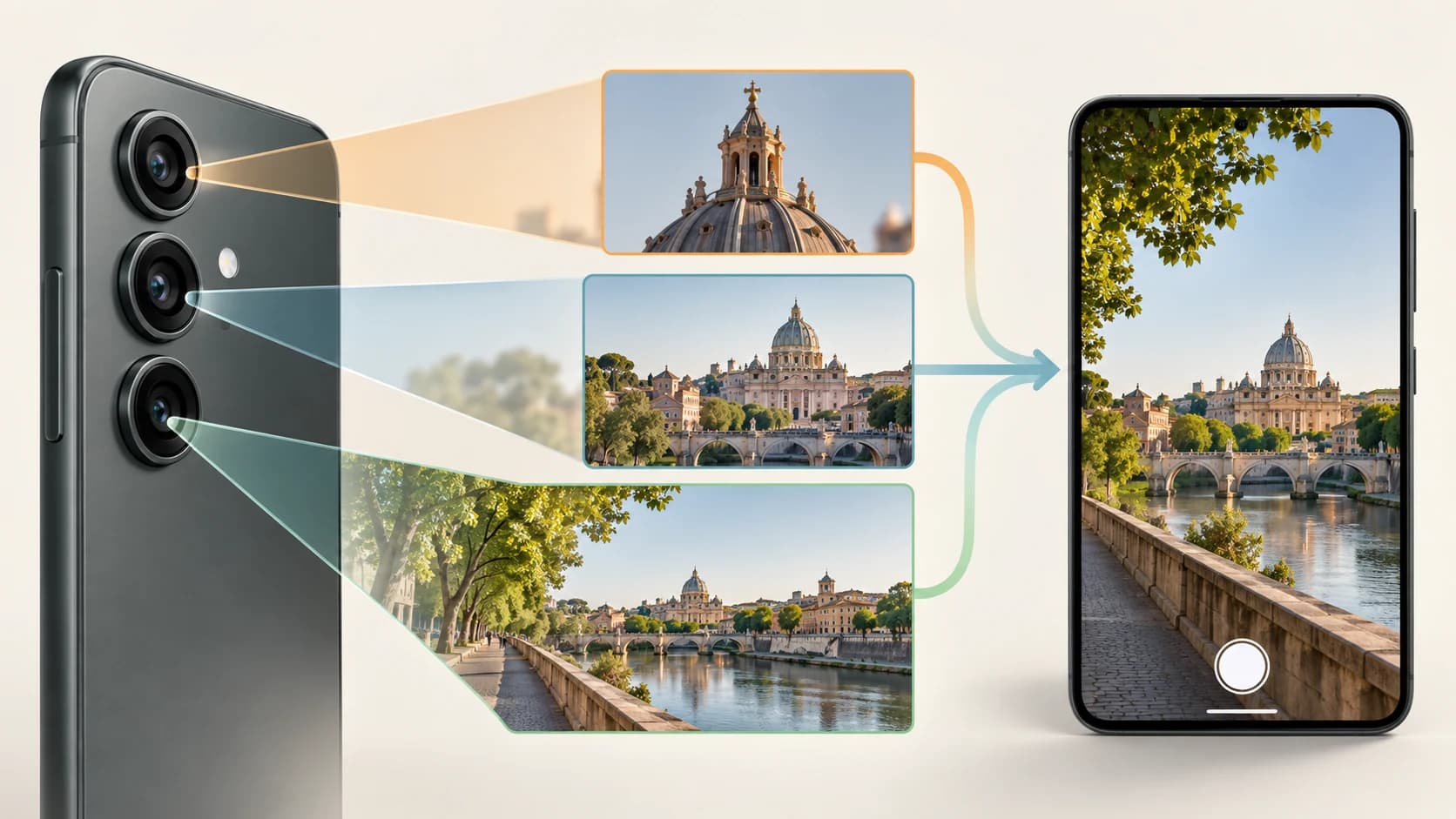
One might provide an ultrawide view. Another handles everyday photography. A third magnifies distant subjects.
Software then tries to make those physically separate cameras behave like one continuous camera system.
The result may look excessive from the outside, but it is largely an engineering workaround for something smartphones cannot easily overcome:
a good camera lens needs physical space.
The Key Concept Is Focal Length
To understand why multiple cameras help, forget megapixels for a moment.
The more important concept is focal length.
Focal length affects two things that matter immediately to a photographer:
- how much of the scene fits into the frame
- how large distant objects appear
A shorter focal length produces a wider field of view.
A longer focal length produces a narrower field of view and greater magnification.
Nikon summarizes the relationship simply: shorter focal lengths produce wider views, while longer focal lengths narrow the angle of view and increase magnification.
That gives us the three familiar smartphone camera roles.
Ultrawide
An ultrawide camera captures much more of the scene.
It is useful for:
- landscapes
- architecture
- large groups
- cramped interiors
- dramatic perspectives
Main or wide camera
This is usually the phone's general-purpose camera.
It often receives the manufacturer's largest sensor, brightest lens and most attention because it handles the majority of everyday photographs.
Telephoto
A telephoto camera has a much narrower field of view.
It is useful for:
- portraits
- distant objects
- concerts
- animals
- architectural details
Instead of one lens physically transforming between these focal lengths, a smartphone can simply place three separate optical systems next to each other.
One Camera Cannot Change Its View Just by Wanting To
Imagine a phone containing only one fixed 24 mm-equivalent main camera.
If you want a wider image, the lens cannot suddenly see beyond what its optics project onto the sensor.
The missing scene simply is not there.
Software cannot reconstruct buildings or people that were completely outside the camera's field of view.
This is why an ultrawide camera needs genuinely different optics.
Zooming in is somewhat easier because software can crop the image.
Suppose the camera captures this:
|-----------------------------|
|                             |
|         [ subject ]         |
|                             |
|-----------------------------|
A digital zoom can take only the middle:
        |-----------|
        | [subject] |
        |-----------|
The subject appears larger on the screen.
But the camera did not capture additional optical detail.
It merely discarded the outside of the original frame and enlarged what remained.
At modest zoom levels, a high-resolution sensor can make this work surprisingly well.
At large zoom levels, the limitations become much more obvious.
Why a High-Resolution Main Camera Can Sometimes Replace a 2x Lens
Modern smartphone manufacturers increasingly use very high-resolution main sensors.
That creates an interesting trick.
Suppose a 48MP camera takes only the central portion of its sensor.
A central crop can still contain enough pixels to produce a useful 12MP photograph.
This lets manufacturers provide something like a 2x view without installing a separate 2x camera.
Apple currently uses this approach on some iPhones. The single-rear-camera iPhone 17e, for example, uses its 48MP main camera to provide a 12MP 2x telephoto view. Apple describes this as a 52 mm-equivalent 2x option derived from the main camera system.
The standard iPhone 17 similarly derives a 2x view from its main 48MP camera while using a physically separate ultrawide module for the wider perspective.
So one excellent high-resolution camera can replace some additional focal lengths.
But there is a limit.
A 5x crop would use a much smaller portion of the original sensor than a 2x crop.
You would be throwing away most of the captured pixels and magnifying:
- noise
- blur
- lens imperfections
- atmospheric haze
- focusing errors
For serious long-range zoom, a dedicated telephoto camera still has a major advantage.
A Telephoto Camera Uses Its Sensor More Efficiently
Imagine photographing a bird far away.
With the main wide camera, the bird may occupy only a small area in the centre of the sensor.
Digital zoom enlarges that small region.
A telephoto lens behaves differently.
Its longer focal length optically magnifies the subject before the image reaches the sensor.
The bird can therefore occupy much more of the telephoto sensor.
That gives the camera more actual image information about the distant subject.
This is why phones with dedicated long telephoto cameras can outperform a simple digital crop at the same high magnification.
Current Pixel Pro phones provide a useful example. Google's Pixel 11 Pro camera system includes separate wide, ultrawide and 5x telephoto cameras. The wide camera has an 82° field of view, the ultrawide 123°, and the 5x telephoto only 23°.
Those are not three copies of the same camera.
They are three different optical views of the world.
Why Not Put a Normal Zoom Lens Inside the Phone?
A conventional camera zoom lens contains multiple optical elements.
Changing focal length requires moving groups of those elements relative to each other.
Look at a large camera lens while zooming and you may physically see the barrel extending.
A smartphone cannot easily do that.
A large moving lens would create several problems:
- much greater thickness
- a larger camera bump
- more mechanical parts
- more space required inside the phone
- greater difficulty with stabilization
- greater durability challenges
- more complicated sealing against dust and water
Samsung's semiconductor division explains the underlying problem directly: smartphones face strict internal space constraints, and unlike interchangeable-lens cameras, users cannot simply swap lenses when a different focal length is required. Multiple dedicated camera units are one solution to that physical limitation.
In other words, several tiny fixed cameras can often fit into a thin phone more practically than one large continuously variable zoom lens.
Telephoto Cameras Have Their Own Space Problem
Long focal lengths create an additional challenge.
A telephoto lens needs a longer optical path.
But a smartphone is thin.
If all the optical elements were stacked conventionally from the back of the phone toward the screen, the camera module could become extremely thick.
That is where folded optics, often called periscope-style cameras, come in.
Instead of sending light straight into the phone, a prism redirects it sideways.
The optical path then extends horizontally through the body of the phone.
Conceptually:
Light enters phone
       ↓
     prism
       ↳ lens elements → sensor
The phone can therefore create a much longer optical path without requiring the entire camera to protrude equally far from the back.
Samsung describes folded telephoto designs as bending the light path roughly 90 degrees, allowing longer focal lengths to fit horizontally inside a thin smartphone.
Apple uses a related folded-path idea in its current high-end telephoto system, describing the iPhone 18 Pro's telephoto module as a tetraprism design.
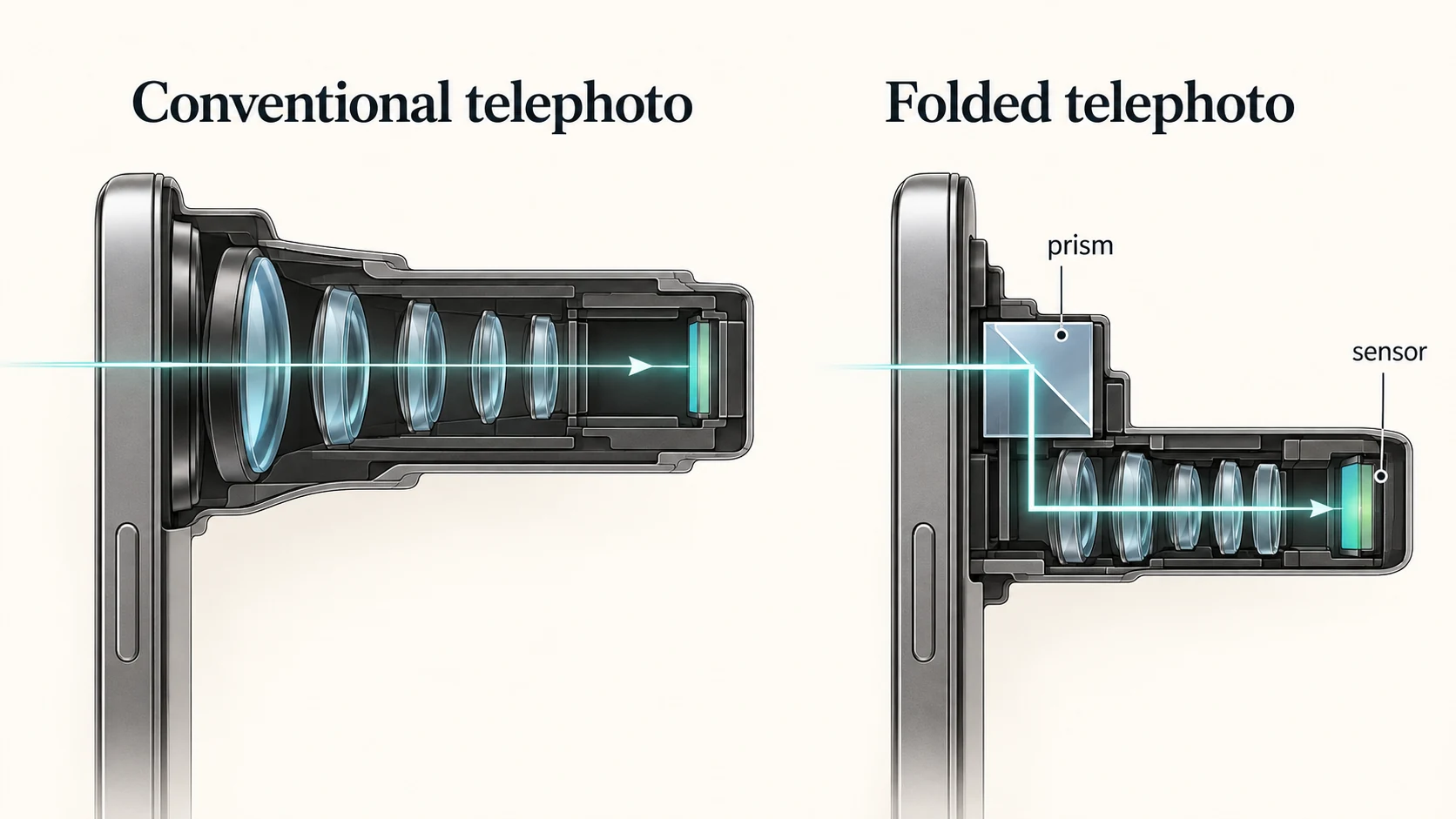
This is a good example of smartphone design working around physics rather than eliminating it.
Why Isn't Every Camera Equally Good?
This is where camera specifications can become misleading.
A phone might advertise:
50MP main + 50MP ultrawide + 50MP telephoto
That does not mean all three cameras produce identical image quality.
Each camera has its own:
- sensor
- sensor size
- lens
- focal length
- aperture
- autofocus system
- stabilization system
Space is limited, so manufacturers make compromises.
The main camera often gets favourable hardware because it is used most frequently.
A telephoto module may require a physically more complicated lens and have a smaller aperture.
An ultrawide camera may use a smaller sensor than the main camera.
For example, Google's current Pixel 11 Pro specifies a 1/1.3-inch-type sensor for its main camera but a 1/1.95-inch-type sensor for its 5x telephoto. Its telephoto also uses an f/2.8 aperture compared with f/1.68 on the main camera.
That does not make the telephoto useless.
It means each module represents a different compromise.
This Is Why the Main Camera Often Wins at Night
Low-light photography depends heavily on gathering enough light.
A camera with a larger effective light-gathering system generally has more information to work with.
That means the main camera may produce a cleaner low-light photograph than a smaller telephoto camera.
This can lead to behaviour that surprises users.
You tap a telephoto zoom button.
But under very poor lighting, some phones may decide that a crop from another camera plus computational processing gives a better result than using the telephoto module directly.
The exact behaviour differs between devices and software versions.
This is another reason the zoom buttons in a smartphone camera app should not always be interpreted as a rigid guarantee that one particular physical sensor is being used for every frame.
The Camera App Tries to Hide All of This Complexity
From the user's perspective, smartphone zoom looks simple.
You might see:
0.5x → 1x → 2x → 5x
Move the slider smoothly and the view magnifies.
Behind that interface, several different things can happen:
- switching between physical cameras
- cropping a high-resolution sensor
- digitally enlarging an image
- blending information from multiple cameras
- applying computational super-resolution
- correcting differences between lenses
Android itself supports the concept of a logical multi-camera, where several physical cameras such as ultrawide, wide and telephoto can be presented to software as parts of one camera system. Android's camera documentation explicitly describes zooming by switching between physical lenses with different focal lengths.
Google's Pixel Camera similarly says the phone can automatically choose which lens to use while zooming, while supported models also allow manual selection between ultrawide, wide and telephoto cameras.
That smooth zoom slider is therefore partly an illusion created by software.
The phone may be moving between entirely different camera modules underneath.
Why Does the Image Sometimes Jump While Zooming?
Once you know multiple cameras are involved, a familiar smartphone-camera behaviour makes sense.
Start at 1x.
Slowly zoom toward the telephoto range.
At some point you may notice:
- a slight shift in perspective
- a change in colour
- a change in sharpness
- a small framing jump
- a difference in exposure
That can happen because the phone just changed cameras.
The physical lenses are located several millimetres apart.
Their sensors and optics may also produce slightly different images.
Manufacturers use calibration and image processing to reduce those differences, but the cameras are not literally in the same physical position.
The better the camera system and software, the less noticeable the transition usually becomes.
Multiple Cameras Can Work Together, Not Just Separately
The cameras do not always behave as isolated systems.
Modern smartphone processors can handle multiple image streams and combine information computationally.
Qualcomm's imaging documentation describes multi-camera systems as enabling simultaneous capture and features such as depth mapping, low-light photography and optical-zoom-like image synthesis.
Image processors can also be designed to handle several cameras at once. Qualcomm's Spectra 580, for example, was designed for concurrent processing from three cameras.
Manufacturers can use this capability for techniques including:
- smoother transitions between focal lengths
- depth estimation
- portrait effects
- image fusion
- HDR
- better zoom
- focusing assistance
The exact algorithm is manufacturer-specific.
But the important point is that having several cameras provides the software with more than one view of the scene.
What About Portrait Mode?
Multiple cameras can also provide information about depth.
Two cameras positioned slightly apart see a subject from slightly different viewpoints, just as your left and right eyes do.
Software can analyze the difference between those views to estimate how far parts of the scene are from the camera.
That information can help with effects such as synthetic background blur.
Modern phones can also estimate depth from a single camera using machine-learning and computational methods, so two cameras are not strictly necessary for portrait mode anymore.
But multi-camera information can still be valuable.
Some phones also include separate depth or time-of-flight sensors, although these are not universal.
What About Macro Photography?
Another camera may also serve more than one purpose.
An autofocus-capable ultrawide camera can sometimes focus at very short distances.
That allows it to become a macro camera for close-up photographs of:
- flowers
- insects
- electronics
- textures
- small objects
Google's current Pixel Pro specifications, for example, pair Macro Focus with the ultrawide camera.
Apple similarly lists macro photography alongside the capabilities enabled by its ultrawide camera systems on supported models.
So a second camera may add not only a wider view but also an entirely different focusing capability.
More Cameras Do Not Automatically Mean a Better Camera Phone
This is worth emphasizing.
A four-camera phone is not automatically better than a two-camera phone.
Manufacturers have sometimes added low-resolution macro or depth cameras partly to expand the specification sheet.
A phone with:
excellent main + excellent ultrawide + excellent telephoto
may be far more useful than one with:
average main + average ultrawide + weak macro + weak depth sensor
What matters is the quality and usefulness of each module.
That includes:
- sensor size
- lens quality
- autofocus
- stabilization
- processing
- consistency between cameras
- actual focal-length coverage
Counting camera circles tells you very little by itself.
Could One Great Camera Eventually Replace Several?
To some extent, this is already happening.
High-resolution sensors can provide high-quality crops.
Computational photography can improve digital zoom.
Variable apertures can give one lens more flexibility.
Folded optics can extend telephoto performance.
Image fusion can smooth the gaps between physical focal lengths.
But physics still matters.
A single fixed ultrawide lens cannot suddenly become a long telephoto lens without either:
- cropping away most of the image
- physically changing its optics
And a mechanically variable lens still requires physical volume.
That means multiple camera modules remain a very practical solution for thin smartphones.
The exact number may change.
The roles may overlap more.
Software may increasingly blur the boundaries.
But the fundamental reason for multiple cameras is unlikely to disappear as long as phones remain thin and users expect everything from ultrawide landscapes to long-distance zoom.
The Whole Camera System in One View
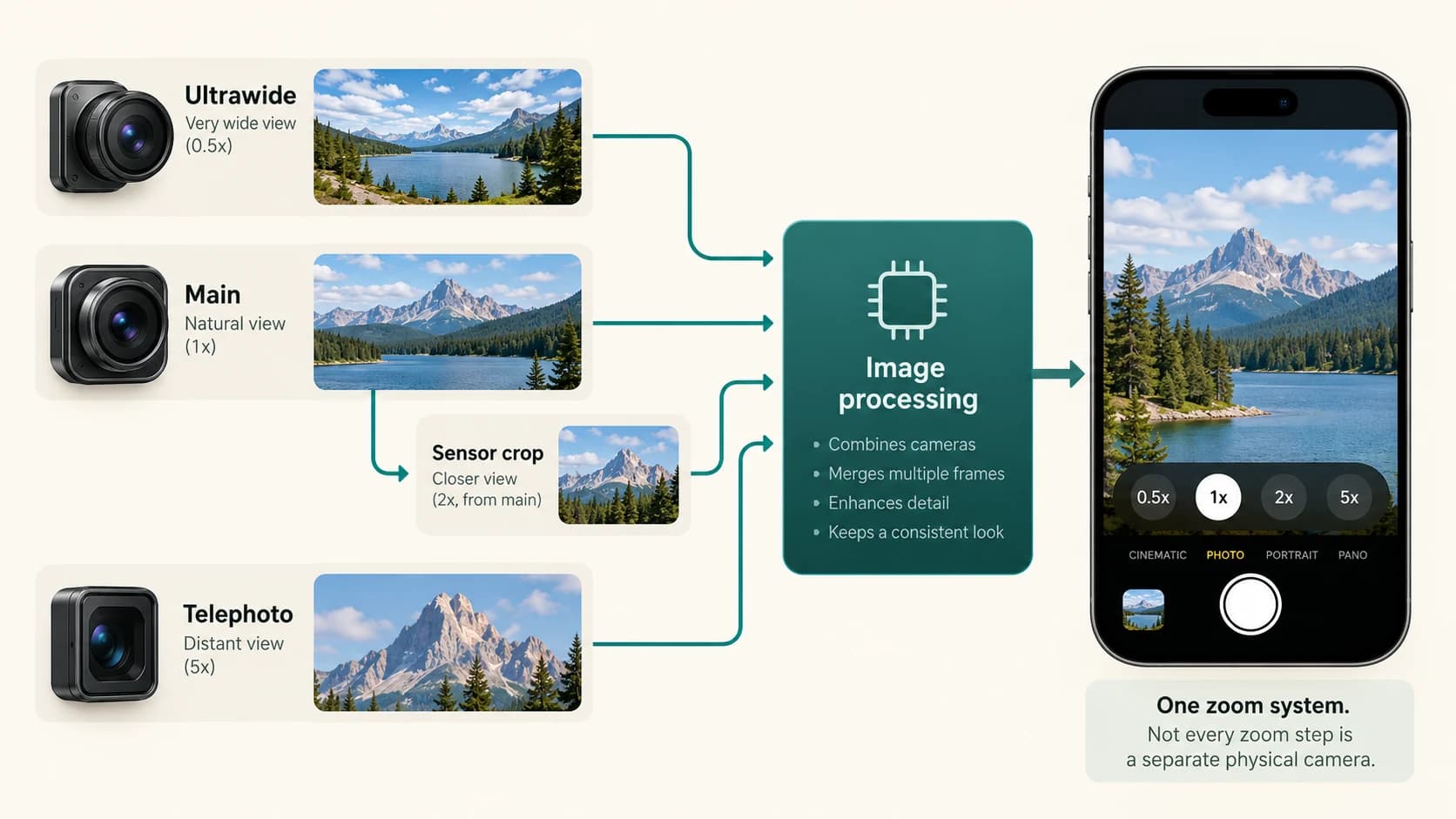
A modern multi-camera phone can be thought of like this:
Ultrawide camera
Very wide field of view
Best suited to:
- landscapes
- architecture
- tight spaces
- sometimes macro
Main camera
General-purpose field of view
Usually strongest for:
- everyday photography
- night photography
- moving subjects
- general video
Telephoto camera
Narrow field of view with optical magnification
Useful for:
- distant subjects
- portraits
- details
High-resolution sensor crop
Intermediate magnification without another camera
Useful for:
- modest zoom such as 2x on some phones
Computational photography
Combines and processes information
Used for:
- HDR
- night photography
- portrait depth
- zoom enhancement
- camera switching
- image fusion
The phone presents all of these pieces through one camera app.
That is the trick.
You are not really carrying one camera with three lenses attached.
You are carrying several miniature cameras plus a computer powerful enough to disguise them as one flexible photographic system.
One Excellent Camera Would Be Simpler—But Less Flexible
If smartphone photography were only about producing the best possible image at one focal length, a manufacturer could devote much more space and money to one outstanding camera.
And some simpler phones effectively take that approach.
But users expect a phone camera to handle radically different situations:
a large building directly in front of you
a person across the room
a bird in the distance
a flower a few centimetres away
Those scenes want different optics.
Traditional cameras solve the problem with large interchangeable or mechanically zooming lenses.
Smartphones do not have that luxury.
So they use a collection of small fixed camera modules and computational photography instead.
The multiple circles on the back of your phone are therefore not simply several versions of the same camera.
They are a compact substitute for something a thin smartphone cannot easily fit:
one large lens capable of physically transforming itself to cover every photographic perspective well.