How Does a Smartwatch Measure Your Heart Rate?
Learn how smartwatch heart-rate sensors use green LEDs, photodiodes and signal processing to detect your pulse—and why readings can sometimes be wrong.
Turn over many smartwatches and you will find a small cluster of lights and sensors pressed against your wrist.
During a workout, some of those lights may flash green.
A few seconds later, the watch might display:
Heart rate: 132 bpm
It looks as though the watch is somehow looking through your skin and watching your heart beat.
That is not quite what happens.
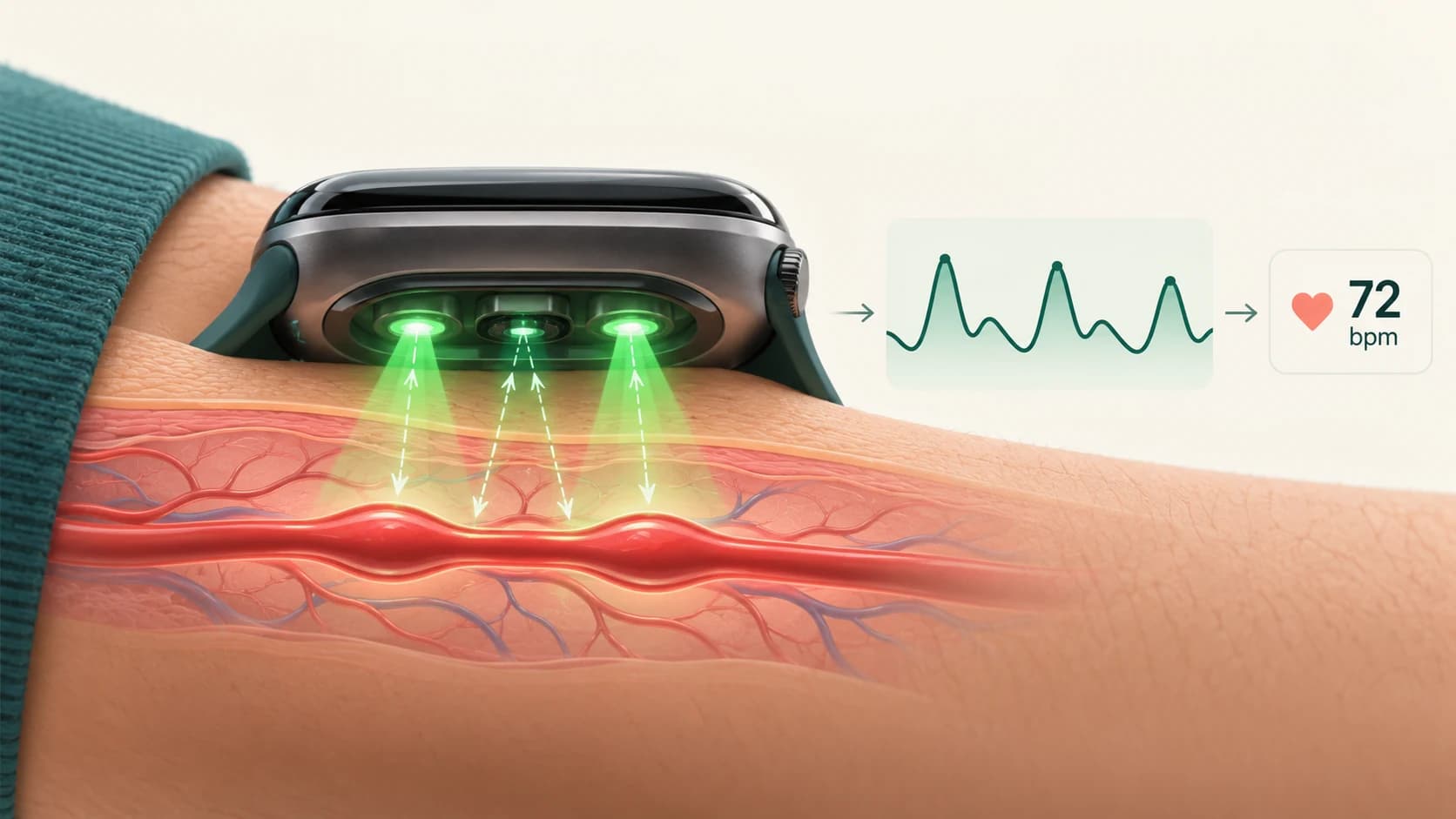
Most smartwatches measure heart rate using an optical technique called photoplethysmography, usually shortened to PPG. The watch shines light into your skin, measures how much light comes back and looks for tiny rhythmic changes caused by blood pulsing through the vessels in your wrist.
Apple describes its optical heart sensor as using green LEDs and light-sensitive photodiodes to detect changes in blood flow at the wrist. Google says Fitbit and Pixel Watch devices similarly use rapidly flashing green LEDs to detect changes in blood volume, while photodiodes measure the resulting optical signal.
So your smartwatch is not directly "seeing" your heart.
It is watching what each heartbeat does to the blood flowing under the skin.
Your Heart Creates a Pulse Far Away From Your Chest
Each time the heart contracts, it pushes blood into the arteries.
That pressure wave travels throughout the circulatory system.
You can feel it manually by placing two fingers over an artery at your wrist or neck.
A smartwatch is detecting a related phenomenon optically.
When more blood enters the small vessels beneath the watch, the optical properties of the tissue change slightly.
Between pulses, blood volume falls again.
This creates a repeating pattern:
Heart contracts
↓
Blood volume in wrist rises
↓
Optical signal changes
↓
Blood volume falls
↓
Optical signal changes again
↓
Repeat
A review of wearable PPG describes the signal as an optical measurement of the arterial pulse wave influenced by the heart and blood vessels.
The watch measures the timing of those repeating pulses and turns them into a heart-rate estimate.
Why Are the Lights Usually Green?
Blood looks red because of the way haemoglobin interacts with visible light.
Green light is strongly absorbed by blood.
That makes changes in blood volume relatively easy for an optical sensor to detect at the wrist.
Apple explains the principle simply: when blood flow through the wrist increases with a heartbeat, more green light is absorbed; between beats, less is absorbed. Its watch flashes green LEDs many times per second and measures the reflected light with photodiodes.
Google gives a similar description for Fitbit devices: rapidly flashing green LEDs illuminate the wrist while light-sensitive photodiodes detect blood-volume changes in the capillaries.
The watch is therefore looking for an extremely small optical rhythm.
It is not measuring the colour of your skin in the ordinary sense.
It is measuring changes in light caused by changing blood volume underneath it.
What Exactly Is a Photodiode?
An LED sends light out.
A photodiode does the opposite job: it detects incoming light.
The underside of a smartwatch therefore contains a miniature optical system.
Conceptually:
Green LEDs
↓
Light enters skin
↓
Some light is absorbed or scattered
↓
Some returns toward the watch
↓
Photodiodes measure returned light
The amount returning changes slightly as blood volume changes.
A single measurement is not very useful.
But take many measurements rapidly and a repeating waveform appears.
That waveform is the photoplethysmogram.
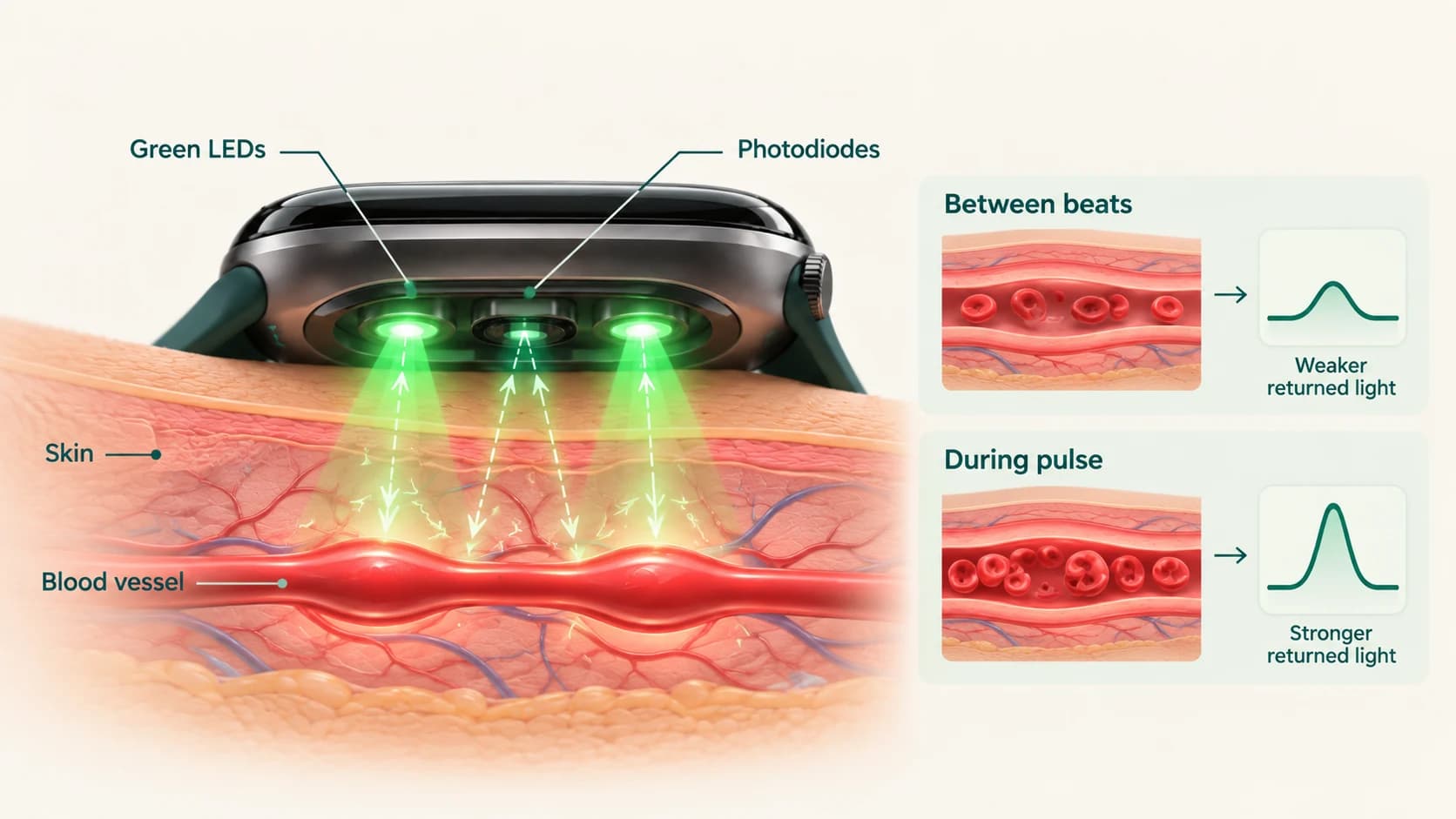
The peaks and valleys contain information about the pulse.
How the Watch Turns Light Into “72 bpm”
Imagine the optical signal shows a repeating pulse roughly once every second.
One pulse per second means:
60 pulses per minute
or approximately:
60 bpm
If the pulses arrive every half-second:
2 pulses per second × 60
=
120 bpm
Real algorithms are more complicated than simply counting obvious peaks.
The watch has to determine:
- which changes are genuine pulses
- which are caused by movement
- whether the signal quality is good enough
- how rapidly the pulse is changing
- whether several recent readings agree
The basic logic, however, remains simple:
find the repeating pulse pattern and calculate how frequently it occurs.
This is why heart rate is reported in beats per minute, even though the device does not normally wait a full minute to produce a reading.
It can estimate the rate from a shorter sequence of pulse intervals.
The Watch Is Really Measuring Your Pulse
This distinction is subtle but useful.
An optical smartwatch sensor measures changes in peripheral blood flow.
It does not directly measure the heart's electrical activity.
In most ordinary circumstances, each heartbeat creates a corresponding peripheral pulse, so pulse rate is a useful way to estimate heart rate.
But they are not fundamentally the same signal.
This is why watches that support an electrocardiogram, or ECG, use additional electrical sensors.
Google's ECG feature, for example, requires the user to remain still and maintain contact with the watch's electrical electrodes during the measurement. Optical PPG and electrical ECG are therefore different sensing technologies.
A useful comparison is:
| Optical PPG | ECG |
|---|---|
| Measures blood-volume changes | Measures electrical activity |
| Uses LEDs and photodiodes | Uses electrodes |
| Can operate continuously in the background | Usually requires a deliberate recording |
| Good for ongoing pulse/heart-rate monitoring | Provides electrical rhythm information |
| Very sensitive to movement | Also requires good contact and limited movement |
Both can tell us something about the cardiovascular system.
They are measuring different physical signals.
Why Does the Watch Flash the Lights So Quickly?
Heart rate changes from moment to moment.
The sensor therefore needs enough measurements to reconstruct the shape and timing of the pulse signal.
Apple says its watch can flash the LEDs hundreds of times per second while measuring heart rate and can adjust LED brightness and sampling behaviour when the optical signal is weak.
A higher sampling rate gives the system more information.
But continuously operating LEDs, photodiodes and processing hardware also uses battery power.
Smartwatch designers therefore balance:
- measurement accuracy
- sampling frequency
- battery life
- device temperature
- required feature
The watch may not use exactly the same measurement strategy during every activity.
Why Can a Smartwatch Measure Heart Rate All Day?
The optical sensor is small and does not require the user to perform a deliberate test every time.
That makes it suitable for background measurements.
Google says supported Fitbit and Pixel Watch devices can track heart rate throughout the day and night.
This continuous or frequent sampling allows the watch to estimate things such as:
- resting heart rate
- workout heart rate
- heart-rate zones
- recovery trends
- sleep-related heart-rate patterns
Other measurements can also use heart-rate data as one of several inputs.
For example, wearable platforms can combine heart information with motion sensors and user characteristics when estimating fitness metrics or energy expenditure.
The exact algorithms differ between manufacturers.
Why Does the Watch Need to Be Snug?
The sensor only works well if the watch can see a reasonably stable optical signal.
Imagine holding a flashlight above a moving surface.
If the distance and angle keep changing, the amount of reflected light changes even when the surface itself has not.
The same problem affects wrist sensors.
A loose watch can:
- move across the skin
- allow outside light underneath
- repeatedly change pressure
- change the sensor-to-skin distance
Those effects can look like pulse changes to the detector.
Google recommends keeping the back of a Fitbit or Pixel Watch in contact with the skin and wearing it snugly, particularly during exercise.
Apple similarly says the watch should fit snugly enough that the optical sensor remains close to the skin.
Samsung gives essentially the same advice for Galaxy Watch devices.
Too loose is bad.
But excessively tight is not better.
A band that strongly constricts the wrist can itself affect local blood flow and comfort.
Motion Is One of the Sensor’s Biggest Problems
Walking is relatively predictable.
Running introduces more movement.
Weightlifting, boxing and tennis can be much harder.
Why?
Because wrist motion produces changes in the optical signal that can overlap with the changes produced by blood flow.
Researchers call this motion artifact.
A major review of wearable PPG identifies motion as one of the most important sources of error in wrist-based optical measurements.
Suppose your true pulse signal looks like a repeating wave.
Now shake the sensor at the same time.
The detector receives:
pulse signal + wrist movement + changing contact + ambient-light effects
The algorithm has to separate them.
That can be difficult, particularly when motion itself is rhythmic.
The Watch Can Use Its Motion Sensors to Help
A smartwatch already contains accelerometers and often gyroscopes for detecting movement.
Those sensors can provide useful context.
If the optical signal changes at exactly the same time as strong wrist motion, an algorithm may treat part of that change as movement-related rather than cardiovascular.
Manufacturers do not publish every detail of their proprietary heart-rate algorithms, but wearable systems commonly combine optical measurements with signal processing designed to reduce motion contamination.
Apple also notes that heart-rate performance varies by activity: rhythmic movement such as running can produce more consistent readings than irregular motion such as tennis or boxing.
This explains why a watch can look extremely accurate during a steady jog but occasionally struggle during strength training.
Why Cold Weather Can Cause Problems
PPG depends on blood reaching the skin.
In cold conditions, the body can reduce blood flow near the skin to preserve heat.
That is called vasoconstriction.
Less peripheral blood flow can weaken the optical pulse signal at the wrist.
Apple specifically warns that low skin perfusion in cold conditions can make heart-rate readings difficult.
Google makes the same point for Fitbit devices, noting that cold weather can reduce blood flow to the skin and interfere with exercise heart-rate measurement.
The watch did not suddenly stop understanding your heartbeat.
The optical signal reaching the sensor became weaker.
Tattoos Can Interfere Too
A tattoo changes how light passes through and reflects from the skin.
Depending on:
- ink colour
- density
- pattern
- placement
the sensor may receive a weaker or distorted optical signal.
Apple states that some tattoos can block light from the optical heart sensor and prevent reliable readings.
Google similarly notes that tattooed skin can affect optical measurements for some wearable sensors.
This is a physical optics problem, not a software preference.
If insufficient useful light reaches the detector, the algorithm has less reliable information to work with.
Does Skin Tone Affect Smartwatch Heart-Rate Accuracy?
This question deserves a careful answer.
Melanin affects the absorption and scattering of light in skin, so researchers have investigated whether optical wearables perform differently across skin tones.
The evidence is not completely consistent.
A systematic review covering ten studies and 469 participants found that four studies reported reduced heart-rate accuracy in participants with darker skin tones, four found no significant effect and two produced mixed results. The authors concluded that the evidence was still insufficient for a simple universal claim.
More recent reviews continue to identify skin tone as an important variable in PPG design and validation, while also noting substantial differences between devices and algorithms.
The sensible conclusion is therefore not:
“Smartwatches do not work on dark skin.”
Nor is it:
“Skin tone can never affect the measurement.”
Instead:
Optical performance can be influenced by skin characteristics, but the size of the effect depends heavily on sensor design, wavelength, algorithms, fit and activity.
Why Do Some Watches Also Use Red and Infrared Light?
Turn over some watches and you may see more than green LEDs.
Red and infrared wavelengths interact differently with tissue.
They are particularly useful for other measurements such as blood oxygen saturation, where the device examines differences in how oxygenated and deoxygenated haemoglobin absorb light.
Some devices also use infrared light for functions such as wrist detection.
Google says Fitbit devices can use infrared light to help detect whether the wearable is being worn.
This illustrates an important point:
The sensor cluster on the back of a modern smartwatch is often not a single-purpose heart-rate sensor.
It may support several optical measurements.
Why Doesn't My Watch Match the Gym Machine or Chest Strap?
Two devices can measure heart rate at nearly the same moment and display slightly different numbers.
That does not necessarily mean one is broken.
They may use:
- different sensors
- different body locations
- different averaging windows
- different filtering algorithms
- different sampling rates
A chest strap commonly detects electrical signals near the heart, while a wrist watch usually relies on optical pulse detection.
Google explicitly notes that Fitbit readings may differ from chest straps or other heart-rate devices because the technologies are different.
Even two watches can disagree slightly because their algorithms do not update or smooth the signal in exactly the same way.
Why Does Heart Rate Sometimes Lag During Exercise?
Imagine suddenly starting a sprint.
Your real heart rate begins rising quickly.
A smartwatch may take a short time before its displayed number fully catches up.
Why?
The algorithm may need several clean pulse cycles before it is confident that the increase is real rather than motion noise.
Manufacturers may also smooth the displayed value to avoid showing wild second-to-second jumps.
The result can be a trade-off:
instantaneous responsiveness
versus
stable, believable readings.
Different devices may choose different balances.
That is one reason comparing only a single displayed number at one instant can be misleading.
What Happens to the Optical Signal Behind the Scenes?
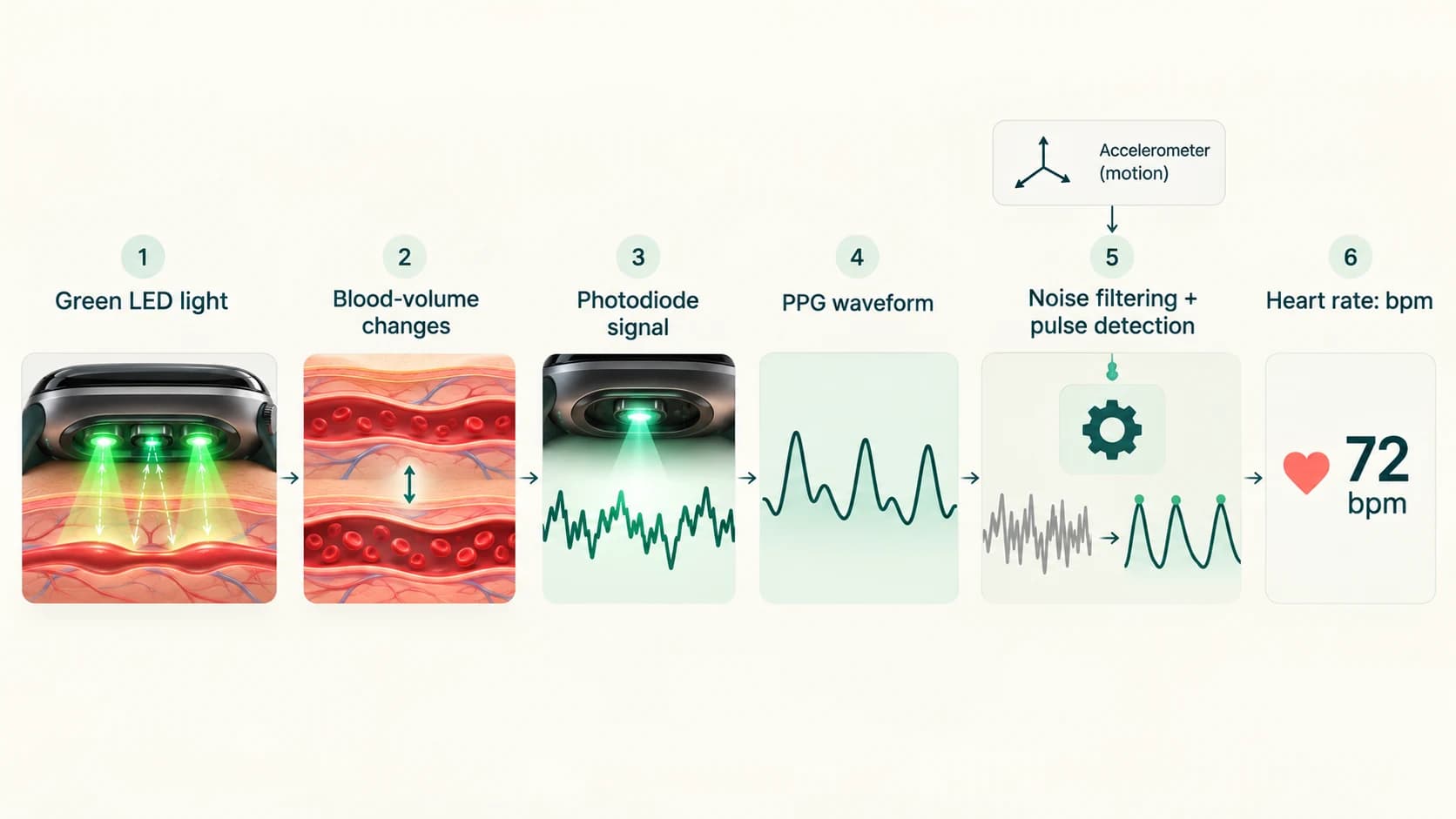
A simplified pipeline looks like this:
1. LEDs illuminate the wrist
Usually green light is used for heart-rate sensing.
2. Blood volume changes with each pulse
Each heartbeat temporarily increases blood volume in vessels beneath the sensor.
3. The reflected-light level changes
The photodiodes detect those tiny optical variations.
4. The watch creates a PPG waveform
Repeated measurements form a pulse-like signal over time.
5. Signal processing removes as much noise as possible
The device tries to compensate for:
- movement
- changing skin contact
- ambient light
- weak blood flow
- other interference
6. Pulse intervals are detected
The algorithm identifies repeating cardiovascular pulses.
7. The rate is converted to beats per minute
The watch displays the result as heart rate.
The full commercial algorithm is far more complicated, but that is the core physical process.
How Accurate Are Smartwatch Heart-Rate Sensors?
There is no single accuracy figure that applies to every watch and every situation.
Accuracy depends on:
- device model
- fit
- exercise type
- movement
- skin perfusion
- temperature
- sensor design
- algorithms
- individual physiology
Research generally finds that consumer wrist wearables can provide useful heart-rate estimates in many situations, but performance can worsen during some forms of exercise or under poor measurement conditions.
A review of PPG measurement error identifies motion artifact, ambient light, sensor pressure, skin characteristics and physiological differences among the important sources of uncertainty.
This is why the number on your wrist should not be treated as though it came from a perfect laboratory instrument.
It is an estimate produced by a very small optical system operating on a moving human wrist.
Can a Smartwatch Detect Heart Problems?
Some watches can identify patterns that may justify further attention.
But that is different from saying the watch can diagnose every heart condition.
Optical pulse data can be analysed for rhythm irregularities, while supported watches may also include ECG features designed for specific rhythm assessments.
However, consumer wearables do not replace the full range of clinical cardiac testing.
Samsung, for example, explicitly states that information from its consumer watch and health software should not be used by itself to diagnose, treat or prevent disease.
A strange one-off reading may be a sensor error.
Repeated unusual readings may be worth investigating through appropriate healthcare channels.
The important distinction is:
measurement is not automatically diagnosis.
A Tiny Optical Laboratory on Your Wrist
The heart-rate number on a smartwatch looks simple because the complicated part is hidden.
Underneath that number is a small chain of physics and computation:
LED emits light
↓
light interacts with skin and blood
↓
blood volume changes with each heartbeat
↓
photodiodes detect reflected-light changes
↓
signal processing tries to remove noise
↓
the pulse frequency is calculated
↓
heart rate appears on screen
All of this happens while the watch is moving, the skin is stretching, the wrist temperature is changing and the wearer may be running down a road.
That is what makes the technology impressive.
The watch is not literally watching your heart.
It is detecting the tiny optical footprint that every heartbeat leaves in the blood beneath your skin—and using mathematics to turn that faint signal into a number you can understand.