Electric Car Battery Replacement: Lifespan, Degradation, Warranty and Ownership Risks
How long do EV batteries last in India? Understand capacity loss, replacement costs, battery warranties, used-EV checks and the risks that really matter.
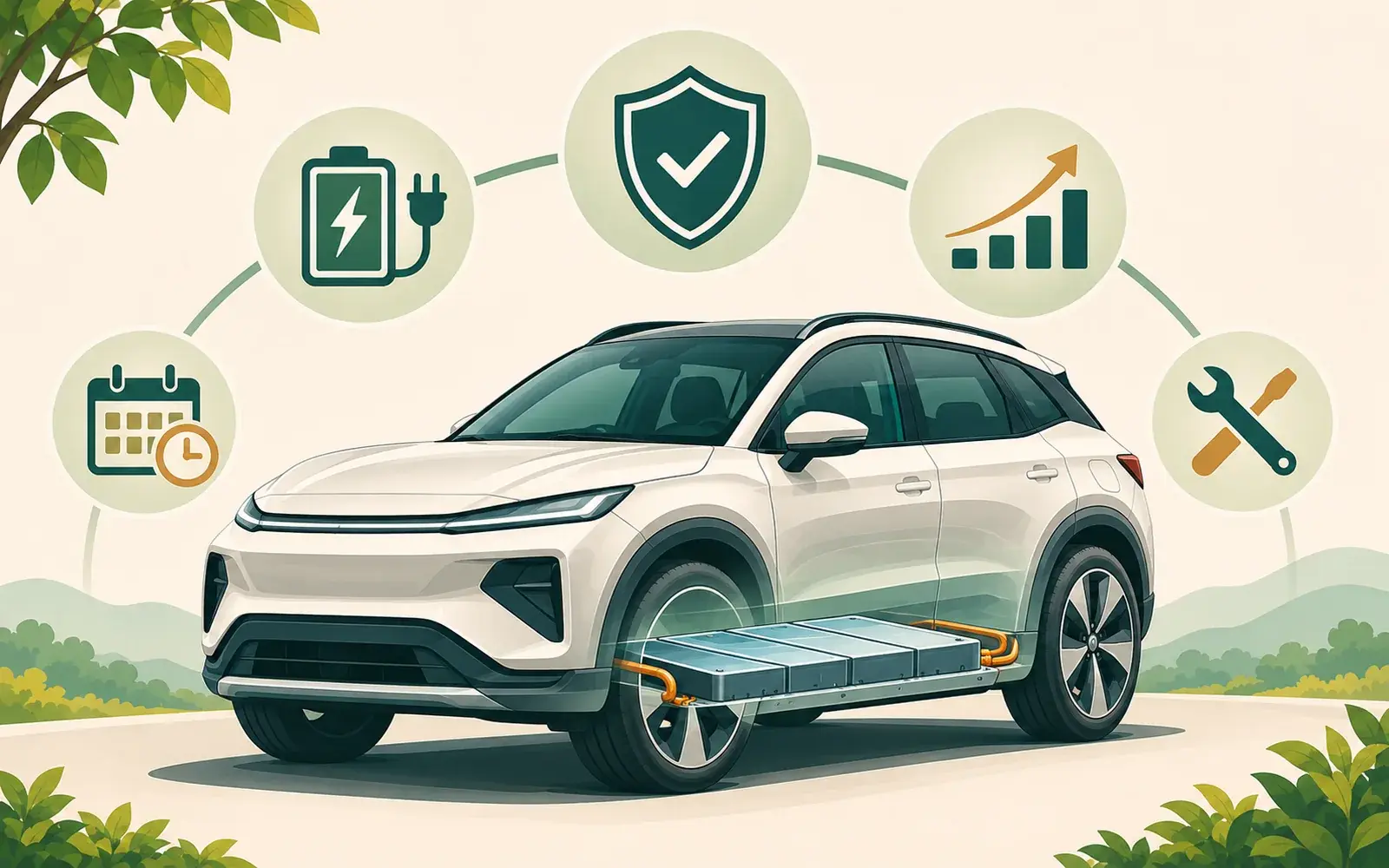
An electric car battery is expensive, so an obvious worry follows: what happens if it needs replacing after the warranty expires? Online discussions often treat battery replacement as inevitable after a fixed number of years. The reality is less dramatic—and more dependent on the particular car.
Modern EV batteries gradually lose some capacity, but capacity loss is not the same as battery failure. Many packs remain useful well beyond their initial warranty, while an unexpectedly defective or accident-damaged pack can require attention much sooner. For Indian buyers, the important questions are how the battery is ageing, what the manufacturer's written warranty covers, and what repair options exist if something goes wrong.
Does an electric car battery need replacing after eight years?
No. Eight years is a common battery-warranty period, not an automatic expiry date. A car may continue working for years after the warranty ends. Conversely, a covered defect can occur within the warranty period.
The US Department of Energy's Alternative Fuels Data Center cites predictive modelling suggesting battery lifespans of roughly 12–15 years in moderate climates and 8–12 years in extreme climates. Those are modelling ranges, not guarantees for Indian cars. Battery design, cooling, heat exposure, mileage and charging habits all matter.
An EV also has two distinct battery systems: the large high-voltage traction battery, which propels the car, and a smaller 12-volt auxiliary battery that supports electronics. A 12-volt battery replacement is a different, usually far less consequential, repair. The discussion below concerns the expensive high-voltage pack.
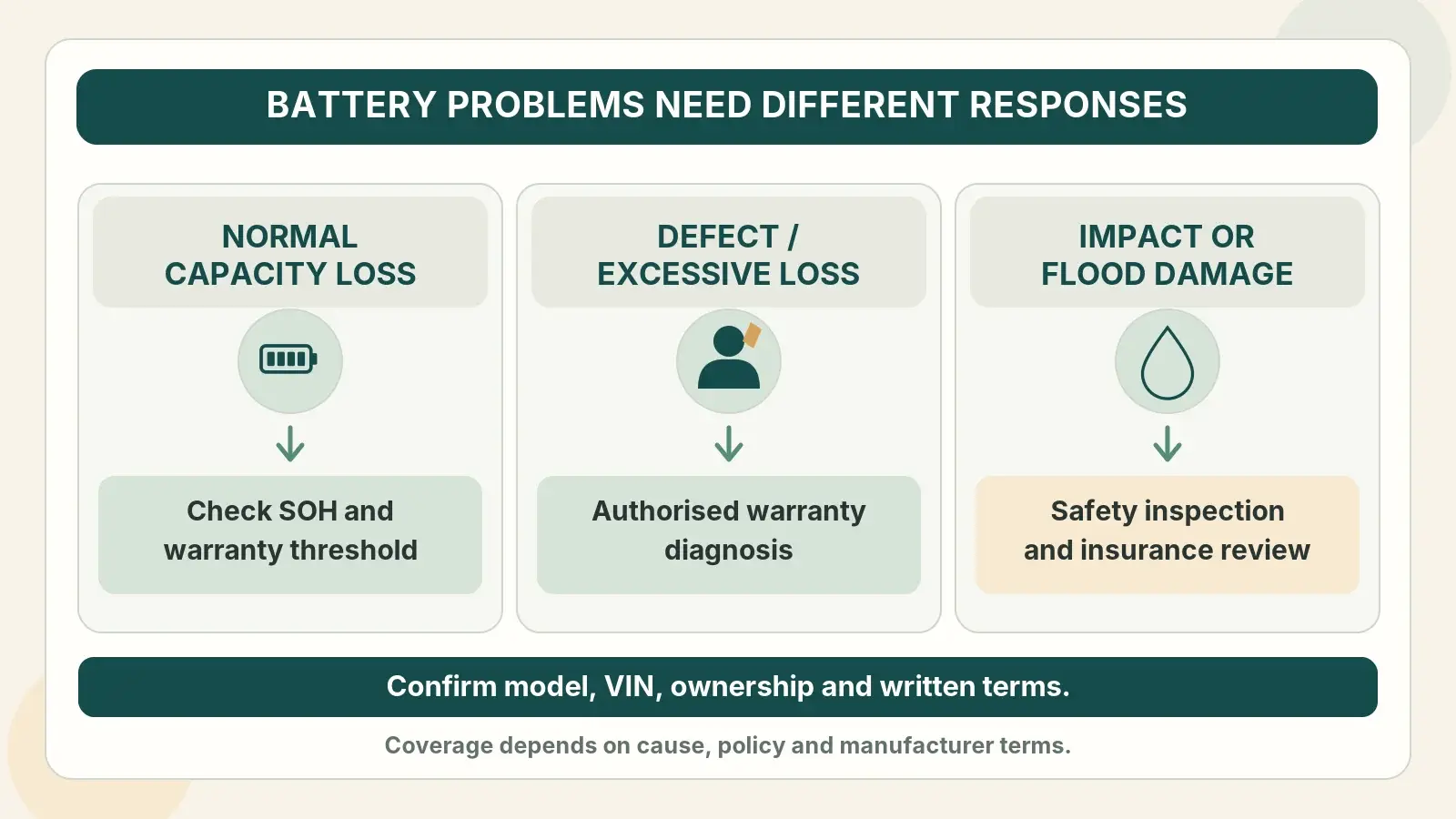
Degradation, failure and damage are three different problems
Normal degradation: less usable energy
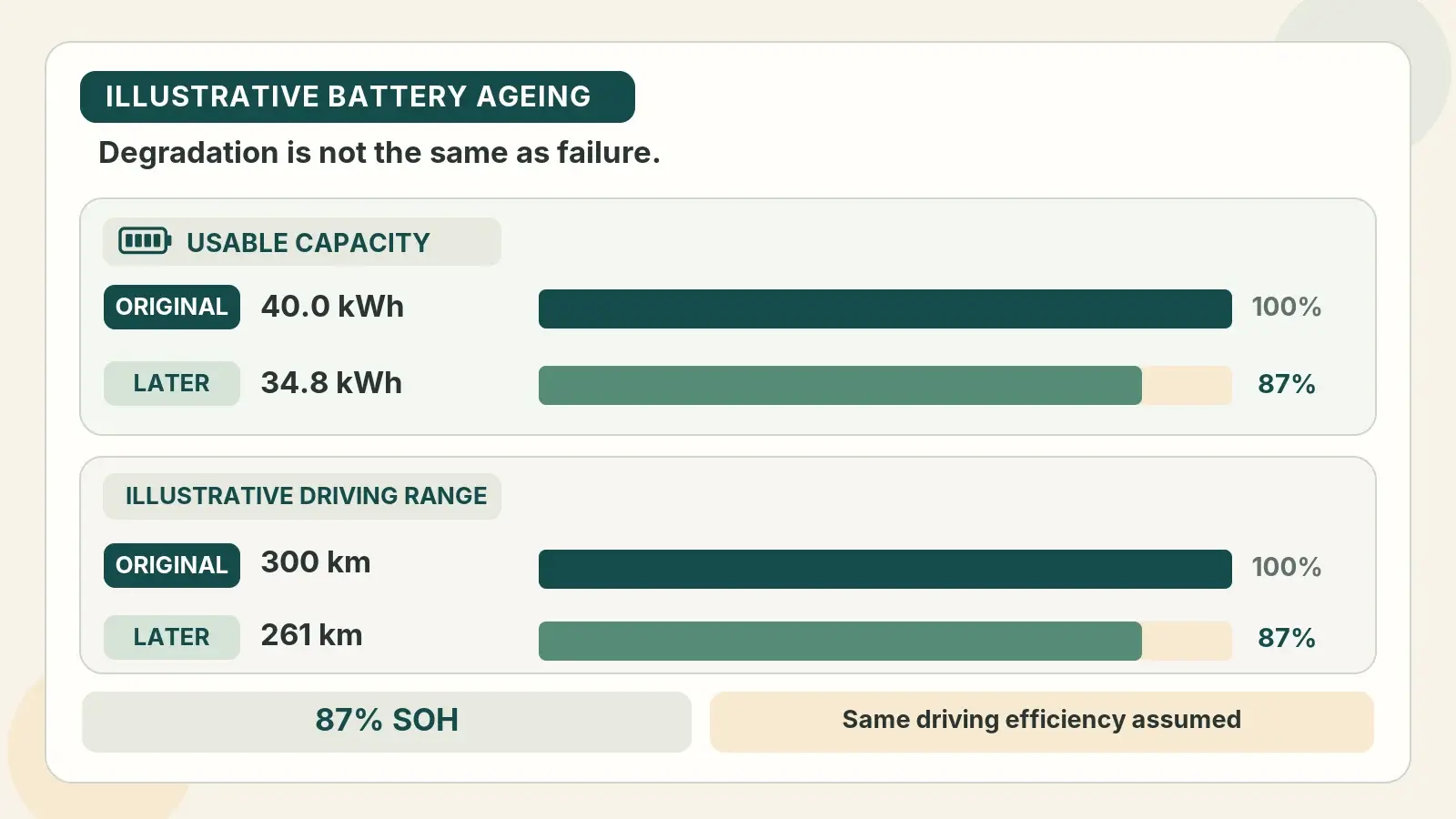
State of health (SOH) describes a battery's remaining energy-storage capacity relative to a reference condition. An illustrative car that began with 40 kWh of usable energy and later holds 34.8 kWh has approximately 87% SOH, assuming both figures use the same measurement basis.
If it originally travelled 300 km under a given set of conditions, a simple capacity-only calculation gives approximately 261 km at 87% SOH. Real-world range will not fall in perfect proportion: tyres, temperature, speed, software and usable-capacity buffers also influence the result.
A battery at 87% SOH is not necessarily faulty. Even a car at 70% SOH may remain drivable, although reduced range could make it less useful to its owner. A warranty threshold is not a physical switch at which the battery suddenly stops working.
Unexpected failure: a repair may be necessary
A battery-management-system fault, isolation problem, defective cell group or other high-voltage issue can limit charging or disable the car. Some problems involve sensors, connectors, cooling or electronics rather than every cell in the pack. Proper diagnosis determines whether the solution is a component repair, authorised battery repair or full pack replacement.
Accident or flood damage: a separate risk
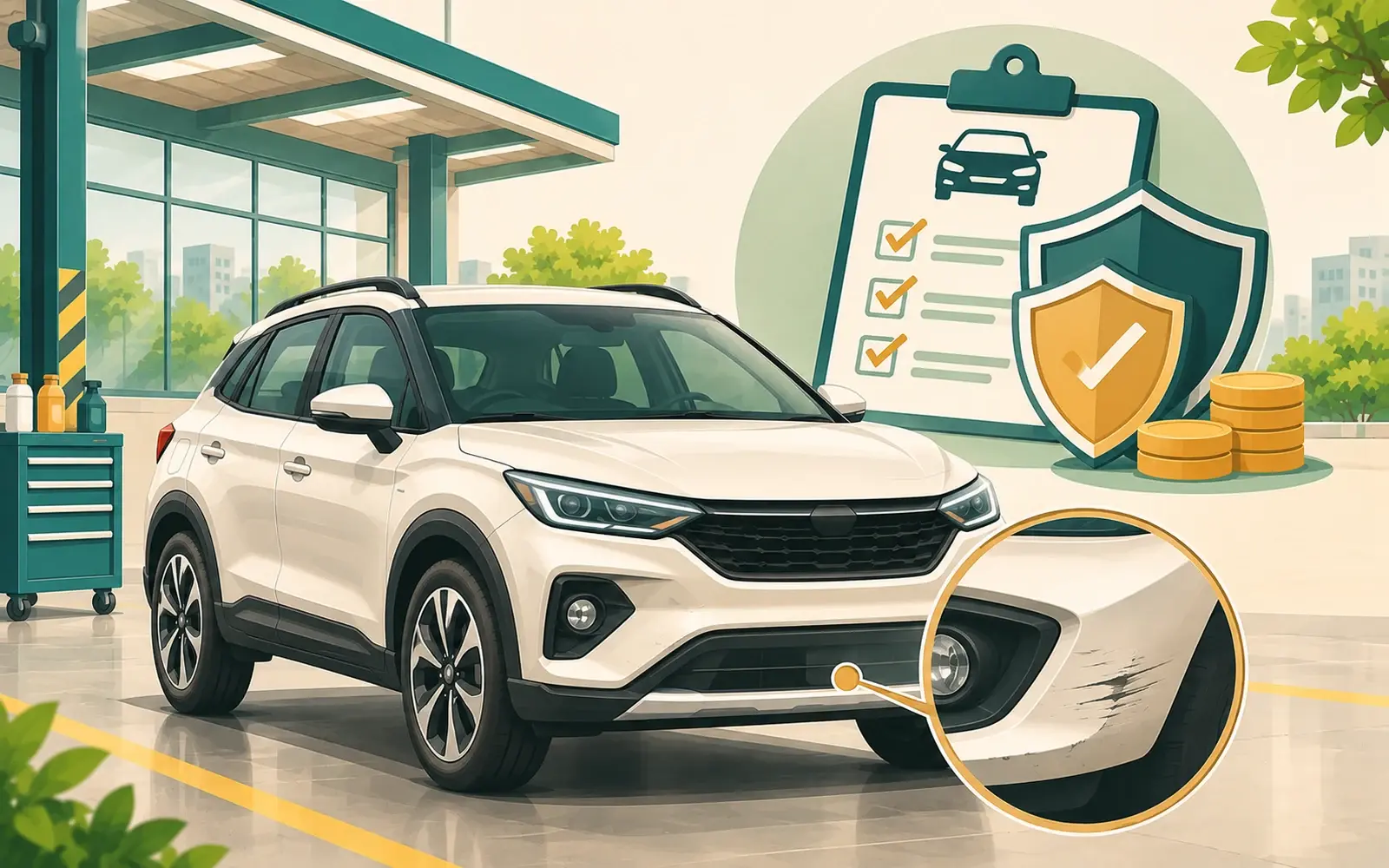
Road debris, an underbody impact, a collision or flooding can damage a pack that was otherwise healthy. Such damage may be excluded from a manufacturing-defect warranty and instead raise an insurance question, depending on the policy and cause. An owner should never open or attempt to repair a high-voltage pack; an authorised EV service facility must assess its safety.
What do real-world studies say about battery lifespan?
The strongest useful evidence follows vehicles over time rather than relying on anecdotes about a single failed pack.
In its April 2026 battery-health analysis, telematics company Geotab examined more than 22,700 vehicles across 21 models. It reported an average degradation rate of approximately 2.3% per year. At that simplified average rate, remaining capacity after eight years would be about 81.6%. Its earlier 2024 analysis had reported 1.8% per year; differences in vehicle mix and charging behaviour matter.
These findings are reassuring, but 2.3% is a fleet average, not an annual deduction to apply to a specific Indian EV. Degradation is often faster initially and slower later; age, cooling and model design can produce different outcomes. Much of the dataset is outside India, so it should not be used as a model-specific Indian ownership forecast.
Failure-related replacements also appear less common than some headlines suggest. A 2024 US Department of Energy summary of Recurrent's roughly 15,000-vehicle sample put battery replacements due to failure at 1.5%, excluding recalls. That dataset included plug-in hybrids as well as full EVs and is historical, not a current Indian failure rate.
What makes an EV battery age faster in India?
Heat is a major consideration. Lithium-ion batteries age even when parked (calendar ageing), and high temperatures accelerate several ageing reactions. A good battery thermal-management system helps, but a car regularly exposed to very hot conditions may age differently from the same model in a milder climate.
Charging behaviour also matters. Geotab's 2026 analysis associated heavy use of DC charging above 100 kW with average degradation of around 3.0% per year, compared with about 1.5% for predominantly lower-power charging. That comparison reflects observed groups, not a controlled claim that every high-power session causes a fixed loss. Many Indian EVs also charge at lower peak DC rates.
Other relevant influences include:
- Time spent at extreme charge levels: Leaving a car near full or near empty charge for extended periods can add stress. Occasional 100% charging for a journey is different from routinely storing it full in the heat.
- Battery chemistry and engineering: Lithium iron phosphate (LFP) and nickel-based chemistries have different characteristics, but neither label alone proves an individual car will last longer. Cooling, protective buffers and software are crucial.
- Repeated heavy use and deep cycling: Total energy throughput matters, although a well-managed pack is designed for many cycles.
- Physical damage or poor repairs: A collision, water ingress or unauthorised electrical work creates a safety and financial risk separate from ordinary ageing.
Follow the charging and storage instructions for the exact car, especially where its manufacturer recommends periodic full charges for calibration. Generic advice to stop every charge at 80% is not a universal rule.
What battery warranties actually cover in India
A battery warranty usually combines a time limit, sometimes a kilometre limit, eligibility conditions and rules governing defects or excessive degradation. It is separate from the car's general warranty. Advertising the word lifetime does not mean an unrestricted, transferable promise forever.
Some verified manufacturer examples illustrate the differences:
| Example in India | Published high-voltage battery coverage | Important qualification |
|---|---|---|
| Tata.ev — selected eligible models, including Nexon.ev 45 kWh and Curvv.ev | “Lifetime” for qualifying first private registration; Tata defines this as 15 years | Terms differ for subsequent owners, including an 8-year/1,60,000 km framework measured from first registration. Verify the exact variant and transfer conditions. |
| Mahindra electric-origin SUVs, including BE 6 and XEV 9e | Lifetime for first registered private owner | For later owners, published terms state 10 years/2,00,000 km, whichever comes first, counted from the original delivery. |
| Hyundai IONIQ 5 | 8 years/1,60,000 km, whichever comes first | Hyundai's India documentation states that normal ageing within its internal standards is excluded. |
| MG Windsor EV | Lifetime battery warranty advertised for the first owner | Check the signed plan's eligibility, transfer and claim rules; a headline alone is insufficient. |
Sources: Tata.ev battery terms, Mahindra EV warranty terms, Hyundai IONIQ 5 warranty documentation and MG Windsor information.
Never assume that every variant or older production batch has the newest advertised warranty. Ask the seller or manufacturer to confirm the policy against the vehicle identification number (VIN) and original registration date.
What does a 70% SOH warranty threshold mean?
Some manufacturers define excessive degradation using 70% SOH. Tata's published terms, for example, describe repair or replacement if eligible battery health falls below that threshold during coverage; Mahindra also publishes a 70% battery-health criterion in its detailed warranty guide. But 70% is not a universal Indian warranty rule. Other manufacturers may use their own criteria or focus on defects.
There is another subtlety: repair under warranty need not return the pack to 100% of new capacity. Tata's terms describe a specified post-repair capacity outcome, rather than an unconditional brand-new battery. Read the exact remedy, exclusions and diagnostic method—not just the percentage.
How much does replacing an EV battery cost?
A full, out-of-warranty traction-battery replacement can cost several lakh rupees, but there is no dependable single India-wide price per kWh or authorised replacement tariff for every model. Internet estimates often mix factory pack costs, cell costs, repair costs, pre-tax numbers and actual dealer quotations. They should not be treated as a service-centre price list.
The final bill can depend on pack size, chemistry, casing and cooling design, battery-management electronics, parts availability, labour, taxes and whether a usable part can be repaired. A complete sealed-pack replacement can cost very differently from repairing a covered component. The US DOE similarly warns that out-of-warranty battery replacement can be a significant expense while noting that manufacturers often do not publish replacement prices.
For perspective, consider a hypothetical older EV worth ₹6 lakh in working condition. If its actual, written out-of-warranty repair quote were ₹4 lakh, the repair alone would equal about 67% of that assumed value. These figures are an ownership-risk example, not a verified quote for any Indian model. Before paying, obtain an itemised authorised estimate, the fault report, repair-versus-replacement options and the warranty on any replacement parts.
This distinction matters for resale: a low-probability but high-cost event can still influence how much a buyer is willing to pay for an older EV.
What if the battery develops a problem?
Do not start by demanding a new pack. First ask an authorised workshop for a written diagnosis identifying the fault codes, battery health result and whether the problem is in the cells, cooling system, high-voltage connections or controls. Request the exact warranty clause used to approve or reject a claim.
For a rejected claim, ask for the measured SOH, test conditions, explanation of any alleged misuse or damage, and the manufacturer's review or escalation process. Keep service and charging records where practical. If the issue involves an impact or flood, notify the insurer promptly and follow emergency/safety instructions; manufacturing warranties and insurance cover different causes.
Buying a used EV: check the battery before the bargain
For a second-hand EV in India, battery condition and warranty transferability may matter as much as odometer reading. Before paying:
- Get a model-specific battery-health report from an authorised service centre. Ask what the SOH number means and whether it reflects usable or nominal capacity.
- Verify the VIN, variant and warranty balance in writing. Note the initial registration/delivery date and whether first-owner lifetime benefits end after transfer.
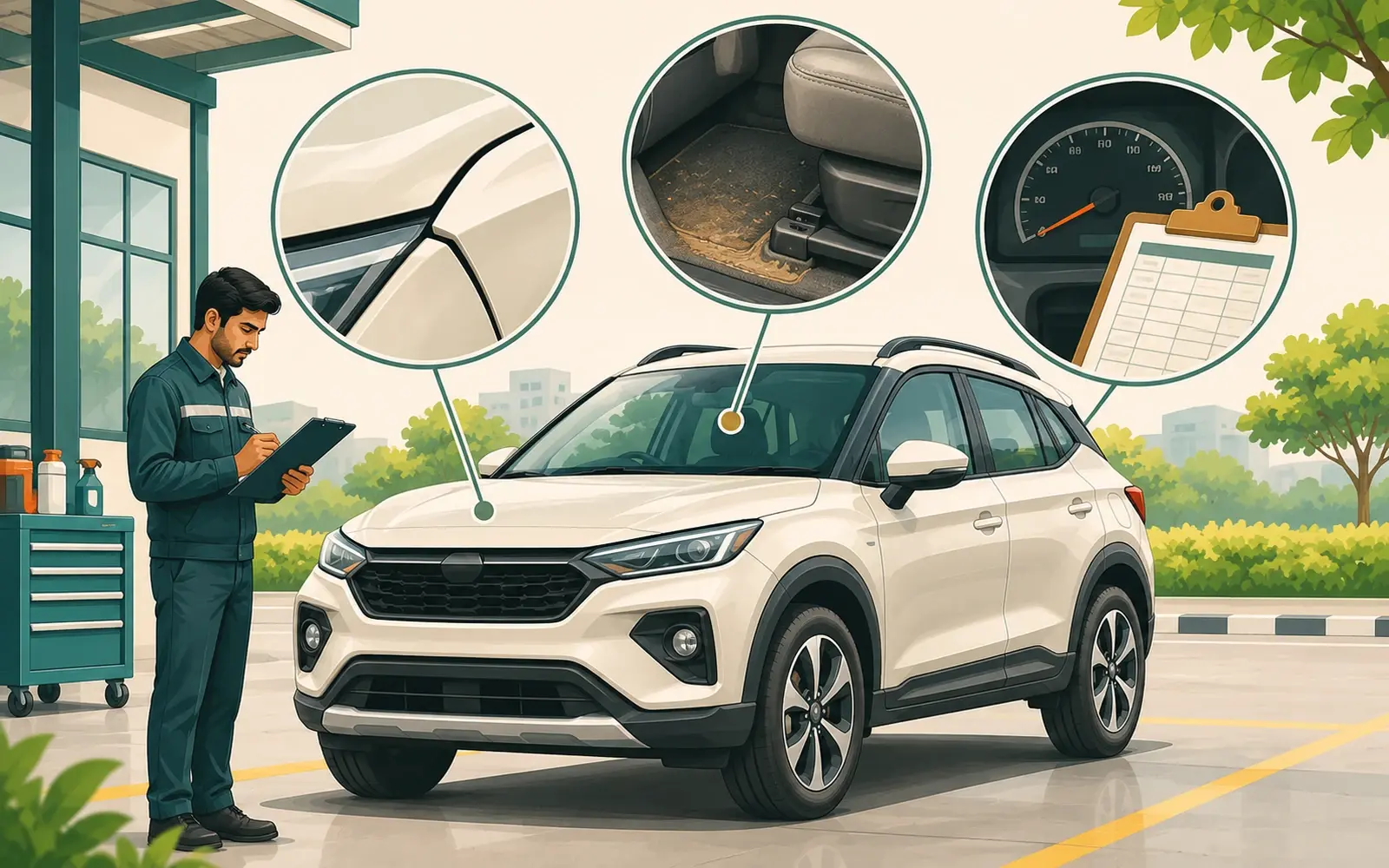
- Inspect for accident, flood and underbody damage. Ask about high-voltage repairs, battery removal and outstanding recalls.
- Check the real driving range sensibly. A short test-drive estimate is not a substitute for a controlled assessment; heat, traffic and speed change efficiency.
- Confirm service support and possible replacement costs. Ask whether the maker offers component-level repair, full-pack replacement and parts availability for that model.
- Check battery financing obligations. Under a Battery-as-a-Service arrangement, usage payments, outstanding finance and transfer/exit conditions can affect the deal; MG's Windsor BaaS FAQ illustrates why these must be examined separately from the car's sale price.
An attractive claimed range or a remaining “lifetime” badge does not substitute for these documents.
How to reduce battery-ownership risk
Prefer a vehicle with credible thermal management, accessible authorised service and clear written battery-health coverage. Charge conveniently at home when possible; use DC fast charging when it is useful, without treating every session as harmful. Avoid unnecessarily leaving a vehicle parked for long periods at extreme charge levels in high heat. Follow manufacturer maintenance and software instructions, and investigate unexpected range changes rather than assuming the battery has worn out.
Finally, evaluate the whole ownership case: expected kilometres, actual charging access, battery-health warranty, insurance, resale prospects and the cost of a potential repair after coverage ends.
The bottom line
EV batteries are not disposable parts with an eight-year countdown. Gradual degradation is normal; outright failure and accident damage are different risks. Modern fleet data points to substantial useful life, while an out-of-warranty full-pack replacement remains financially serious.
For an Indian buyer, the sensible approach is to verify the exact warranty, protect the pack from avoidable stress and demand a credible battery-health assessment before buying used. Those steps matter more than either fear-driven replacement-cost headlines or an unqualified “lifetime battery” promise.
Sources and Further Reading
- US Department of Energy — EV benefits, battery life and replacement considerations
- Geotab — 2026 real-world EV battery health study
- US Department of Energy — battery replacements due to failure, historical sample
- Tata.ev — high-voltage battery warranty terms
- Mahindra Electric SUV — battery warranty conditions
- Hyundai India — vehicle warranty policy
- MG Motor India — Windsor EV battery warranty
- MG Motor India — Battery-as-a-Service FAQs