GATE CS vs GATE DA: Which Paper Should Computer Science Students Choose?
Compare GATE CS and GATE DA syllabi, preparation overlap, competition and M.Tech eligibility to choose the right paper for your academic and career goals.
Imagine two final-year computer science students deciding to prepare for GATE. One enjoys algorithms, operating systems and building software. The other is fascinated by probability, machine learning and finding patterns in data. Both want to pursue an M.Tech, but preparing for the same entrance paper may not be their best strategy.
The Graduate Aptitude Test in Engineering offers two particularly relevant papers: Computer Science and Information Technology (CS) and Data Science and Artificial Intelligence (DA). The latter was introduced in GATE 2024, giving students a dedicated route to demonstrate their knowledge of data science and AI.
For a typical computer science student who has not yet decided on a specialisation, CS is a sensible default. DA is a strong alternative when your target programmes accept it and your strengths lie in mathematics and machine learning. Taking both is also possible under the GATE 2027 two-paper rules, but the extra preparation is substantial.
The choice is less about which field is more fashionable and more about which examination opens the doors you actually want to enter.
GATE CS and GATE DA at a glance
The two papers have the same basic examination structure but test different bodies of knowledge. GATE 2027 uses a three-hour, English-language computer-based test with multiple-choice, multiple-select and numerical-answer questions.
| Feature | GATE CS | GATE DA |
|---|---|---|
| Official subject | Computer Science and Information Technology | Data Science and Artificial Intelligence |
| Main emphasis | Computing foundations, systems and algorithms | Mathematical modelling, data and learning algorithms |
| Programming language in syllabus | C | Python |
| General Aptitude | 15 marks | 15 marks |
| Remaining marks | 13 engineering mathematics + 72 other subject marks | 85 subject marks, including mathematics |
| Total marks | 100 | 100 |
| Duration | 3 hours | 3 hours |
The absence of a separately allocated engineering mathematics section in DA does not mean there is less mathematics. Its mathematical topics are integrated into the 85 subject marks, with no fixed chapter-wise mark allocation published in the official pattern.
Both papers penalise incorrect MCQ answers by one-third of the question's value. Incorrect MSQ and NAT answers do not attract negative marks, but MSQs have no partial credit. The basic examination technique therefore transfers between the papers, even where the technical content does not.
How different are the syllabi?
Consider an online shopping platform that recommends products to customers. A CS-oriented problem might examine how its database indexes work, how concurrent purchases are handled, or how quickly a search algorithm finds a product. A DA-oriented problem might ask how a prediction model estimates customer preferences, measures uncertainty or evaluates accuracy.
Both perspectives matter to the same application. They simply examine different parts of it.
What CS expects you to know
The CS syllabus is close to the traditional undergraduate computer science curriculum. Its distinctive areas include digital circuits, processor and memory organisation, operating systems, networking, formal languages and compilers. Alongside those subjects, it tests algorithms, C programming, databases and engineering mathematics.
This breadth makes CS a good fit for students who enjoy understanding computing from hardware through software. For instance, a question may require tracing a C program using pointers, calculating cache behaviour, identifying a deadlock or determining the time complexity of a recurrence.
However, the familiar names of these subjects can be deceptive. Passing a university operating systems examination is not the same as solving unfamiliar scheduling and synchronisation problems accurately under time pressure.
What DA expects you to know
DA shifts the focus towards mathematical reasoning about data. The official syllabus includes probability and statistical inference, matrix and vector methods, single-variable calculus and optimisation, Python and selected algorithms, databases and warehousing, machine learning and AI.
You may need to interpret a confidence interval, reason about a matrix decomposition or calculate a model's prediction. Learning the syntax of a Python machine learning library will not substitute for understanding the mathematical method behind the model.
The machine learning component covers regression, classification, model validation, neural-network fundamentals, clustering and dimensionality reduction. The AI component also includes search and probabilistic inference. It is not an examination dedicated to generative AI, prompt engineering or building chatbots.
How much preparation actually overlaps?
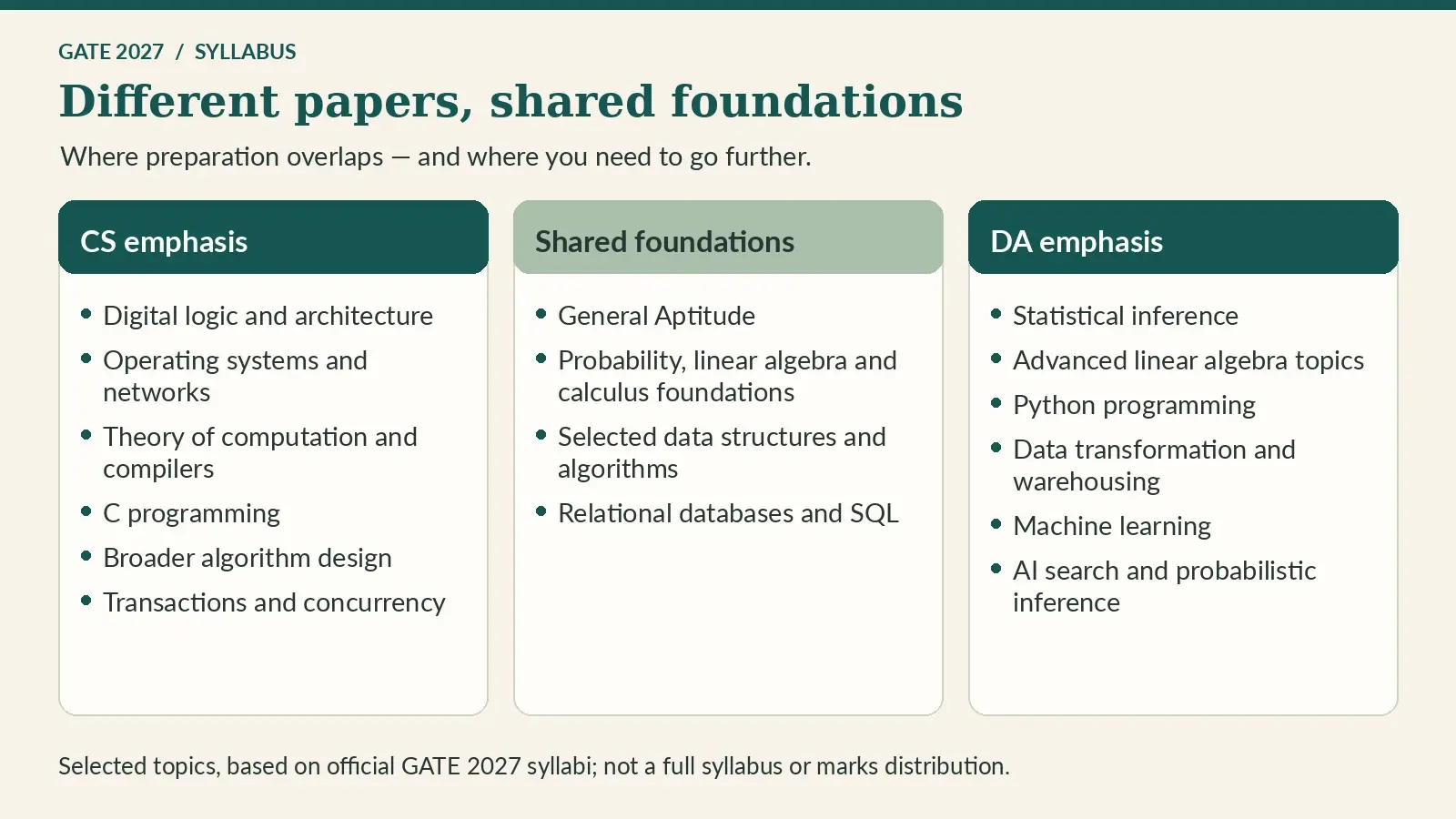
There is genuine overlap, but the same subject heading can conceal significant differences in depth and scope. The following comparison is based on the official GATE 2027 syllabi.
| Area | Shared foundation | Important differences |
|---|---|---|
| Mathematics | Probability, matrix methods, calculus and some logic | CS adds broader discrete mathematics; DA extends statistical inference and linear algebra |
| Programming | Fundamental computational reasoning | CS uses C; DA uses Python |
| Algorithms | Searching, sorting and selected graph methods | CS covers broader algorithm design and complexity |
| Databases | Relational concepts, SQL, normal forms and indexing | CS emphasises transactions and concurrency; DA adds data transformation and warehousing |
| Aptitude | Common General Aptitude syllabus | Practise timed questions for each sitting |
A student who understands Bayes' theorem can reuse that knowledge in both papers. But someone preparing for DA must also be comfortable with topics such as hypothesis testing and confidence intervals. Likewise, learning eigenvalues for CS helps with DA, but does not finish DA's linear algebra requirements, which extend to concepts such as projections and singular value decomposition.
The largest paper-specific preparation blocks are computing systems and theoretical CS on one side, and statistics, machine learning and AI on the other. There is no official percentage of syllabus overlap, and assigning one without a consistent measure would be misleading. Counting chapter headings is particularly unhelpful because chapters vary in size and difficulty.
If you intend to attempt both papers, build shared conceptual notes and then solve separate question sets. For example, study relational algebra once, then practise CS transaction questions and DA warehouse questions independently. For programming, practise both languages rather than assuming that proficiency in one automatically transfers to examination questions in the other.
Does DA have less competition than CS?
The official GATE 2026 results provide an interesting comparison.
| GATE 2026 statistic | CS | DA |
|---|---|---|
| Registered | 259,922 | 91,764 |
| Appeared | 211,020 | 69,242 |
| General qualifying marks | 30.0 | 26.4 |
| OBC-NCL/EWS qualifying marks | 27.0 | 23.7 |
| SC/ST/PwD qualifying marks | 20.0 | 17.5 |
DA had roughly one-third as many test-takers as CS in that year. Its qualifying threshold was also lower. Neither fact establishes that a good rank or a postgraduate seat is easier to obtain through DA.
The number of candidates competing for a particular programme, their performance, the seats available and the programme's selection method all matter. Some programmes accept several GATE papers, so the competition does not necessarily consist solely of people who took your paper. Moreover, the qualifying cutoff is not an admission cutoff.
A lower qualifying threshold in one year may reflect differences in paper difficulty and the distribution of candidate marks. It does not forecast the next year's threshold. Use the data to understand the scale of participation, not to estimate your odds of admission.
CS also has a longer archive of past examination questions. DA candidates have official papers from 2024 onward, making it especially important to supplement them with concept exercises rather than rely on a few observed topic patterns.
Check M.Tech eligibility before choosing the paper
This is the most consequential part of the decision. Being eligible to write a GATE paper does not mean every university will accept that paper for admission.
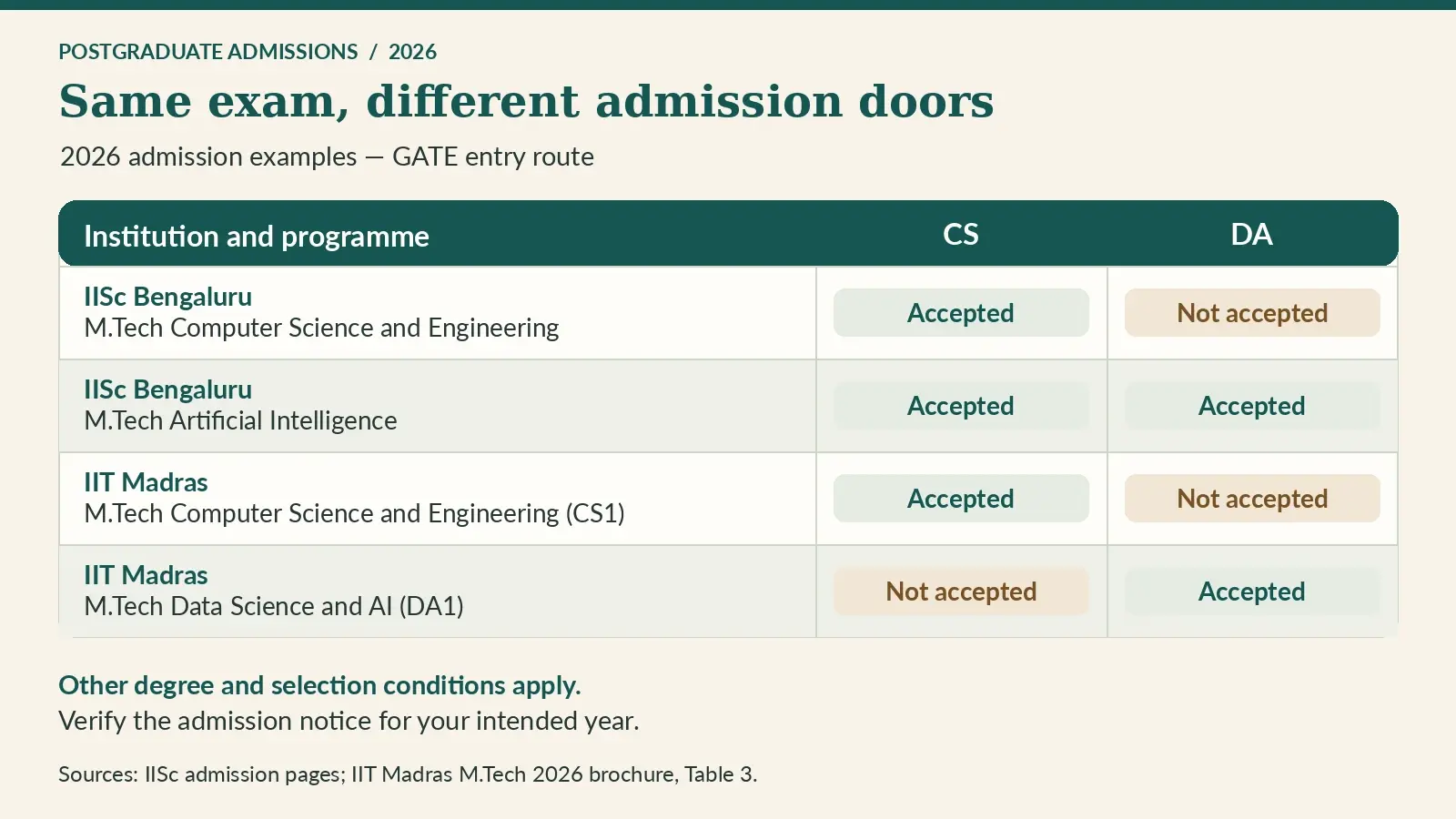
Consider these actual examples from the 2026 admission cycle:
| Institution and programme | CS accepted? | DA accepted? |
|---|---|---|
| IISc Bengaluru — M.Tech Computer Science and Engineering | Yes | No |
| IISc Bengaluru — M.Tech Artificial Intelligence | Yes | Yes |
| IIT Madras — M.Tech Computer Science and Engineering (CS1) | Yes | No |
| IIT Madras — M.Tech Data Science and Artificial Intelligence (DA1) | No | Yes |
These are programme-specific GATE entry requirements, not an exhaustive admission list. Degree eligibility, academic performance, shortlisting criteria and other entry routes also apply. IISc's AI programme, for instance, accepts some other GATE papers and requires a written test for shortlisted GATE-mode applicants.
Notice what this means in practice. An excellent DA score does not replace the required CS score for IISc's traditional M.Tech CSE programme. Equally, a strong CS score alone does not satisfy the DA1 paper requirement in IIT Madras's 2026 table. The decision is about the programme, not just the reputation of the institution.
For NITs and other institutions participating in CCMT, check the official mapping of institute, programme, qualifying degree and accepted GATE paper. For IITs and IISc, consult the individual admission notices and apply as directed by the institution; COAP is used by participating institutions for offers, not as a substitute for their application procedures.
Before registering, shortlist five to ten programmes you would genuinely be willing to join. Record the accepted papers and any degree restrictions. If the admission notice for your intended year is unavailable, use the previous cycle provisionally and revisit the list when the new rules appear. The 2026 examples above are not promises of 2027 admission eligibility.
Which paper fits your career goals?
If your ambition is to work in software engineering, infrastructure, systems research, cybersecurity or other broad computing fields, CS offers a useful foundation and aligns with many traditional CSE admission routes. It also leaves room to specialise in AI later through electives, projects or research. You do not need a DA examination score to become a machine learning engineer.
DA is particularly attractive if you enjoy statistical reasoning and want to pursue AI, machine learning, data science or related research. Its syllabus helps develop the mathematical vocabulary needed to understand why models work, when they fail and how to evaluate them. Nevertheless, practical software engineering, data pipelines and model deployment still require skills beyond the examination syllabus.
If public-sector recruitment is your motivation, start with the employer's actual recruitment notification. A PSU may specify a particular GATE paper, eligible engineering degree and examination year. Never assume that DA is accepted because a vacancy concerns computing, or that a CS score guarantees a recruitment opportunity.
Neither paper is a professional certification or a guarantee of salary. The postgraduate curriculum, research opportunities, internships and skills you develop matter more to your eventual career than the label of the entrance examination alone.
Should you attempt both CS and DA?
The official GATE 2027 combination list permits CS and DA together, in either primary-secondary order. Candidates select the two papers in a single application, subject to the available application windows and applicable fees. Each paper is assessed separately; there is no combined score that merges the best parts of both examinations.
Attempting both can make sense when your preferred programme list includes CS-only and DA-only options, and you already have a substantial foundation in both areas. It is less attractive when you are struggling to finish the main syllabus or when every programme you actually want accepts the same paper.
Suppose you have 20 hours per week available. You might initially reserve 12 hours for your primary paper's distinctive topics and practice, five for shared foundations, and three for the secondary paper. This is an illustrative starting split, not a universal schedule. Increase or reduce the secondary allocation based on actual performance. If your primary mock results deteriorate or essential topics remain untouched, focus on one paper instead.
Use separate timed mock tests and track accuracy, unanswered topics and recurring errors. Completing two sets of video lectures is not the same as being ready for two competitive examinations.
A practical way to make the final choice
Try a short diagnostic before committing months of preparation. Select official past questions from each paper, including unfamiliar subjects, and attempt comparable timed sets. Review not only your marks but also how much learning each error would require. An unfamiliar Python construct may be quick to learn; weak foundations in probability or operating systems can take considerably longer.
Combine that experience with your target programme list.
| Your situation | Sensible starting choice |
|---|---|
| You enjoy broad CSE subjects and want traditional M.Tech CSE options | CS |
| Your target programme requires DA | DA |
| Both papers are accepted and you are stronger in statistics and ML | DA may suit you better |
| You want AI specialisation but are stronger in systems and algorithms | CS, if accepted by your targets |
| Your important targets require different papers and you can prepare for both | CS + DA |
| You have limited time and large gaps in both syllabi | One paper aligned with your highest-priority target |
Your preferences can change as you learn. There is nothing wrong with exploring AI while preparing for CS, or learning core computing systems while preparing for DA. You are selecting an entrance paper, not making an irreversible career commitment.
The bottom line
Choose CS if you want a broad computer science route and your target programmes accept it. Choose DA if your interests, mathematical strengths and admission requirements point towards data science and AI. Choose both only when the additional opportunities justify the extra workload.
A well-prepared attempt at the right paper is usually a stronger strategy than two underprepared attempts. Start with the programmes you want, then work backwards to the examination that gets you there.
For exam-cycle information, visit our GATE Computer Science exam hub.
Related reading: how GATE marks, score and rank differ.
Sources and Further Reading
- GATE 2027 — official papers and revised syllabi.
- GATE 2027 — CS syllabus (PDF).
- GATE 2027 — DA syllabus (PDF).
- GATE 2027 — examination pattern.
- GATE 2027 — permitted two-paper combinations and FAQs.
- GATE 2026 — official paper-wise participation and qualifying marks.
- IISc — M.Tech admission eligibility and selection and M.Tech AI programme.
- IIT Madras — M.Tech 2026 information brochure (PDF), Table 3.
- CCMT — programme and qualifying paper mapping.
- GATE 2027 — official examination portal.