UGC NET Computer Science vs GATE CSE: Common Syllabus, Key Differences and Combined Preparation Strategy
Compare GATE CSE and UGC NET Computer Science syllabi, exam patterns and eligibility, and learn how to prepare for both using shared concepts and separate practice.

Imagine spending three weeks learning database normalization for GATE. You understand functional dependencies, can find candidate keys and know how to decompose a relation into BCNF. When you open the UGC NET Computer Science syllabus, you discover that much of this work is already useful there too. But the syllabus also expects you to understand database triggers, data mining and distributed databases.
That is the opportunity — and the trap — of preparing for these examinations together. A considerable part of your technical foundation can be reused, but neither examination is simply a smaller version of the other.
The most efficient combined strategy is to learn shared computer science concepts once, extend them according to each syllabus, and practise separately for each examination. Whether that strategy is worth pursuing depends on your career goals, eligibility and available preparation time.
Two examinations with different destinations
GATE (Graduate Aptitude Test in Engineering) assesses academic knowledge in a chosen discipline. Its Computer Science and Information Technology paper has the code CS, commonly called GATE CSE. Candidates use it primarily for technical postgraduate programmes, certain doctoral programmes and recruitment opportunities where employers accept the relevant GATE score.
UGC NET (University Grants Commission National Eligibility Test) serves a different purpose. Computer Science and Applications is subject code 87. Its qualification categories relate to Junior Research Fellowship (JRF), Assistant Professor eligibility and Ph.D. admission.
| Feature | GATE CSE | UGC NET Computer Science |
|---|---|---|
| Typical goal | M.Tech, research or eligible technical recruitment | JRF, teaching eligibility or Ph.D. admission |
| Technical scope | Defined core CS and engineering mathematics | Core CS plus additional computing disciplines |
| Common component | General Aptitude | Paper 1: teaching, research and general aptitude |
| Result | Marks, GATE score and rank | Qualification category based on applicable result criteria |
There is overlap in research pathways: some doctoral programmes accept GATE, while others accept NET or use additional selection methods. Neither result guarantees admission, funding or employment. Always check the institution's own rules.
Check eligibility before planning for both
GATE 2027 permits eligible students in the third year or later of undergraduate study, as well as graduates of recognized qualifying programmes. Eligibility to take GATE is broader than eligibility for a particular M.Tech programme.
For UGC NET, the usual master's-degree route requires at least 55% for General/General-EWS candidates and 50% for specified reserved categories, including OBC-NCL, SC, ST, eligible disability categories and third gender candidates. Candidates pursuing a qualifying master's degree may apply provisionally, subject to the bulletin's conditions.
The December 2026 bulletin also permits the four-year bachelor's degree route with a minimum of 75% aggregate or equivalent grade, with prescribed relaxations. Crucially, a candidate qualifying through that route may be eligible for JRF or Ph.D. admission, but not Assistant Professor appointment on the basis of that qualification alone.
JRF also has an upper age limit of 30 years under the current bulletin, measured on the specified cycle-specific date, with applicable relaxations. NET for Assistant Professor or Ph.D. admission has no upper age limit. Verify the latest bulletin and the relevant degree and subject requirements before applying.
Exam pattern: the same three hours, a different challenge
The examination formats below are based on GATE 2027 and the updated UGC NET December 2026 information bulletin.
| Feature | GATE CSE | UGC NET |
|---|---|---|
| Duration | 180 minutes | 180 minutes for both papers together |
| Questions | 65 | 150 |
| Maximum marks | 100 | 300 |
| Distribution | Aptitude 15, mathematics 13, other CS 72 | Paper 1: 50 questions/100 marks; Paper 2: 100 questions/200 marks |
| Question types | MCQ, MSQ, numerical answer | Single-answer MCQ |
| Wrong answers | MCQ penalty: one-third of question value; none for MSQ/NAT | No negative marking |
GATE's multiple-select questions have no partial credit. Its numerical questions require you to produce the answer instead of recognizing it among options. NET, by contrast, rewards completing a large number of questions accurately within the same total time.
A GATE candidate has an average of roughly 166 seconds per question; a NET candidate has 72 seconds. These are arithmetic averages, not recommended time limits for individual problems. A long GATE scheduling problem can take several minutes, while an easy aptitude question might take seconds.
This difference changes how you should practise. For GATE, build calculation accuracy and judgement about which questions deserve time. For NET, train quick recall, statement evaluation, elimination and numerical problem solving without getting trapped in one question. Both require understanding; NET is not merely memorization, and GATE also tests theoretical knowledge.
Common syllabus: what can you learn together?
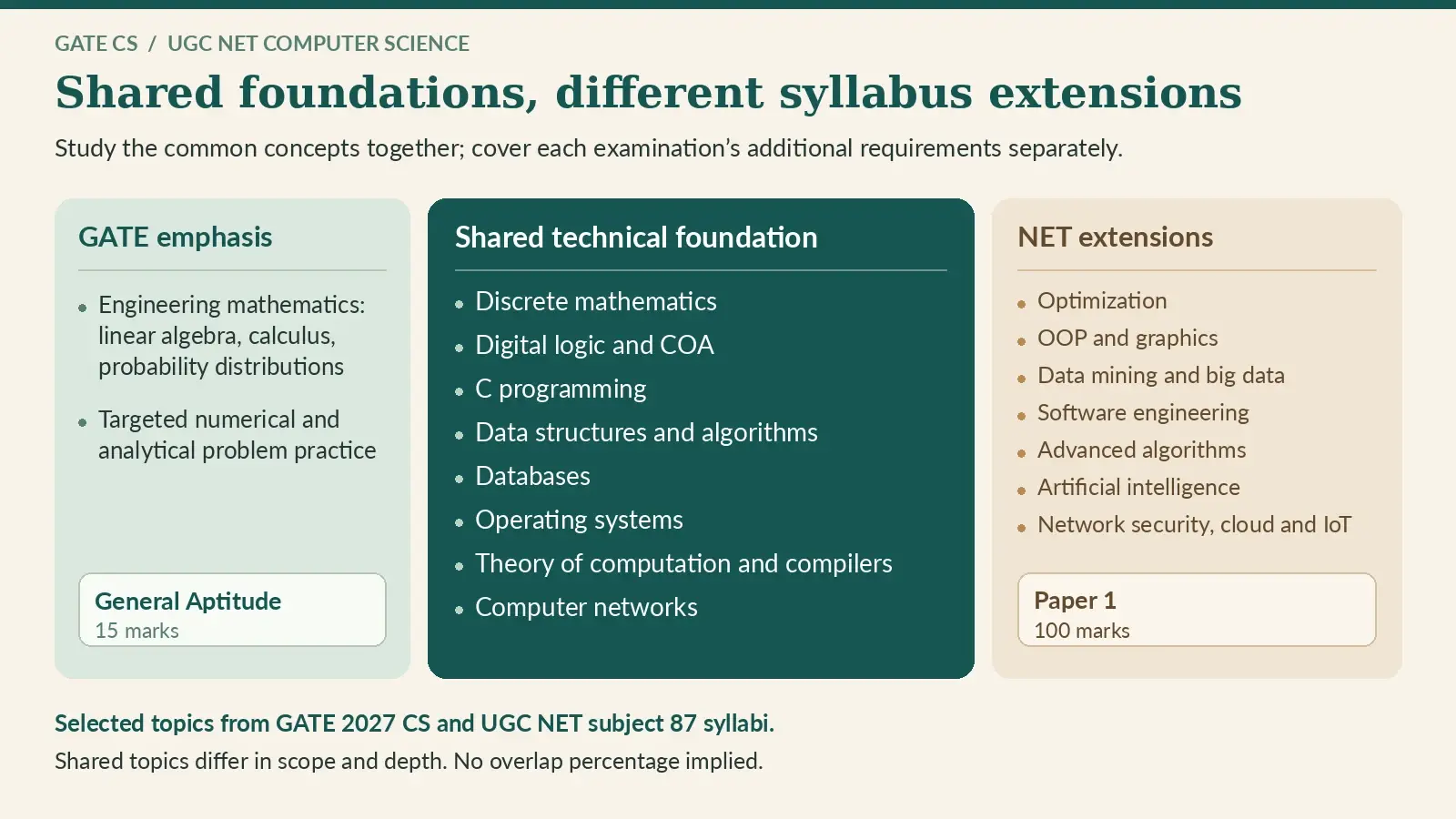
The GATE 2027 CS syllabus contains ten technical sections. UGC NET Computer Science organizes its technical content into ten units of a different scope. The following is a practical mapping of selected shared topics, not an official equivalence table or a prediction of marks.
| Shared study area | UGC NET unit | Reusable foundation |
|---|---|---|
| Discrete mathematics | 1 | Logic, sets, relations, counting, graphs and discrete probability |
| Digital logic and COA | 1, 2 | Boolean simplification, circuits, arithmetic and processor organization |
| C programming | 3 | Expressions, functions, arrays and pointers |
| Data structures and algorithms | 7 | Trees, graphs, searching, sorting, complexity and design techniques |
| Databases | 4 | Relational models, SQL, dependencies, normalization and transactions |
| Operating systems | 5 | Processes, synchronization, scheduling, memory and files |
| Theory of computation | 8 | Automata, grammars, language classes and computability |
| Compiler design | 8 (also 3 and 5 for related foundations) | Translation, parsing, intermediate representation and optimization |
| Computer networks | 9 | Layering, switching, addressing, routing and transport protocols |
Start with these shared foundations. You do not need to buy two sets of textbooks or create duplicate notes for every concept. A good explanation of a semaphore remains useful in either examination.
But do not mark an entire NET unit as completed because you finished a similarly named GATE subject. Unit 4, for example, includes much more than traditional relational database design. Unit 9 includes communications and network technologies beyond the topics explicitly listed for GATE CS.
Where the syllabi diverge
NET generally has a wider spread of named computing topics. The following additions deserve dedicated study rather than a last-minute skim:
| NET-specific extensions | Examples to prepare |
|---|---|
| Optimization and algebra | Linear programming, project scheduling, rings and fields |
| Programming and graphics | Object-oriented C++, web technologies, geometric transformations and rendering |
| Database extensions | Data warehousing, mining, NoSQL and big-data systems |
| System software and OS extensions | Linking, loaders, Linux, Windows, virtualization and distributed systems |
| Software engineering | Requirements, design quality, estimation and testing |
| Algorithm extensions | NP-completeness, maximum flow, approximation and randomized algorithms |
| Networking extensions | Data transmission, IPv6, network security, mobile networks, cloud and IoT |
| Artificial intelligence | Heuristic search, knowledge representation, fuzzy systems and neural networks |
These are examples of additional NET syllabus content, not an exhaustive list. The compiler and architecture units also contain extensions, such as global optimization and multiprocessor organization. Some topics may arise incidentally while learning GATE concepts even though they are not separately specified there.
GATE has its own distinct needs. Engineering Mathematics explicitly includes linear algebra, calculus and continuous probability distributions. NET's discrete mathematics unit does not replace this complete mathematics syllabus. Matrices are useful in NET graphics, for instance, but that does not mean preparing graphics automatically covers GATE eigenvalue problems.
Similarly, GATE's tightly defined topics require sustained problem practice: cache mapping, pipeline hazards, graph algorithms, C recursion, synchronization and formal languages. Studying a wider NET syllabus cannot substitute for that practice.
Avoid claims that a fixed percentage of the two syllabi overlaps. Counting chapter titles ignores differences in detail, and counting topics does not reveal how many examination marks they will carry.
Why the same concept needs two practice methods
Consider an original CPU scheduling example. Three processes arrive at time zero, with burst times of 6, 2 and 4 milliseconds respectively. Under non-preemptive shortest-job-first (SJF) scheduling, they run in the order of burst times 2, 4 and 6.
Their waiting times are 0, 2 and 6 milliseconds. Average waiting time is therefore 8/3, or approximately 2.67 milliseconds.
A GATE-style numerical question might ask for this average, or change the arrival times and require a new schedule. A NET-style single-answer question might ask which statement describes non-preemptive SJF correctly, or present the same calculation with four possible answers.
For example, the statement that an arriving shorter job immediately interrupts a running process is false under non-preemptive SJF. That describes preemption, associated with shortest-remaining-time scheduling under the corresponding assumptions.
Both questions rely on the same foundation. One emphasizes tracing a schedule; the other may require recognizing a precise distinction quickly. The best preparation includes both tasks. These examples are illustrative, not actual previous-year questions.
Paper 1 is not just another name for General Aptitude
GATE General Aptitude and NET Paper 1 share useful skills in arithmetic, logical reasoning and reading comprehension. But they are not interchangeable.
NET Paper 1 additionally covers teaching and research methods, communication, ICT, environmental and development issues, higher education and specialized logical reasoning, including Indian logic. A computer science graduate may already know some ICT content, but understanding computer networks does not automatically prepare them for education policy or research ethics.
At 100 out of 300 marks, Paper 1 accounts for one-third of the NET examination. Leaving it entirely until the final weeks can undo the advantage gained from studying technical subjects together.
A combined preparation strategy that actually works
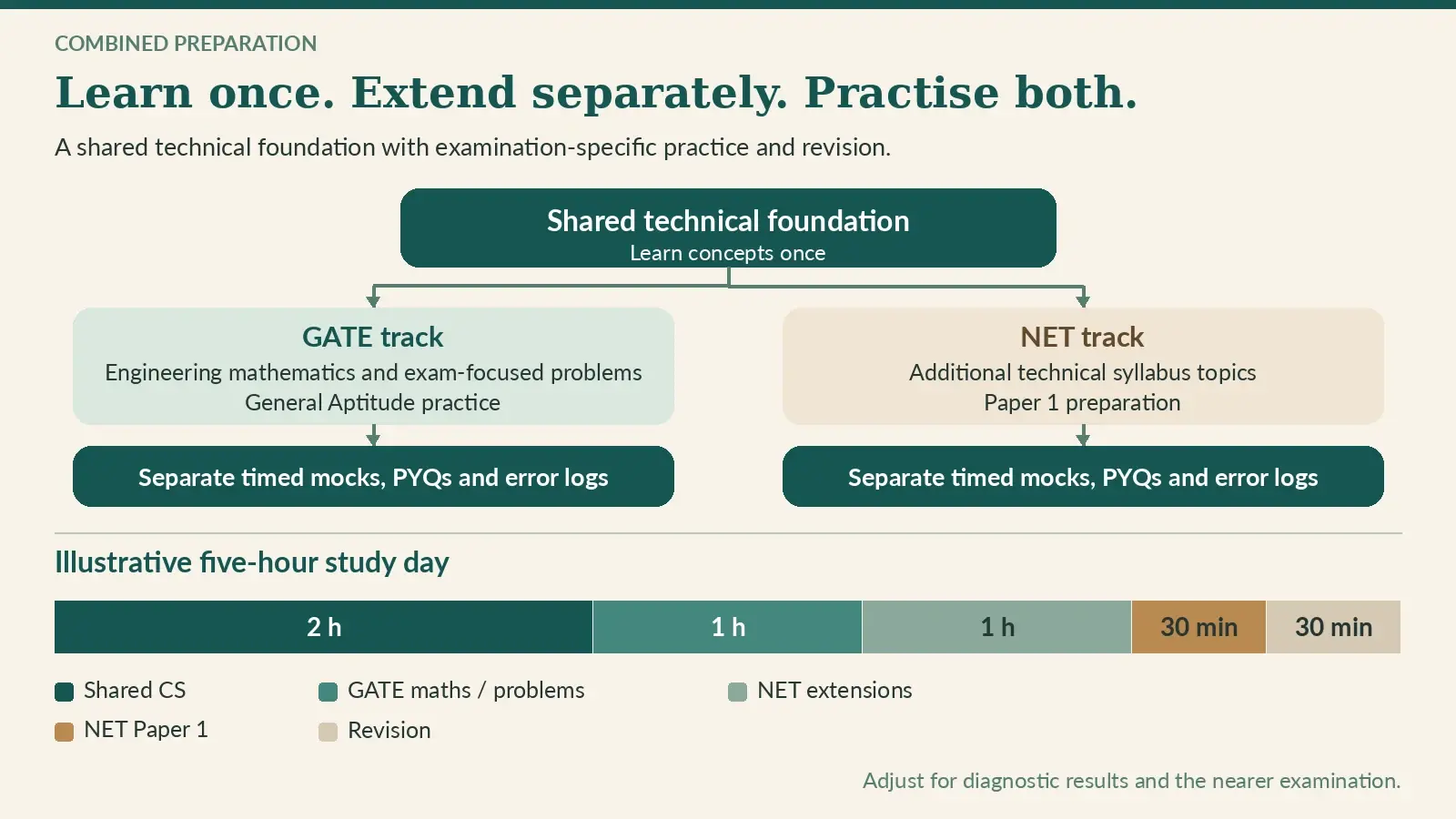
Instead of running two independent timetables, organize your study into three layers: the common technical foundation, examination-specific additions and separate examination practice.
Layer 1: Build the common foundation
Begin with C programming and discrete mathematics, then progress through data structures and algorithms. Study databases, operating systems, digital logic and architecture, networks, theory of computation and compilers in an order that fits your existing knowledge.
After each topic, solve relevant questions from both examinations. For example, complete functional dependencies before attempting normalization questions, then test yourself using both numerical or reasoning problems and fast conceptual MCQs.
Layer 2: Extend each topic immediately
Keep one main notebook or digital note collection. At the end of a chapter, add a small section for GATE-specific scope and another for NET-specific extensions.
After covering traditional DBMS, for instance, spend a separate study block on NET's warehouse, mining and NoSQL concepts. Keep engineering mathematics and NET Paper 1 running as parallel tracks from the beginning. Do not wait until every shared technical subject is finished.
Layer 3: Practise in the real examination formats
Maintain separate previous-year question sets, mock tests and error logs. A GATE mock score and a NET mock score cannot be directly compared, even if converted into percentages. Track improvement against the expectations of each examination instead.
Record why you missed a question: missing knowledge, incorrect reasoning, arithmetic, misreading, poor time management or an unnecessary guess. Your revision priorities should emerge from those errors rather than simply following whichever subject you enjoy most.
An illustrative five-hour study day
| Activity | Time |
|---|---|
| Shared technical concept study | 2 hours |
| GATE mathematics or GATE-focused problems | 1 hour |
| NET technical extensions | 1 hour |
| NET Paper 1 | 30 minutes |
| Mixed revision and error review | 30 minutes |
| Total | 5 hours |
This is a starting allocation, not a fixed formula. On a mock-test day, replace study blocks with a full three-hour paper and analysis. Practise GATE General Aptitude regularly within the relevant practice blocks, and increase its allocation when diagnostic results indicate a weakness.
As one examination approaches, shift more time toward its incomplete topics and timed mocks. Maintain the other track with shorter revision sessions if doing so does not compromise the primary target. A student with a strong technical background may need considerably more time for NET-only topics than for the common foundation.
Should you attempt both?
Choose GATE as your primary target if technical postgraduate study or a particular GATE-based recruitment opportunity is your main objective. Choose NET as your primary target if JRF, university teaching eligibility or a NET-based doctoral pathway is more relevant.
Preparing for both makes the most sense when you meet the respective eligibility requirements, have realistic time for both and would genuinely use either result. If one examination is close and you still have major gaps, concentrating on one may be the better decision.
The goal is not to collect qualifications simply because the syllabi overlap. It is to create more useful academic and career options without doubling the effort. For the current GATE cycle and its official resources, explore the GATE Computer Science exam hub.
Related reading: how to interpret NET percentile, qualifying cutoffs and JRF eligibility.
Sources and further reading
The study strategy, topic groupings and worked questions are editorial guidance.
- IIT Madras — GATE 2027 CS syllabus (PDF)
- GATE 2027 — question paper pattern
- GATE 2027 — eligibility criteria
- GATE 2027 — opportunities
- UGC NET Bureau — official syllabus index (codes 00 and 87)
- Atal Bihari Vajpayee Vishwavidyalaya — university-hosted reproduction of UGC NET CS syllabus (PDF, CS section on printed pages 3–10 of the entrance syllabus)
- University of Calicut — reproduction of UGC NET Paper 1 syllabus (PDF)
- NTA — updated UGC NET December 2026 information bulletin, chapters 1–3.
- NTA — UGC NET examination overview
Check the current official syllabus and bulletin before each examination cycle.