UGC NET Paper 1 vs Computer Science Paper 2: How Should You Divide Your Preparation Time?
Learn how to balance UGC NET Paper 1 and Computer Science Paper 2 with realistic study schedules, mock-test analysis and a flexible preparation strategy.

Imagine two UGC NET Computer Science candidates. One spends almost every study session on technical subjects and scores 136 in Paper 2, but manages only 42 in Paper 1. The other scores 128 in Paper 2 and 70 in Paper 1. Despite getting fewer technical questions right, the second candidate finishes 20 marks ahead.
That is the danger of treating Paper 1 as a minor formality. The opposite mistake is equally costly: spending so much time on teaching aptitude and reasoning that the much larger Computer Science syllabus remains unfinished.
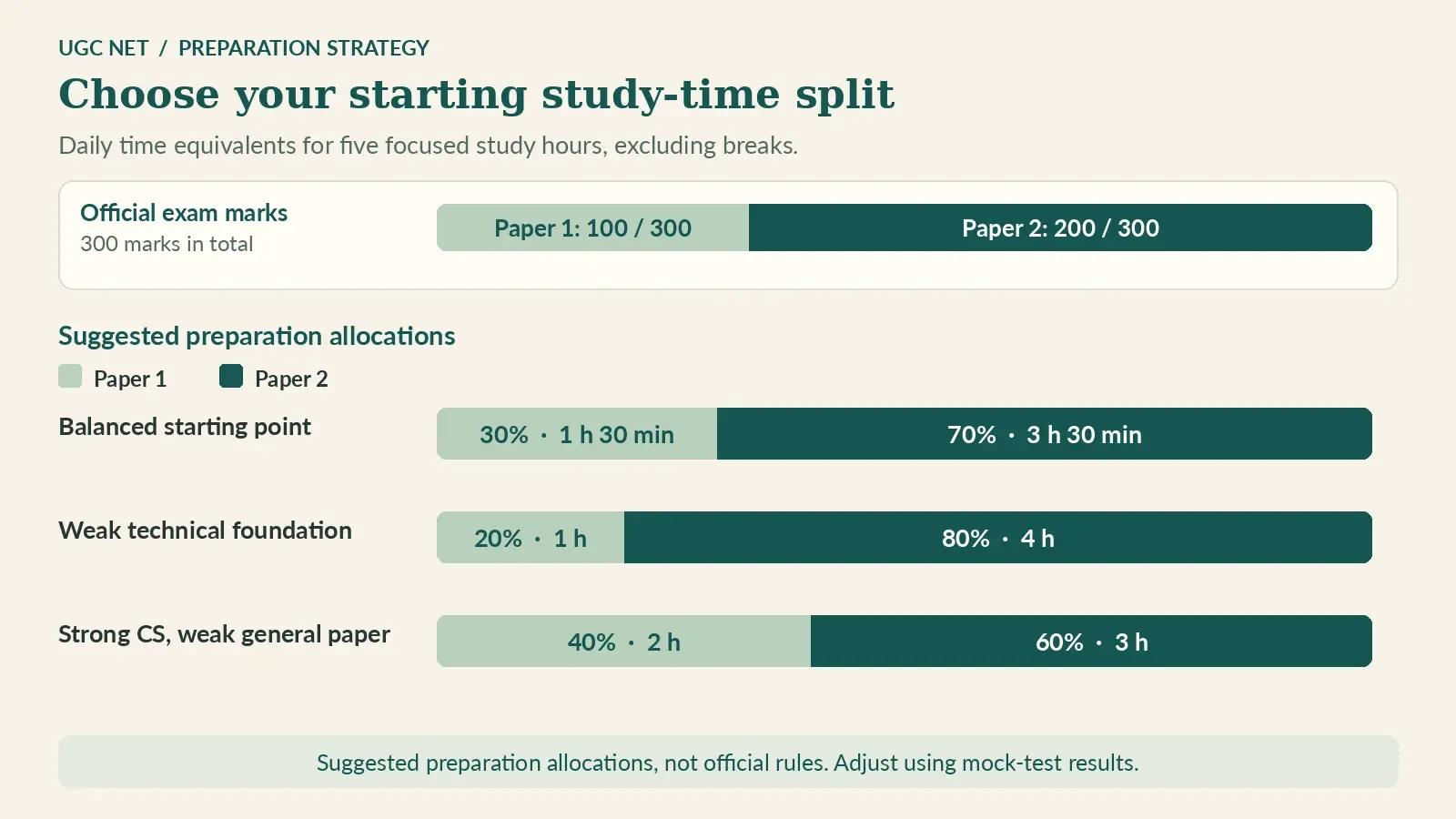
For most Computer Science aspirants, a sensible starting point is to devote 30% of preparation time to Paper 1 and 70% to Paper 2. But the best division depends on your current knowledge, weaknesses and the time left before the examination. A fixed ratio is a starting hypothesis, not a rule to follow until exam day.
Understand what each paper contributes
UGC NET is a single examination with two papers. According to the NTA information bulletin for December 2026, the standard pattern is as follows:
| Feature | Paper 1 | Paper 2 (Computer Science and Applications) |
|---|---|---|
| Questions | 50 | 100 |
| Maximum marks | 100 | 200 |
| Marks per correct answer | 2 | 2 |
| Negative marking | None | None |
| Share of total marks | One-third | Two-thirds |
The combined examination lasts 180 minutes without a scheduled break. There is no separately prescribed one-hour limit for Paper 1 in the standard pattern. Candidates must manage the combined time within the examination interface.
For qualification, the two papers contribute to the same aggregate. The minimum aggregate is 40% for General and General-EWS candidates and 35% for the specified relaxed categories. These are thresholds for consideration, not the final competitive cutoffs. Normalized marks apply where required by the multi-shift result methodology. The applicable qualification category and other eligibility conditions also matter.
There is no separate minimum score in Paper 1 or Paper 2 under this aggregate rule. A correct answer in teaching aptitude earns exactly as many marks as a correct answer on operating systems. This is why your next hour should be spent where it can produce useful improvement, rather than where a subject happens to sound more important.
Why Paper 1 deserves regular attention
The general paper tests abilities relevant to teaching, research, communication, reasoning and higher education. Its syllabus comprises ten units. The UGC syllabus specifies five two-mark questions from each unit, giving students a useful framework for balanced coverage.
Instead of treating all ten units as identical, organize them by the type of preparation they require.
| Learning approach | Units to cover |
|---|---|
| Understand concepts and distinctions | Teaching Aptitude, Research Aptitude, Communication |
| Practise timed questions | Comprehension, Mathematical Reasoning and Aptitude, Logical Reasoning, Data Interpretation |
| Recall facts in context and update notes | Information and Communication Technology (ICT), People, Development and Environment, Higher Education System |
These are study groupings, not official divisions. Several units need a mixture of understanding, recall and practice.
A Computer Science student may find ICT terminology, basic mathematics and some logical reasoning familiar. However, research design, assessment methods, Indian logic and educational governance can require substantial new learning. Being comfortable with programming does not automatically make someone good at Paper 1.
For example, memorizing that formative assessment occurs during learning is only the beginning. A question may describe a teacher giving feedback halfway through a course and ask which assessment approach is being used. Learning to recognize a concept in a situation is more valuable than memorizing a definition in isolation.
Paper 1 rewards consistency. A short session on research aptitude followed by practice and a later review is often more useful than spending a whole weekend reading notes without checking what you remember.
Why Computer Science Paper 2 needs the larger share
Paper 2 accounts for 200 marks and covers far more technical ground. Subject code 087 has ten units, but their size and difficulty are not uniform. Unlike the five-question specification in Paper 1, you should not assume that Paper 2 will always contain an identical number of questions from every unit.
The syllabus becomes easier to manage when you group related topics:
| Study cluster | Selected Paper 2 topics |
|---|---|
| Mathematical and computational foundations | Discrete structures, optimization, data structures, algorithms |
| Computer systems | Architecture, operating systems, system software, networks |
| Programming and computation | Programming languages, computer graphics, theory of computation, compilers |
| Data and software development | Databases, software engineering |
| Intelligent systems | Artificial intelligence |
This is an editorial grouping of the official units, not a replacement for the detailed syllabus. Keep the official checklist beside your notes so that smaller topics are not missed.
Technical preparation has a different rhythm. Understanding a functional dependency in DBMS is useful, but you also need to calculate closures, find candidate keys and identify normal forms. Knowing the definition of a scheduling algorithm is not enough unless you can trace its execution.
Give these subjects uninterrupted blocks of time. Avoid replacing active problem solving with long video playlists. After learning a topic, attempt questions without notes; when you make a mistake, reconstruct the solution rather than merely reading the answer.
Choose a starting time split based on your preparation level
The 30:70 split works as a reasonable default because it gives the larger technical syllabus priority without neglecting the general paper. It is not necessarily the most efficient ratio for every student.
| Starting situation | Paper 1 | Paper 2 | On a five-hour study day |
|---|---|---|---|
| Balanced starting point | 30% | 70% | 1 h 30 min + 3 h 30 min |
| Weak technical foundation | 20% | 80% | 1 h + 4 h |
| Strong technical foundation, weak general paper | 40% | 60% | 2 h + 3 h |
A beginner in Computer Science may need several weeks of concentrated technical learning, while a graduate who recently prepared for GATE may benefit from extra Paper 1 time. However, GATE preparation alone does not cover the entire NET Computer Science syllabus: areas such as software engineering, graphics, optimization and AI still need attention.
Do not select your split solely from your degree or the subjects you enjoy. Take a representative mock test and inspect your actual mistakes. Even strong academic students can lose marks on seemingly familiar questions if they are slow, careless or unaccustomed to the exam format.
The ratios above include learning, practice and revision attributable to each paper. A mock test may combine both papers; record its review time according to the questions you analyse. Count focused study, not breaks or time spent organizing resources.
Use mock tests to decide where the next hour belongs
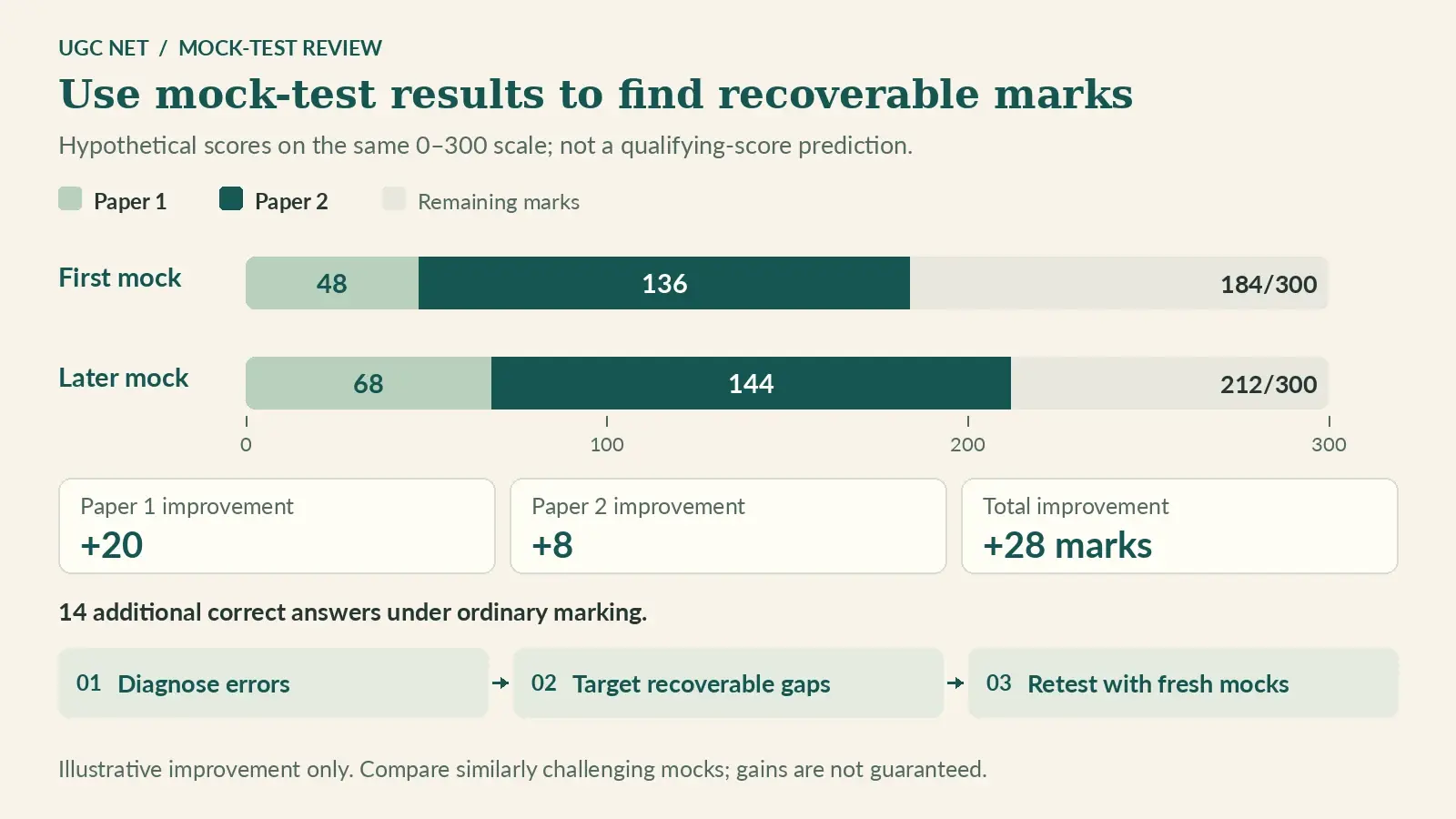
Consider this fictional candidate's first full mock test, scored using the normal two-marks-per-correct-answer rule.
| Measure | Paper 1 | Paper 2 |
|---|---|---|
| Correct answers | 24/50 | 68/100 |
| Marks | 48/100 | 136/200 |
| Percentage of available marks | 48% | 68% |
The aggregate is 184/300. Paper 2 has the higher percentage, but that does not automatically mean all additional study belongs to Paper 1. The real question is how many missed questions are realistically recoverable.
Suppose the candidate reviews the mistakes and discovers several Paper 1 questions on research methods and data interpretation that could be improved through focused practice. After a week of targeted preparation, a comparable mock produces 34 correct answers in Paper 1 and 72 in Paper 2.
| Measure | First mock | Later mock | Improvement |
|---|---|---|---|
| Paper 1 | 48 | 68 | +20 |
| Paper 2 | 136 | 144 | +8 |
| Total | 184 | 212 | +28 |
That is an improvement of fourteen correct answers across both papers. It illustrates the potential of targeting gaps rather than simply increasing study hours. The scores are hypothetical, not expected gains or qualifying targets. Different mock difficulty, guesses and familiarity can also affect results.
To make a reliable adjustment, compare several fresh, similarly challenging mocks. Record whether a missed answer came from a concept gap, a forgotten fact, a calculation mistake, misreading or time pressure. Each cause needs a different response.
For instance, if your DBMS mistakes are mostly from normalization problems, work through functional dependencies before attempting another mixed test. If you keep missing Paper 1 questions because you confuse research methods, create a compact comparison sheet and practise scenarios. If you already know the material but run out of time, more lectures may not help.
Review your split every week or two. Move a small block of time toward the most recoverable weakness, keep both papers active and test whether the adjustment works. One disappointing mock is not a reason to abandon your entire plan.
What a realistic five-hour study day looks like
Here is a sample day using the 30:70 starting ratio. The time shown is focused study, excluding breaks.
| Session | Activity | Duration |
|---|---|---|
| 1 | Paper 2: learn a technical topic | 2 hours |
| 2 | Paper 1: study one unit or subtopic | 45 minutes |
| 3 | Paper 2: solve PYQs and related problems | 1 hour |
| 4 | Paper 1: timed practice and error review | 45 minutes |
| 5 | Paper 2: revise older concepts and mistakes | 30 minutes |
| Total | 5 hours |
If you can study only two hours on a working day, the same ratio gives 36 minutes to Paper 1 and 84 minutes to Paper 2. You can round the sessions or balance the allocation across the week rather than watching the clock every minute.
Make revision cumulative. When you move from algorithms to operating systems, keep a few earlier questions in your practice set. When Paper 1 moves from research to communication, revisit research definitions after a few days. This helps prevent the first subjects from disappearing from memory by the time you complete the syllabus.
Replace an ordinary study session periodically with a full three-hour mock and allow time afterward for analysis. A mock without review tells you where you stand, but not how to improve.
Change the balance as exam day approaches
During the foundation stage, use most of your time to understand new material and establish a daily Paper 1 habit. When substantial syllabus coverage is complete, make topic-wise practice and spaced revision more prominent. Do not wait until you finish every unit to attempt questions.
In the final stage, shift from acquiring resources to retrieving knowledge. Full-length mocks, short revision notes, formula sheets and your error log become more useful. Keep some room for high-value unfinished topics, but do not attempt to master every obscure subtopic at the expense of material you can reliably score on.
If Paper 1 is already consistently strong, maintain it with short timed sessions while devoting more attention to Paper 2. If a weak Paper 1 continues to drag down the aggregate, give it a temporary larger share. Neither paper should vanish from your schedule altogether.
Preparation time is not the same as exam-hall time
You might spend 70% of your study hours on Computer Science without needing 70% of the examination duration for it. Some technical questions take seconds to answer; others require multiple calculations. The same variation exists in Paper 1.
A useful starting plan to test in mocks is 50 minutes for Paper 1, 115 minutes for Paper 2 and 15 minutes for review. This adds up to the standard 180 minutes. It is not an official sectional timing rule. Adjust it for your demonstrated pace, the available navigation controls and any approved additional examination time.
Avoid getting stuck on one difficult question early. Move on when the interface permits, return to uncertain questions and check that your responses are saved. Because ordinary incorrect answers do not attract negative marks, make a reasoned attempt at remaining unanswered questions before submitting. Do not mistake this for a preparation strategy based on guessing.
Practise the entire sitting so you understand how concentration changes after the first hour. The goal is to collect as many reliable marks as possible across both papers, rather than to finish one section with a perfect feeling while leaving the other rushed.
The bottom line
Start with a 30:70 Paper 1-to-Paper 2 preparation split if you have no better evidence. Protect the larger technical preparation block, establish regular general-paper practice and make your next adjustment using actual mock-test performance.
Your objective is not to achieve a perfectly balanced timetable. It is to improve the combined score while developing the knowledge and exam skills that your current performance lacks. Paper 1 and Paper 2 are not competing priorities; they are two routes to the same result.
Related reading: compare the two qualifications and their shared computing topics.
Sources and Further Reading
- NTA — Updated UGC NET December 2026 Information Bulletin (16 October 2026), sections 3.2, 3.5 and 11.3 (pattern, marking and result criteria).
- NTA — UGC NET examination overview.
- UGC NET Bureau — Official syllabus index, codes 00 and 87.
- UGC NET Bureau — Paper 1 syllabus, including the unit-wise question specification.
- Atal Bihari Vajpayee Vishwavidyalaya — University-hosted syllabus compilation, reproducing the UGC Computer Science and Applications syllabus (code 87).
- NTA — UGC NET archive, for official notices and available answer-key materials.