SBI SO IT vs IBPS SO IT Officer: Recruitment, Technical Knowledge and Interview Preparation Compared
Compare SBI and IBPS IT Officer recruitment, exam patterns, shared technical subjects, role-specific skills and interview preparation to build a practical strategy for both.
A computer science graduate preparing for a banking IT Officer examination might expect SBI and IBPS to test roughly the same knowledge. Both recruit specialists who need to understand databases, networks, operating systems and information security. Yet preparing for one recruitment process exactly as you would for the other can leave important gaps.
The biggest difference is not a programming language or a particular technical subject. It is the way the recruitment is organized. IBPS conducts a common selection process for IT Officer (Scale I) positions in participating public sector banks. State Bank of India (SBI) recruits its own specialist officers against particular job advertisements, and those advertisements can specify very different selection methods.
Build a shared technical foundation, but tailor your examination practice and interview preparation to the actual post. This approach is especially useful if you want to pursue both opportunities without maintaining two completely separate sets of study notes.
1. Understand which SBI IT post you are comparing
IBPS SO IT Officer is a defined Scale I recruitment category. SBI SO, on the other hand, is an umbrella term for Specialist Cadre Officer (SCO) recruitment. An Assistant Manager (System), an experienced IT architect and a data scientist may all fall within SBI's specialist recruitment, but they are not interchangeable jobs.
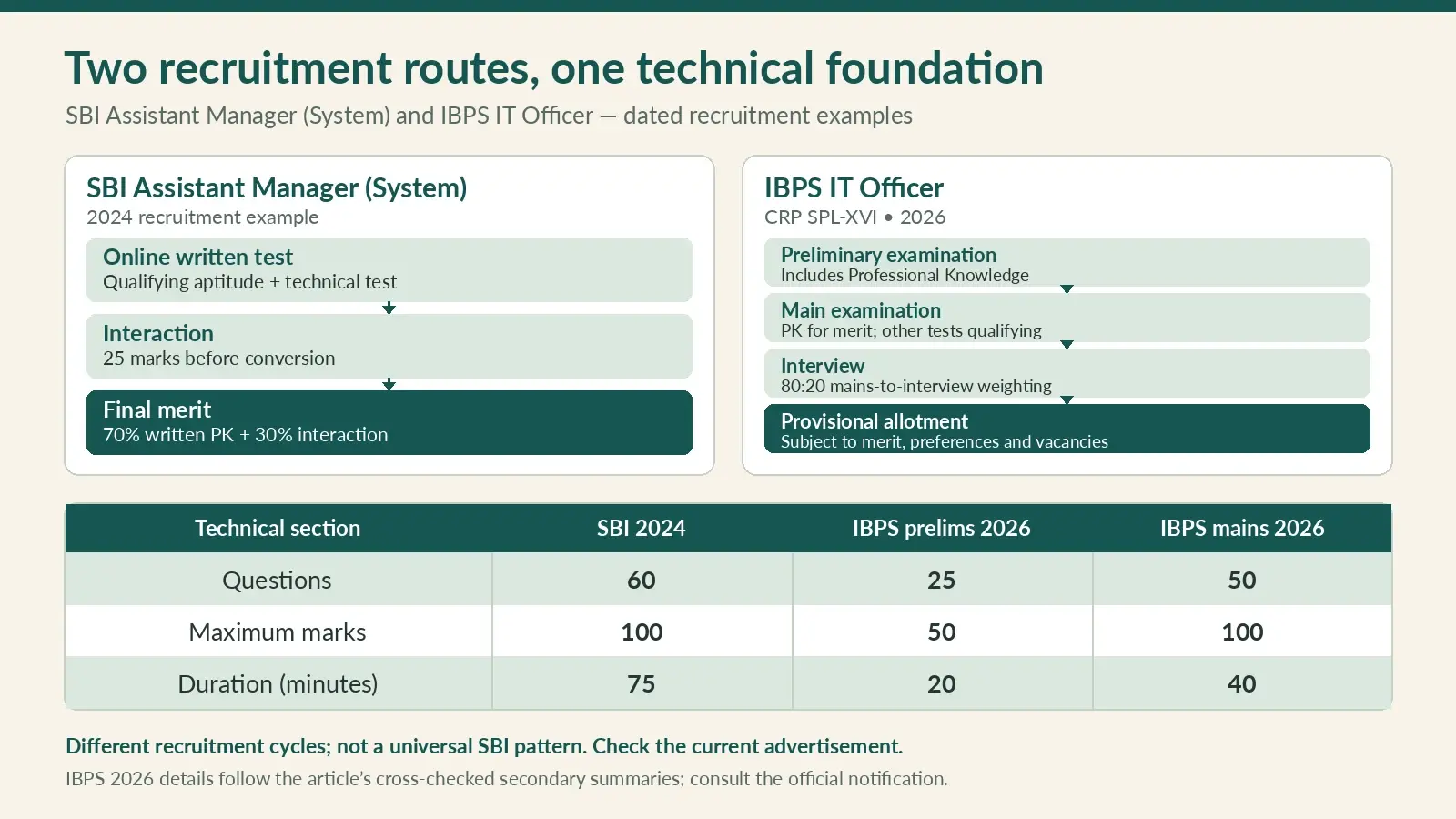
For a fair comparison, this article uses SBI's 2024 Assistant Manager (System) recruitment (CRPD/SCO/2024-25/15) as a historical entry-level example and IBPS's 2026 CRP SPL-XVI as the common recruitment example. These are different recruitment cycles, not two simultaneously advertised vacancies. [1–4]
| Feature | SBI Assistant Manager (System), 2024 | IBPS IT Officer, CRP SPL-XVI, 2026 |
|---|---|---|
| Recruiting organization | SBI | IBPS for participating banks |
| Recruitment approach | Post-specific | Common Scale I selection |
| Selection stages | Written test, interaction | Prelims, mains, interview |
| Employer | SBI | Bank allotted through the process |
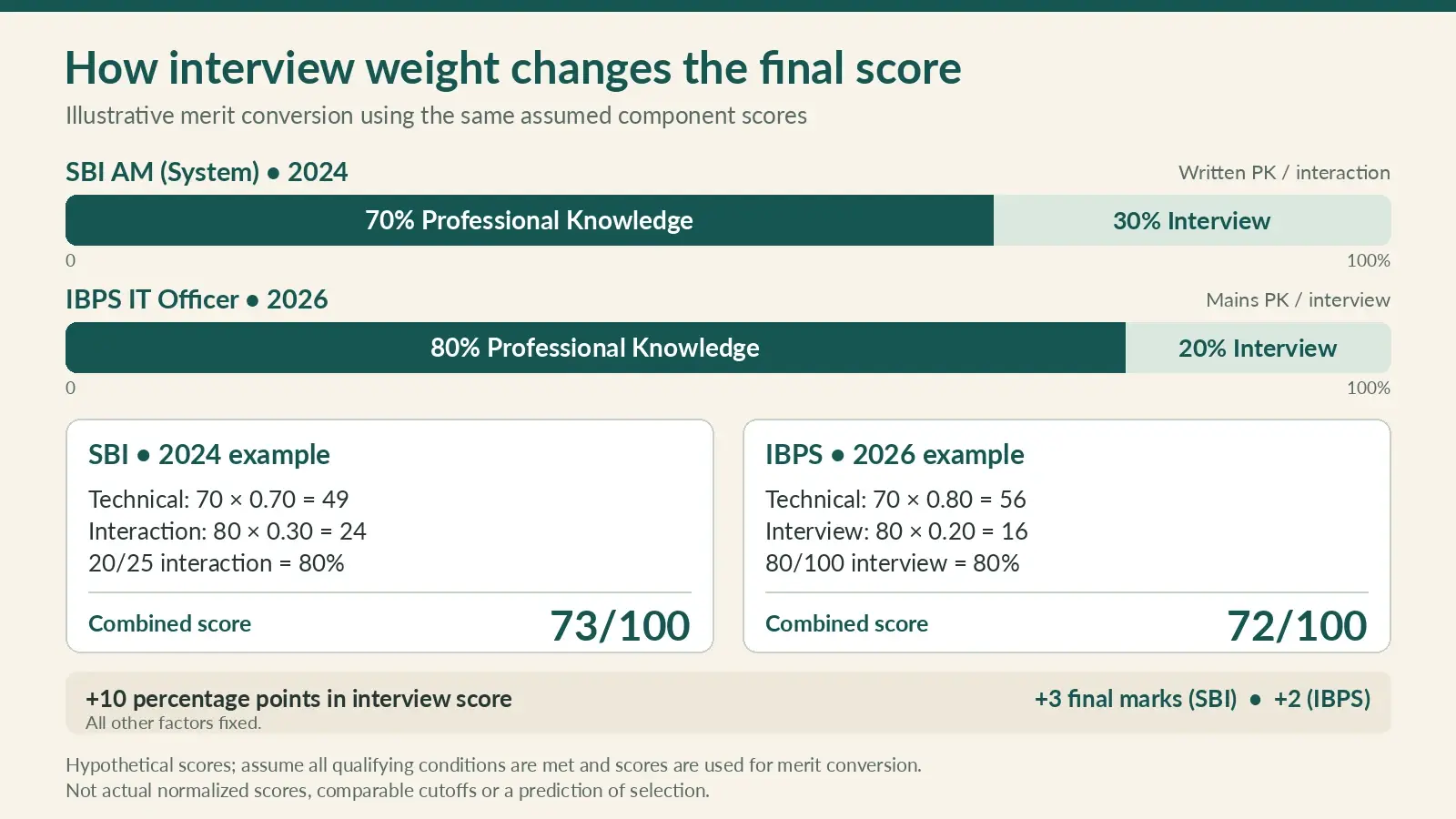
| Final merit weights | Written PK 70%; interaction 30% | Mains PK 80%; interview 20% |
PK stands for Professional Knowledge. Provisional selection and allotment remain subject to eligibility and other applicable requirements. SBI is not an additional bank preference in the IBPS common IT Officer process.
SBI's more experienced positions illustrate why the distinction matters. Its November 2026 data scientist advertisement, CRPD/SCO/2026-27/31, specifies experience requirements and different selection routes depending on seniority, including interview-based shortlisting for the Chief Manager position. 5 A candidate cannot assume that clearing a general banking IT exam is sufficient for these experienced roles.
Before beginning preparation, read the exact advertisement for the degree requirements, minimum marks, age cut-off date, experience, certificates, appointment type and job profile. Do not assume that a degree or certification accepted for one post is automatically accepted for another.
2. How the written examinations differ
SBI Assistant Manager (System): the 2024 example
SBI's November 2024 examination handout described a single two-hour online test. General aptitude covered English, reasoning and quantitative aptitude (50 questions, 50 marks, 45 minutes combined). The technical section contained 60 questions worth 100 marks, with 75 minutes available.
The aptitude component was qualifying, and the written test had no negative marking. The interaction was worth 25 marks before conversion to its 30% final merit contribution. These rules belong to this particular recruitment, not every SBI SO examination. 2
IBPS IT Officer: the revised 2026 example
CRP SPL-XVI introduced Professional Knowledge in prelims as well as mains. The preliminary test has 100 questions for 125 marks over 80 minutes. The technical section contains 25 questions worth 50 marks in 20 minutes.
The main examination has 150 objective questions for 200 marks and two descriptive English questions for 25 marks, with 155 minutes in total. Professional Knowledge accounts for 50 questions, 100 marks and 40 minutes. Other mains sections are qualifying; technical marks determine mains merit. Objective errors attract a penalty of one-quarter of the question's assigned marks. 3, 4, 6, 7
| Technical test | SBI AM (System) 2024 | IBPS IT 2026 prelims | IBPS IT 2026 mains |
|---|---|---|---|
| Questions | 60 | 25 | 50 |
| Maximum marks | 100 | 50 | 100 |
| Minutes | 75 | 20 | 40 |
| Average seconds per question | 75 | 48 | 48 |
The time averages are not targets for individual questions. They show why IBPS practice should emphasize quick recognition and accuracy, while the historical SBI format offered more time per technical question. Neither pattern establishes that one exam is inherently easier. Question difficulty, competition and qualifying requirements matter too.
Check the fresh advertisement and examination handout before attempting either recruitment. A new SBI notification need not reproduce its 2024 structure, and IBPS may revise its process again.
3. The technical knowledge you can prepare together
You do not need two separate courses to understand the core subjects. Learn each concept thoroughly once, then apply it to the different examination formats and job descriptions.
| Shared subject | Concepts worth mastering | Banking relevance |
|---|---|---|
| DBMS and SQL | Keys, joins, normalization, ACID, indexing | Consistent account records and reporting |
| Computer networks | TCP/IP, subnetting, DNS, routing, TLS | Reliable communication between services |
| Operating systems | Processes, memory, synchronization, deadlocks | Stable applications and servers |
| Cybersecurity | Access control, cryptography, secure development | Protecting transactions and customer data |
| Programming and algorithms | OOP, collections, complexity, code tracing | Application logic and problem solving |
| Software engineering | Testing, version control, development lifecycle | Reliable software changes |
| Cloud and infrastructure | Virtualization, service models, backups | Deployment, capacity and recovery |
Consider a transfer of ₹2,000 between two accounts. The database must preserve the relationship between the debit and credit. The network carries messages, the operating system supports application processes, and security controls verify identity and permissions. Application code must handle errors instead of blindly submitting a transaction again.
That scenario is a useful way to study: connect an abstract concept to an operational consequence. The actual design of interbank payments is more complex than this teaching example; not every transaction is a single local database operation.
Candidates who have studied GATE or UGC NET already possess many of these foundations. The additional task is to cover applied IT topics and practise faster retrieval rather than spending all their time on advanced theoretical problems.
4. Where to adapt your technical preparation
The 2024 SBI Assistant Manager (System) advertisement supplied an indicative technical distribution: software development and infrastructure support had 20 questions each, while networking and cloud operations had 10 each. This is useful historical evidence of the role's breadth, not a forecast for future exams. 1
For SBI's general systems role, revise application development, REST interfaces, version control, software testing, infrastructure and cloud concepts alongside core computer science. Understand how the parts fit together: a web service may use authentication, a relational database, application logs and a deployment pipeline. A change that passes a unit test may still fail during integration or under production load.
For an experienced SBI specialist role, use the advertised responsibilities to guide deeper preparation. An infrastructure specialist might focus on availability and recovery, while an application specialist might need to explain design and testing decisions. Do not collect unrelated certifications simply because they sound impressive; examine which ones the advertisement actually requires or prefers.
For IBPS, emphasize breadth and timed mixed questions across the shared topics. The reviewed 2026 summaries establish the examination format but do not establish a guaranteed chapter-wise distribution. Use the site's Computer Awareness library for basic revision. The latter is not a substitute for specialist-level knowledge.
5. Why the interview deserves serious preparation
A candidate may know what a database transaction is but struggle to explain what should happen if a payment times out. Written examinations reward identifying correct answers; interviews give you an opportunity to explain reasoning, show judgment and relate knowledge to work.
The merit weights in the compared notifications illustrate the importance of the interaction or interview. Imagine a candidate receives a technical score of 70 out of 100 and an interview score equivalent to 80%. Assume that these are the scores used for weight conversion and that all qualifying conditions are met.
| Merit component | SBI 2024 example | IBPS 2026 example |
|---|---|---|
| Technical contribution | 70 × 0.70 = 49 | 70 × 0.80 = 56 |
| Interview contribution | 80 × 0.30 = 24 | 80 × 0.20 = 16 |
| Combined score | 73/100 | 72/100 |
An SBI interaction result of 20/25 corresponds to 80%; the IBPS example uses 80/100. These are hypothetical conversions, not actual normalized results or cutoffs. The two final scores are not comparable across different candidate pools. The example simply shows how the weighting works. With all else fixed, increasing the interview percentage by ten points would add three final marks in the SBI example and two in the IBPS example.
Prepare answers around problems, not memorized definitions
Use the following original practice prompts for both routes. They are not recalled interview questions or an official interview syllabus.
| Practice question | What a strong answer should cover |
|---|---|
| A payment times out. Should the user retry immediately? | Check transaction status, avoid duplicate requests, reconcile and follow approved procedures. |
| Why does a bank use database transactions? | Atomicity, consistency, isolation and durability; relate them to account updates. |
| An application becomes unusually slow. Where would you look? | Establish scope, review metrics and logs, examine network, application and database layers. |
| A staff member receives a suspicious email. What should happen? | Avoid unsafe interaction, report through authorized channels and preserve evidence. |
| How do backups differ from high availability? | Recovery from data loss versus continuity during component failure; test restoration. |
For SBI, study the advertised job description and be prepared to discuss the relevant projects, design choices or experience in your application. For IBPS, also understand the common recruitment route and basic banking terminology without pretending you already know your future bank's internal systems.
Prepare core banking systems (CBS), UPI, NEFT, RTGS, IMPS, KYC, reconciliation and digital banking security at a conceptual level. Read current official information rather than memorizing outdated limits or regulatory figures. Practise a concise introduction and an honest explanation of your qualifications, projects and reasons for entering banking IT. If you lack professional experience, discuss genuine academic or personal projects; never manufacture production experience.
6. A combined preparation strategy
A five-hour study day can cover both routes without sacrificing aptitude or communication practice. Here is one starting template for a candidate with basic undergraduate CS knowledge.
| Activity | Daily time |
|---|---|
| Shared technical concepts | 120 minutes |
| Timed technical questions and error analysis | 60 minutes |
| Role-specific applied IT and banking scenarios | 45 minutes |
| Aptitude, English and descriptive practice | 45 minutes |
| Interview practice and retrieval revision | 30 minutes |
| Total | 300 minutes |
Rotate subjects across the week. For example, learn transactions and indexing on one day, practise subnetting the next, and revisit both in a mixed test later. Keep a single concept notebook and separate practice logs for the different examinations. Tag errors by cause: missing concept, calculation, reading or timing.
During early preparation, give concept learning more attention. Near an IBPS written exam, increase timed tests and practise every qualifying section. When preparing for an SBI interaction or interview, move more time to the advertised role, project explanations and verbal scenario practice. In either case, simulate the actual examination pattern rather than relying on a generic bank exam mock.
7. Which recruitment should you prioritize?
If you are eligible for an SBI entry-level systems post and the common IBPS IT Officer route, preparing for both is a reasonable option. A specialist recruitment with mandatory experience is different: prioritize it only if you can document the requirements and demonstrate the advertised skills.
Compare the actual appointment conditions, responsibilities, possible postings and career development opportunities rather than relying on the brand name alone. IBPS allotment depends on the recruitment rules, preferences, merit and available vacancies; SBI recruits directly for its own requirements. Do not assume a particular location, team, work-from-home arrangement or job assignment is guaranteed.
The most efficient preparation is to understand computer science well enough to use it in banking situations, then practise the correct selection format. That combination is valuable whether your next challenge is a technical multiple-choice test, an interview or a real IT problem.
Related reading: plan the IBPS IT Officer Professional Knowledge syllabus.
Sources and further reading
- SBI — CRPD/SCO/2024-25/15 detailed advertisement (official Hindi edition). Historical role-specific syllabus and selection criteria.
- SBI — Assistant Manager (System) examination handout, November 2024.
- IBPS — Specialist Officers XVI official listing, notification listed 1 July 2026.
- IBPS — CRP SPL-XVI detailed notification (official PDF link).
- SBI — CRPD/SCO/2026-27/31, Data Scientist recruitment, 20 November 2026.
- Improvam — IBPS IT Officer 2026 selection stages, secondary corroboration of the revised pattern.
- Pareeksha — CRP SPL-XVI pattern and marking summary, secondary corroboration of the objective penalty.
- SBI Careers — current openings.
Check the official recruitment notification and any corrigenda before applying. Study allocations and sample scores are illustrative.