IBPS RRB Scale II IT Officer vs General Banking Officer: Eligibility, Experience and Preparation Differences
Compare IBPS RRB Scale II IT Officer and General Banking Officer eligibility, relevant work experience, exam patterns, interview expectations and preparation strategies.

Imagine two computer science graduates applying for a managerial position in a Regional Rural Bank (RRB). One has spent eighteen months maintaining applications at a software company. The other has spent three years working as a general banking officer. Both have technical degrees, but their experience may make them eligible for different posts.
That is the essential distinction between the IBPS RRB Officer Scale II Information Technology (IT) Officer and General Banking Officer (GBO). Both are managerial recruitment categories, but one seeks relevant specialist experience and the other seeks experience as an officer in a financial institution.
Choosing between them is not simply a question of whether you prefer computers or banking. Your qualifications, employment history, examination strengths and career interests all matter. This guide uses the 2026 CRP RRBs-XV recruitment framework as a dated reference; always check the notification and amendments for your own recruitment cycle. [1–5]
1. What is the difference between the two roles?
A General Banking Officer is a generalist manager. Depending on the assignment, the work may involve branch operations, deposits, lending, credit appraisal, recovery, customer service, compliance and supervising staff. In an RRB, understanding rural households, agricultural lending and small businesses can be particularly valuable.
An IT Officer is recruited for specialist technology capabilities. Possible responsibilities include supporting core banking systems, maintaining infrastructure, monitoring applications and networks, assisting digital banking operations, managing access controls and coordinating incident resolution.
These are illustrative responsibilities, not guaranteed job descriptions. The actual allocation of work depends on the employing RRB, organizational structure and service rules. IT Officers need to understand banking operations, and GBOs increasingly need to be comfortable with technology.
The key question is whether you want to develop primarily as a banking generalist or as a technology specialist working within banking.
2. Eligibility: your degree is only half the answer
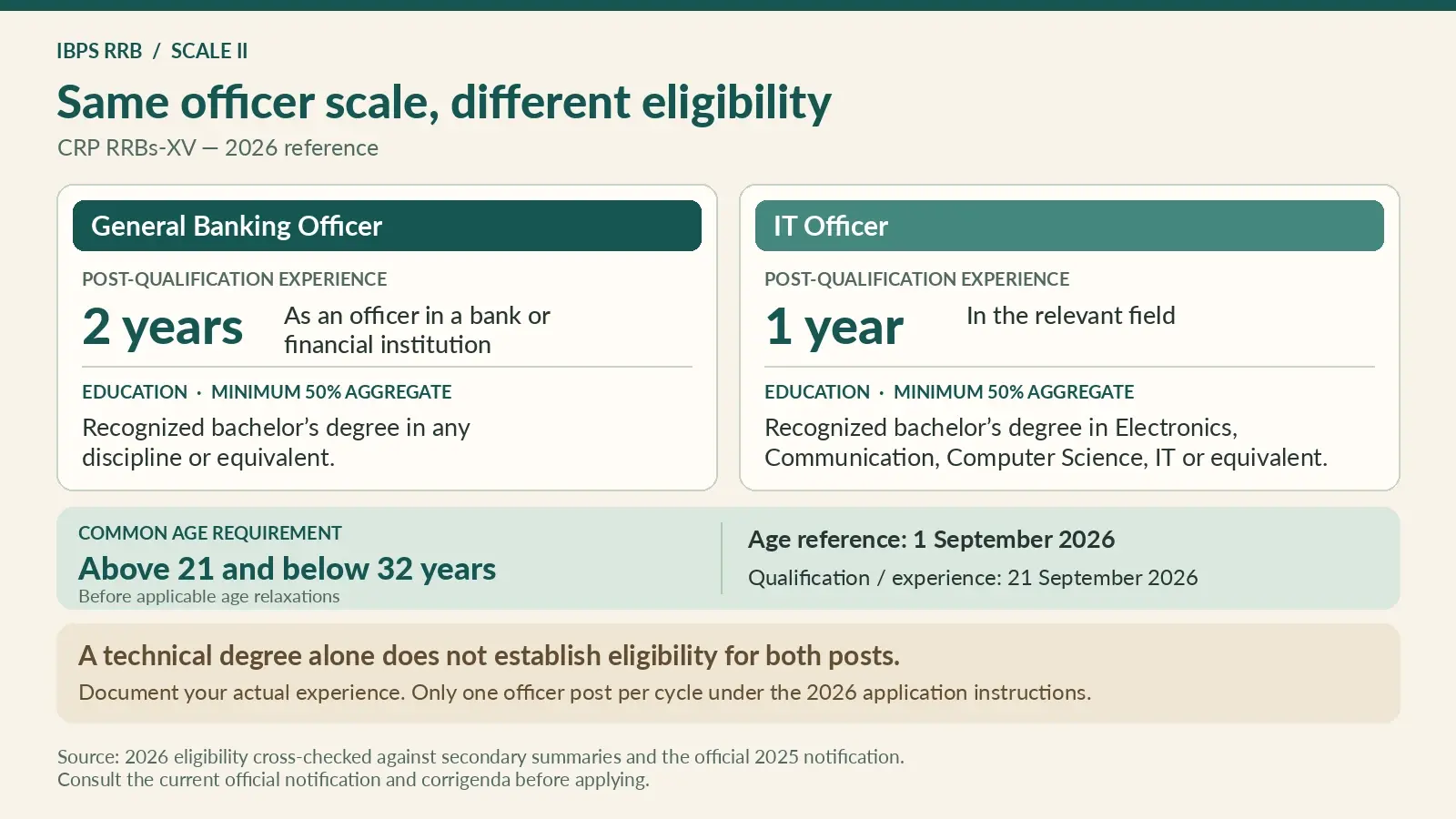
Here are the essential requirements reflected in the CRP RRBs-XV framework. The 2025 official notification also contains the same core qualification and experience distinction. [1, 2, 4–6]
| Requirement | General Banking Officer | IT Officer |
|---|---|---|
| Academic qualification | Recognized bachelor's degree in any discipline or equivalent | Recognized bachelor's degree in Electronics, Communication, Computer Science, IT or equivalent |
| Minimum aggregate marks | 50% | 50% |
| Post-qualification experience | Two years as an officer in a bank or financial institution | One year in the relevant field |
| General age requirement | Above 21 and below 32 years | Above 21 and below 32 years |
| Additional academic preferences | Specified disciplines including banking, finance, agriculture, IT and management | Certain technology certifications are desirable |
For the 2026 cycle, age is reckoned on 1 September 2026. The qualification and experience reference date reported in the notification is 21 September 2026. An extension to the application window does not automatically extend eligibility dates. Check the latest corrigenda and applicable category-based age relaxations.
A computer science degree can meet the academic requirement for either post. That does not mean its holder meets both experience requirements. Similarly, a professional certification may strengthen an IT application, but it does not replace a mandatory degree or experience condition.
Can private-sector IT experience count?
The IT experience requirement refers to the relevant field, rather than limiting experience expressly to banks. A software developer, network engineer or systems administrator may therefore have a relevant background outside banking. The actual duties, duration, qualification date and supporting documents still need to satisfy the recruiting authority.
For GBO, the nature of the employer and the officer status are essential. Two years at a software company do not automatically qualify merely because the company provides services to banks. Likewise, working in a bank as a clerk or outsourced support worker does not automatically establish two years of officer experience.
Consider four fictional profiles:
| Candidate profile (assume academic and age criteria are met) | GBO experience | IT experience |
|---|---|---|
| CS graduate with no employment experience | Insufficient | Insufficient |
| CS graduate with 18 months of relevant software employment | Not established | Potentially meets requirement |
| CS graduate with three years as a general banking officer, without established specialist IT duties | Potentially meets requirement | Not established |
| CS graduate with two years as a bank IT officer, with documented relevant duties | Potentially meets requirement | Potentially meets requirement |
These examples explain the distinction, not individual eligibility decisions. Do not assume internships, freelance work, apprenticeships, overlapping employment periods or work before graduation will be accepted without clarification. If your degree or employment status is unusual, seek authoritative clarification through the official IBPS channels before applying.
Keep your experience certificates, appointment and relieving records, degree documents and other evidence requested in the notification ready. An experience certificate should accurately establish the dates, designation and nature of work. Do not rely on a job title alone.
One more practical restriction matters: the 2026 application instructions allow only one officer-cadre post in the cycle. Even if you meet both sets of requirements, do not submit separate applications for GBO and IT Officer expecting to sit both examinations. 3
3. How the examinations differ
Unlike Officer Scale I, neither of these Scale II routes has a preliminary examination followed by mains. Both use a single online objective examination and a subsequent interview for shortlisted candidates.
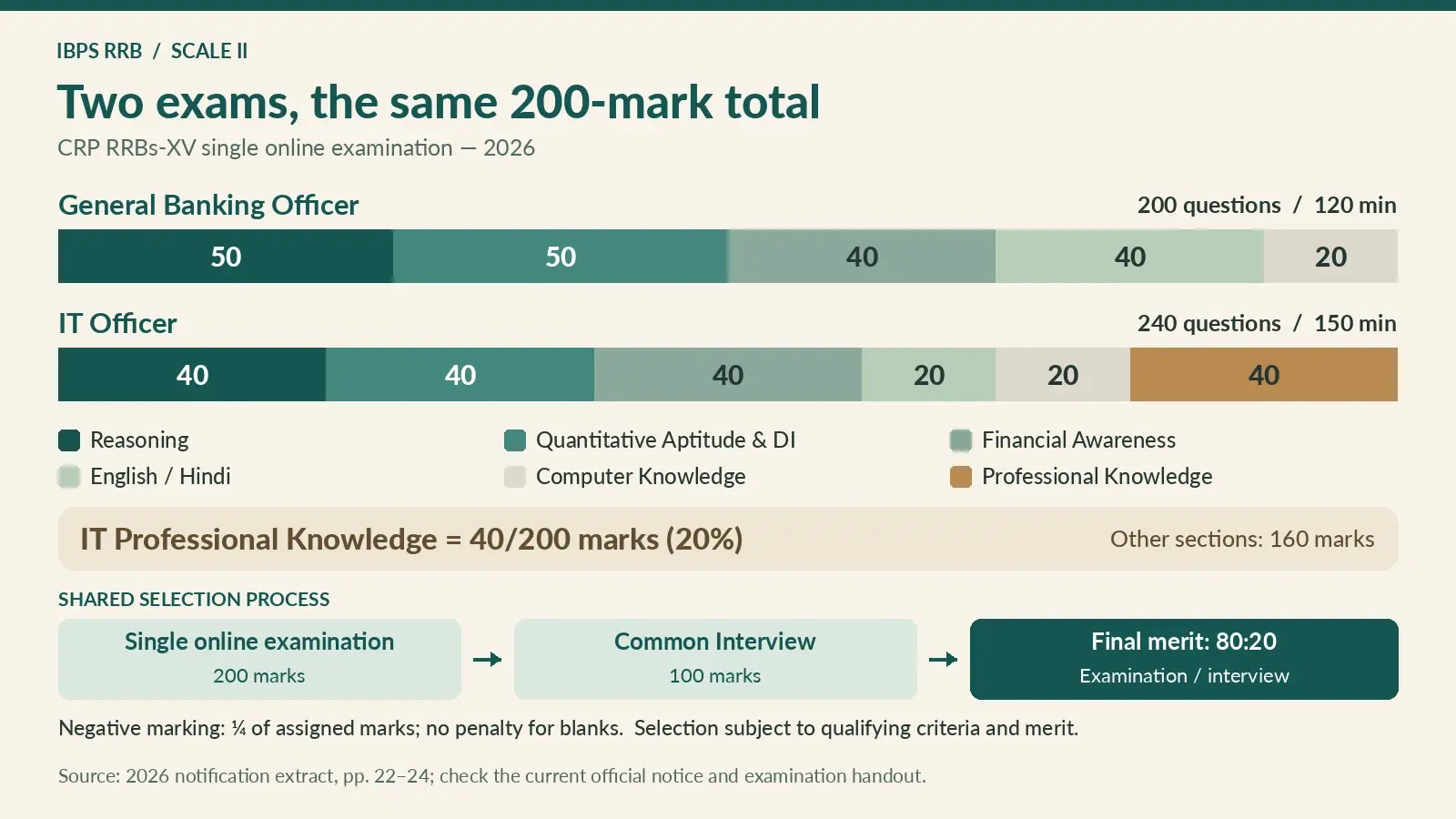
The following table compares the notified single-examination structures for 2026. 7
| Section | GBO questions / marks / minutes | IT Officer questions / marks / minutes |
|---|---|---|
| Reasoning | 40 / 50 / 30 | 40 / 40 / 30 |
| Quantitative Aptitude and Data Interpretation | 40 / 50 / 30 | 40 / 40 / 30 |
| Financial Awareness | 40 / 40 / 15 | 40 / 40 / 15 |
| English or Hindi (choose one) | 40 / 40 / 30 | 40 / 20 / 30 |
| Computer Knowledge | 40 / 20 / 15 | 40 / 20 / 15 |
| Professional Knowledge | — | 40 / 40 / 30 |
| Total | 200 / 200 / 120 | 240 / 200 / 150 |
The IT Officer paper adds a 40-question specialist section but retains a 200-mark overall maximum. Its Professional Knowledge section represents just 20% of the available marks. The other five sections together account for 160 marks.
GBO, meanwhile, assigns half its total marks to Reasoning and Quantitative Aptitude with Data Interpretation. Both posts give Financial Awareness 40 marks, so a technically strong candidate cannot afford to ignore finance.
The exam imposes sectional time limits in the cited pattern. You cannot assume that unused time in one section can be moved to another. Wrong answers attract a deduction equal to one-quarter of the marks assigned to the question, while unanswered questions incur no such deduction. Sectional and aggregate merit requirements apply. Verify the current examination handout for changes.
Why accuracy matters even in familiar subjects
Suppose an IT Officer candidate attempts 35 of the 40 Professional Knowledge questions, with 28 correct and seven incorrect. With one mark per question and a quarter-mark penalty, the corrected raw score is 28 − 1.75 = 26.25/40.
If four of those wrong answers become correct after targeted revision, the score becomes 32 − 0.75 = 31.25/40. That is a five-mark improvement without attempting more questions. The example is hypothetical; actual scores may be normalized across sessions under the notified method.
4. What should you study for each post?
Five sections provide a common preparation base. Build that foundation first, then direct extra attention toward the requirements of your chosen post. The topics below are suggested study areas, not an official chapter-wise syllabus or predicted question distribution.
| Common area | Suggested preparation |
|---|---|
| Reasoning | Puzzles, seating arrangements, syllogisms, inequalities and logical deductions |
| Quantitative aptitude and DI | Percentages, ratios, interest, time and work, data tables and charts |
| Financial Awareness | RBI, NABARD, banking operations, monetary policy, financial inclusion and current financial developments |
| Language | Reading comprehension, grammar and vocabulary in your chosen test language |
| Computer Knowledge | Hardware, operating-system basics, office tools, internet and information security fundamentals |
Our Banking Awareness library and Computer Awareness library can support the common sections. Use more advanced technical material for specialist preparation.
GBO: strengthen banking judgment and quantitative speed
A GBO candidate should connect financial terminology to actual branch decisions. Understand deposit products, loan appraisal, asset classification, priority sector lending, KYC, anti-money-laundering controls, customer grievances and rural credit. Study current RBI and NABARD publications for relevant developments, rather than memorizing old regulatory limits.
For reasoning and DI, work on timed sets and question selection. A difficult puzzle that consumes the entire sectional allowance can undermine your score even if you eventually solve it. Practise identifying manageable questions before committing time to a long set.
IT Officer: go beyond basic computer awareness
Professional Knowledge is different from the separate Computer Knowledge section. Knowing office shortcuts or recognizing a type of malware is not the same as explaining how transactions are isolated in a database or how an application handles a network failure.
Prioritize DBMS and SQL, computer networks, operating systems and cybersecurity. Extend your preparation to programming, data structures, software engineering, computer architecture, web technologies and cloud fundamentals. Avoid relying on an assumed number of questions from any chapter.
Apply these concepts to banking: a database transaction must preserve account consistency; an access-control policy should prevent unauthorized operations; backups must be recoverable. Those connections help you retain technical ideas and prepare for interview discussions.
5. A practical five-hour preparation day
These two schedules are starting templates for candidates with reasonable foundations. They allocate more time to the different scoring opportunities without abandoning common sections.
| Activity | GBO | IT Officer |
|---|---|---|
| Reasoning and quantitative aptitude / DI | 120 min | 90 min |
| Financial Awareness | 60 min | 45 min |
| Language | 45 min | 30 min |
| Computer Knowledge | 30 min | 20 min |
| Professional Knowledge | — | 90 min |
| Mixed practice and error review | 45 min | 25 min |
| Total | 300 min | 300 min |
These are study-time allocations, not exam timings or official subject weightage. Rotate topics across the week if shorter blocks become impractical. Use full-length mocks to test your stamina under the actual sectional timings.
After each mock, ask whether your errors came from missing knowledge, careless reading, calculation mistakes or poor time management. A candidate repeatedly missing Financial Awareness questions should not spend every extra hour on technical subjects simply because IT is the preferred career. Adjust the schedule according to recoverable marks and sectional weaknesses.
6. Interview preparation: make your experience count
Both routes use an 80:20 weighting of online examination and interview scores in final merit. The interview is scored out of 100. The 2026 notice specifies a minimum interview qualification threshold of at least 40%, reduced to 35% for SC, ST, OBC and PwBD candidates. Passing the minimum does not guarantee selection. 7
For example, suppose the online score used for conversion is 130/200 and the interview score is 75/100. The online contribution is 52 out of 80, and the interview contribution is 15 out of 20, giving an illustrative combined score of 67/100. This is not an actual cutoff or selection prediction.
The interview is also where your previous work becomes particularly relevant. Practise these original scenario-based prompts, rather than treating them as past interview questions:
| GBO practice prompt | IT Officer practice prompt |
|---|---|
| How would you assess a small business loan application? | How would you investigate a slow banking application? |
| How would you address an overdue agricultural loan? | How would you respond to a suspected phishing incident? |
| What controls reduce operational errors in a branch? | How do transactions, reconciliation and access controls reduce payment risks? |
For both posts, prepare a concise introduction, explain your genuine previous responsibilities, understand the purpose of RRBs and discuss why you want to work in rural banking. Prepare examples of problems you solved, the action you took and the outcome. Avoid disclosing confidential customer data or employer systems.
7. Which post should you choose?
Start by eliminating any route for which you cannot establish eligibility. Then compare the work you enjoy, the skills you want to develop and your performance in representative mocks. A banking officer with a technical degree need not automatically prefer IT; a software engineer need not abandon a specialist career simply because GBO has a broader academic entry requirement.
If you are eligible for both, shared preparation remains worthwhile, but select a single officer post in accordance with the application rules. Compare the actual recruitment conditions and vacancy notices rather than assuming that one role always offers easier selection, better postings or faster promotion.
The best choice is the post where your documented experience, preparation strengths and long-term interests align. Both routes reward a combination of financial understanding, disciplined examination practice and the ability to explain how your past work prepares you for greater responsibility.
Related reading: find the wider public-sector bank IT Officer pathways.
Sources and further reading
- IBPS — CRP RRBs-XV notification listing, 1 September 2026.
- IBPS — CRP RRBs-XV revised notification (official PDF link). Consult the cycle notices and corrigenda.
- IBPS — CRP RRBs-XV officer application instructions, one officer-post restriction.
- Next Career India — CRP RRBs-XV qualification and experience summary, secondary corroboration of eligibility and cutoff dates.
- Oliveboard — RRB IT Officer 2026 eligibility, secondary corroboration of specialist experience and degree requirements; the exam table's printed total duration is inconsistent, so the notification extract is used instead.
- IBPS — official CRP RRBs-XIV notification, 2025, historical confirmation of qualification, experience and exam structure.
- CRP RRBs-XV notification, pages 19–24 (externally hosted extract), single examination table, marking, shortlisting and interview rules.
- IBPS — CRP FAQs, document and eligibility guidance.
Check the full IBPS notification and corrigenda before applying. Role descriptions and examples are illustrative.