Bank Exam Mock-Test Analysis: How to Improve Speed and Accuracy Without Increasing Study Hours
Learn how to analyse bank exam mock tests, reduce negative marking, improve question selection and build speed and accuracy within your existing study schedule.
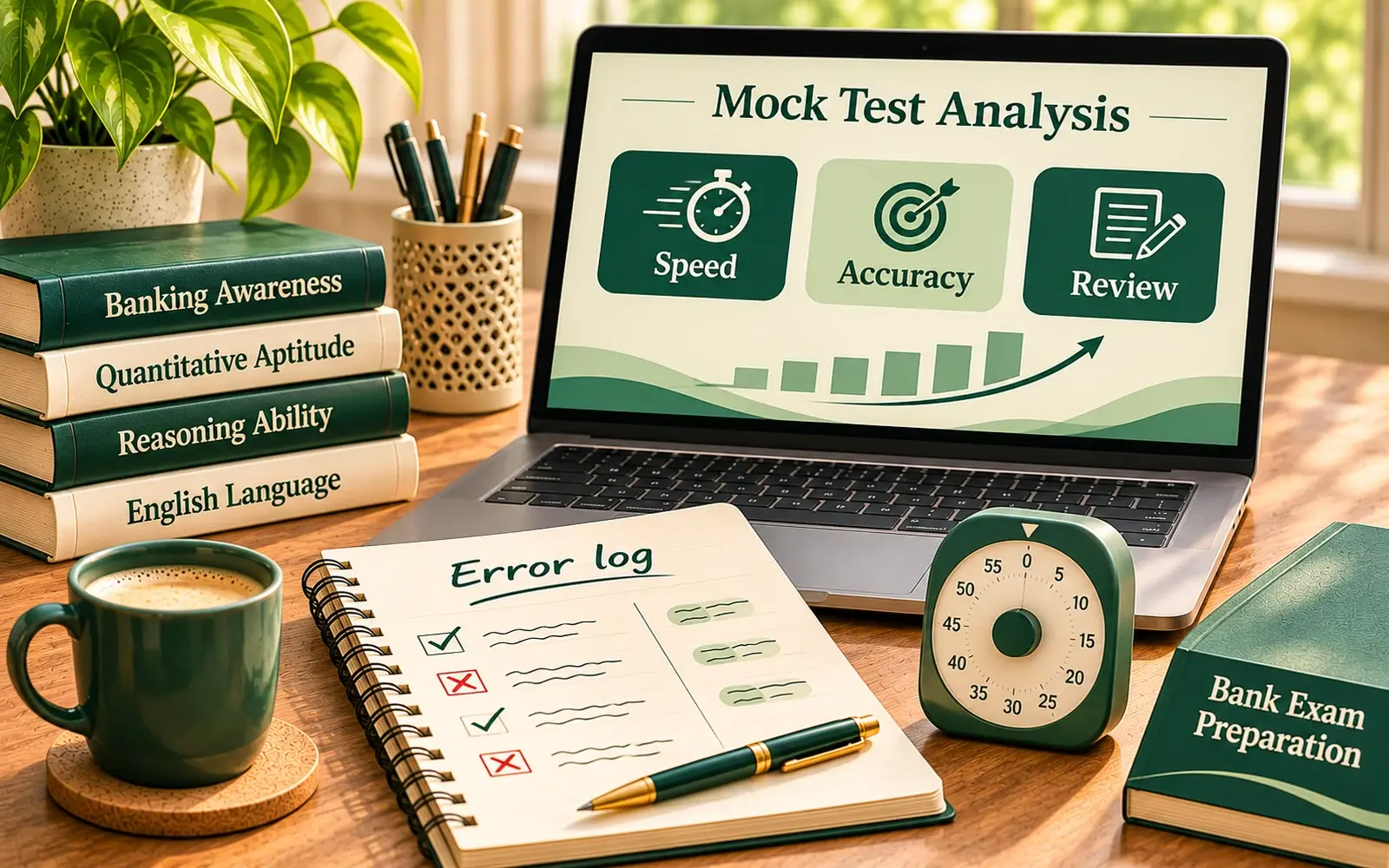
You finish a bank exam mock test, check your score and discover that it is almost identical to last week's. You have been studying regularly, watching solutions and attempting more questions. Yet the marks refuse to move.
The natural reaction is to increase study hours or take another mock. But what if the problem is not how much you study? Perhaps you spend too long on the wrong puzzles, make the same calculation errors or watch explanations without ever trying those questions again.
A mock test is not just a rehearsal for the examination. It is also a diagnostic tool that can tell you where your next hour of preparation will be most useful. The aim is to turn that information into better decisions, faster methods and fewer mistakes, without necessarily spending longer at your desk.
1. More attempts do not always mean more marks
Many banking recruitment examinations impose a penalty for incorrect objective answers. For example, IBPS's PO recruitment notifications specify a deduction of one-quarter of the marks assigned to an incorrectly answered question, while leaving an answer blank carries no penalty. [1–3] Check your own examination's notification and handout, because marks per question, timings and marking rules can differ between posts and stages.
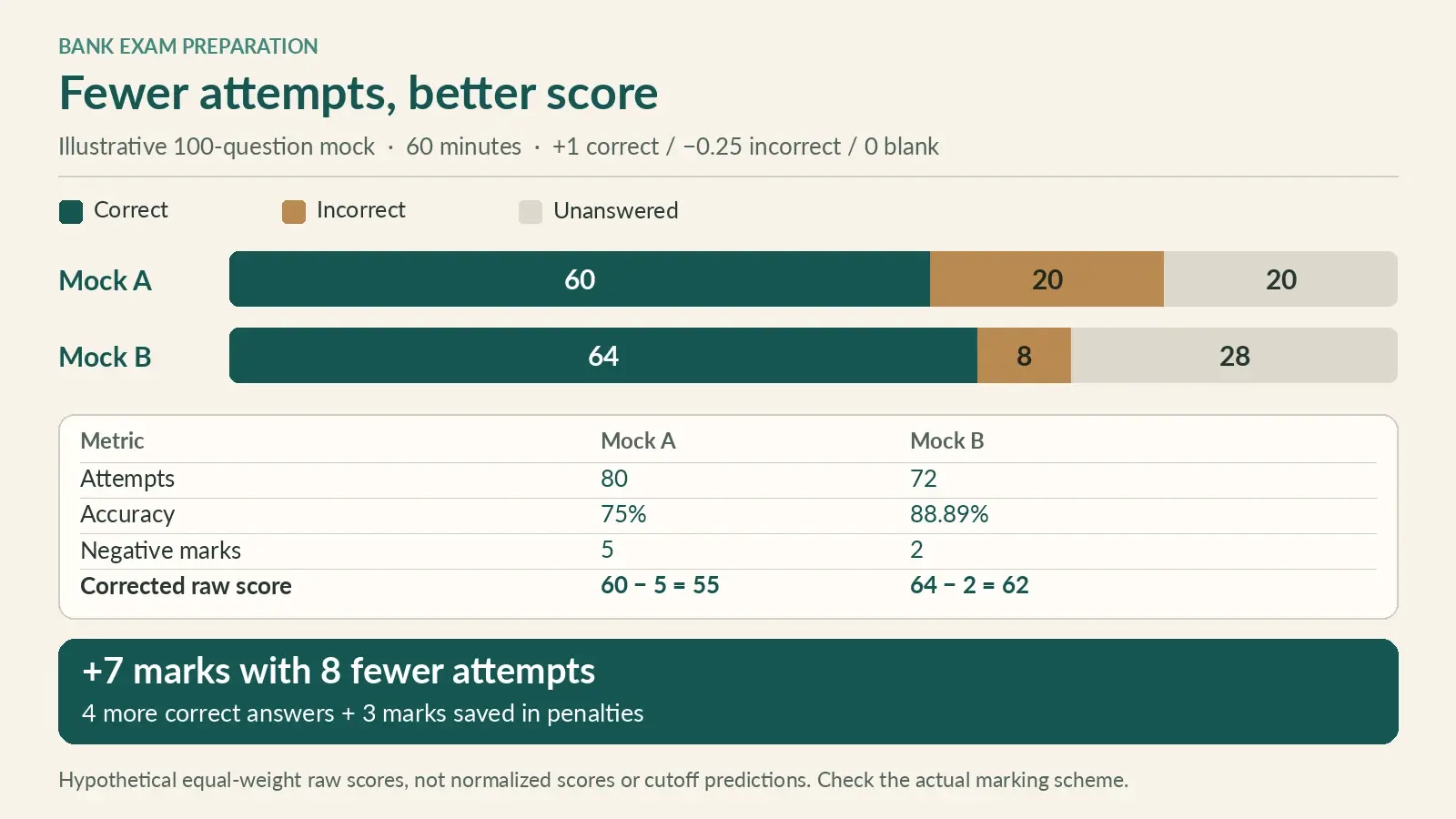
Consider two hypothetical mocks, each containing 100 equally weighted one-mark questions, lasting 60 minutes and applying a 0.25-mark penalty for each incorrect answer.
| Metric | Mock A | Mock B |
|---|---|---|
| Questions attempted | 80 | 72 |
| Correct answers | 60 | 64 |
| Incorrect answers | 20 | 8 |
| Unanswered questions | 20 | 28 |
| Accuracy | 75% | 88.89% |
| Negative marks | 5 | 2 |
| Corrected raw score | 55 | 62 |
Accuracy is the number of correct answers divided by the number attempted, multiplied by 100. In Mock A, the corrected score is 60 − (20 × 0.25) = 55. In Mock B, it is 64 − (8 × 0.25) = 62.
The candidate gained seven marks despite attempting eight fewer questions. Four additional correct answers contributed four marks, and twelve fewer incorrect answers reduced the penalty by three marks.
That does not mean attempting fewer questions is always better. It means that attempts are useful only when they contribute to the score. A stronger candidate may eventually increase attempts and accuracy together. These are illustrative raw scores, not normalized examination scores or predicted cutoffs.
2. Track the numbers that explain your performance
Most mock platforms display a score, rank and accuracy percentage. These are useful, but they do not necessarily explain why your performance changed. Record a few additional measurements in a notebook or spreadsheet.
| Metric | What it reveals |
|---|---|
| Corrected score by section | Which section needs attention |
| Accuracy among attempted questions | Whether mistakes are consuming marks |
| Correct answers per minute | How efficiently time produces correct answers |
| Solvable questions left unanswered | Missed scoring opportunities |
| Repeated error count | Whether previous review actually worked |
For example, Mock A produces one correct answer per minute across the full hour; Mock B produces about 1.07. Although the candidate attempts fewer questions per minute, useful output improves. This is a better measure of productive speed than clicks or attempts alone.
If questions have different marks, also track corrected marks per minute. Compare similar tests using the same marking scheme, difficulty and section timings wherever possible. A difficult mock can lower your score even if your preparation is improving. Platform percentile reflects the platform's participating candidates, not necessarily the actual examination population.
Look at the last three to five comparable mocks rather than reacting to every individual result. The trend is more useful than an isolated good or bad day.
3. The mock-test review that actually changes your next score
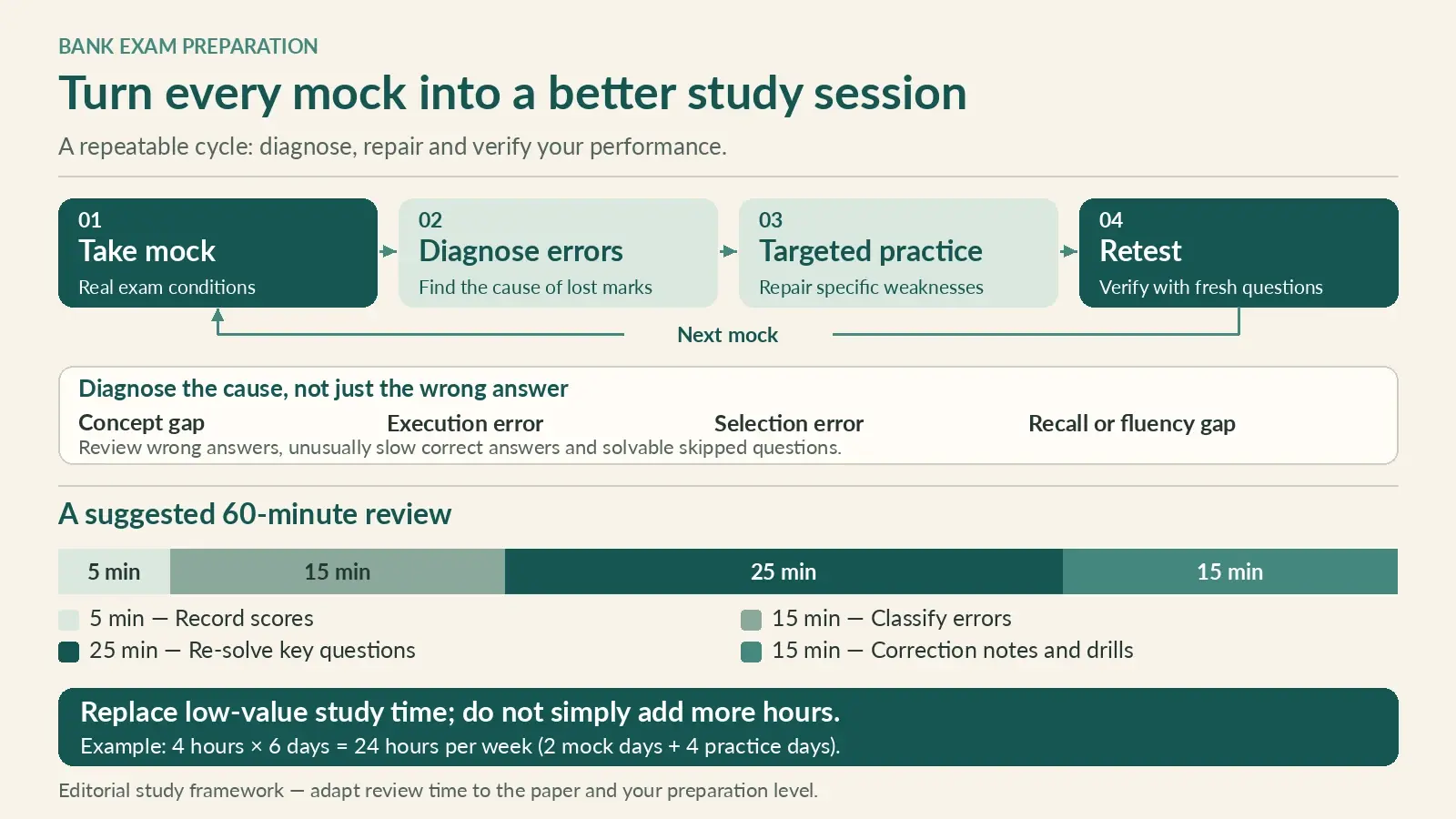
Start with a 60-minute review after a one-hour mock. Extend it by replacing another study activity if the paper is more complex, rather than treating review as unlimited extra work.
| Review activity | Suggested time |
|---|---|
| Record section scores and identify problem areas | 5 min |
| Classify wrong, skipped and unusually slow answers | 15 min |
| Re-solve the highest-value questions | 25 min |
| Create correction notes and schedule drills | 15 min |
| Total | 60 min |
Do not restrict the review to incorrect questions. A correct answer obtained through a lucky guess or a five-minute calculation can hide a weakness. Equally, a skipped question that you could have solved in thirty seconds deserves attention.
Use four error categories:
- Concept gap: You did not know the rule, formula or method.
- Execution error: You knew the method but made a calculation, reading or marking mistake.
- Selection error: You chose an unproductive question or set and missed an easier opportunity.
- Recall or fluency gap: You understood the concept but could not retrieve or apply it efficiently under time pressure.
Assign the primary cause, rather than calling everything a silly mistake. If you repeatedly misread the phrase "at least", the solution is a specific reading habit, not a general instruction to concentrate harder.
Try the question again without viewing its solution first. If you still cannot solve it, study the explanation, close it and reconstruct the method yourself. Later, attempt a fresh question of the same type. Recognizing a familiar answer is not the same as being able to produce it independently.
Research on learning techniques supports practice testing, corrective feedback and spaced practice as useful approaches for retention. 4, 5 That evidence does not establish a guaranteed bank exam score increase or a uniquely optimal review duration.
4. Improve speed through better question selection
Imagine a reasoning section with a twenty-minute timer. You start a seating arrangement that consumes four minutes without producing a single answer. Meanwhile, several shorter questions remain unseen.
You may eventually solve the arrangement, but the opportunity cost can be substantial. Suppose you could instead solve three independent one-mark questions in the same time, correctly. Those three marks matter more than the satisfaction of completing a difficult set that produces fewer marks.
The right strategy is not to avoid puzzles altogether. It is to recognize when progress has stalled and when a set is worth the investment. A partially solved arrangement that can unlock five questions may deserve more time than an isolated question.
Try a two-pass strategy inside each section, where the interface permits navigation. On the first pass, attempt questions with a clear approach. Mark promising but lengthy questions for later. On the second pass, return to those with the highest realistic scoring potential. Reserve a small review buffer if your timing allows.
For an independent question, a 45–60 second progress check can be a useful starting experiment. If you have not identified a workable approach, consider moving on. This is not a universal time limit: data interpretation and multi-question reasoning sets require their own time budgets.
Rehearse the exact test interface and sectional timers. In separately timed sections, unused time may not be transferable, and a completed section may be inaccessible. Do not build a strategy around navigation that the real examination prohibits.
What about guessing?
For an equal-weight question worth one mark with a 0.25 penalty, the mathematical expected score of an answer is positive when its probability of being correct exceeds 20%. That follows from p − 0.25(1 − p) > 0.
This is an expected-value threshold, not a guarantee or a recommended accuracy target. Your confidence estimates may be poor, random guesses add variability, and guessing can consume time that could earn more reliable marks elsewhere. Use the actual marking scheme and distinguish reasoned elimination from blind guessing.
5. Fix the bottleneck, not the whole syllabus
Different subjects need different responses to mock-test mistakes.
Quantitative Aptitude: If you know how to solve percentage and ratio questions but need too much time, practise a short set of calculation drills, then solve word problems using the improved method. If the equation itself is wrong, return to the concept instead of chasing calculation shortcuts.
Reasoning: Keep track of the puzzle families that consume time without generating answers. Practise drawing clean tables, selecting an informative clue and avoiding unnecessary cases. Compare time across entire sets as well as individual questions.
English Language: Separate vocabulary gaps from grammar and comprehension errors. For reading comprehension, identify the sentence that supports your answer. For grammar, write down the rule and create a new example instead of merely memorizing an option.
Banking and General Awareness: If your examination includes these sections, classify errors into missing knowledge, outdated information and confused facts. Retrieve definitions from memory and check time-sensitive facts against authoritative, current sources. The Banking Awareness library can help strengthen conceptual foundations, but it does not replace current affairs preparation.
The same approach works for Computer Knowledge and specialist IT sections. Identify whether the missing marks come from unfamiliar concepts, weak recall or poor examination decisions. Your drill should address that specific cause.
6. Build an error log you will actually revisit
An effective error log is small enough to review. Do not copy entire questions and lengthy solutions if a short note can capture the lesson. Record a question identifier so you can locate it again.
| Topic | Error cause | Next action | Retest |
|---|---|---|---|
| Profit and loss | Used selling price as percentage base | Identify cost price before calculating | Tomorrow |
| Seating arrangement | Stayed too long without progress | Practise selecting and abandoning sets | In 3 days |
| Reading comprehension | Chose unsupported inference | Find textual evidence before answering | Tomorrow |
| Banking awareness | Confused two institutions' functions | Recall and compare their mandates | In 7 days |
These entries are examples, not required review intervals. Schedule a brief retest after roughly one day, three days and a week where useful. Retire an entry from active review when you can solve fresh variants independently and within a reasonable time budget.
A log that only grows is a record of past failures. A log that helps you stop repeating them is a preparation tool.
7. Reallocate your existing study hours
Suppose you already study four focused hours a day, six days a week. That gives you 24 hours. Instead of increasing the total, try replacing repetitive full mocks or passive solution videos with targeted corrective work.
| Activity | Two mock days (each) | Four practice days (each) |
|---|---|---|
| Full mock | 60 min | — |
| Structured mock review | 60 min | — |
| Targeted concepts and drills | 60 min | 90 min |
| Timed sectional practice | — | 45 min |
| Other syllabus and awareness | 60 min | 60 min |
| Error-log retests and revision | — | 45 min |
| Daily total | 240 min | 240 min |
This schedule keeps weekly study time at 24 hours. The remaining day can be reserved for rest. The mock length is illustrative: for a longer mains paper, adjust the rest of the day's work or the weekly allocation without pretending that it fits a one-hour slot.
If you are still learning most of the syllabus, use more concept sessions and fewer full mocks. As the examination approaches, shift time toward realistic simulations and consolidation. Two well-reviewed mocks may be more useful than a succession of tests whose mistakes are never addressed, although the appropriate frequency depends on your stage of preparation.
8. Decide what to change after every three mocks
Use your recent comparable results to choose one or two priorities for the next study cycle. If accuracy is high but many familiar questions remain unanswered, focus on fluency and selection. If attempts rise while accuracy falls, identify whether guessing, rushing or conceptual weaknesses caused the decline. If both attempts and accuracy remain low, rebuild the most frequently missed foundations.
Do not change your entire strategy after every mock. For instance, if you introduce a new reasoning selection method, try it over a few comparable tests. Check whether it reduces time spent on abandoned sets and improves corrected marks without hurting sectional performance.
Set a measurable next action: complete ten fresh ratio questions accurately under a reasonable time limit, or reduce repeated reading errors in the next two English sectionals. A goal such as "increase speed" is too vague to guide tomorrow's study session.
Your eventual objective is not to achieve a particular mock-platform percentile or an arbitrary attempt target. It is to become consistently capable of scoring well under the actual examination's rules.
The bottom line
You cannot control the difficulty of the next bank examination or the cutoff that follows it. You can control how you use the hours already available to you. A mock test reveals where marks are lost; review identifies the reason; targeted practice repairs the weakness; and a later mock checks whether that repair worked.
Treat those four steps as one continuous cycle. The most productive mock is not necessarily the one with your highest score. It may be the one that teaches you how to earn more marks next time.
Sources and further reading
- IBPS — CRP PO/MT-XV detailed notification (2025), sections D–G: test structure, wrong-answer penalty and corrected-score normalization.
- IBPS — CRP PO/MT-XVI recruitment notices (2026), current recruitment listing and official amendments.
- CRP PO/MT-XVI notification (2026, externally hosted reproduction), wrong-answer penalty reference.
- Dunlosky et al. (2013), Improving Students' Learning With Effective Learning Techniques, review of practice testing and distributed practice.
- McDermott (2021), Practicing Retrieval Facilitates Learning, review of retrieval practice.
The mock examples and study strategies are illustrations. Consult the notification for the marking rules of your exam cycle.