IBPS SO IT Officer Professional Knowledge: How to Prioritize DBMS, Networking, Operating Systems and Cybersecurity
Build an effective IBPS SO IT Officer preparation strategy with a practical topic roadmap, banking IT examples, the revised exam pattern and mock-test-based priorities.
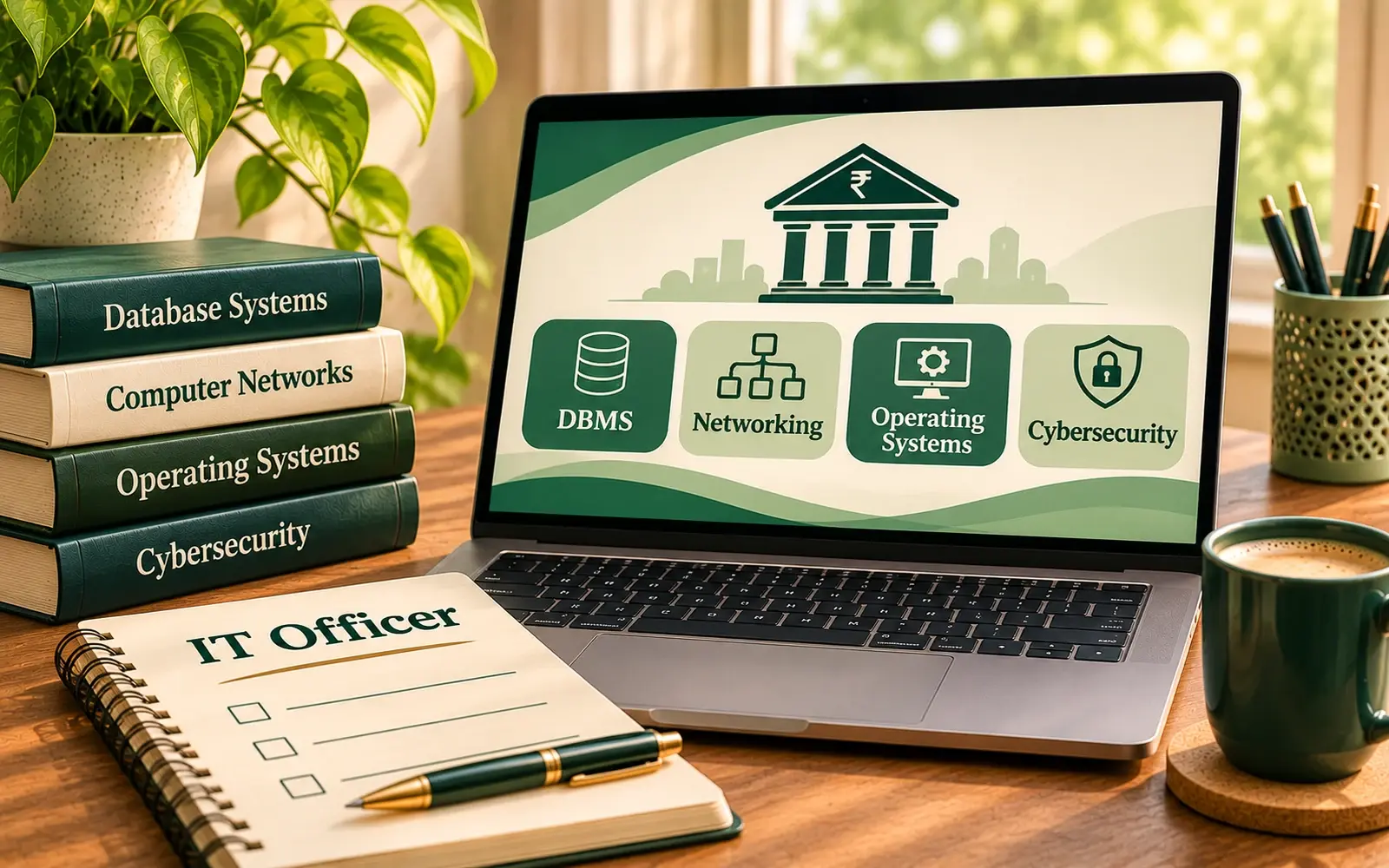
Imagine opening a banking app to transfer money. A database must update the account records correctly, a network must carry the request, an operating system must manage the resources used by the application, and security controls must protect the transaction. If any of these layers fails, the customer may face a delayed payment, an incorrect balance or a security incident.
That single example explains why Database Management Systems (DBMS), Computer Networks, Operating Systems and Cybersecurity form such a useful foundation for IBPS Specialist Officer (SO) IT Officer preparation. They are not four unrelated subjects. They describe different parts of the systems that banks rely on every day.
Start with these four areas, but do not treat them as the entire syllabus. Learn the concepts, practise short technical questions and gradually add programming, data structures, software engineering and other IT topics. The aim is to develop both breadth and the ability to distinguish between closely related concepts under time pressure.
Understand the revised IBPS SO exam pattern first
Before preparing a timetable, check the recruitment notification for your cycle. The CRP SPL-XVI notification issued in July 2026 introduced a substantially different examination structure from the older format, in which the IT Officer mains consisted of a Professional Knowledge test alone.
For the IT Officer (Scale I) post, the 2026 notification specifies the following Professional Knowledge (PK) sections:
| Feature | Prelims | Mains |
|---|---|---|
| PK questions | 25 | 50 |
| PK maximum marks | 50 | 100 |
| PK time | 20 minutes | 40 minutes |
| Average available time per PK question | 48 seconds | 48 seconds |
| PK share of objective marks | 50 of 125 | 100 of 200 |
Prelims also includes English Language, Reasoning and Quantitative Aptitude. Mains includes those three objective tests and an additional descriptive English paper worth 25 marks. The total notified mains duration is 155 minutes, including the descriptive test.
The mains tests other than PK are qualifying in nature; merit ranking at that stage is based on PK scores. Candidates still need to clear the applicable qualifying requirements. The notification provides an 80:20 mains-to-interview weightage for final selection. Prelims marks do not contribute to final merit.
Wrong objective answers attract a deduction of one-quarter of the marks assigned to the question, while unanswered questions incur no penalty. Check the current notification and information handout before each attempt because IBPS can change the structure.
The practical consequence is clear: start technical preparation before prelims, rather than waiting for its result. At the same time, do not ignore the qualifying sections.
Which subjects deserve priority?
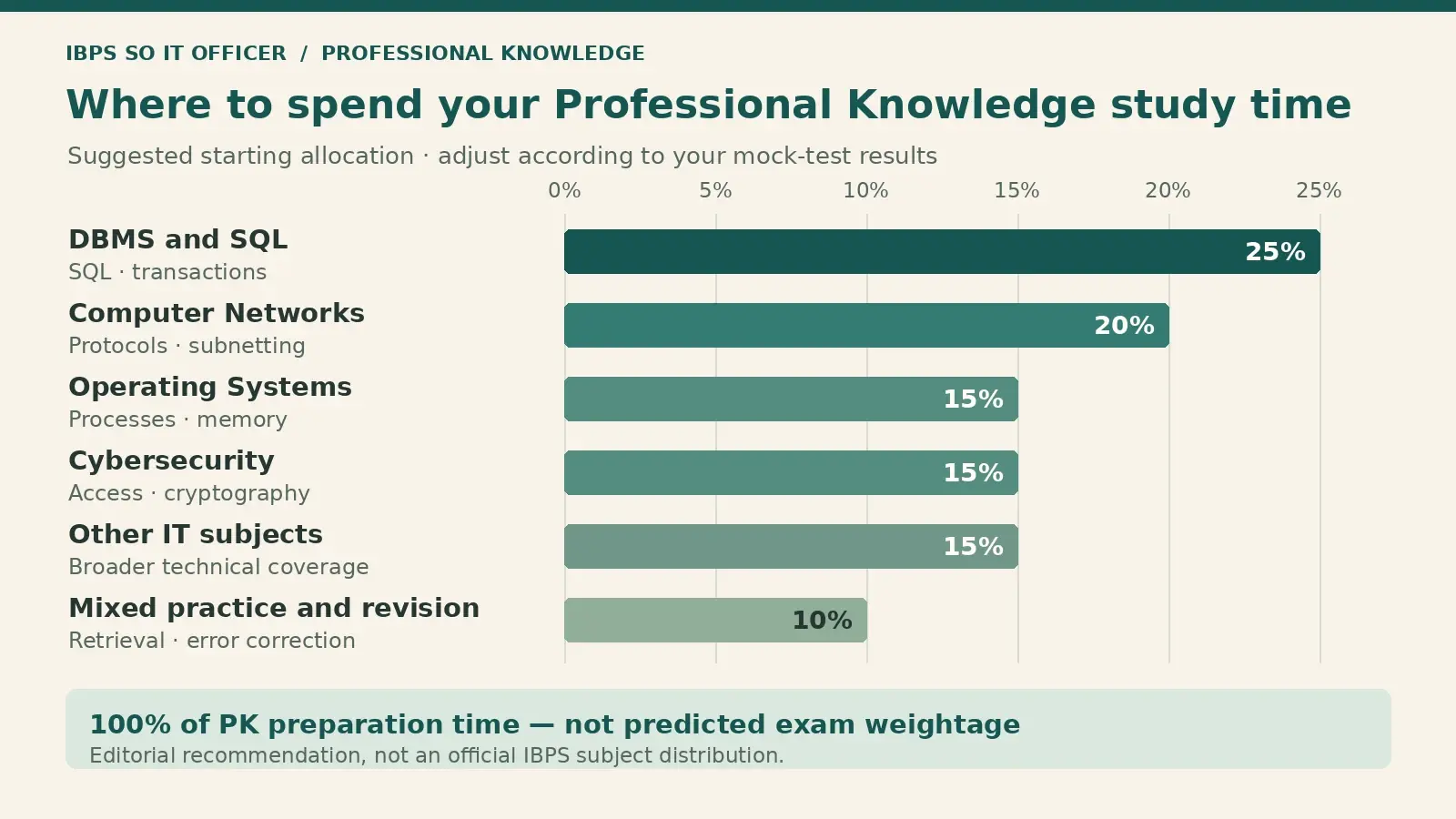
IBPS's detailed 2026 recruitment notification specifies the tests and marks but does not give a chapter-wise IT syllabus or an official subject-wise question distribution. The roadmap below is therefore a preparation recommendation, informed by core computer science, the IT Officer role and publicly reported memory-based exam analyses. It is not a prediction of the next paper.
| Study block | Suggested initial share of PK time | Why it matters |
|---|---|---|
| DBMS and SQL | 25% | Data integrity, transactions and practical queries |
| Computer Networks | 20% | Communication, protocols and troubleshooting |
| Operating Systems | 15% | Processes, memory and resource management |
| Cybersecurity | 15% | Protection of banking systems and information |
| Other IT subjects | 15% | Broader technical coverage |
| Mixed practice and revision | 10% | Retrieval, speed and error correction |
These percentages allocate study time, not examination marks. A student who already understands SQL but repeatedly makes networking errors should redistribute time accordingly. Avoid the tempting claim that a particular subject will always contribute a certain number of questions.
1. DBMS and SQL: build a strong foundation
DBMS is a sensible starting point because many concepts are directly relevant to banking and can be practised using small tables rather than lengthy notes.
Prioritize relational models, primary and foreign keys, constraints, ER diagrams, functional dependencies and normalization up to BCNF. Learn relational algebra and SQL together: selection, projection, joins, aggregation, subqueries, grouping and filtering. Then study indexing, transactions, ACID properties, concurrency control and recovery.
A useful distinction is between WHERE and HAVING. The first filters rows before grouping; the second filters groups after aggregation. Consider a table named Transactions with account_id and amount columns:
SELECT account_id, SUM(amount) AS total_amount
FROM Transactions
GROUP BY account_id
HAVING SUM(amount) > 10000;
This query returns accounts whose summed transaction amounts exceed 10,000 in the supplied dataset. It does not identify account balances, nor does it necessarily measure withdrawals alone. Understanding what a query actually computes is more valuable than memorizing its syntax.
For banking-oriented understanding, consider a simplified transfer between two accounts within one database transaction. A debit succeeds, but the corresponding credit fails before the transaction commits. Atomicity requires the transaction to complete as a whole or have its partial changes undone. Actual interbank payments involve additional systems, reconciliation and recovery mechanisms; this example illustrates a local database property rather than the entire payment process.
Practise SQL on a small local database with fictional data. For normalization, write down dependencies and work through a few decompositions. For transactions, compare isolation, consistency and durability instead of memorizing ACID as four disconnected words.
2. Computer Networks: learn how the layers work together
Begin with the OSI and TCP/IP models, then connect each layer to its responsibilities. Study Ethernet, MAC addresses, switching, IP addressing, subnetting, routing, TCP and UDP. Move on to DNS, DHCP, HTTP/HTTPS, email protocols, NAT, VPNs and common troubleshooting concepts.
Port numbers are worth revising, but knowing that DNS commonly uses port 53 is not enough. Understand why DNS can use both UDP and TCP, and why a DNS failure can stop a website from loading even when the computer has working network connectivity.
Use small calculations to strengthen your understanding. An IPv4 /26 network leaves six host bits, giving 64 addresses and ordinarily 62 usable host addresses in a conventional subnet. Practising examples like this helps you answer subnetting questions without reconstructing the entire method during the exam.
A branch employee who cannot access the core banking application may be facing a connectivity failure, a name-resolution problem, an authentication issue or an application outage. Those are different faults. Learn to identify which layer a question is describing.
Create a one-page protocol table containing function, typical transport and default port where applicable. Include exceptions rather than assuming every protocol always uses one transport or port. Review the table through short quizzes instead of repeatedly copying it.
3. Operating Systems: focus on mechanisms and comparisons
Operating Systems can become difficult when preparation starts with memorizing scheduling formulas without understanding processes, threads and resources.
Start with process states, context switching, threads and CPU scheduling. Practise FCFS, SJF, priority scheduling and Round Robin using simple examples. Next, cover synchronization, semaphores, race conditions and the four necessary conditions for deadlock. Finish with paging, segmentation, virtual memory, page replacement, file systems and storage basics.
A page fault occurs when a memory access cannot proceed normally through the current page mapping, for example because the page is not resident in RAM. The operating system handles the fault; it is not automatically a program crash. Similarly, a deadlock is not simply a slow process: it involves a set of processes or threads waiting on resources in a way that prevents progress.
Learn to differentiate prevention, avoidance, detection and recovery in deadlock questions. Connect these concepts to database concurrency, but remember that database locks and OS resource management are distinct mechanisms.
For scheduling and page replacement, solve short numerical problems. For theory, maintain comparison notes: process versus thread, paging versus segmentation, mutex versus semaphore, and internal versus external fragmentation.
4. Cybersecurity: understand the purpose of every control
Security preparation becomes easier when organized around confidentiality, integrity and availability. A bank needs to protect customer information, maintain accurate records and keep essential services accessible.
Study authentication, authorization, multifactor authentication, role-based access control and least privilege. Cover symmetric and asymmetric encryption, hashing, digital signatures, certificates and TLS. Learn the roles of firewalls, IDS and IPS, common threats such as phishing and ransomware, secure coding basics, patch management, logging and incident response.
Do not confuse encryption with hashing. Encryption is reversible with the appropriate key; cryptographic hashing is designed as a one-way transformation. Digital signatures support integrity and verification of the signer's authenticity, while encryption primarily protects confidentiality. These distinctions frequently appear in technical practice questions.
Banking IT also requires operational resilience. A backup is a recoverable copy of data; disaster recovery concerns restoring systems after disruption; business continuity concerns maintaining critical activities during disruption. Recovery Time Objective (RTO) describes the targeted recovery time, while Recovery Point Objective (RPO) describes the targeted maximum tolerable data loss measured in time.
For banking context, read the RBI's Commercial Banks cybersecurity and technology-risk framework alongside your basic security notes. Its themes include access management, technology governance and resilience. You need not memorize every regulatory clause merely because it relates to IT; review the current official document if a regulation-specific question or interview requires it.
One banking operation, four technical perspectives
Consider a simplified internal account transfer initiated through a banking application.
| Technical area | Question to ask |
|---|---|
| Networking | Can the request and response reach their destinations reliably? |
| Operating Systems | Can application processes obtain and manage the resources they need? |
| DBMS | Are related account updates recorded consistently and recoverably? |
| Cybersecurity | Is the request authenticated, authorized and protected from tampering? |
This is a conceptual model, not a representation of any bank's actual architecture. It helps connect subjects without assuming that a single database or server handles every real payment.
When revising, try explaining another scenario, such as a failed login or an unavailable banking service, from the same four perspectives. The exercise also provides useful interview preparation.
Do not neglect the rest of Professional Knowledge
Four strong subjects are a foundation, not a complete preparation plan. Include programming and object-oriented concepts, data structures and basic algorithms, software engineering and testing, web technologies, computer architecture fundamentals, cloud computing, virtualization and basic AI concepts. Learn banking technology terminology such as CBS, digital payment systems, reconciliation and information-system auditing at an appropriate introductory depth.
For programming, practise tracing short code snippets and understanding scope, loops, arrays and classes. For software engineering, compare development models, testing levels and version control concepts. Cloud preparation should distinguish IaaS, PaaS and SaaS rather than focus on memorizing particular vendor products.
The site's Computer Awareness library is a useful place to refresh foundational terminology. Treat it as a starting resource, not a substitute for undergraduate-level Professional Knowledge preparation.
A practical four-hour PK study day
If you can dedicate four focused hours to technical preparation, use the following balanced template. These hours exclude English, Reasoning, Quantitative Aptitude and breaks.
| Activity | Time |
|---|---|
| Main technical subject: new concepts | 90 minutes |
| Second subject or additional IT topics | 60 minutes |
| Topic-based questions and short calculations | 45 minutes |
| Mixed timed questions | 30 minutes |
| Error log and spaced revision | 15 minutes |
| Total | 240 minutes |
Rotate the main and secondary subjects across the week. One session could pair DBMS with security; another could pair networking with operating systems. Keep revisiting earlier material while learning new topics. The table is a daily learning structure, not an additional allocation on top of the earlier percentage-based plan.
As coverage improves, move time from new material into mixed tests. Reproduce the notified 25-question, 20-minute prelims PK section and the 50-question, 40-minute mains PK section in separate practice sessions. Periodically take full-exam mocks so qualifying sections are not neglected.
Let mock tests decide your next priority
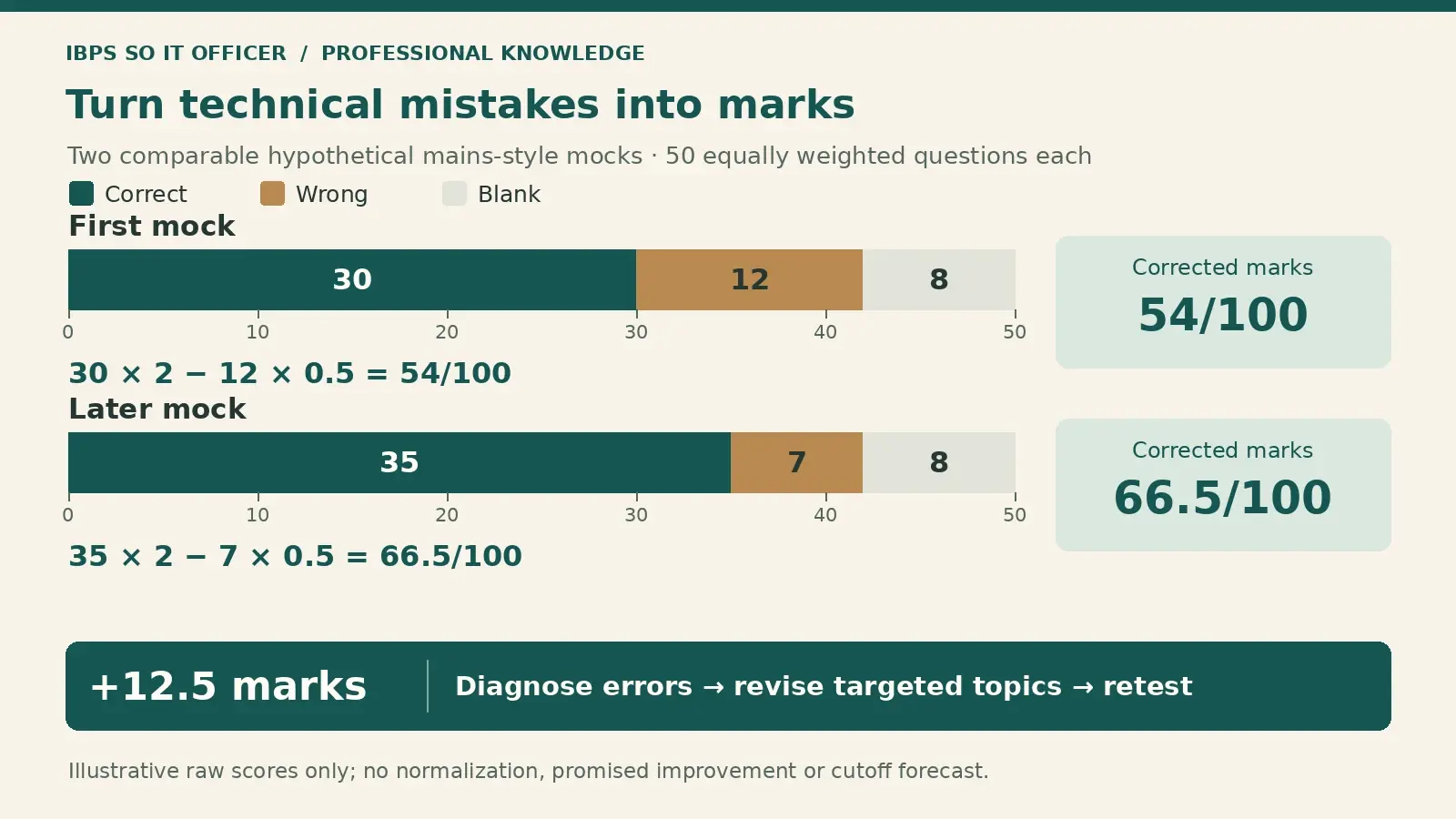
Imagine a mains-style PK mock with 50 equally weighted two-mark questions. A candidate answers 30 correctly, 12 incorrectly and leaves eight unanswered. The raw corrected score is 60 minus 6, or 54 out of 100.
After targeted revision, a comparable mock has 35 correct answers, seven wrong answers and eight blanks. Its corrected score is 70 minus 3.5, or 66.5.
| Mock | Correct | Wrong | Blank | Corrected marks |
|---|---|---|---|---|
| First | 30 | 12 | 8 | 54 |
| Later | 35 | 7 | 8 | 66.5 |
The improvement is 12.5 marks. This is a hypothetical raw-score comparison, not a forecast of normalized scores or cutoffs. It shows the value of converting errors into correct answers instead of simply increasing attempts.
For every mistake, record the topic, reason and correction. Separate missing knowledge from confused definitions, calculation mistakes and careless reading. If five networking errors came from subnetting, revise subnetting rather than restarting the entire networking syllabus. Use several comparable mocks before making a large change to your study plan.
The best preparation order
For a beginner, start with DBMS and SQL, then work through networking fundamentals and operating systems. Introduce basic security concepts early, and deepen them once you understand the systems they protect. Rotate in other subjects and mixed questions from the beginning rather than postponing them indefinitely.
If you have already prepared for GATE or UGC NET, use your technical foundation but adapt your practice to the shorter IBPS questions and broader banking IT context. Do not assume that the same depth, question format or subject distribution applies.
Professional Knowledge preparation is successful when you can explain a concept, distinguish it from a similar one, apply it to a small example and retrieve it quickly in a mixed test. A well-revised foundation is more useful than a long list of topics you have read only once.
Sources and further reading
- IBPS — Specialist Officers XVI official notification listing, notification dated 1 July 2026.
- CRP SPL-XVI detailed notification — hosted reproduction, Sections D–I, pp. 13–16.
- BankersAdda — memory-based Professional Knowledge prelims questions, 2026. Secondary evidence for topic breadth only, not official PYQs or weightage.
- RBI — Commercial Banks: Cybersecurity, Technology: Risk, Resilience and Assurance Framework Directions, 2026, updated 1 October 2026 as listed. Banking context, not an IBPS syllabus.
Check the recruitment notification and handout for your exam cycle.