UGC NET Computer Science Explained: Percentile, Cutoffs, JRF and Assistant Professor Eligibility
Understand UGC NET Computer Science marks, percentile, qualifying cutoffs, JRF and Assistant Professor eligibility with real cutoff data and practical examples.

Imagine scoring 200 out of 300 in UGC NET Computer Science. You have answered two-thirds of the examination correctly, and your percentile might look impressive. Does that mean you have secured a Junior Research Fellowship (JRF), qualified to become an Assistant Professor, or earned eligibility for Ph.D. admission only?
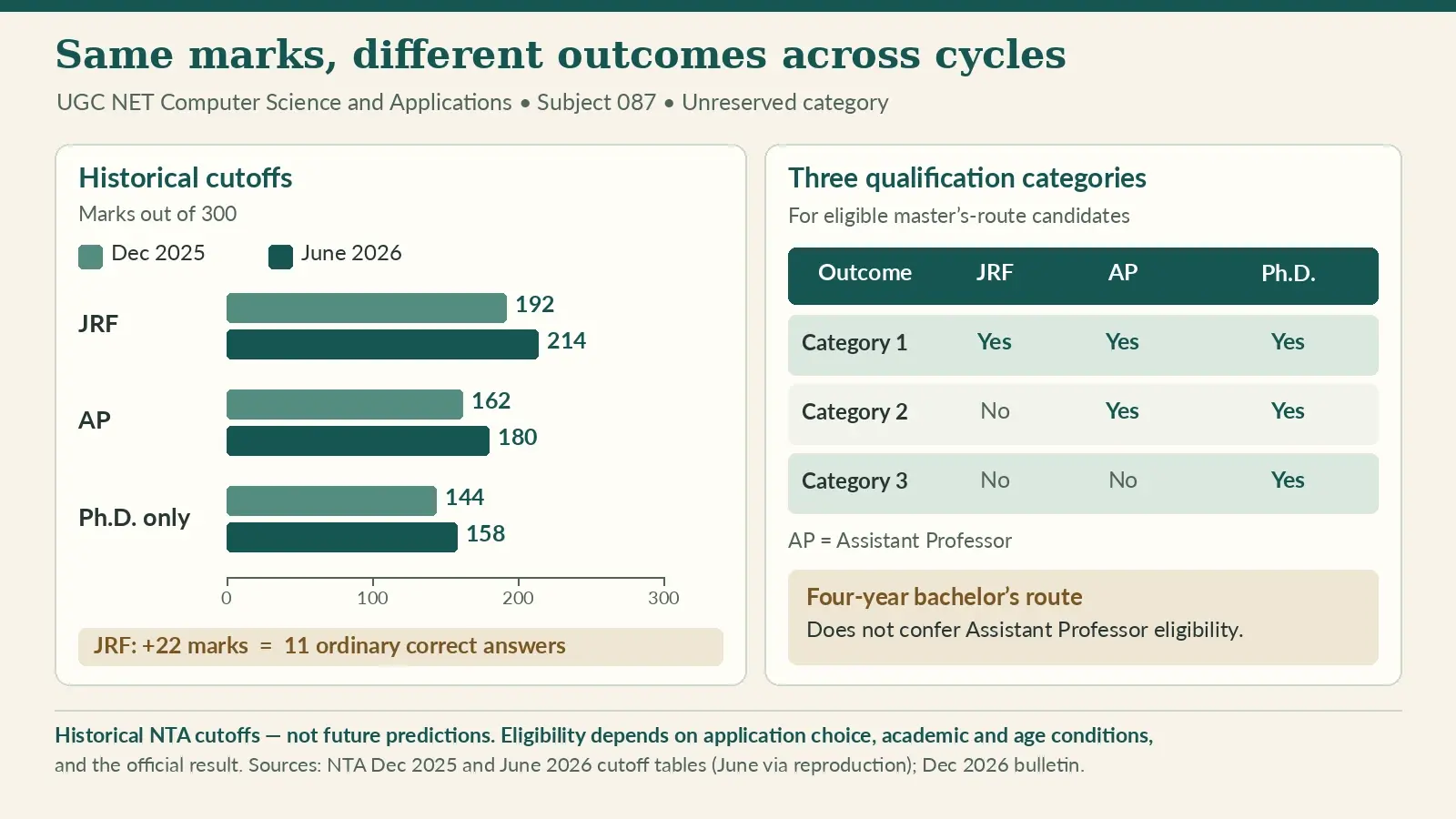
The answer depends on more than your marks. In the December 2025 examination, 200 marks exceeded the unreserved Computer Science JRF cutoff. In June 2026, the same marks fell short of that cutoff but exceeded the Assistant Professor cutoff.
Marks measure examination performance, percentile measures relative standing, and the applicable cutoff helps determine what you qualify for. Your educational qualifications, application choice and, for JRF, age eligibility also matter.
Understanding these distinctions makes the result much easier to interpret and helps you set a meaningful preparation target. The examination framework discussed here follows the updated NTA December 2026 information bulletin, while the earlier results are historical examples.
Start with the marks: how the 300-point total works
UGC NET Computer Science and Applications has subject code 087. The examination combines a common aptitude paper with a subject-specific paper in a single three-hour session.
| Component | Questions | Maximum marks |
|---|---|---|
| Paper 1 — Teaching and Research Aptitude | 50 | 100 |
| Paper 2 — Computer Science and Applications | 100 | 200 |
| Total | 150 | 300 |
Each correct answer ordinarily earns two marks; incorrect answers carry no negative marking. Final answer-key decisions, including the treatment of dropped questions, can affect the official result.
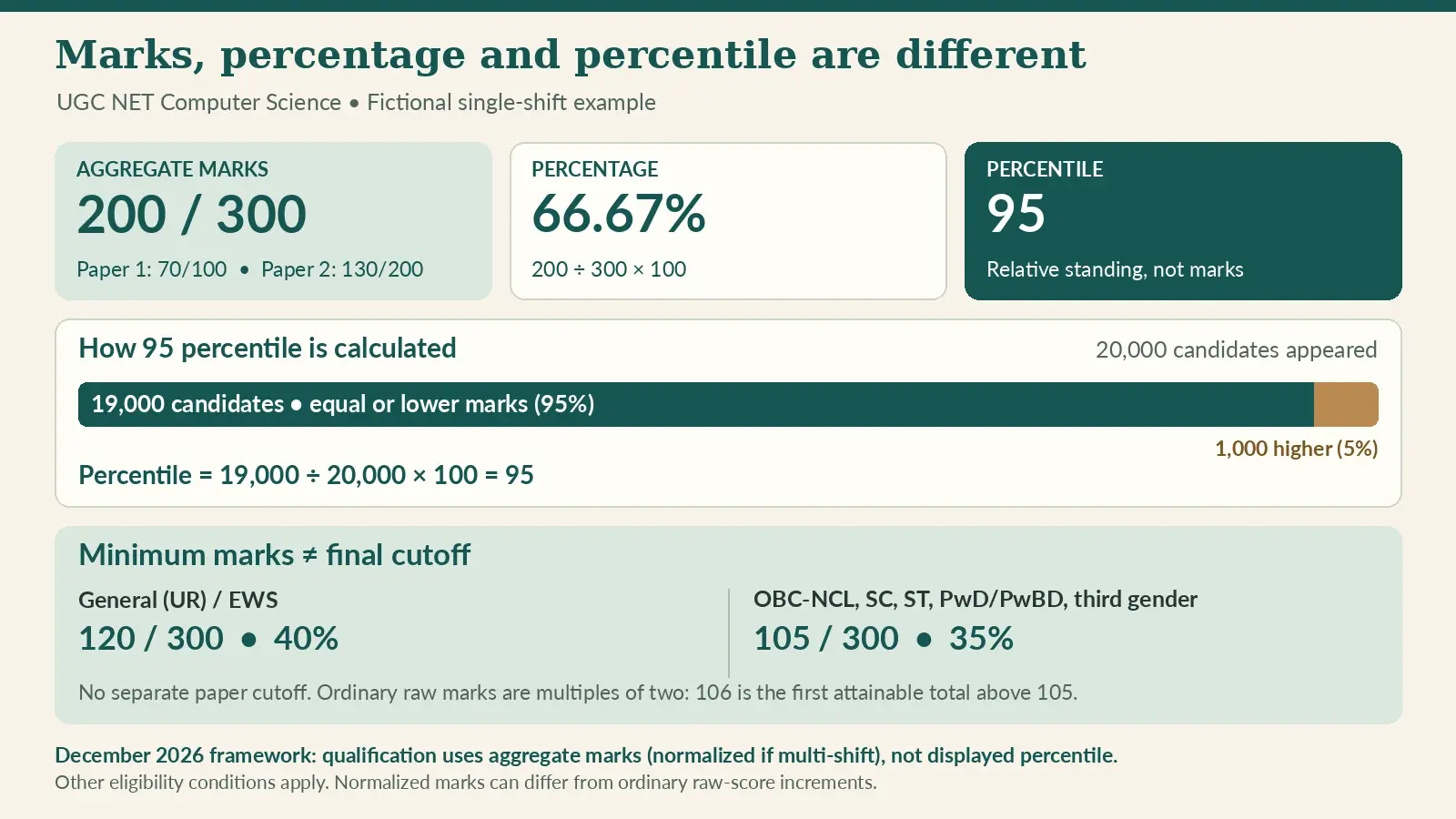
Suppose you answer 35 questions correctly in Paper 1 and 65 in Paper 2, with no special answer-key adjustments. Your marks would be 70 and 130 respectively, giving a total of 200 out of 300, or 66.67%.
The two papers contribute to the same aggregate. There is no ordinary separate qualifying cutoff for each paper under the result framework discussed here. A stronger Paper 1 can therefore compensate for a weaker technical performance, and vice versa. That is one reason why neglecting Paper 1 is such an expensive preparation mistake.
Percentage and percentile are not interchangeable
Percentage tells you how much of the available marks you earned. Percentile tells you how your performance compares with that of other candidates in the same subject.
For a single-shift subject, the updated December 2026 bulletin calculates percentile using the number of candidates who obtained marks no higher than yours, divided by the number who actually appeared in that subject, multiplied by 100.
Consider this fictional result:
| Measurement | Value |
|---|---|
| Aggregate marks | 200/300 |
| Percentage | 66.67% |
| Candidates who appeared in the subject | 20,000 |
| Candidates with marks equal to or below yours | 19,000 |
| Percentile | 95 |
Your percentile is 95 because 19,000 ÷ 20,000 × 100 = 95. It does not mean you scored 285 marks, nor does it mean you have secured JRF. Candidates with identical marks can share a percentile, and absent candidates do not belong in the denominator.
The highest scorer can have a percentile of 100 without obtaining full marks. Moreover, your percentile is not a reliable way to compare performance across different NET subjects, each of which has its own candidate population.
What happens if the subject has multiple shifts?
For December 2026, NTA plans a single shift per subject. If a subject must be conducted across several shifts, the bulletin provides for equi-percentile normalization.
The method matches equivalent positions in the different shift-wise score distributions and averages their corresponding marks. For example, if a particular percentile corresponds to 190 marks in one shift and 210 in another, the equivalent normalized mark for that percentile in this simplified two-shift illustration is 200. Actual calculations also use interpolation where an exact matching percentile is unavailable.
The result percentile is then calculated across the subject using normalized marks. Under the updated December 2026 rules, qualification is decided using aggregate marks (or normalized marks for a multi-shift subject), not the displayed percentile. Older cycles may have used different result procedures, so always check the bulletin for the examination you took.
Minimum qualifying marks are not the final cutoff
This is probably the most common misunderstanding about UGC NET. The examination has an initial minimum aggregate requirement and a separate competitive selection process.
| Reservation category | Minimum aggregate | Marks out of 300 |
|---|---|---|
| General (UR) and General-EWS | 40% | 120 |
| OBC-NCL, SC, ST, PwD/PwBD and third gender | 35% | 105 |
For an ordinary raw-score result where marks increase in steps of two, 106 is the first attainable total above the 105-mark threshold. Normalized marks can behave differently.
These thresholds only determine whether a candidate meets the minimum marks condition for consideration. They do not guarantee any qualification. Someone scoring 130 in the General category has cleared the initial marks threshold but may still fall below even the Ph.D.-only cutoff.
The Assistant Professor selection framework starts with 6% of the candidates who appeared in both papers on the master's-degree or equivalent route across NET. The resulting slots are distributed by reservation category, then allocated among subjects using the eligible candidate counts. The marks at the relevant selection boundary determine the subject-category cutoff. This is not simply a rule that everyone above the 94th percentile qualifies in each subject.
JRF has a separate allocation of limited fellowship slots. The results committee determines the number selected for Ph.D.-only eligibility. Consequently, the three outcomes can have different competitive boundaries, and the cutoffs can change each examination cycle.
What real Computer Science cutoffs tell us
Here are selected reservation-category cutoffs for Computer Science and Applications from two completed examination cycles. All figures are marks out of 300, not percentiles.
| Category | Dec 2025 JRF | Dec 2025 AP | Dec 2025 Ph.D. only | June 2026 JRF | June 2026 AP | June 2026 Ph.D. only |
|---|---|---|---|---|---|---|
| UR | 192 | 162 | 144 | 214 | 180 | 158 |
| OBC-NCL | 176 | 146 | 132 | 200 | 162 | 146 |
| EWS | 182 | 148 | 134 | 200 | 162 | 142 |
| SC | 168 | 140 | 126 | 188 | 156 | 140 |
| ST | 166 | 138 | 124 | 182 | 154 | 138 |
AP = Assistant Professor. Sources: NTA's December 2025 and June 2026 subject/category cutoff tables (see references). Candidates in other applicable categories, including disability subcategories, should consult their exact official row. The June 2026 table is linked through the official listing and an accessible reproduction.
Notice what happened to the unreserved JRF cutoff: it rose by 22 marks, equivalent to 11 ordinary correct answers. The Assistant Professor cutoff increased by 18 marks. A target that was comfortably sufficient in one cycle might become inadequate in the next.
Exam difficulty, the distribution of marks, the eligible candidate pool and the allocation of qualifying slots can all affect the boundary. A rise in cutoff does not, by itself, establish which factor caused the change.
Four candidates, four possible outcomes
Using the June 2026 unreserved thresholds, imagine four candidates with aggregate marks of 220, 190, 170 and 130. Assume all have the necessary master's-level qualifications, valid category details, have applied for all relevant outcomes and meet the JRF age condition.
| Marks | What the score would support in that historical cycle |
|---|---|
| 220 | JRF, Assistant Professor and Ph.D. admission |
| 190 | Assistant Professor and Ph.D. admission, without JRF |
| 170 | Ph.D. admission only |
| 130 | None of the three, despite meeting the initial 120-mark minimum |
This comparison is illustrative. The official result and certificate establish the actual outcome; a cutoff table alone cannot confirm an individual's eligibility. Never use historical boundaries as guaranteed predictions of future results.
What the three qualification categories actually offer
For candidates on the eligible master's-degree route, the current result framework has three broad outcomes:
| Result category | JRF | Assistant Professor | Ph.D. admission |
|---|---|---|---|
| Category 1 | Yes | Yes | Yes |
| Category 2 | No | Yes | Yes |
| Category 3 | No | No | Yes |
The four-year bachelor's route has an important exception, discussed below.
JRF: support for pursuing research
JRF is a fellowship, not a teaching appointment. It can provide financial support during eligible full-time research after you secure placement at an appropriate institution and complete the activation formalities.
UGC's published general fellowship scheme lists monthly amounts of ₹37,000 at the junior stage and ₹42,000 at the senior stage, subject to the applicable progression and funding conditions. The usual maximum tenure is five years or thesis submission, whichever is earlier. The December 2026 examination bulletin states a three-year validity period for the JRF offer from the award letter's issue date. Follow the actual award letter and scheme-specific joining requirements rather than assuming money is paid automatically after the result.
Assistant Professor: eligibility, not a job offer
An eligible NET certificate can satisfy the NET-related requirement for teaching vacancies governed by the relevant rules. You still need to meet the employer's degree, subject, recruitment and other conditions, and compete for the advertised post. Engineering and technical institutions may have distinct requirements; NET does not replace them.
UGC's FAQ describes the Assistant Professor eligibility certificate as having lifetime validity. That does not mean recruitment regulations can never change.
Ph.D. admission: a separate selection stage
For Categories 2 and 3, the bulletin specifies a 70:30 weighting of NET marks and the institution's interview or viva for admission through this route. Those NET marks remain valid for Ph.D. admission for one year after result declaration. For JRF-qualified applicants, the bulletin provides for interview-based admission under the applicable Ph.D. regulations. In either case, obtaining eligibility is not equivalent to receiving an admission offer or funded research position.
Educational qualifications and age can change the outcome
A high score cannot override the eligibility conditions. On the usual master's route, the required degree marks are 55% for General and General-EWS candidates, and 50% for the specified relaxed categories. Candidates awaiting their qualifying degree may be provisionally eligible, with completion deadlines and conditions specified in the bulletin.
Candidates with a qualifying four-year bachelor's degree can also use the undergraduate route, generally with at least 75% aggregate or equivalent grade and an applicable five-percentage-point relaxation for eligible groups. This route may lead to JRF or Ph.D. admission eligibility, but does not confer Assistant Professor eligibility through that NET qualification. A B.Tech graduate should not assume a JRF-level score on the undergraduate route creates a teaching qualification.
For the December 2026 examination, the standard JRF upper age is 30 years on 1 December 2026, with prescribed relaxations for eligible applicants. NET for Assistant Professor or Ph.D. admission has no upper age restriction, although recruitment and admission requirements can apply separately. Check the reference date for your own cycle, not simply your age on the application date.
How to use cutoffs while preparing
Start with the outcome that matters to you. If your goal is research funding, prepare for the JRF boundary rather than stopping at the minimum marks. If your priority is teaching, focus on Assistant Professor eligibility while ensuring that your academic qualifications support it.
Use several completed cycles to establish a working target and aim for a margin above the historical boundaries. For example, moving from 190 to 220 raw marks requires 15 additional ordinary correct answers. That improvement could come from five extra Paper 1 answers and ten extra Computer Science answers. Break a large score target into specific skills you can improve: research aptitude, SQL, graph algorithms, operating-system numericals or weak topics such as software engineering.
Take full-length mocks in the actual examination format. Track correct answers, topic-wise errors and time management separately. Since incorrect answers do not attract a penalty, practise reaching every question rather than leaving easy marks untouched because of poor pacing. A mock percentile is only as meaningful as its test-taking population; your raw marks and error patterns are usually more actionable for preparation.
When results arrive, download the official scorecard and the cutoff notice for your exact cycle and subject. Check the qualification status, category and applicable validity dates. Retain the e-certificate or JRF award letter for future applications.
The real goal is not to collect an impressive percentile. It is to earn the qualification that unlocks your intended academic path, with a clear understanding of what it permits and what still needs to be done.
Sources and Further Reading
- NTA — Updated UGC NET December 2026 Information Bulletin (16 October 2026), especially Chapters 1–3, 11.3 and Annexures X–XI (scoring, eligibility and normalization).
- NTA — December 2025 subject/category cutoff marks, subject 087.
- NTA — June 2026 cutoff marks for 84 subjects, official listing.
- June 2026 NTA cutoff table — accessible third-party reproduction, subject 087, printed page 37.
- UGC — Junior Research Fellowship scheme, fellowship rates and tenure; consult award-specific joining terms.
- UGC — Frequently Asked Questions, Assistant Professor certificate validity.
- NTA — Official UGC NET portal, current notices, results and certificates.