GATE CSE Subject Dependency Map: What Is the Best Order to Study the Subjects?
Discover a practical GATE CSE subject study order, understand the prerequisites connecting core computer science subjects, and build an efficient preparation roadmap.
Imagine starting Compiler Design on the first day of your GATE preparation. You encounter regular expressions, finite automata, grammars and parsing. Before long, you are watching separate tutorials simply to understand the terms used in the original lecture.
Now imagine studying those same concepts after Theory of Computation. Lexical analysis no longer feels mysterious: it is an application of ideas you already know. The subject has not become smaller, but the amount of unfamiliar information you must process has.
This is the value of studying GATE Computer Science in a dependency-based order. Instead of treating every subject as an isolated chapter, you learn the concepts that make later subjects easier to understand.
A good starting point is C programming and Discrete Mathematics, followed by Data Structures and Algorithms. Study Digital Logic before Computer Organization, and Theory of Computation before Compiler Design. General Aptitude and the remaining mathematics should run alongside your core preparation.
That is a useful roadmap, not a compulsory sequence. Understanding where you have flexibility is just as important as knowing the dependencies.
Start with the syllabus, not someone else's timetable
The official GATE 2027 Computer Science and Information Technology (CS) syllabus contains ten sections. Programming and Data Structures form a single official section, while Algorithms is a separate one. Discrete Mathematics belongs to Engineering Mathematics, together with linear algebra, calculus, and probability and statistics.
The paper carries 100 marks, allocated as follows:
| Component | Marks |
|---|---|
| General Aptitude | 15 |
| Engineering Mathematics | 13 |
| Core computer science | 72 |
These allocations come from the official examination pattern. There is no corresponding guaranteed marks allocation for each individual core subject in every examination. A dependency map should therefore help you learn efficiently, rather than encourage you to skip subjects based on predicted weightage.
The roadmap below is an editorial recommendation based on the relationships between concepts in the official syllabus. GATE itself does not prescribe a preparation sequence.
The GATE CSE subject dependency map
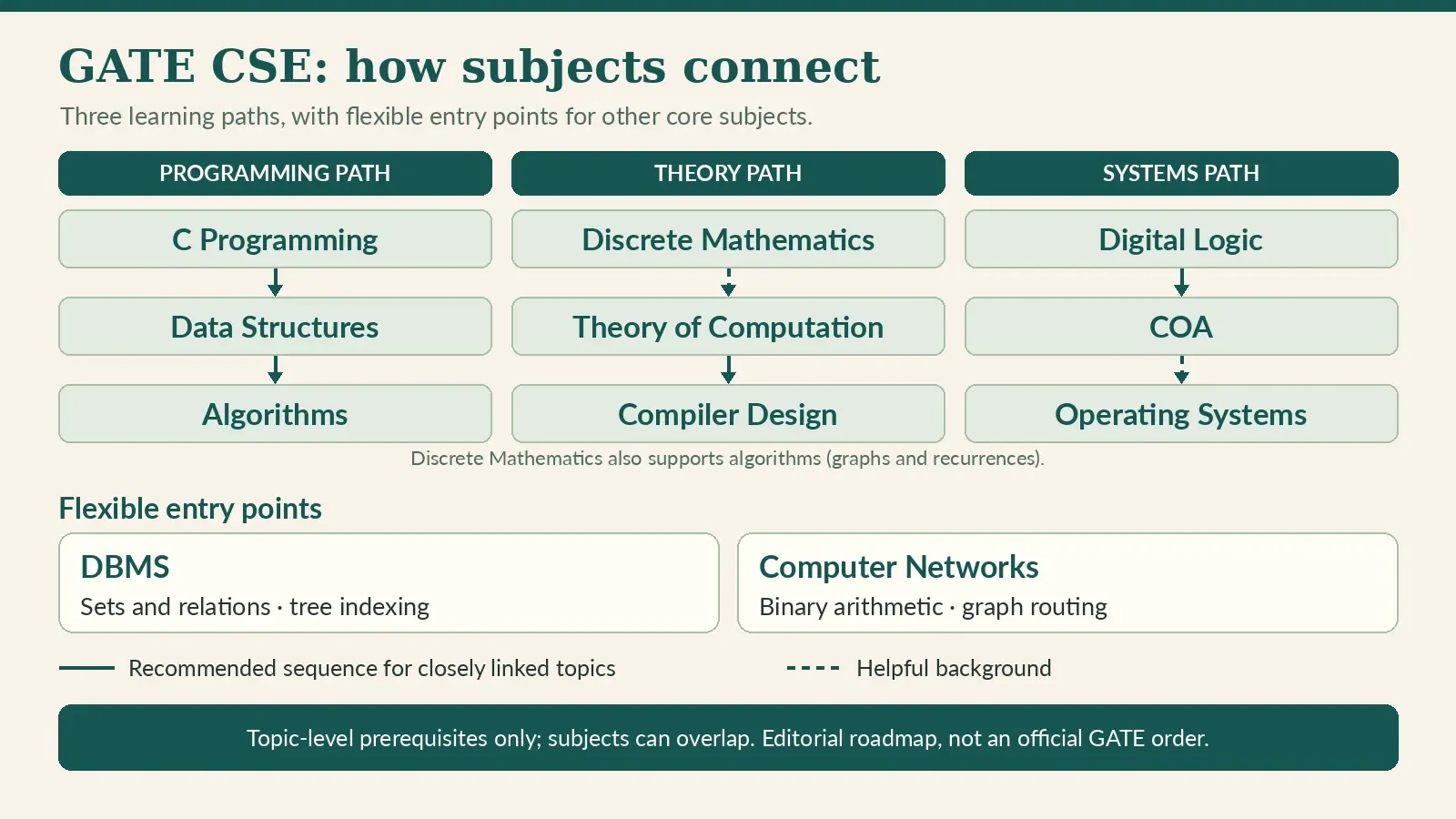
A useful dependency map has three main learning paths: programming and algorithms, mathematical reasoning and computation, and computer hardware and systems. Databases and Computer Networks draw on selected ideas from more than one path.
| Study this foundation first | Then move towards | Why the connection matters |
|---|---|---|
| C programming | Data Structures | Implementing and tracing structures in memory |
| Data Structures | Algorithms | Choosing suitable structures and analysing operations |
| Discrete Mathematics | Algorithms | Graph reasoning, counting and recurrences |
| Discrete Mathematics | Theory of Computation | Logic, sets and reasoning about languages |
| Theory of Computation | Compiler Design | Automata, grammars and parsing |
| Digital Logic | Computer Organization and Architecture (COA) | Circuits, binary arithmetic and hardware components |
| COA and C basics | Operating Systems (OS) | Memory, interrupts and execution of programs |
| Sets and relations; Data Structures | Database Management Systems (DBMS) | Relational queries and tree-based indexing |
| Graph algorithms; binary arithmetic | Computer Networks (CN) | Routing and IP addressing |
These are not all equally strict. Knowing how to trace a recursive function before tackling recursive algorithms is a strong practical prerequisite. Knowing every topic in COA before opening an OS textbook is not.
For planning purposes, distinguish strong learning dependencies from helpful connections. The former justify studying foundational topics first; the latter may require only a short refresher. For example, you can start database modelling and SQL without completing all of Algorithms or Operating Systems.
Path 1: C programming, Data Structures and Algorithms
C programming makes abstract questions concrete
If you are uncomfortable with programming, begin here. GATE CS specifically includes C, so familiarity with Python or Java alone is not enough. You should be able to follow control flow, arrays, pointers, functions and recursion without relying on a compiler to tell you what happens.
Consider a function that calls itself twice on an input of size n/2 and performs a constant amount of additional work. To analyse its running time, you first need to understand how recursive calls behave. Otherwise, the recurrence feels like a formula to memorise instead of a description of the program.
Practise tracing small programs on paper. Draw the changing values of variables, the contents of arrays and the sequence of recursive calls. Avoid getting distracted by building applications or learning entire software frameworks; your immediate goal is examination-level reasoning.
Data Structures give algorithms something to work with
Once you understand basic C and recursion, move to arrays, linked lists, stacks, queues, trees, heaps and graphs. Learn both their behaviour and the costs of common operations.
A queue is central to breadth-first search, while a stack or recursive calls can implement depth-first search. A heap supports efficient priority-queue operations. These relationships make algorithm design much easier to reason about than memorising isolated implementations.
Algorithms connect programming with mathematics
Study searching, sorting, hashing, complexity analysis and the major algorithm-design techniques. Revisit graph algorithms after you understand graph representations and traversal.
You do not need to finish every mathematical topic before starting. Learn asymptotic notation alongside simple code analysis; refresh logarithms and recurrences when analysing divide-and-conquer algorithms. Study discrete graph concepts before moving deeper into shortest paths and spanning trees.
The aim is to develop a habit of asking why an algorithm works, what resources it consumes and when it fails to be the right choice.
Path 2: Discrete Mathematics, Theory of Computation and Compiler Design
Discrete Mathematics is particularly valuable because it gives you a language for reasoning across several subjects. Sets and relations support database theory; graph concepts and recurrences support algorithms; logic and proof techniques help with computation theory.
Start with these relevant foundations rather than waiting to finish every topic in Engineering Mathematics.
Theory of Computation before Compiler Design
Theory of Computation (TOC) explores what different models of computation can recognise and which problems are computable. Its early topics, especially finite automata, regular expressions and context-free grammars, have direct applications in Compiler Design.
Take the statement total = price + tax;. A compiler first recognises elements such as identifiers and operators. It then checks how those elements fit into a grammatical structure. Automata help explain the first task; grammars help explain the second.
When studying a compiler's lexical analyser or parser, therefore, you are not encountering a completely new mathematical language. You are applying familiar concepts to programming-language translation.
For this reason, learning TOC before Compiler Design is usually efficient. However, advanced undecidability results are not prerequisites for learning basic parsing. If you already understand automata and grammars, you can start compiler topics while completing the remaining TOC syllabus.
Programming and Data Structures are also helpful for Compiler Design. Trees, stacks and graphs appear in parsing, intermediate representations and program analysis.
Path 3: Digital Logic, COA and Operating Systems
This path explains the computer from the circuit level upwards.
Digital Logic before Computer Organization
Begin with binary representations, Boolean expressions and circuit behaviour. A multiplexer, register or arithmetic circuit becomes easier to understand once you can reason about its inputs and outputs.
COA builds on this foundation by examining how hardware executes instructions, stores information and communicates with devices. Memory hierarchy, cache behaviour and instruction pipelines explain why programs do not execute at a uniform speed.
For example, if a problem describes a byte-addressable memory and a cache with a particular block size, understanding binary representation helps you work out how addresses are divided into fields. Without that foundation, cache questions often become a collection of memorised equations.
COA provides useful context for Operating Systems
Operating Systems introduces processes, scheduling, synchronization, deadlocks, memory management and file systems. The connection with COA is especially clear in virtual memory, interrupts and I/O.
Imagine a program trying to access a virtual address. The operating system manages the mappings between virtual and physical memory, while hardware supports address translation and access checks. Learning the two subjects together helps you understand which component performs which task.
Do not confuse a cache miss with a page fault: they describe different events in the memory system. Knowing the hardware context helps you avoid that kind of conceptual mistake.
Still, you can learn basic process scheduling, semaphores and deadlock reasoning before mastering every architectural detail. The useful dependency is understanding relevant hardware concepts, not necessarily completing an entire COA course.
Where do Databases and Computer Networks fit?
DBMS is a flexible subject. You can begin with entities, relationships, tables and SQL relatively early. Familiarity with sets, functions and relations makes relational algebra and normalization easier to understand. Tree structures help later when you study indexing. Operating Systems offers useful parallels for concurrency and deadlocks, although database transactions have their own rules.
Computer Networks is similarly flexible. Binary arithmetic is useful for subnetting and addressing. Graph concepts help you reason about routing, while operating-system concepts provide context for sockets and communication between processes.
You do not have to finish all these subjects before starting CN. Learn the necessary background as you reach the relevant topic. For example, study basic network layering and performance independently, then revise shortest-path algorithms before link-state routing.
If you want an early change of pace from mathematically demanding subjects, DBMS is a reasonable choice. Its introductory topics can be studied alongside programming or discrete mathematics without disturbing the major learning paths.
A practical study order for a beginner
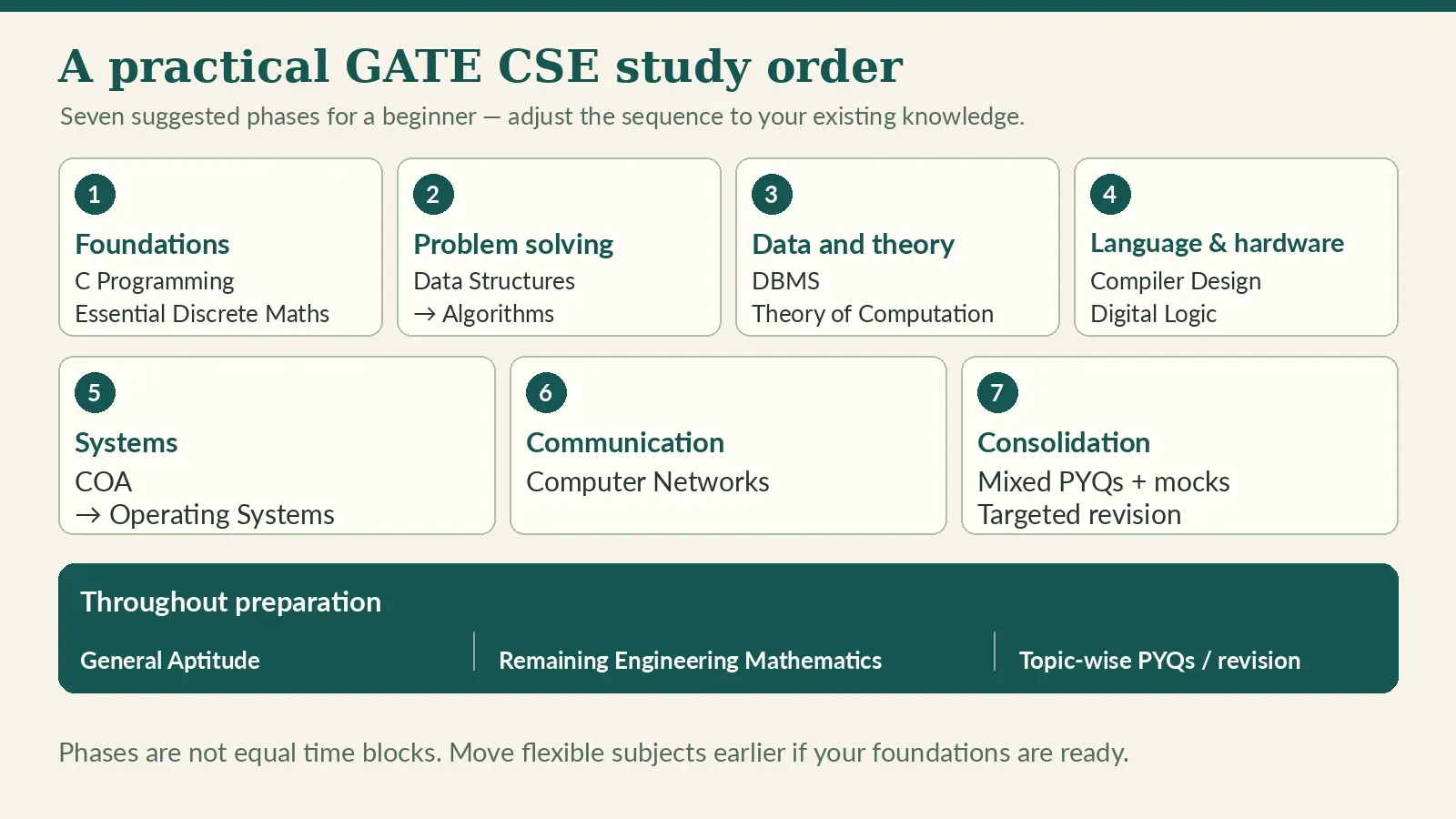
If you want one straightforward sequence, the following is a sensible default. The two mathematics tracks are intentionally separated so you do not have to finish calculus or probability before starting core computer science.
| Phase | Main subjects | Supporting work |
|---|---|---|
| 1 — Foundations | C programming; essential Discrete Mathematics | Begin General Aptitude |
| 2 — Problem solving | Data Structures, then Algorithms | Graphs, recurrences and remaining discrete topics |
| 3 — Data and theory | DBMS; Theory of Computation | Continue linear algebra, calculus, probability and statistics |
| 4 — Language and hardware | Compiler Design; Digital Logic | Refresh automata, grammars and binary arithmetic |
| 5 — Computer systems | COA, then Operating Systems | Revisit C, memory and concurrency concepts |
| 6 — Communication | Computer Networks | Review graph algorithms and binary addressing |
| 7 — Consolidation | All subjects | Mixed PYQs, mock tests and targeted revision |
You can move Digital Logic to Phase 1 or 2, followed by COA, if you prefer hardware subjects. You can also complete TOC and Compiler Design consecutively before starting DBMS. Both alternatives preserve the useful dependencies.
The phases are not equal-length time blocks. Algorithms may need more time than a familiar subject, and a student with a strong university background may need only a diagnostic test and selective revision in some areas.
Keep General Aptitude and mathematics running in parallel
A common mistake is to reserve mathematics and aptitude for the final month. Together, these components account for 28 marks under the GATE 2027 pattern. They also improve through regular practice rather than a single concentrated reading session.
An example of a five-hour study day might include two and a half hours for the main core subject, one hour for mathematics, half an hour for aptitude and one hour for problem solving and revision. Adjust the balance when you have a difficult topic or a scheduled mock test.
Avoid studying several unfamiliar core subjects simultaneously. One primary subject and one supporting stream are often enough. Parallel study should help you connect ideas, not leave you with several unfinished chapters.
Make previous-year questions part of the learning sequence
Do not wait until the entire syllabus is complete to solve previous-year questions (PYQs). After finishing a topic, try relevant questions without notes. This exposes gaps while the underlying material is still fresh.
When a question goes wrong, classify the mistake. Did you misunderstand a prerequisite, apply an incorrect formula, make an arithmetic error or misread the question? A routing question that exposes weak graph reasoning may justify revisiting one Algorithms lesson, not restarting the entire subject.
As more subjects are completed, introduce mixed practice. It is easy to identify a technique when you already know which chapter a question belongs to; an examination does not always give you that advantage.
Use official past papers and answer keys when possible. Check older questions against the current syllabus, because examination scope can change over time. Keep some complete papers unseen for timed practice.
What if you have already studied computer science in college?
You do not need to start from zero just because a study roadmap begins with C. Test your existing knowledge first. If you can trace pointers and recursive code reliably, move into Data Structures or Algorithms and repair gaps when they appear.
Likewise, if you work with SQL regularly, you may be ready to start relational algebra, normalization and transaction questions. Practical experience is valuable, but it does not automatically cover the theoretical reasoning tested in GATE.
Use the map to identify missing foundations, not as a reason to repeat everything you already understand. If your exam is close, focus on recoverable weaknesses and realistic coverage instead of postponing all practice until prerequisites are perfect.
The bottom line
The best GATE CSE study order is the one that makes each new subject easier to learn without delaying useful practice. Follow the strong connections: programming before advanced algorithms, automata and grammars before parsing, and digital circuits before hardware architecture. Treat the other connections as opportunities for targeted revision.
Computer science is a network of related ideas, not a pile of unrelated textbooks. Once you start seeing those relationships, revision becomes more meaningful and unfamiliar problems become easier to approach.
For the current examination cycle, syllabus and official exam information, visit the GATE Computer Science Exam Hub.
Sources and Further Reading
- GATE 2027 — Official CS syllabus (IIT Madras) — basis for the subject coverage and topic relationships.
- GATE 2027 — Test papers and syllabus — official syllabus index.
- GATE 2027 — Question paper pattern — marks distribution and examination format.
- GATE 2027 — Frequently asked questions — official advice on using the syllabus and past papers.
- GATE 2027 — Official website — official downloads and examination updates.