GATE CSE Marks vs GATE Score vs AIR: What Is the Difference and Which Matters Most?
Understand GATE CSE marks out of 100, score out of 1000 and All India Rank, including normalization, score calculation, qualifying cutoffs and M.Tech admissions.

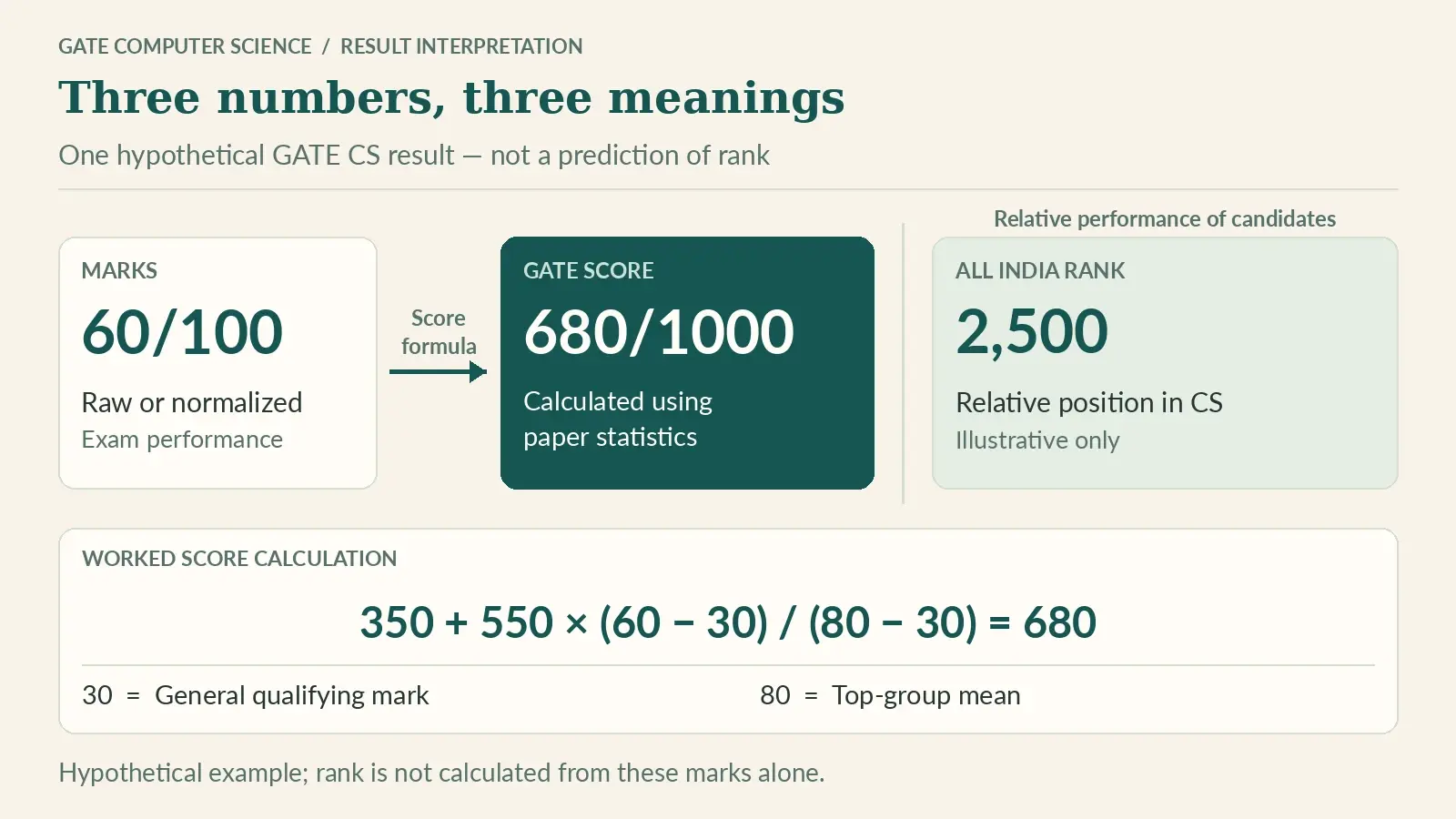
Imagine checking your GATE CSE result and finding that you have scored 60 marks out of 100, your GATE score is 680 out of 1000, and your All India Rank (AIR) is 2,500. Which of these numbers actually matters? Does a score of 680 mean you obtained 68% in the examination? And can someone with the same marks in another year have a completely different rank?
These are three different measurements of your performance, not three ways of expressing the same percentage. The marks reflect your examination performance, the score converts that performance to a standardized scale, and the rank tells you where you stand among other candidates in your paper.
The numbers above are illustrative, not an actual result or a predicted rank. Understanding the distinction can help you set better preparation targets and interpret your result without being misled by online rank predictions.
The three numbers at a glance
| Measure | What it represents | Main use |
|---|---|---|
| GATE marks (out of 100) | Net examination marks, adjusted for session differences where applicable | Assess performance and determine qualification |
| GATE score (out of 1000) | A calculated measure based on marks and the paper's performance statistics | Admission and recruitment wherever the score is accepted |
| All India Rank (AIR) | Relative position among candidates in the same test paper and exam year | Understand competitiveness |
While preparing for GATE, marks are generally the most actionable measurement. When applying for postgraduate programmes, the GATE score is often the most relevant number. AIR puts your performance in competitive context.
GATE marks: what you actually earned in the exam
The official name of the GATE CSE paper is Computer Science and Information Technology, with paper code CS. It contains 65 questions worth 100 marks, normally attempted in three hours. The 100 marks are distributed across General Aptitude (15), Engineering Mathematics (13) and core subject questions (72).
The questions are not all worth the same amount. Each carries either one or two marks, and the marking rules depend on the question format.
| Question type | Incorrect answer |
|---|---|
| Multiple Choice Question (MCQ), 1 mark | −1/3 mark |
| Multiple Choice Question (MCQ), 2 marks | −2/3 mark |
| Multiple Select Question (MSQ) | No negative marks; no partial credit |
| Numerical Answer Type (NAT) | No negative marks |
Unattempted questions earn zero. An MSQ requires the complete correct selection, without selecting incorrect options, to earn its marks.
Suppose your correct responses earn 64 marks. You also answer six one-mark MCQs and three two-mark MCQs incorrectly. Your penalty is 6 × 1/3 + 3 × 2/3 = 4 marks. Your raw total is therefore 60 out of 100.
This example shows why counting correct questions alone is not enough. The marks you gain through additional attempts can be offset by avoidable errors. When analysing mock tests, record marks lost through negative marking separately from marks missed because you did not know a concept. These problems require different improvements.
Raw marks vs normalized marks: why exam shifts matter
In years when GATE CS is conducted in more than one session, candidates do not necessarily receive identical question papers. One session might contain more time-consuming algorithms problems, while another might have questions that are quicker to solve.
Comparing raw marks directly would ignore possible differences in session difficulty. GATE uses a statistical normalization method for multi-session papers to make the results more comparable.
The method uses two reference points from the performance distribution: the average marks of the highest-performing 0.1% and the sum of the mean and standard deviation. It considers these statistics both for the individual session and for all sessions of that paper combined. The method relies on the assumption that candidate abilities are similarly distributed across randomly allocated sessions.
Normalization can increase or decrease an individual's marks. It is not a fixed bonus for everyone who took a particular shift, and a small difference in perceived difficulty does not establish how much adjustment will occur.
For example, imagine that a raw mark of 58 in one session and 62 in another both become 60 after normalization. This is a hypothetical demonstration of the concept, not an actual GATE adjustment. Neither candidate automatically receives an advantage just because their raw mark was higher.
For a single-session paper, this adjustment is unnecessary. For a multi-session paper, normalized marks are used in the subsequent score calculation. That is why the marks calculated from your response sheet and the marks on your final result may differ.
How is the GATE score calculated?
The GATE score is not obtained by multiplying your marks by ten. The official formula, as published in the information brochure, can be written as:
GATE score = 350 + 550 × (M − Mq) / (Mt − Mq)
Here:
- M is your raw mark for a single-session paper or normalized mark for a multi-session paper.
- Mq is the General-category qualifying mark for that paper.
- Mt is the mean mark of the highest-performing 0.1% of candidates or the top ten candidates, whichever group is larger, across the paper.
The formula has two important anchors. The General qualifying mark corresponds to a score of 350, and the top-group mean corresponds to 900. The second anchor is an average, not the highest individual mark.
A worked example
Assume the following hypothetical statistics for a GATE CS examination:
| Input | Value |
|---|---|
| Your marks used for scoring | 60 |
| General qualifying mark (Mq) | 30 |
| Top-group mean (Mt) | 80 |
Substituting these values:
GATE score = 350 + 550 × (60 − 30) / (80 − 30)
= 350 + 330
= 680
The candidate has 60 marks, but a GATE score of 680. The score does not imply 68 marks or a 68th percentile. The official result reports scores on a scale with a maximum of 1000; the uncapped formula can produce higher values at the upper end.
Now suppose that in a different year the General qualifying mark is 35 and the top-group mean is 85. The same 60 marks would yield 625 instead of 680. Both calculations are illustrative, but they demonstrate why a universal marks-to-score conversion table cannot work across years.
You can even reverse the calculation to estimate a marks target. Under the first set of hypothetical statistics, a score of 750 would require approximately 66.36 marks. That estimate is useful only under those assumptions, not as a guaranteed target for the next GATE examination.
All India Rank: how you compare with other candidates
AIR measures your position in the results of a particular test paper. An AIR of 2,500 in CS means you occupy the 2,500th rank in that paper, not across all GATE subjects or only within your reservation category. Tied results can complicate a literal count of the people ahead of you.
A simple example illustrates the difference between marks and rank. If you obtain 60 marks in a year when relatively few candidates cross that level, your rank may be strong. If many more candidates cross 60 in another year, the same mark may produce a worse rank.
Within the same paper and year, higher marks used for scoring generally produce higher scores and better ranks. But scores are rounded and have an upper limit, so they need not uniquely identify a rank. Likewise, knowing the score formula does not reveal how many candidates performed better than you.
Rank predictors use past results or data voluntarily submitted by candidates. Their estimates can be useful for exploring possibilities, but self-reported samples may be unrepresentative. Before official results are announced, no predictor can establish your exact AIR without the complete evaluated performance distribution and applicable ranking procedure.
What actual GATE CSE results tell us
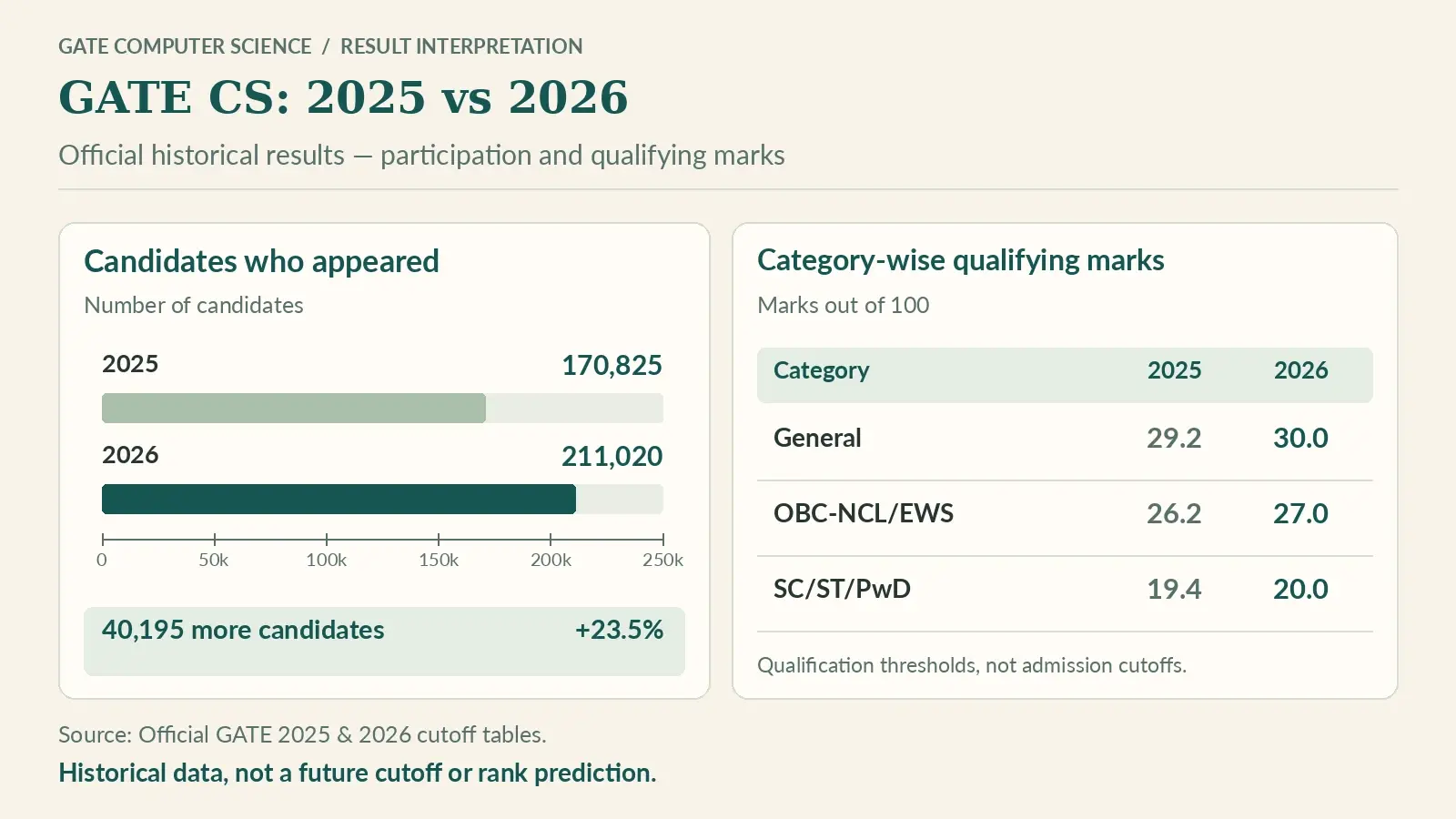
Official data from two completed exam cycles show how the competition and qualification thresholds can change.
| GATE CS exam year | Candidates appeared | General cutoff | OBC-NCL/EWS cutoff | SC/ST/PwD cutoff |
|---|---|---|---|---|
| 2025 | 170,825 | 29.2 | 26.2 | 19.4 |
| 2026 | 211,020 | 30.0 | 27.0 | 20.0 |
Source: official GATE 2025 and GATE 2026 cutoff tables.
The number of candidates who appeared increased by 40,195, or about 23.5%, between these cycles. That increase does not prove that the exam became easier or harder, or that every rank became harder to achieve. It shows why the competition cannot be treated as a constant.
Another revealing fact: the official GATE 2026 CS AIR 1 result records 92.57 normalized marks and a GATE score of 1000. A perfect GATE score therefore does not require a perfect examination mark.
These figures describe past results. They are not predictions of the cutoff or rank distribution for a future examination.
Qualifying cutoff vs admission cutoff: the difference that matters
The qualifying cutoff decides whether your marks satisfy the GATE qualification requirement for your category. Under the published GATE 2027 framework, the General cutoff is based on the paper's mean and standard deviation, with a lower bound of 25 and an upper bound of 40. The OBC-NCL/EWS and SC/ST/PwD thresholds are based on nine-tenths and two-thirds of the General cutoff respectively, subject to the published figures.
The score formula still uses the General cutoff regardless of your category. Reservation categories affect the qualification threshold and may affect admission eligibility and seat allocation, but they do not give candidates different GATE scores for the same scoring marks in the same paper and year.
The admission cutoff is a different threshold. It depends on the institute, programme, category, available seats, applicant pool and selection process. A department may use a score for initial shortlisting and then conduct a written test or interview.
Qualifying GATE is therefore not equivalent to securing an M.Tech seat at an IIT, NIT or IISc. Similarly, qualifying does not automatically secure a scholarship or a public-sector job. A recruitment notification may accept only specified papers and examination years, and may have additional degree or selection requirements.
Which number should you use for M.Tech admissions?
Many institutions evaluate eligible applicants using a valid GATE score rather than the raw marks or AIR alone. The score is particularly useful because candidates from different valid examination years can apply in the same admission cycle, where the programme permits it.
GATE scores normally remain valid for three years from the announcement of results. However, a particular employer or academic programme can restrict which exam years or test papers it accepts.
For participating IIT programmes, candidates generally apply separately to the institutes and use COAP (Common Offer Acceptance Portal) to view and respond to offers. COAP registration by itself is not an M.Tech application. For participating NITs and other institutions, CCMT provides centralized counselling, subject to its programme eligibility rules and current admission brochure.
When researching a programme, check whether its published cutoff is a GATE score, a mark or a rank. Also check whether the number refers to shortlisting, a previous admission round or the final admitted candidate. Comparing figures with different meanings can cause you to rule out a realistic option or overestimate your chances.
How to use marks, score and AIR while preparing
You cannot directly control how many other candidates perform better than you or what the qualifying cutoff will be. You can control the quality of your preparation and the marks you earn.
Start by taking a previous-year paper under examination conditions. Analyse the marks by subject, and distinguish conceptual errors from calculation mistakes, misread questions and time pressure. Prioritize topics that repeatedly cost you marks rather than chasing an arbitrary number of daily questions.
As your preparation improves, track net marks across several full-length tests of comparable difficulty. A single unusually easy mock can create a misleading impression. A stable improvement across varied papers is more useful than one exceptional score.
Use previous admission cutoffs to set an ambitious but realistic score range. Do not turn that range into an exact future marks or rank promise. After the official result, use your actual score, eligibility and programme requirements to build an application shortlist. A disappointing rank does not automatically make every programme unavailable, and an excellent rank does not replace the application process.
For the current examination cycle, consult the GATE Computer Science exam hub and the organizing institute's official notices.
The bottom line
GATE marks tell you how well you performed in the examination, the GATE score expresses that performance on a calculated scale, and AIR tells you how you placed in the competition. Each answers a different question.
During preparation, focus on earning more net marks. When results arrive, use AIR to understand your standing and your valid GATE score to investigate actual admission and recruitment opportunities. Do not confuse a qualifying cutoff with a target college's selection threshold, or a historical marks-to-rank estimate with a promise.
Sources and Further Reading
- GATE 2027 official website — IIT Madras — current information brochure and exam notices.
- GATE 2027 question paper pattern — CS marks distribution and marking rules.
- GATE 2027 FAQs — scorecard eligibility and validity.
- GATE 2027 Information Brochure, archived copy (Section 8, printed pp. 27–28) — score formula and normalization; consult the official website for revisions.
- GATE 2026 Information Brochure — IIT Guwahati (Section 8) — cross-check of scoring methodology.
- GATE 2025 official cutoff marks and GATE 2026 official cutoff marks — historical CS statistics.
- GATE 2026 official AIR 1 results — normalized marks and score of the CS topper.
- IIT Madras M.Tech admission information, 2026 cycle — example of score-based admissions and COAP's role.
- CCMT official counselling portal — participating programmes and eligibility.