How Does FASTag Work—and How Is the Toll Money Deducted?
Learn how FASTag uses passive RFID, toll-plaza readers, the NETC network, NPCI and banks to identify your vehicle and deduct the correct toll.
You approach a toll plaza.
There is no QR code to scan.
You do not tap a card.
You do not type a PIN.
Your car simply moves beneath the toll-lane equipment and, moments later, you receive a message saying that the toll has been deducted.
It can look as though the plaza somehow recognized your bank account from a sticker on the windscreen.
That is not quite what happens.
FASTag combines two separate technologies:
RFID identifies the vehicle's tag
and
the NETC payment network handles the toll transaction.
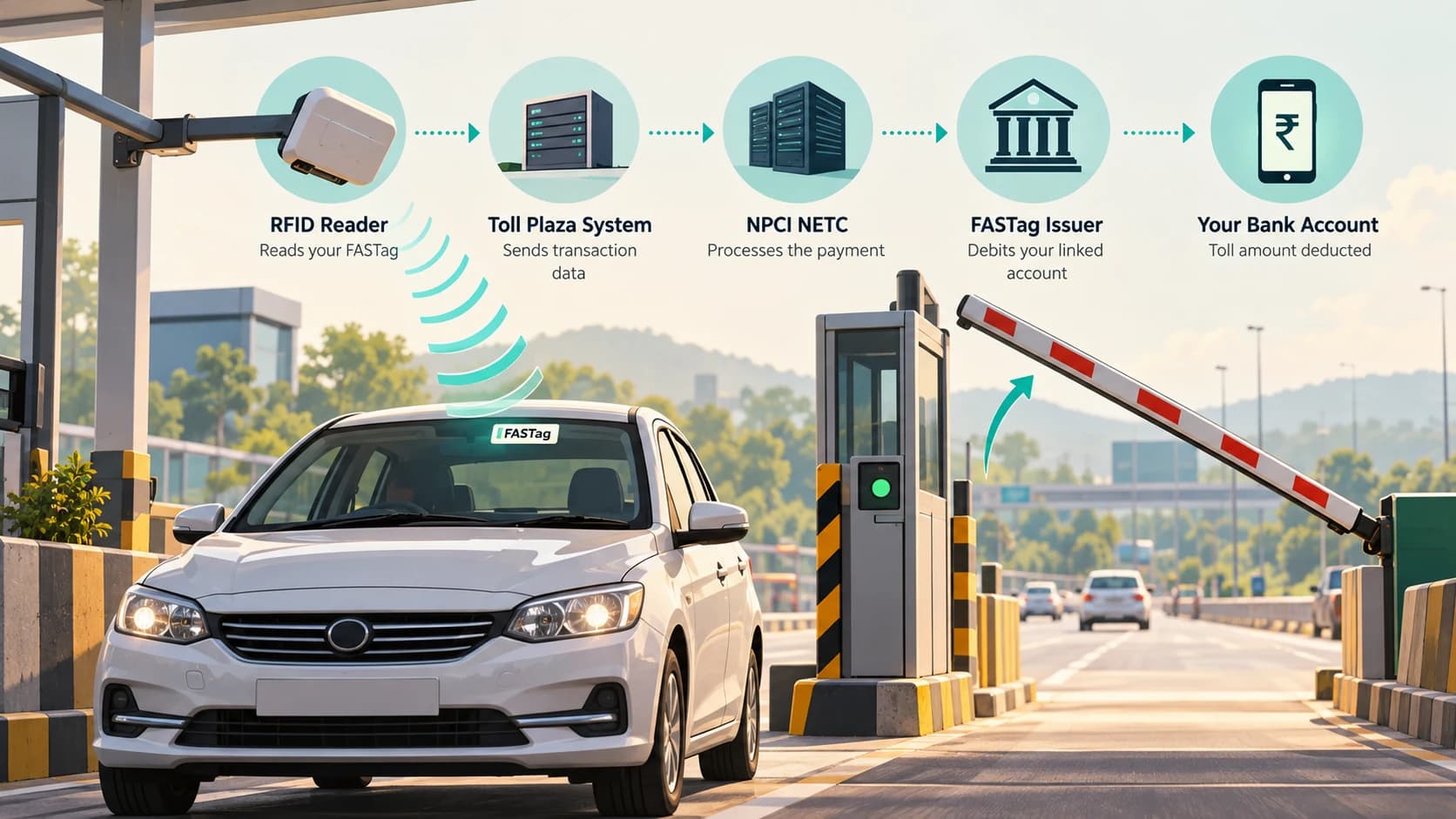
The sticker on your windscreen is a passive Radio Frequency Identification tag. A reader at the toll plaza communicates with it wirelessly and obtains its identifier. The plaza's electronic tolling system then uses that identifier, vehicle information and the applicable toll tariff to create a payment transaction.
That transaction passes through the National Electronic Toll Collection, or NETC, ecosystem operated by the National Payments Corporation of India (NPCI).
The FASTag issuer checks the linked account or prepaid balance, deducts the toll, and sends the result back through the system.
By July 2026, NPCI's published NETC statistics showed 40 banks live on NETC, more than 127 million FASTags issued, and about 347 million FASTag transactions during that month.
The convenience is simple.
The technology behind it is a coordinated conversation between a sticker, radio equipment, toll-plaza computers, banks and a national payment network.
What Exactly Is the FASTag on Your Windscreen?
A FASTag is not merely a printed barcode.
Inside the thin sticker are two important electronic components:
- a tiny microchip,
- an antenna.
The tag is designed to be attached to the vehicle's windscreen.
NPCI describes FASTag as a passive RFID tag.
“Passive” is important.
It means the tag does not need its own battery to function.
Unlike a mobile phone, it is not continuously broadcasting.
It normally sits inactive until an RFID reader sends radio-frequency energy toward it.
The tag's antenna captures enough of that energy to power the tiny chip for the brief exchange.
The chip then responds by changing how the incoming radio signal is reflected back toward the reader.
This technique is called backscatter communication.
So the sequence is approximately:
Reader sends radio signal
↓
FASTag antenna receives energy
↓
Tag chip powers up
↓
Tag returns encoded identification data
↓
Reader converts the returned signal into digital information
This is why FASTag can keep working for years without a battery.
FASTag Uses UHF RFID
Indian electronic tolling specifications use the UHF, or Ultra High Frequency, family of passive RFID technology.
Government highway specifications have required FASTag-type RFID transponders to follow the EPC Generation 2 / ISO 18000-6C family of standards.
Recent IHMCL specifications for free-flow tolling use UHF readers in the 865–868 MHz range.
The exact radio engineering is mostly invisible to a driver.
What matters is that this technology allows the reader to detect the tag from a useful distance without physical contact.
That makes it very different from:
- inserting a smart card,
- tapping an NFC card centimetres from a terminal,
- scanning a visible barcode.
The vehicle can be identified while moving through the tolling zone.
FASTag Is Not GPS
This is one of the most common misconceptions.
The FASTag sticker does not normally determine your location by receiving signals from GPS satellites.
It does not need to know:
“I am approaching Toll Plaza X.”
Instead, Toll Plaza X has an RFID reader.
The reader detects the tag only when the vehicle comes within the designed reading area.
A useful mental model is:
GPS: device determines where it is.
FASTag RFID: fixed roadside reader asks, “Which tag is near me?”
The location comes from the toll-plaza infrastructure, not from the FASTag calculating its own position.
The Tag Does Not Need to Store Your Bank Balance
Another easy misconception is to imagine that the ₹2,000 in your FASTag wallet is physically stored inside the windscreen chip.
That is not how the payment system works.
The RFID tag mainly provides a secure machine-readable identity used by the NETC ecosystem.
The financial account is maintained by the issuer's backend system.
Depending on the FASTag product, the tag can be linked to:
- a prepaid FASTag account/wallet,
- or supported savings/current-account arrangements.
NPCI describes FASTag as capable of being linked to prepaid or savings/current accounts.
The actual balance and transaction records therefore live in financial systems—not as rupee values physically stored inside the sticker.
FASTag Is Vehicle-Specific
A FASTag is associated with a particular vehicle.
NPCI states that once a tag is affixed to a vehicle it is not meant to be transferred to another vehicle.
IHMCL's current One Vehicle One FASTag policy also means that a vehicle should have only one active FASTag; older active tags linked to that vehicle are deactivated or suspended according to the applicable process.
This matters because the NETC system does not treat the tag merely as:
customer number 12345.
It also associates the tag with vehicle information.
That information is important when deciding the toll because toll rates differ between vehicle classes.
What Happens When Your Car Enters a FASTag Lane?
Let us follow one car through a traditional FASTag-enabled toll lane.
Suppose you are driving a car toward a toll plaza where the car toll is ₹100.
Step 1: The toll lane detects the vehicle
The lane can contain several pieces of equipment, potentially including:
- RFID antenna/reader,
- vehicle detector,
- lane controller,
- automatic vehicle-classification equipment,
- cameras,
- boom barrier,
- display and traffic signals.
Not every plaza uses exactly the same equipment layout.
The central FASTag component is the RFID reader.
Step 2: The reader interrogates the FASTag
The reader sends a radio signal toward the windscreen.
The passive FASTag harvests energy from this field and responds with its encoded identifier.
No physical contact is required.
Step 3: The lane system creates the toll event
The reader passes the tag information into the toll-plaza system.
The system now knows that a particular FASTag has crossed a particular toll lane at a particular time.
It can add other information such as:
- toll-plaza identifier,
- lane,
- timestamp,
- vehicle-related information,
- applicable transaction details.
The result is a digital toll transaction request.
How Does the System Know How Much to Deduct?
The reader itself does not simply decide:
“This looks like ₹100.”
The toll amount depends on the tariff applicable to that plaza and the vehicle category.
IHMCL says toll rates differ between vehicle categories based on factors such as size, load and type of use.
The FASTag is registered with vehicle information.
NPCI maintains a central FASTag repository known as the NETC Mapper.
Current NETC procedural guidance states that the acquirer side can obtain the FASTag details from the Mapper and perform fare calculation using the registered vehicle class.
So, conceptually:
Tag ID
↓
registered vehicle class
toll-plaza tariff
↓
applicable toll amount
This is also why incorrect vehicle classification can create an incorrect deduction and a later dispute or adjustment.
What Is the NETC Mapper?
Think of the NETC Mapper as a central directory used by the toll-payment ecosystem.
FASTag issuers register the tag and relevant information in the NETC Mapper.
NPCI's current customer-onboarding rules say a newly issued FASTag must be successfully registered in the Mapper before it is issued for use.
The Mapper can contain information necessary for the system to associate a FASTag with its registered vehicle context and status.
This makes nationwide interoperability possible.
The toll plaza does not have to maintain a separate local database containing every FASTag ever issued in India.
It can participate in a common network.
The Toll Plaza and Your FASTag Bank May Be Completely Unrelated
Suppose:
Your FASTag issuer: Bank A
Toll plaza's acquiring bank: Bank B
You can still use the toll lane normally.
That is the point of NETC interoperability.
NPCI describes NETC as a nationwide interoperable toll-payment solution designed so a customer can use the same FASTag across participating toll plazas regardless of which bank has acquired that particular plaza.
The major roles are:
Issuer
The bank or authorised issuer that issued the FASTag and maintains the customer's FASTag relationship.
Acquirer
The bank connected to the toll plaza for accepting and processing its FASTag transactions.
Toll plaza operator / concessionaire
The entity operating the toll facility and collecting the applicable user fee.
System integrator
The technology provider connecting plaza equipment, lane systems and payment infrastructure.
NPCI
The central NETC switch, clearing and settlement body connecting participants.
This is similar in spirit to card payments.
The bank that issued your card does not need to be the same bank serving the shop's card terminal.
What Happens to the Payment Request?
IHMCL's FASTag FAQ describes the transaction path in a straightforward way.
After the tag is detected:
- the toll system creates the transaction,
- the ETC system sends it to the plaza's acquiring bank,
- the acquirer passes it through NPCI's NETC infrastructure,
- the transaction reaches the FASTag issuer,
- the issuer debits the customer's FASTag-linked account,
- the response travels back through the network.
Current NETC procedural guidance describes the acquirer-to-NETC-to-issuer leg as an online transaction flow.
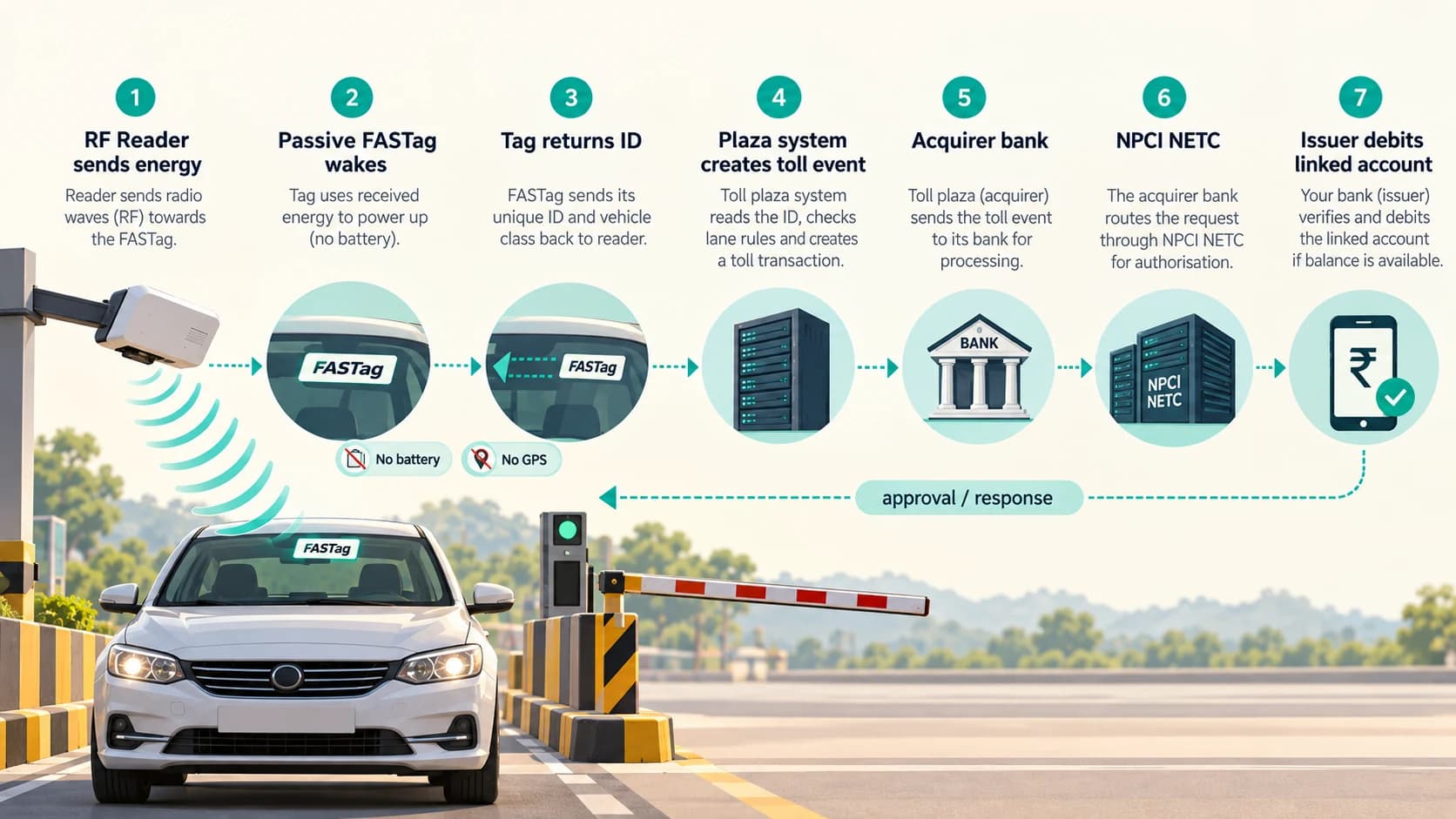
So the financial path is conceptually:
FASTag read
↓
Plaza system
↓
Acquirer bank
↓
NPCI NETC
↓
FASTag issuer
↓
Linked customer account / prepaid balance
The money is not being deducted by the RFID reader itself.
The reader identifies the tag.
The banking system performs the debit.
Exactly Where Is the Money Deducted From?
This depends on the FASTag product.
For a prepaid FASTag, the amount may come from the prepaid FASTag balance maintained by the issuer.
For other supported setups, the FASTag may be linked to a savings/current account arrangement.
NPCI's current FASTag description explicitly refers to a linked:
prepaid or savings/current account.
The important principle is:
The RFID tag identifies the FASTag relationship; the issuer's financial system performs the debit.
Imagine your prepaid FASTag balance is:
₹800
The plaza sends an approved toll transaction for:
₹100
The issuer processes it and the account becomes:
₹700
The tag itself has not changed from “₹800” to “₹700.”
The issuer's backend ledger has.
Why Does the Boom Barrier Open So Quickly?
The lane does not need to wait for a human cashier to:
- identify the vehicle,
- look up a tariff,
- collect cash,
- count change.
The electronic system can perform those steps automatically.
Once the transaction has progressed sufficiently for the lane to recognize a valid FASTag transaction, the lane controller can operate the barrier according to the plaza's configuration.
The entire customer experience may take only a few seconds.
However, the system still involves several network hops.
A slow response can occur if there is:
- poor plaza connectivity,
- issuer-bank latency,
- system congestion,
- tag-reading difficulty,
- an invalid tag status.
That is why some toll crossings feel nearly seamless while others involve a brief pause.
Why Does the FASTag Sometimes Fail to Read?
Passive RFID is reliable, but it still depends on radio communication.
Problems can arise if:
- the tag is damaged,
- it is incorrectly affixed,
- it has been removed or tampered with,
- the reader or antenna has a fault,
- windscreen characteristics or placement interfere with reading,
- the tag is no longer functional.
The placement matters because the system is designed around a tag fixed to the windscreen.
Government specifications also require the tag to be tamper-evident or tamper-resistant so removing it can damage its antenna or chip connection.
That helps preserve the one-tag-to-one-vehicle relationship.
Why Not Keep the FASTag Loose in the Car?
Because FASTag is intended to be properly affixed to the windscreen of the vehicle for which it was issued.
A loose tag creates several problems:
- inconsistent reading,
- incorrect orientation,
- potential transfer between vehicles,
- difficulty enforcing vehicle identity.
IHMCL has issued policies dealing specifically with non-affixation and improper affixation.
The windshield location is therefore part of the system design, not merely a convenient place to keep the sticker.
What Happens If Your FASTag Has Insufficient Balance?
If the issuer cannot approve the transaction because the FASTag is not in an acceptable funded/status condition, the electronic toll transaction may be declined.
NPCI notes that inadequately funded prepaid FASTags can be blacklisted.
Depending on the plaza rules and circumstances, the vehicle may then need to resolve the tag issue or pay through the applicable alternative process.
This is why recharging a prepaid FASTag before a long journey remains useful.
Current IHMCL guidance also notes that FASTag users can recharge through several payment methods rather than being restricted to the bank that issued the tag.
How Does the Toll Operator Finally Receive the Money?
The real-time vehicle experience and the back-end financial settlement are related but not identical.
At the customer level:
your FASTag account is debited for the toll.
At the ecosystem level:
the issuer, acquirer and toll operator have financial obligations that must be cleared and settled.
NPCI's NETC product documentation says NPCI acts as the centralized clearing and settlement body for participating NETC members.
The acquirer ultimately settles the toll proceeds with the plaza operator/concessionaire according to the applicable arrangement.
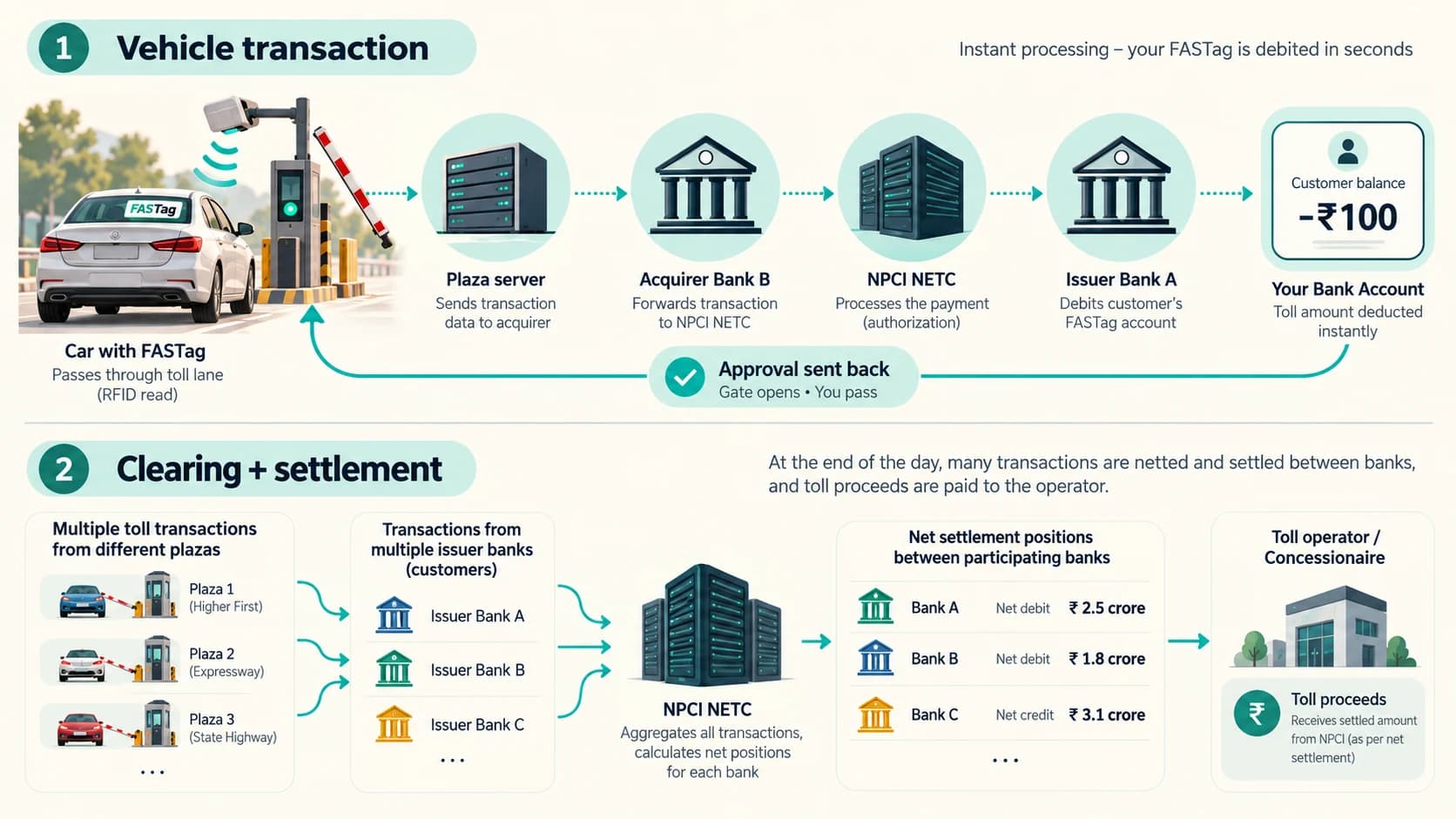
So the physical toll lane does not need to receive a ₹100 bank transfer directly from your bank at the exact instant your car crosses.
The payment network records the transaction and the institutional settlement process completes the financial movement between participants.
How Can One FASTag Work at Toll Plazas Across India?
This is the biggest achievement of the system.
Without interoperability, you could imagine needing:
- one tag for one highway operator,
- another tag for another state,
- another account for a different plaza network.
NETC standardizes the ecosystem.
NPCI defines common:
- technical specifications,
- transaction processes,
- switching,
- clearing,
- dispute handling.
IHMCL/NHAI administer tolling infrastructure and programme requirements for relevant highway plazas.
Banks and other certified participants connect into the same framework.
The result is:
one vehicle
one active FASTag
many interoperable toll plazas.
The driver does not need to know which acquiring bank serves each plaza.
Why Does the Toll Amount Sometimes Appear Later Than the Actual Crossing?
The ideal experience is close to real time, but the physical vehicle crossing and the final transaction posting do not always occur at precisely the same instant.
Current NETC procedural guidance says connectivity from the plaza server to the acquirer can be real time or near-real time depending on network availability, although real time is preferred.
This means you might occasionally receive the SMS or app notification after you have already travelled some distance beyond the plaza.
The RFID reading happened at the toll point.
The financial message can complete slightly later.
What If the Wrong Amount Is Deducted?
Electronic systems can still have errors.
Possible disputes include:
- incorrect toll amount,
- wrong vehicle classification,
- duplicate deduction,
- transaction even though another payment method was used,
- incorrect vehicle association.
IHMCL says customers can report incorrect deductions and that the issuer can raise a chargeback to recover an excess amount from the toll-plaza side when the claim is valid.
NPCI maintains a formal NETC dispute and reconciliation framework between issuers and acquirers.
This is another reason digital tolling is more than RFID.
The payment network needs systems for:
- reconciliation,
- chargebacks,
- corrections,
- audit trails.
Why Can Cameras Be Present If FASTag Uses RFID?
You may notice cameras at toll plazas and assume that they are reading the FASTag.
Usually, the core FASTag identification is still RFID.
Cameras can perform other roles such as:
- vehicle-number recognition,
- evidence for disputes,
- vehicle classification,
- violation handling,
- enforcement,
- free-flow tolling.
Current IHMCL specifications for future Multi-Lane Free Flow systems combine FASTag RFID with ANPR, or Automatic Number Plate Recognition.
The two technologies complement each other.
RFID asks:
Which FASTag responded?
ANPR asks:
Which registration number is visible on the vehicle?
Comparing both can make tolling and enforcement more robust.
FASTag Is Moving Toward Free-Flow Tolling
Traditional toll plazas still create a physical bottleneck because vehicles must funnel through lanes and barriers.
A more advanced model is Multi-Lane Free Flow (MLFF) tolling.
Instead of stopping at a booth, vehicles travel under roadside or overhead gantries.
IHMCL's recent MLFF specifications describe:
- RFID readers,
- multiple antennas,
- ANPR cameras,
- vehicle classification,
- high-speed detection.
In such systems, the same broad FASTag concept can remain:
identify the vehicle electronically → create the toll transaction → process it through NETC
but the physical barrier can disappear.
This is an important future direction because it shows what FASTag really is.
It is not fundamentally a toll-booth technology.
It is an electronic vehicle-identification and payment system.
What Happens in Those Few Seconds at a Toll Plaza?
The full journey can be summarized as:
1. Vehicle enters the tolling zone
Lane sensors and RFID equipment detect the approaching vehicle.
2. RFID reader sends radio energy
The passive FASTag powers up briefly.
3. FASTag responds
The chip backscatters its identifier to the reader.
4. Plaza system creates the transaction
The toll event is linked to the plaza, lane, time and FASTag.
5. Vehicle information is resolved
NETC information helps determine the registered vehicle context and status.
6. Toll is calculated
The system applies the relevant vehicle-class tariff.
7. Acquirer sends the transaction into NETC
NPCI routes it to the FASTag issuer.
8. Issuer debits the linked account
The prepaid balance or supported linked account is charged.
9. Response returns
The transaction result reaches the plaza system and customer notification systems.
10. Clearing and settlement follow
NPCI and participating financial institutions reconcile and settle the transaction, and the toll operator receives the proceeds according to the settlement arrangement.
All you experience is:
beep → barrier opens → SMS.
The Clever Part Is the Separation of Identification and Payment
FASTag becomes much easier to understand once you separate its two halves.
RFID layer
Answers:
Which registered FASTag is this?
Payment layer
Answers:
How much is due, can the account be charged, and where should the money go?
The windscreen sticker handles the first problem.
NETC and the participating financial institutions handle the second.
That separation is why the tag can remain thin, cheap and battery-free.
It does not need:
- a screen,
- a keypad,
- GPS,
- mobile data,
- a bank balance stored locally.
It only needs to identify itself securely enough for the back-end systems to do the rest.
The next time you pass through a toll plaza, the tiny sticker on the windscreen is therefore only the beginning of the transaction.
Above the lane, a radio reader wakes the tag.
Behind the plaza, computers build a toll event.
Across the banking network, NPCI routes the transaction.
And somewhere inside the FASTag issuer's systems, a ledger entry changes.
That is how a simple sticker turns a moving vehicle into a digital payment.