If an App or Website Is Free, How Does It Make Money?
Free apps and websites still need revenue. Learn how ads, subscriptions, in-app purchases, commissions, data, referrals and other models pay the bills.
You download an app.
It costs nothing.
There is no subscription screen, no payment request and perhaps not even an obvious advertisement.
Yet someone had to design it, write the code, maintain the servers, fix bugs, answer support requests and keep it compatible with new phones.
So who is paying for all of that?
This is where the familiar phrase appears:
“If you're not paying for the product, you are the product.”
It is memorable.
It is also too simplistic.
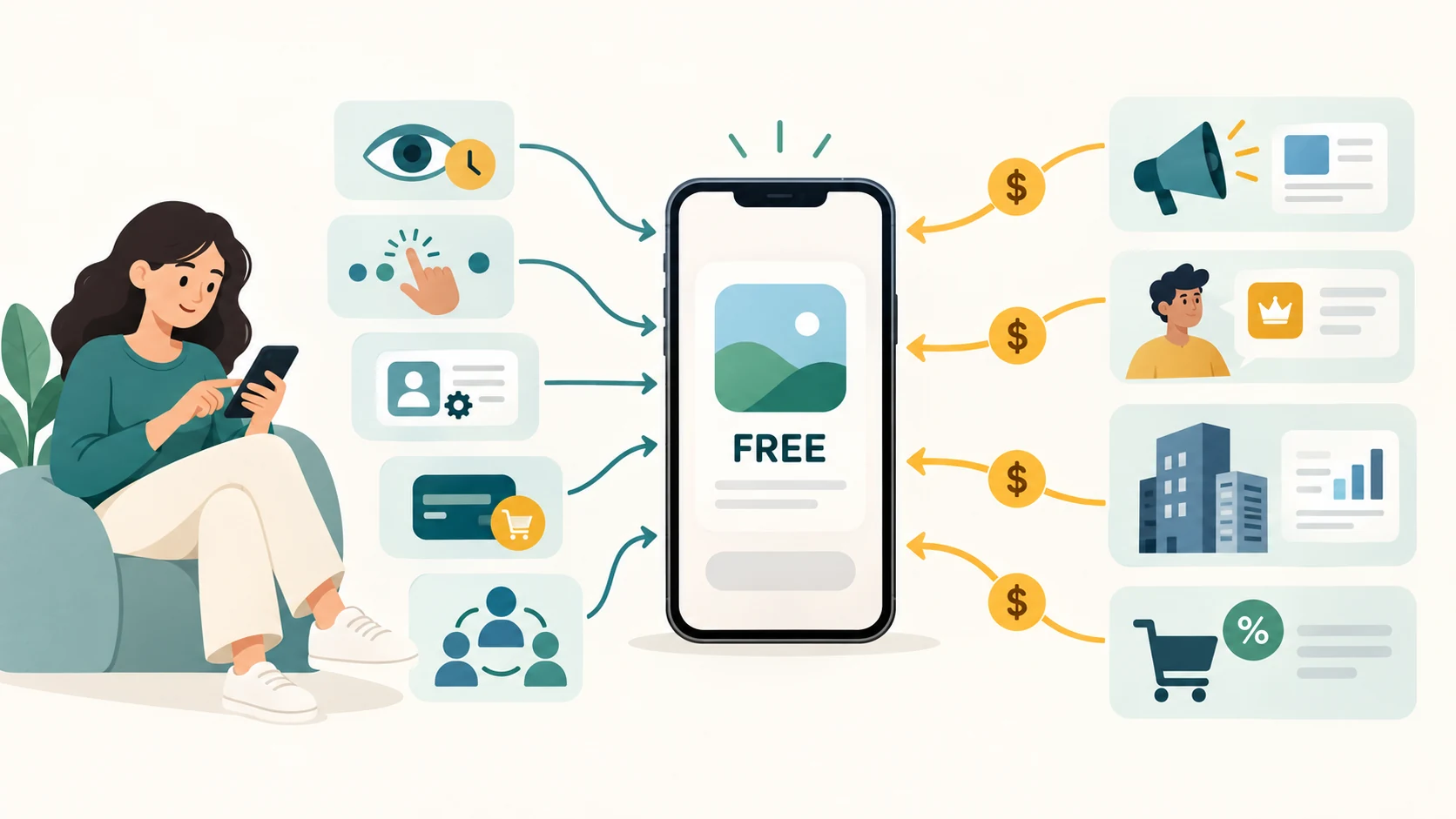
Sometimes your attention helps generate advertising revenue.
Sometimes the company hopes you will eventually pay for premium features.
Sometimes another user, an advertiser or a business customer subsidizes you.
Sometimes the service takes a commission when you buy something.
Sometimes your activity helps improve recommendations or advertising.
And sometimes the free product exists mainly because it makes another product more valuable.
The better rule is:
If you are not paying money, ask what business model is paying for your access.
Because “free” describes the price you see.
It does not explain the economics behind the product.
A Free App Still Has Real Costs
Even a relatively simple app can require:
- software development
- cloud servers
- databases
- bandwidth
- customer support
- cybersecurity
- analytics
- app-store distribution
- design
- moderation
- marketing
A website faces many of the same costs.
If millions of people use a service, infrastructure can become a significant expense.
The company therefore needs revenue from somewhere.
For commercial apps and websites, the money usually comes from one or more of a handful of models.
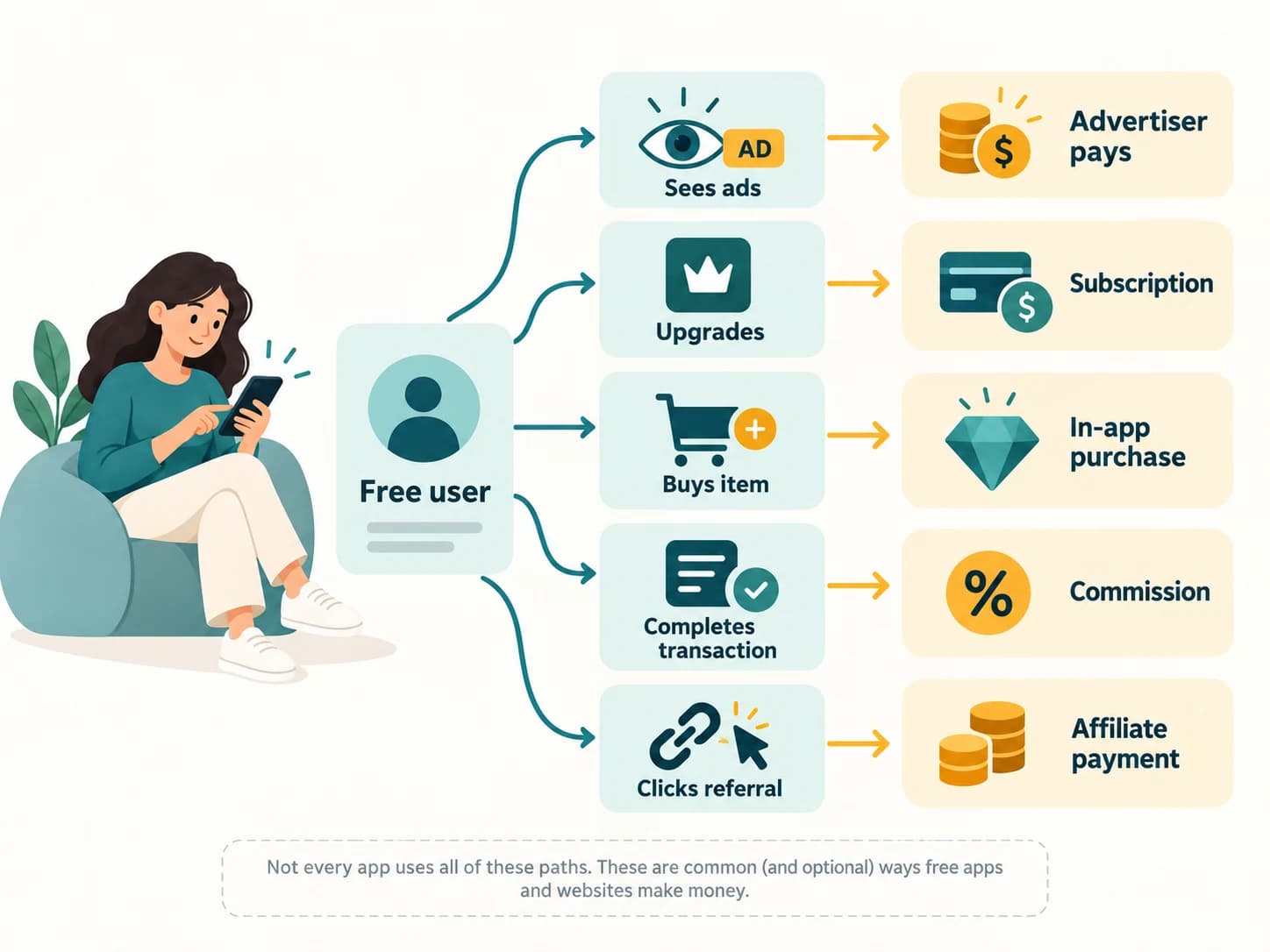
Model 1: Advertisers Pay for Your Attention
Advertising is probably the most familiar answer.
You use the service for free.
Advertisers pay to appear in front of you.
This can happen through:
- banner ads
- video ads
- sponsored posts
- search ads
- ads between short videos
- ads inside games
- rewarded ads
Google's AdMob platform, for example, is specifically designed to let mobile-app developers earn money by displaying advertising inside their apps. Google handles the advertising marketplace and pays participating publishers for eligible ad activity.
In this model, the user is valuable partly because the user's attention creates advertising opportunities.
Imagine a free game with one million active players.
If each player sees five advertisements per day, the developer can potentially serve millions of ad impressions without asking those players to buy the game.
What does the free app get from you?
Primarily:
your time and attention.
The longer people use the service, the more opportunities it may have to display advertising.
That helps explain why ad-funded products often care about metrics such as:
- daily active users
- time spent
- sessions per day
- retention
- video views
- engagement
The service does not have to charge each user directly if advertisers are willing to pay for access to that audience.
Model 2: Information Helps Make Advertising More Valuable
Not all advertising is the same.
Imagine two advertisements.
One is shown randomly.
The other is shown to someone who is likely to be interested in the product.
Advertisers may consider the second opportunity more useful.
That is why some platforms use information such as:
- approximate location
- interests
- previous activity
- device information
- searches
- content interactions
to personalize advertising or measure its effectiveness.
But this is where explanations often become inaccurate.
A company using your data for advertising does not necessarily mean it is literally selling your personal information to an advertiser.
The underlying business can instead look more like:
Platform knows something about audience
↓
Advertiser selects desired audience
↓
Platform decides which users should see the ad
↓
Advertiser pays for the advertising opportunity
The advertiser may never receive your complete personal profile.
That is still a data-driven business model, but it is different from directly selling a database of user information.
Is Your Data the Payment?
Sometimes people say:
“You pay with your data.”
That is useful shorthand, but it can still oversimplify things.
Different kinds of data play different roles.
Data needed to operate the service
A navigation app needs location information to navigate.
A messaging service needs information required to deliver messages.
This information may be essential to the product itself.
Analytics data
Developers may collect information such as:
- crashes
- device models
- feature usage
- session duration
to understand whether the app is working properly.
Personalization data
A streaming service may use viewing history to recommend other content.
Advertising data
Some services use activity or identifiers to personalize or measure advertising.
Data shared with outside companies
Some apps may allow third-party advertising, analytics or other software components to receive certain information, depending on the app's design and permissions.
Those cases are not equivalent.
So rather than asking:
“Does this free app collect data?”
a more useful question is:
“What data does it collect, why does it collect it, and who receives it?”
Apple now requires developers to disclose categories of data collection in App Store privacy labels and requires permission under App Tracking Transparency before certain forms of cross-company tracking for advertising or data-broker purposes.
Model 3: The Free User Is Being Converted Into a Paying User
Another enormous business model is freemium.
The basic product is free.
Advanced features cost money.
For example:
Free
- basic editing
- limited cloud storage
- advertisements
- limited AI requests
- basic templates
- fewer exports
Paid
- more storage
- advanced tools
- no advertising
- higher limits
- business features
- premium content
The important idea is that free users are not necessarily expected to generate revenue immediately.
Instead:
Free access → regular use → dependence or value → optional upgrade
Suppose an app attracts 10 million free users.
If only a relatively small percentage eventually subscribe, those paying customers may generate enough revenue to support the broader service.
The free version therefore has another job:
customer acquisition.
It lets millions of people try the product without paying first.
So What Does a Freemium App Get from a Free User?
Even if you never pay, you may still provide value.
You can:
- increase the size of the user base
- recommend the product to others
- create content that attracts other users
- help the company test features at scale
- potentially become a paid user later
A free user is therefore not necessarily worthless just because no money changed hands.
This becomes especially important for products with strong network effects.
A messaging service becomes more useful when more of your friends are on it.
A marketplace becomes more useful when it has more buyers and sellers.
A social network needs people to create and consume content.
In those cases, simply participating can make the entire product more valuable.
Model 4: In-App Purchases
Some apps are free to install but make money after you start using them.
Games are the clearest example.
You might download the game for ₹0 and later buy:
- virtual currency
- characters
- cosmetic items
- extra levels
- battle passes
- faster progression
Other apps use the same model for:
- premium filters
- additional templates
- extra features
- digital content
The initial “free” price removes the barrier to trying the product.
The developer earns money from the users who choose to buy something later.
App stores can also earn from these transactions through service fees. Google Play, for example, charges fees on eligible digital transactions, with the exact rate depending on program, transaction type and market.
So one payment can support more than one business:
User buys digital item
↓
Developer earns revenue
↓
App-distribution platform may receive a service fee
Model 5: Subscription
Some services are technically free but are designed to make the paid subscription much more attractive.
Examples might include:
- music streaming
- cloud storage
- productivity software
- fitness apps
- news
- AI tools
- photo editors
The free tier gets you through the door.
The subscription becomes the long-term business.
That can actually align the company's incentives quite differently from an advertising model.
An ad-funded product benefits when it can create valuable advertising opportunities.
A subscription product benefits when users believe the service is valuable enough to keep paying for.
Neither model is automatically good or bad.
They simply create different economic incentives.
Model 6: The Free Trial
A free trial is not the same thing as a permanently free product.
A typical structure is:
Day 1: ₹0
↓
Trial period
↓
Trial ends
↓
Paid subscription begins unless cancelled
The business gets something very valuable during the free period:
a chance to demonstrate enough value that you do not cancel.
Some services ask for payment information at the beginning precisely because they plan to convert the trial into a paid subscription.
The U.S. Federal Trade Commission warns consumers that many free trials automatically become paid subscriptions if they are not cancelled before the deadline and recommends checking the future price and cancellation terms before signing up.
That does not make free trials inherently deceptive.
The important issue is whether the conversion and cancellation terms are clear.
Model 7: Commission on Transactions
A marketplace can offer its app or website for free because it earns money when transactions happen.
Imagine an online platform that connects:
buyer ↔ seller
The user may pay nothing simply to browse.
The seller might pay:
- commission
- listing fee
- transaction fee
- payment-processing fee
- promoted-placement fee
Examples of this general model include:
- food-delivery marketplaces
- travel-booking services
- e-commerce marketplaces
- ticketing platforms
- freelance marketplaces
The application itself does not need an entry fee because the transaction is the monetization event.
This changes what the platform wants from you.
It wants you to:
complete transactions.
Model 8: Affiliate and Referral Revenue
Sometimes a website appears to provide free information:
- product comparisons
- hotel recommendations
- credit-card comparisons
- software reviews
- shopping guides
You click a link.
You purchase something from another company.
The original website receives a referral commission.
This is called affiliate marketing.
In this model, the site's valuable asset is its ability to influence or direct purchasing decisions.
You may never pay the website itself.
The merchant pays it for sending a customer.
This is why responsible publishers disclose affiliate relationships clearly.
The business model does not automatically make the recommendation dishonest.
But knowing the financial relationship helps the reader understand the incentive.
Model 9: Businesses Pay So Consumers Don't Have To
Some services offer a free consumer product because business customers pay.
Imagine software that provides:
Free personal account
but charges companies for:
- administration
- security
- collaboration
- compliance
- advanced analytics
- employee management
The business customer can generate much more revenue than an individual consumer subscription.
So the company may happily offer the consumer version free because it:
- builds familiarity
- attracts future business users
- spreads the product
- creates an ecosystem
In this model, the free user is part of the product's distribution strategy.
Model 10: One Product Subsidizes Another
Sometimes the free service does not even need to make money by itself.
Imagine a company that sells:
- phones
- laptops
- cloud infrastructure
- advertising
- financial services
- enterprise software
It might offer another app for free because that app strengthens the larger ecosystem.
A free cloud utility might make the company's hardware more useful.
A free browser might support a search or advertising business.
A free companion app might help sell a physical device.
The product's economics therefore make sense only when you zoom out.
The free app can be a supporting piece of a much larger business.
Sometimes Investors Are Paying for the Free Service
Startups can operate for years while spending more than they earn.
How?
Investors provide capital.
A young app might offer extremely generous free access to:
- attract users
- prove demand
- beat competitors
- build a network
- gather market share
The company may monetize later through:
- subscriptions
- ads
- commissions
- enterprise plans
This means a service can genuinely be free today without having a mature revenue model yet.
But it also creates uncertainty.
Free limits can change.
Features can move behind subscriptions.
Prices can appear later.
The company's initial business model is not necessarily its permanent one.
Why Do Free Apps Want Notifications?
Not every permission request is about selling information.
A free app may ask to send notifications because notifications can bring you back.
More return visits can mean:
- more advertising opportunities
- more purchases
- higher subscription conversion
- stronger retention
- more marketplace transactions
That is why engagement itself has business value.
This also explains many seemingly small product decisions:
- streaks
- daily rewards
- “someone liked your post” notifications
- limited-time offers
- recommendations
- autoplay
- infinite feeds
The goal is often not simply to collect data.
It is to get the user to return and continue using the product.
Why Does a Free App Care How Long You Stay?
Suppose two free apps each have one million users.
App A
Average use: 3 minutes per day.
App B
Average use: 60 minutes per day.
If both rely on advertising, App B potentially has far more opportunities to show ads.
If both offer subscriptions, App B's highly engaged users may be more likely to see value in upgrading.
If they are social platforms, App B may also produce far more:
- posts
- comments
- recommendations
- messages
- interaction data
So companies frequently measure engagement because engagement can eventually translate into revenue even when the individual activity itself is free.
Does Every Free App Track You?
No.
That is an important misconception.
A free app can be financed through:
- donations
- grants
- volunteers
- paid business customers
- open-source sponsorship
- another product
- optional subscriptions
without relying on personalized advertising.
Even two ad-funded apps may collect very different information.
This is why you should not assume:
Free = tracking
or:
Paid = private
A paid application may still collect analytics.
A free open-source app may collect almost nothing.
The price does not tell you the privacy model.
What Can You Check Before Installing a Free App?
You do not need to distrust every free service.
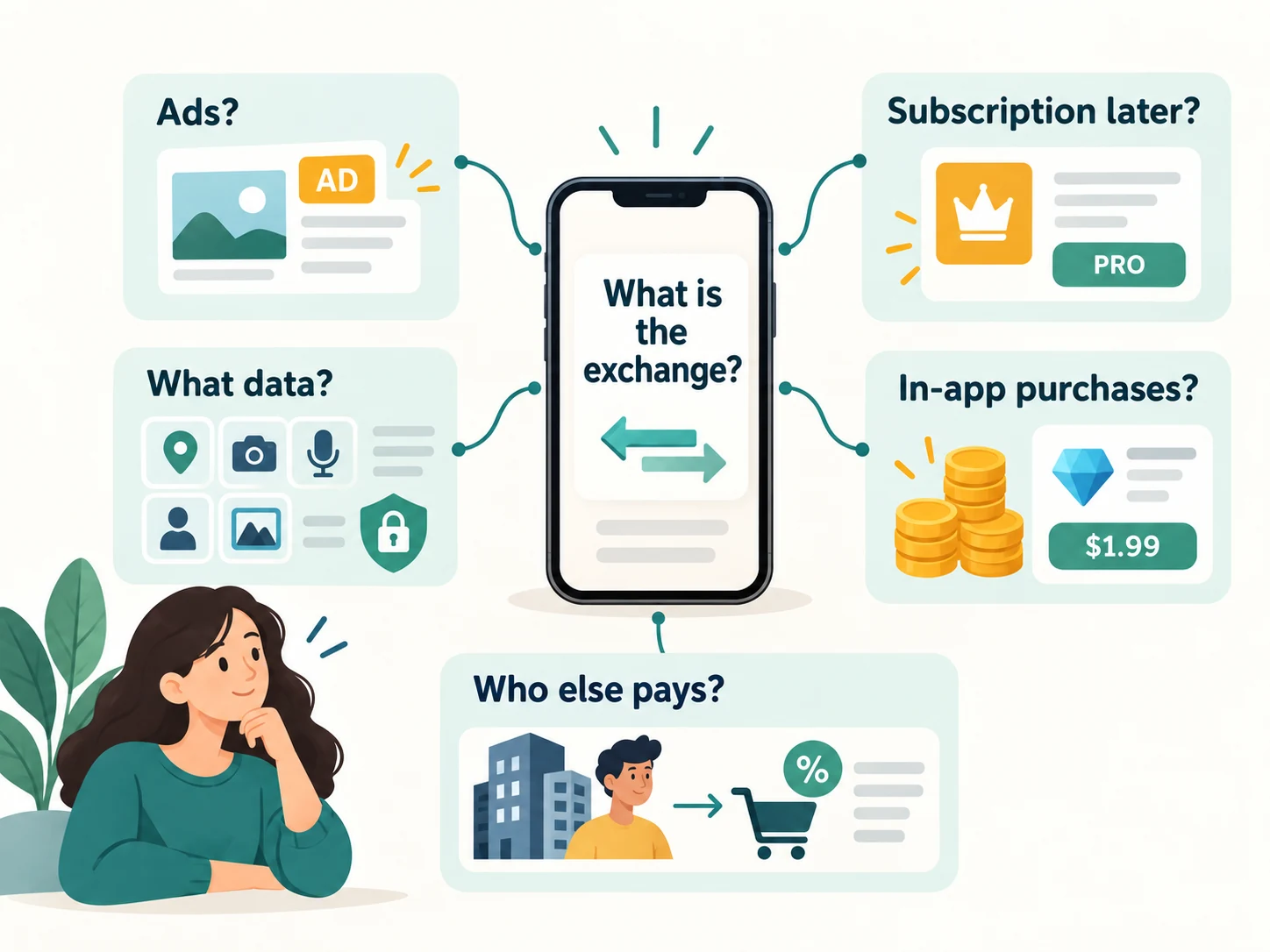
Instead, try to understand the exchange.
Look at the business model
Ask:
Where does the money probably come from?
Ads?
Subscription?
Commission?
In-app purchases?
Read the app-store privacy information
Apple's App Store provides privacy labels showing data categories developers say they collect and whether certain information may be linked to you or used for tracking.
Check permissions
Does a simple flashlight app really need:
- contacts
- microphone
- precise location
If a permission does not make sense for the feature, investigate before allowing it.
Look for ads and in-app purchases
The store listing normally gives clues about the monetization model.
Check trial terms
If your payment card is required for a free trial, identify:
- when the trial ends
- how much the subscription costs
- whether it renews automatically
- how to cancel
Consider account deletion and export
Can you delete your data?
Can you export information if you leave?
Those questions matter especially for services you may use for years.
A Better Way to Think About “Free”
Instead of thinking of free apps as one category, think of several possible exchanges.
| Free service model | What mainly pays for it |
|---|---|
| Advertising | Advertisers |
| Freemium | Premium users |
| In-app purchases | Users who buy digital items |
| Subscription trial | Future subscribers |
| Marketplace | Transaction commissions |
| Affiliate site | Referral payments |
| Enterprise-supported | Business customers |
| Ecosystem service | Another product/business |
| Investor-funded | Investment capital |
| Donation/open source | Donors, sponsors or volunteers |
A service can combine several at once.
For example, a streaming app might have:
free advertising tier + paid subscription + partnerships
A game might have:
free download + ads + in-app purchases
A shopping platform might combine:
commissions + advertising + seller fees
That is why “How does this free app make money?” rarely has one universal answer.
So What Does a Free App Actually Get From You?
Possibly nothing more than another user.
Or it may receive value from:
Your attention
because advertisements can be shown.
Your money later
because free access can lead to a subscription or purchase.
Your transactions
because the platform takes a commission.
Your activity
because it helps recommendations, analytics or product development.
Certain data
because it may support personalization, advertising or measurement.
Your participation
because a larger network makes the service more useful.
Your loyalty
because the free product keeps you inside a company's ecosystem.
The mistake is assuming all free apps use the same exchange.
Some rely heavily on advertising.
Some barely collect data.
Some make almost all their money from a small percentage of paying users.
Some are subsidized by another business entirely.
The word “Free” therefore tells you almost nothing about how the product works economically.
It tells you only one thing:
the company is not asking you for money at the moment you enter.
The useful question comes next:
If I am not paying, who is—and what does this service gain from having me here?