How Does Your Car Know the Key Is in Your Pocket?
Learn how keyless entry uses antennas, radio signals and encrypted authentication to detect a key fob, unlock the car and verify the key is inside.
You walk up to your car with the key somewhere in your pocket.
You do not press a button.
You simply grab the door handle.
The doors unlock.
Then you sit down, leave the key exactly where it is and press the engine start button.
The car starts.
Yet if the same key is lying several metres away, the door normally stays locked. And when starting the engine, the car often needs to determine not merely that the key is nearby, but that it is actually inside the cabin.
How does it know?
The surprising answer is that the car does not know anything about your pocket.
It knows about radio signals, distance zones and cryptographic authentication.
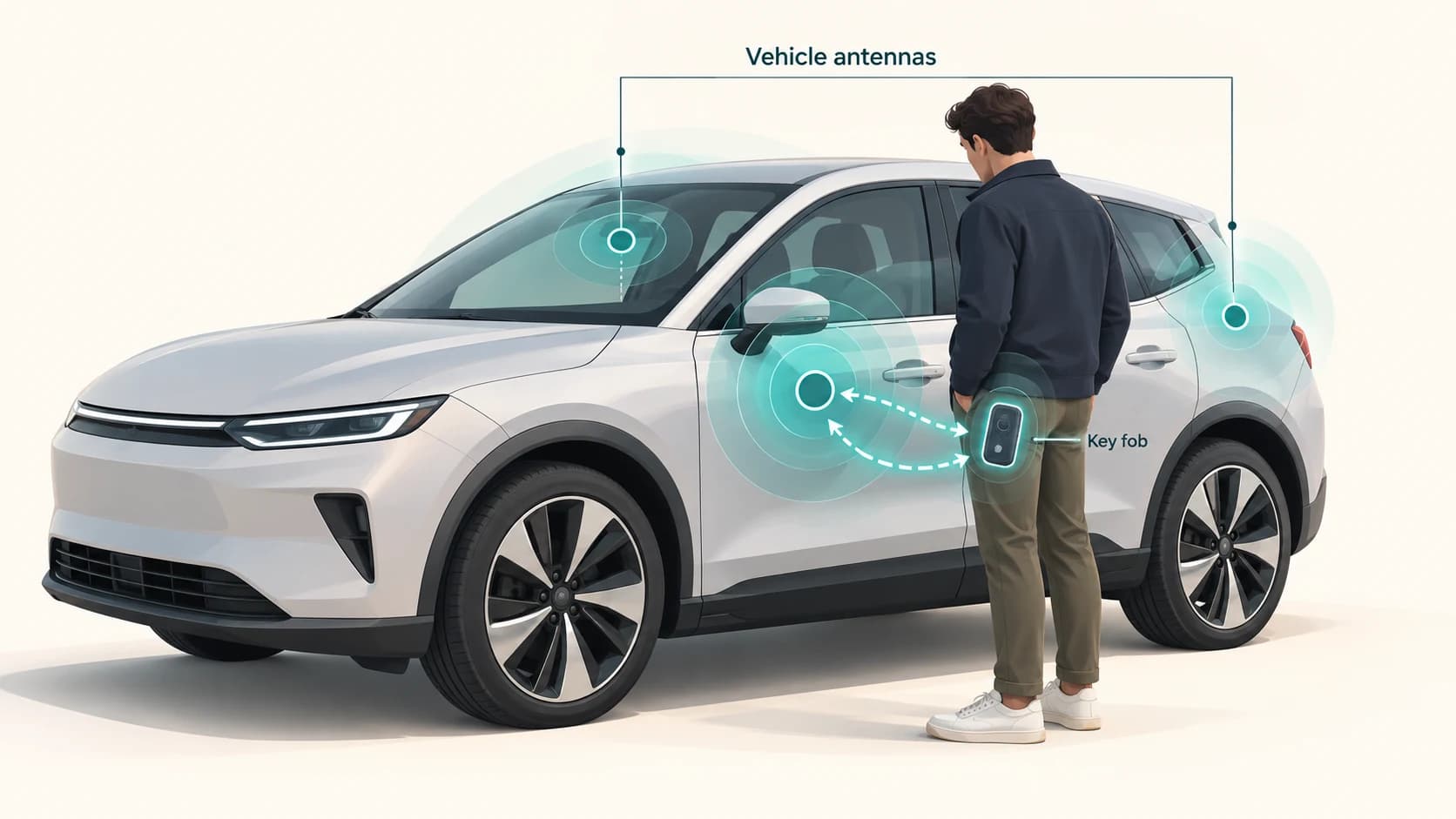
In a typical passive keyless-entry system, antennas positioned around the vehicle transmit a short radio signal. The key fob receives that signal, wakes up and sends an authenticated response. The vehicle checks whether the response belongs to a valid key and whether the key appears to be in the correct area.
NXP describes the classic process as a low-frequency signal from the vehicle waking the key, followed by an encrypted response from the key over a higher-frequency radio link. If authentication succeeds, the vehicle can unlock. A similar check is performed before starting the engine.
What feels like the car recognising you is really a very fast wireless conversation between the vehicle and a small computer inside the key fob.
Keyless Entry Is Not the Same as a Remote Unlock Button
It helps to distinguish two systems that are often both called “keyless entry.”
Remote keyless entry
You take out the key fob and press:
Unlock
The fob deliberately transmits a radio message.
The car receives it, verifies it and unlocks the doors.
You initiated the communication by pressing the button.
Passive keyless entry
You keep the fob in your pocket.
You:
- touch the door handle
- approach the vehicle
- press a small handle button
depending on the car.
The vehicle then looks for an authorized key nearby.
Toyota, for example, describes its Smart Key system as allowing the doors to be locked or unlocked simply while the electronic key is being carried, and uses antennas both outside and inside the cabin to establish operating areas.
This passive version is the one that creates the impression that the car somehow “senses” the key through your clothing.
The Key Fob Is a Small Radio Computer
A modern key fob contains considerably more than a simple button and battery.
Depending on the design, it can include:
- a microcontroller
- radio receiver
- radio transmitter
- cryptographic hardware or software
- low-frequency receiving circuitry
- antennas
- immobilizer transponder
- coin-cell battery
NXP's current passive-keyless-entry chips, for example, combine a 125 kHz low-frequency receiver, UHF transmitter, security transponder and controller inside the key-fob electronics.
The fob spends most of its time using very little power.
It does not need to blast a powerful signal continuously all day waiting for the car to hear it.
Instead, the vehicle can wake it when communication is needed.
That helps a tiny coin-cell battery last for years rather than hours.
Step 1: Something Tells the Car You Want to Enter
The process may start when you grab or touch the door handle.
Many vehicles place a touch or capacitive sensor in the handle.
Toyota's current Smart Key documentation, for example, instructs the driver to grip the door handle to unlock and notes that a sensor on the rear of the handle detects the action.
Other systems can begin preparing as the authorized device approaches.
The exact trigger differs between vehicles.
But conceptually, the car now asks:
Is one of my authorized keys close enough to this door?
Step 2: The Car Sends a Short-Range Wake-Up Signal
The vehicle has several antennas placed in strategic locations.
They may be positioned:
- near front doors
- inside the passenger compartment
- near the rear of the vehicle
Toyota's Smart Key documentation explicitly shows separate antennas outside the cabin, inside the cabin and near the rear of the vehicle.
A classic passive-entry system can use low-frequency radio, commonly around 125 kHz, for this part of the communication.
The vehicle transmits a localized signal around the relevant area.
The signal effectively says:
Authorized key, if you are nearby, wake up and prove who you are.
The key fob's low-frequency receiver detects it.
NXP's current keyless-entry hardware uses this type of 125 kHz wake-up reception before communicating back to the vehicle.
Why Use Low-Frequency Radio Near the Car?
The point is not simply to communicate.
The system also needs some idea of where the key is.
A normal long-range radio transmission could tell the vehicle:
I can hear the key.
But the car needs finer distinctions:
Is the key beside the driver's door?
Is it inside the cabin?
Is it near the boot?
Those questions matter because each location authorizes a different action.
The localized low-frequency fields from antennas around the car help create separate detection regions.
Toyota gives a practical example: on the cited Smart Key system, door operation normally requires the electronic key to be within roughly 0.7 metres of the relevant exterior door handle, whereas engine starting requires the key to be detected inside the vehicle.
That exact distance is not universal.
Every vehicle can use different antenna positions, calibration and software.
The important idea is that the car creates different radio zones rather than treating the entire area around it as one giant detection bubble.
Step 3: The Key Sends Back a Secure Response
Merely receiving a radio signal is not enough.
Otherwise, any electronic device capable of replying might unlock the vehicle.
The car needs to verify that the responding fob is one of the keys that was legitimately paired with it.
Classic keyless-entry systems therefore use authentication.
NXP describes the sequence this way: the vehicle sends a challenge; the key analyses it and transmits an encrypted response; the vehicle compares that response with the information it expects before allowing the door to unlock.
Conceptually:
Car sends challenge
↓
Key receives challenge
↓
Key calculates secure response
↓
Key transmits response
↓
Car verifies response
↓
Valid key → unlock
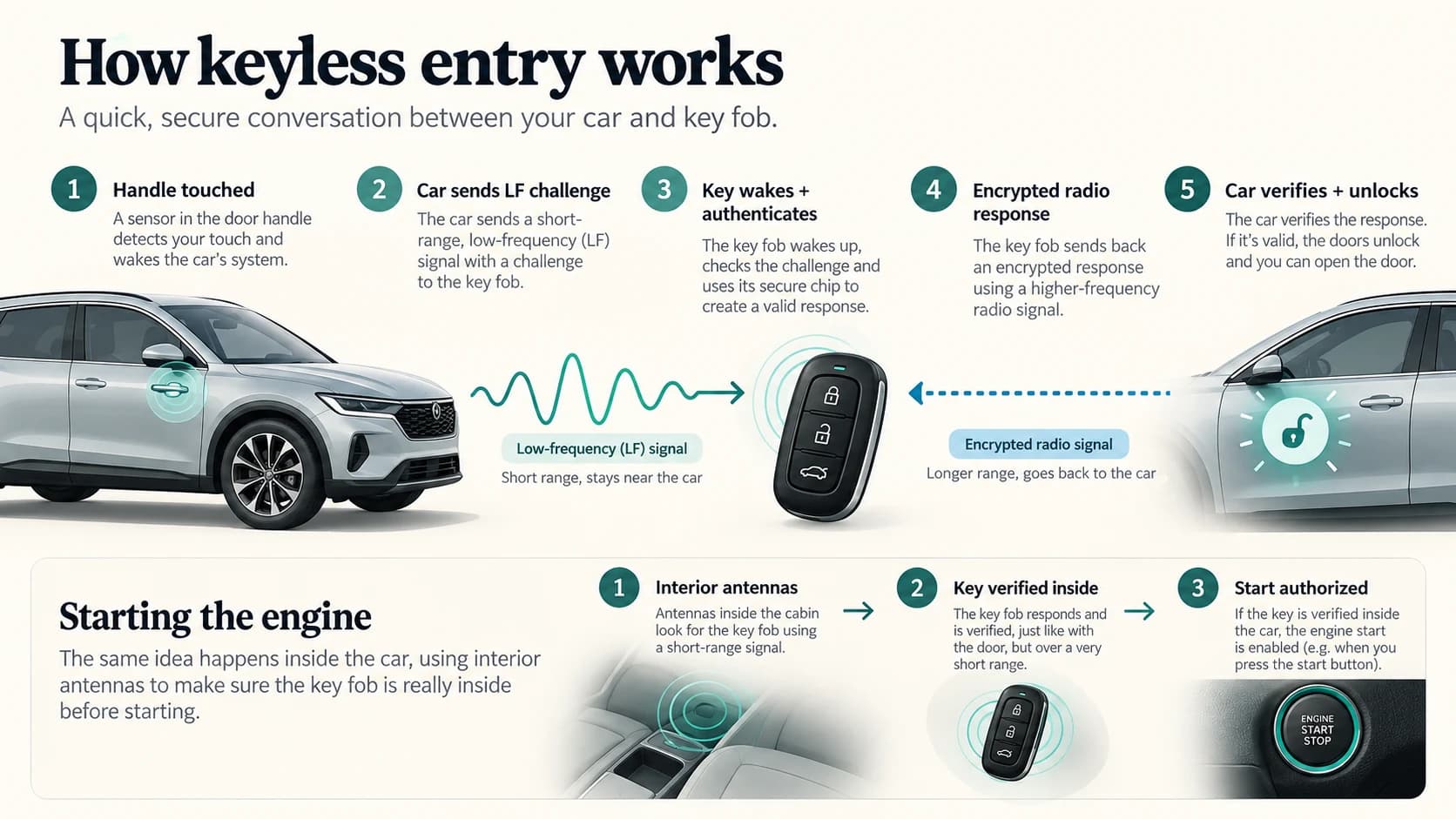
The actual cryptography is more complicated than this diagram suggests, and implementations differ between manufacturers.
But the critical point is that the key is not supposed to transmit one permanently reusable “unlock password.”
The car and key participate in an authentication process designed to make straightforward copying much harder.
Why Does the Reply Use a Different Radio Link?
In classic systems, the wake-up signal and response can use different frequency ranges.
The low-frequency connection is useful for waking and locating the fob close to the vehicle.
The response can then travel over a higher-frequency radio connection.
NXP's passive-keyless-entry devices, for example, combine low-frequency reception with a UHF transmitter. Earlier NXP implementations support UHF ranges used by automotive remote-control systems in different markets.
This combination has useful advantages.
The key can remain asleep most of the time.
The vehicle can create a localized low-frequency detection zone.
The fob can then efficiently send the authenticated response back over another radio channel.
So How Does the Car Know Which Door You Are Standing Beside?
Imagine the key is in your right pocket while you stand beside the driver's door.
The car does not have one single antenna at the centre of the roof.
It has multiple sensing zones.
When the driver's handle is activated, the system can energize or evaluate the antennas relevant to that part of the vehicle.
If a valid key responds in the expected area, that door can be unlocked.
Toyota specifically notes that, on its Smart Key implementation, only doors detecting the key can perform the relevant entry operation under certain settings.
This explains why standing beside one door can work while somebody pulling another handle farther away may not unlock it.
The key is not broadcasting:
I am in the owner's right trouser pocket.
The system is effectively determining:
An authenticated key appears to be inside the permitted radio zone for this door.
Starting the Car Requires a Different Location Check
Unlocking the door proves that the key is close enough to enter.
That should not automatically mean the engine can start.
Imagine this scenario:
You place the key on the roof.
Open the door.
Sit inside.
Press Start.
If mere proximity were sufficient, the vehicle might start even though the key is still outside.
So passive-start systems try to establish whether the key is in the interior detection area.
NXP describes its keyless-go process as performing another authentication procedure for starting and checking that the key is inside the car rather than somewhere such as on the roof.
Toyota similarly distinguishes its outside door-handle detection zones from the interior area used for starting the vehicle.
Honda documentation makes the same basic distinction: the engine can be started when its Smart Entry remote is within the vehicle's operating area, while warning that a key very close to a door or window can sometimes create borderline detection behaviour.
That last detail is revealing.
Radio localization is extremely useful.
It is not magic.
How Can Several Antennas Tell Inside From Outside?
Think about standing between several speakers playing different sounds.
Your position changes how strongly you hear each speaker.
Keyless-entry systems can use a related idea with electromagnetic fields.
Different antennas create different low-frequency fields.
The key can measure aspects of the signal it receives.
The system can then use those measurements to infer which antenna region contains the key.
Some key-fob chips include three-axis low-frequency receivers, allowing them to sense field strength regardless of the orientation of the key in your pocket or bag. NXP describes key-localization capability using three-dimensional LF reception and RSSI, or received signal strength indication.
That matters because the fob could be:
- upright
- sideways
- upside down
- covered by other objects
You should not need to orient your pocket toward the door.
The system is designed to work while you carry the key naturally.
Why Doesn't the Key Fob Battery Die Quickly?
A fob that continuously transmitted radio signals at full power would waste energy.
Passive-entry hardware is therefore designed around low-power operation.
The key can remain largely asleep until the vehicle's wake-up signal reaches it.
NXP's current passive-entry key chip, for example, advertises ultra-low-power LF wake-up operation and multi-year coin-cell battery life under its design assumptions.
The general sequence is energy-efficient:
Sleep
↓
Receive wake-up
↓
Authenticate
↓
Transmit briefly
↓
Return to low-power state
That is why simply carrying your fob does not mean it is constantly transmitting at full power.
What Happens When the Key-Fob Battery Is Weak?
A dead fob battery does not necessarily mean you are permanently locked out.
The exact emergency procedure depends on the vehicle.
Many systems include a separate passive immobilizer transponder or backup method that can be powered by the vehicle's nearby reader rather than relying entirely on the fob's coin cell.
NXP's passive-entry devices, for example, include security-transponder functionality that can operate even when the external key-fob battery is depleted.
Manufacturers may instruct the driver to:
- hold the fob against a specific part of the steering column
- hold it near the Start button
- use a hidden mechanical key to open the door
The owner's manual is the correct source for the exact procedure.
Why Can a Phone or Metal Object Sometimes Interfere?
Radio communication can be affected by the environment around the key.
Toyota warns that Smart Key operation can be affected when the key is:
- close to some electronic devices
- near another wireless key
- covered by certain metallic objects
- near strong radio interference
and also notes that the precise position of the fob can affect detection.
Some vehicle documentation similarly warns that keeping the fob next to a mobile phone or laptop may interfere with reliable passive-entry detection.
This is another clue to what is actually happening.
The vehicle is not detecting a physical object called “the key.”
It is detecting and authenticating radio communication from electronics inside the key.
Anything that seriously disrupts that communication can interfere with operation.
Why Can't Any Key Fob Unlock the Car?
Because the vehicle is not simply asking:
Is there a key-shaped radio nearby?
It is asking:
Can this device prove that it possesses the correct cryptographic credentials?
NHTSA describes keyless ignition as electronically verifying the correct fob before allowing normal vehicle operation.
Immobilizer systems add another layer.
Even if somebody physically enters the car, the engine-management system can refuse normal starting when the correct electronic authorization is absent.
NHTSA categorizes immobilizing anti-theft devices as systems that prevent unauthorized activation of the vehicle, including systems that use coded electronic keys.
Unlocking and authorizing the powertrain are therefore related but not necessarily identical security operations.
The Weakness of Classic Keyless Entry: Relay Attacks
Passive keyless entry created a new security problem.
Imagine your key is inside your house.
The car is outside.
Normally the low-frequency signal from the car should not reach far enough for the fob to participate.
But an attacker can potentially use two electronic devices:
Device A near the car
and
Device B near the key
to relay the radio conversation over a greater distance.
Conceptually:
Car
→ attacker relay →
Key inside house
→ attacker relay →
Car
The key itself may be genuine.
The cryptographic response may also be genuine.
The problem is that the communication has been artificially extended, making the car believe the key is nearby.
This is called a relay attack.
NXP explicitly identifies relay-attack hardening as a design requirement for modern secure car-access systems.
That is why simply encrypting the radio message does not completely solve every keyless-entry security problem.
The car also needs reliable information about physical proximity.
Ultra-Wideband Makes Distance Harder to Fake
Newer car-access systems increasingly use ultra-wideband, or UWB.
Instead of estimating proximity mainly from signal strength, UWB can measure signal travel time very precisely.
Radio waves travel extremely quickly, so measuring their time of flight requires precise electronics.
But the principle is powerful.
If the vehicle can measure how long the signal actually takes to travel between itself and the key, it can estimate physical distance.
The Car Connectivity Consortium describes modern Digital Key systems as using UWB time-of-flight measurements for secure ranging, helping prevent attackers from simply amplifying or relaying signals to make a distant key appear nearby.
NXP's current Digital Key reference platform similarly combines Bluetooth for initial communication with UWB for precise and relay-resistant localization.
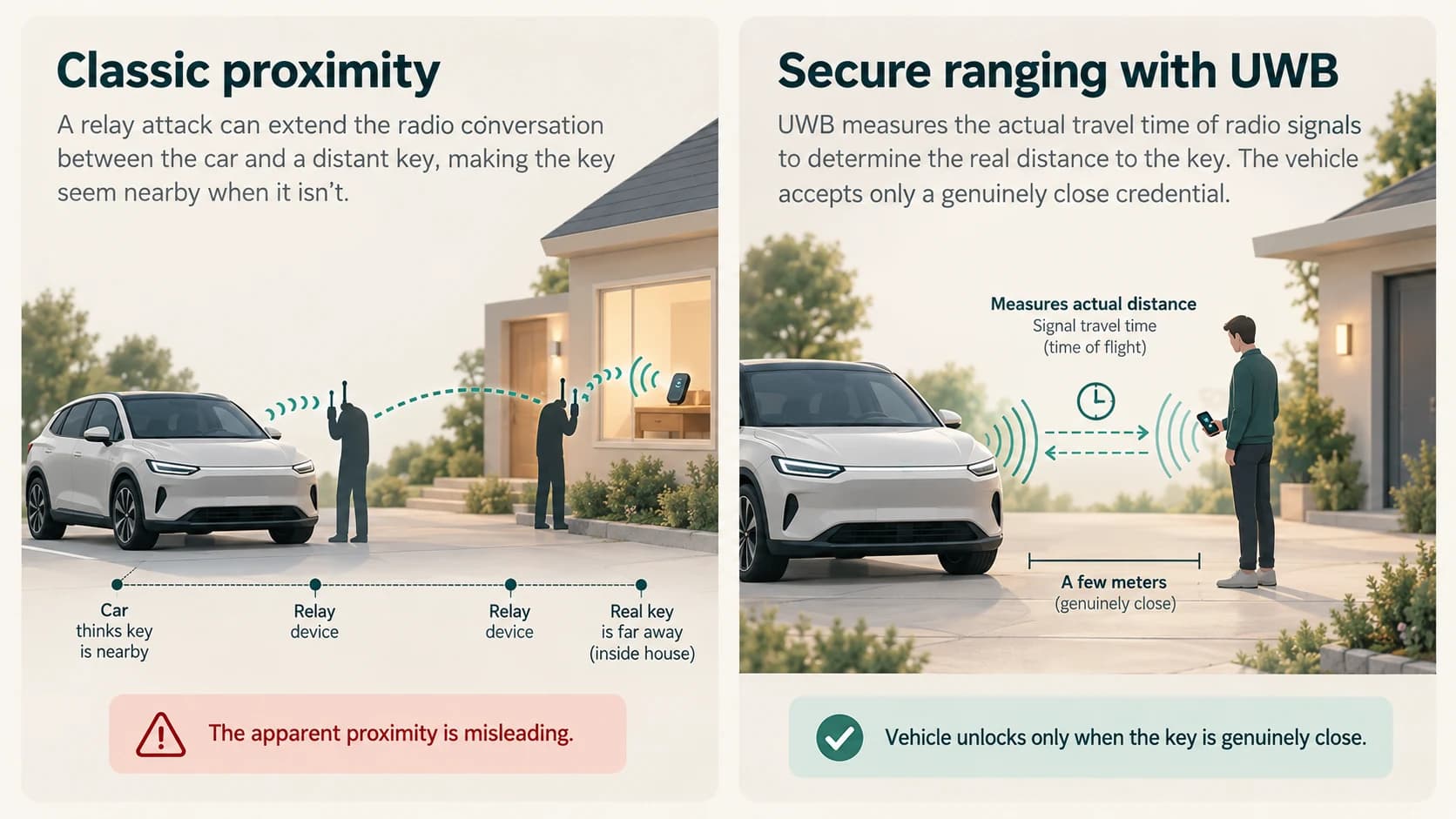
This changes the security question from:
Can I hear an authorized key?
to something closer to:
Can I authenticate the key and verify that it is physically at the expected distance?
That is a much stronger test.
Your Phone Can Now Become the Key
The same concepts are increasingly being applied to smartphones and smartwatches.
A modern digital-key system can use technologies such as:
- Bluetooth Low Energy
- UWB
- NFC
- secure hardware inside the phone and car
The Car Connectivity Consortium's Digital Key specification supports hands-free vehicle access in which a smartphone can remain in the owner's pocket while the vehicle and phone authenticate one another.
NXP describes newer access designs using Bluetooth for discovery or pre-ranging and UWB for precise distance measurement and localization.
In other words, the physical plastic key fob may eventually become optional on more vehicles.
But the underlying task remains remarkably similar:
Find authorized credential
↓
Verify identity
↓
Verify proximity
↓
Authorize requested action
Why Can the Car Refuse to Lock With the Key Inside?
Some systems try to prevent you from locking your key inside the vehicle.
The same interior antennas used for passive starting can help detect that an electronic key remains in the cabin.
Toyota's Smart Key system, for example, can display a warning that a key has been detected inside when the driver attempts certain locking operations.
Honda also documents Smart Entry systems that prevent normal exterior locking when the remote is detected inside the vehicle.
Again, this is not because the car visually sees the key on the seat.
It is using radio localization to decide that the authenticated fob appears to remain within an interior detection region.
Why Does Walk-Away Locking Work?
Some cars reverse the process when you leave.
Instead of asking:
Has the key arrived?
they ask:
Has the key moved away?
Honda's Walk Away Auto Lock, for example, monitors the presence of the Smart Entry remote near the vehicle and can automatically lock after the driver moves beyond the operating range, provided the necessary conditions are satisfied.
Modern systems can therefore use proximity for more than unlocking.
Depending on the vehicle, proximity may trigger:
- welcome lighting
- door unlocking
- boot access
- engine-start authorization
- walk-away locking
- alarm arming
NXP lists passive entry and walk-away locking among applications supported by contemporary car-access hardware.
What Happens in the Few Moments Before the Door Unlocks?
The entire sequence can be reduced to a simple flow.
1. You touch or approach the car
The system determines that an entry request may be happening.
2. The vehicle activates the relevant antennas
A localized radio signal is transmitted around the door area.
3. Your key wakes up
The fob detects the low-frequency message even though it remains in your pocket.
4. The car and key authenticate
The key generates the required response.
5. The vehicle checks proximity
The system determines whether the authorized fob appears to be within the appropriate detection zone.
6. The door unlocks
The lock actuator operates.
7. Starting requires another location check
Interior antennas help verify that an authorized key is within the passenger compartment before the powertrain is enabled.
To you, the whole process feels like:
touch handle → click
The complicated part happens invisibly between those two events.
The Car Does Not Detect Your Pocket
That is the central idea.
Your trousers, handbag or jacket are irrelevant to the logic.
You could hold the fob in your hand and the system would work essentially the same way.
The vehicle is trying to establish three things:
Is a compatible electronic key responding?
Can that key prove it is authorized?
Is it in the correct location for what the user is trying to do?
Older passive-entry systems commonly solve those questions using localized low-frequency signals, UHF responses, multiple antennas and cryptographic authentication.
Newer systems can add Bluetooth and UWB to provide more accurate proximity information and stronger resistance to relay attacks.
So when you walk up to your car, leave the key buried in your pocket and hear the doors unlock, the car has not recognized your clothing or even necessarily identified you personally.
It has conducted a tiny wireless security conversation with the key.
And it has completed that conversation quickly enough that, from your perspective, nothing happened at all.