How to Study Difficult Subjects Without Simply Reading Them Again
Learn how to study difficult subjects using worked examples, active recall, self-explanation, problem solving, feedback and spaced practice.

You spend an hour reading a difficult chapter.
Some of it makes sense.
The next day, you open the book and realize you can't explain half of it.
So you read the chapter again.
It feels easier this time. The terminology looks familiar. The equations no longer seem completely foreign. You recognize the diagrams.
Then you try to solve a question without looking at the book.
Nothing happens.
This is one of the most frustrating experiences in studying difficult subjects: the material becomes familiar without becoming usable.
The problem isn't that reading is useless. Reading is often necessary when you first encounter a topic. The problem is what happens afterward.
Subjects such as mathematics, physics, programming, accounting, economics, computer science and advanced theory usually require more than recognizing explanations on a page. You eventually have to retrieve concepts, choose methods, connect ideas and solve problems without being shown each step.
That requires a different study process.
Instead of:
Read → Read again → Highlight → Read again
a stronger approach is:
Understand → Reconstruct → Apply → Check → Correct → Return later
The harder the subject, the more important that change becomes.
First, Work Out Why the Subject Feels Difficult
Not every difficulty has the same cause.
Suppose you say:
"I don't understand calculus."
That description is too broad to guide your studying.
The actual problem might be:
- weak algebra
- confusion about functions
- not understanding what a derivative represents
- knowing the idea but not knowing which formula to use
- being unable to solve unfamiliar questions
- forgetting procedures between study sessions
Those are different problems.
Reading the calculus chapter again won't necessarily fix weak algebra. Memorising derivative formulas won't necessarily fix a conceptual misunderstanding.
Before studying, ask:
What exactly can I not do yet?
Try to make the answer observable.
Instead of:
"I don't understand databases."
use:
"I can explain what a primary key is, but I cannot decide when a table violates third normal form."
Instead of:
"Operating systems are difficult."
use:
"I understand processes and threads separately, but I cannot explain why context switching has a cost."
That diagnosis tells you what kind of practice you need.
Don't Try to Learn an Entire Difficult Chapter at Once
A difficult subject often contains many ideas that depend on one another.
Working memory — the limited mental workspace you use while thinking through a task — can become overloaded when too many unfamiliar elements have to be processed simultaneously.
This is one reason beginners can stare at a complete solution and feel as though every line makes sense individually while the whole thing remains confusing.
Break the material into smaller units.
For example, don't study:
"SQL joins"
as one giant topic.
Break it into:
- What two tables represent
- What a matching key is
- INNER JOIN
- LEFT JOIN
- What happens to unmatched rows
- How multiple joins interact
- Practice choosing the correct join
Or instead of trying to master:
"Newton's laws"
all at once, separate:
- force
- mass
- acceleration
- free-body diagrams
- first law
- second law
- third law
- applying them to actual problems
The goal isn't to make the subject artificially simple.
It is to keep the number of new relationships you must manage at one time within a workable range.
When You're a Beginner, Study a Worked Example Before Fighting With a Problem
There is a popular idea that the best way to learn is to struggle with problems completely on your own.
For beginners, that can be inefficient.
If you have almost no idea how to solve a problem, you may spend most of your mental effort searching randomly for a path instead of learning the structure of the solution.
Research on the worked-example effect has repeatedly found that novice learners can benefit from carefully studying complete worked solutions before being asked to solve similar problems independently. Worked examples can reduce unnecessary search and leave more mental capacity for understanding why the solution works.
Suppose you're learning quadratic equations.
Instead of immediately facing:
Solve:
2x^2 + 7x + 3 = 0
with no idea what to do, first study a worked example.
But don't merely read the solution line by line.
Ask:
- Why was this step chosen?
- What changed between these two lines?
- Which rule allowed that change?
- How would the solution differ if the coefficients changed?
- What clue tells me which method to use?
That turns a worked solution from something you watch into something you learn from.
Explain Every Important Step to Yourself
This technique has a research name: self-explanation.
Instead of simply accepting a statement, you explain why it follows.
Imagine a programming example contains:
if x > 10:
    ...
Don't just read the code and continue.
Ask:
Why is the condition here?
What happens if it is false?
What input would cause the other branch to execute?
What concept is this line demonstrating?
Classic research on students learning from worked examples found that stronger learners spontaneously generated more explanations linking solution steps with underlying principles. Experimental work has also found benefits when students are deliberately prompted to self-explain material.
Self-explanation is especially valuable when something looks deceptively obvious.
If you cannot explain a step without repeating the textbook's wording, you may not understand it as well as it seems.
Then Close the Book
This is the point many study sessions never reach.
You understand the explanation while looking at it.
Now remove it.
Try to reproduce what you just learned.
For a conceptual topic, ask:
What is the idea?
Why does it work?
Can I give an example?
How is it different from the related concept?
For a mathematical method:
What is the first step?
Why?
What comes next?
For programming:
Can I write the basic version without copying the example?
For a diagram:
Can I draw it from memory?
This is retrieval practice.
Research consistently shows that practising retrieval can improve later retention compared with simply exposing yourself to the material again. Reviews of the testing effect also indicate that retrieval is particularly useful when repeated over time and accompanied by corrective feedback.
The important word is attempt.
Don't look at the answer the moment you feel uncertain.
Give your memory a genuine chance to retrieve it.
Use a Blank Page to Discover What You Actually Know
One of the simplest methods requires nothing more than paper.
After studying a difficult topic, close everything.
Write the topic at the top.
For example:
TCP vs UDP
Then reconstruct everything you can remember:
- connection-oriented vs connectionless
- reliability
- ordering
- acknowledgements
- overhead
- examples of applications
- situations where each is useful
When you finish, reopen the source.
Compare.
Mark:
- correct information
- missing information
- incorrect information
- things you remembered but could not explain
This is much more diagnostic than asking yourself:
"Does this chapter make sense?"
Almost everything makes more sense while the answer is still visible.
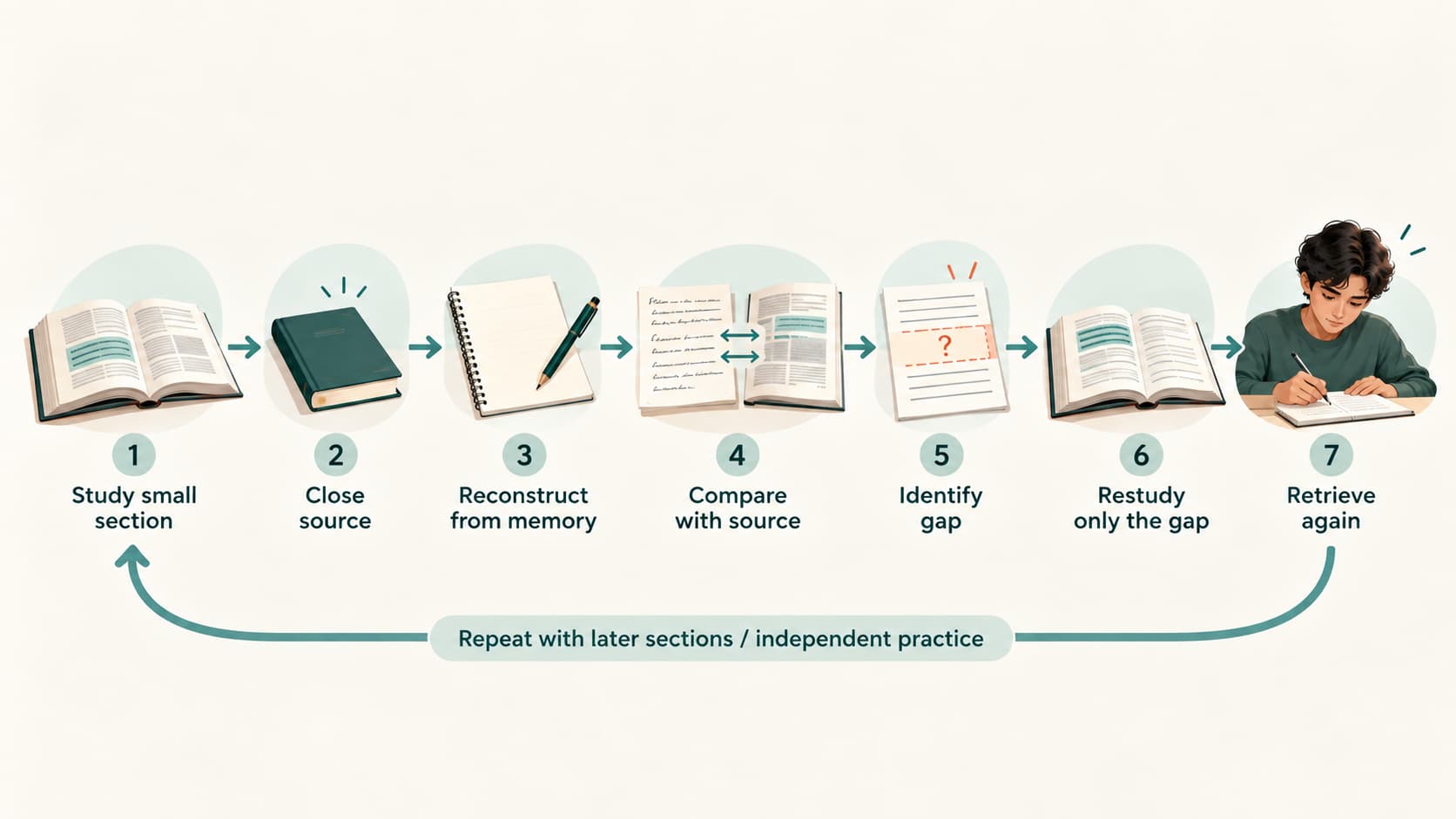
Move From "Can I Explain It?" to "Can I Use It?"
Understanding and application are related, but they aren't identical.
You may be able to explain what a binary search does and still be unable to implement one correctly.
You may understand a statistics formula and still fail to recognize when it should be used.
You may understand an accounting entry while reading it but make mistakes when creating one yourself.
Once you can reconstruct the concept, start using it.
A useful progression is:
Worked example
↓
Similar problem with some support
↓
Similar problem without support
↓
Different-looking problem using the same principle
↓
Mixed problems where you must decide which principle applies
This gradually removes guidance instead of jumping directly from "I watched someone solve it" to "I can solve anything."
Don't Look at the Solution Too Quickly
Difficult questions produce discomfort.
The temptation is:
- Read the question.
- Think for 20 seconds.
- Feel stuck.
- Open the solution.
- Think, "Oh yes, of course."
- Move on.
That creates another form of recognition.
The solution feels understandable because you're seeing it.
You haven't demonstrated that you could produce it.
Instead, when stuck, first identify where you're stuck.
Ask:
- Do I understand what the question is asking?
- Which concepts might apply?
- What information is given?
- What am I trying to find?
- Can I solve one smaller part?
- Is there a similar example I have seen?
If you still cannot proceed, use a hint or worked example.
But after seeing the solution, close it and solve the problem again yourself.
Otherwise you have studied the answer without practising the skill.
But Don't Spend an Hour Being Completely Stuck
Productive difficulty is useful.
Aimless frustration isn't.
Worked-example research is particularly relevant here: beginners often benefit from more guidance, while the need for that guidance decreases as expertise grows.
This suggests a sensible rule.
If you are a complete beginner:
Use more explanation and worked examples.
As you become competent:
Remove more support and solve independently.
Eventually:
Practise unfamiliar problems under realistic conditions.
The goal isn't maximum struggle.
The goal is the right amount of challenge for your current level.
Keep an Error Log
Wrong answers are valuable if you study the reason they were wrong.
Create a simple error log.
| Question | What went wrong? | Correct idea | What I will do next |
|---|---|---|---|
| Probability problem | Used permutations instead of combinations | Order didn't matter | Practise identifying when order matters |
| SQL query | LEFT JOIN condition placed incorrectly | Filtering changed unmatched rows | Rebuild query from small example |
| Physics problem | Forgot direction of friction | Force depends on tendency of motion | Draw free-body diagram first |
Don't write:
"Silly mistake."
That tells you nothing.
Classify the mistake.
Was it:
- missing knowledge?
- forgotten formula?
- conceptual misunderstanding?
- incorrect method selection?
- algebra or arithmetic?
- misreading the question?
- careless execution?
- inability to connect two topics?
Patterns appear surprisingly quickly.
If ten mistakes have the same cause, rereading ten chapters is unnecessary.
You have identified one target.
Mix Problems Once You Know the Basics
Textbooks often teach like this:
20 questions on Method A
then:
20 questions on Method B
then:
20 questions on Method C
That is useful at the beginning because you're learning each method.
But real exams usually don't tell you:
"This is a Method B question."
You must recognize the problem type yourself.
That is why interleaving can be useful.
Instead of:
AAAAA → BBBBB → CCCCC
eventually practise:
A → C → B → A → B → C
Now every question requires two decisions:
- What kind of problem is this?
- How do I solve it?
Research on mathematics practice has found that interleaved problem sets can improve later performance because learners must discriminate between problem types and select the appropriate strategy rather than repeating the same method automatically. However, the benefit varies by learning material, so interleaving is a tool rather than a universal rule for every topic.
Use blocked practice to learn a method.
Use mixed practice to learn when to use it.
Return to the Topic Later
A difficult concept that makes sense tonight may feel strangely unfamiliar three days later.
That is normal.
Instead of interpreting forgetting as proof that the previous study session failed, use it as a reason to retrieve the material again.
Spacing study across multiple sessions generally produces better long-term retention than putting the same total practice into one concentrated session. A large meta-analysis of distributed practice examined hundreds of experiments, and more recent classroom-focused evidence also supports an advantage for distributed over massed practice.
You don't need a perfect mathematical spacing schedule.
A practical pattern might be:
Day 1: Learn and practise
Day 2: Retrieve and solve a few questions
Day 4: Mixed practice
Day 7: Closed-book recall + harder problems
Two weeks later: Short review or test
Adjust the intervals according to your forgetting and the exam date.
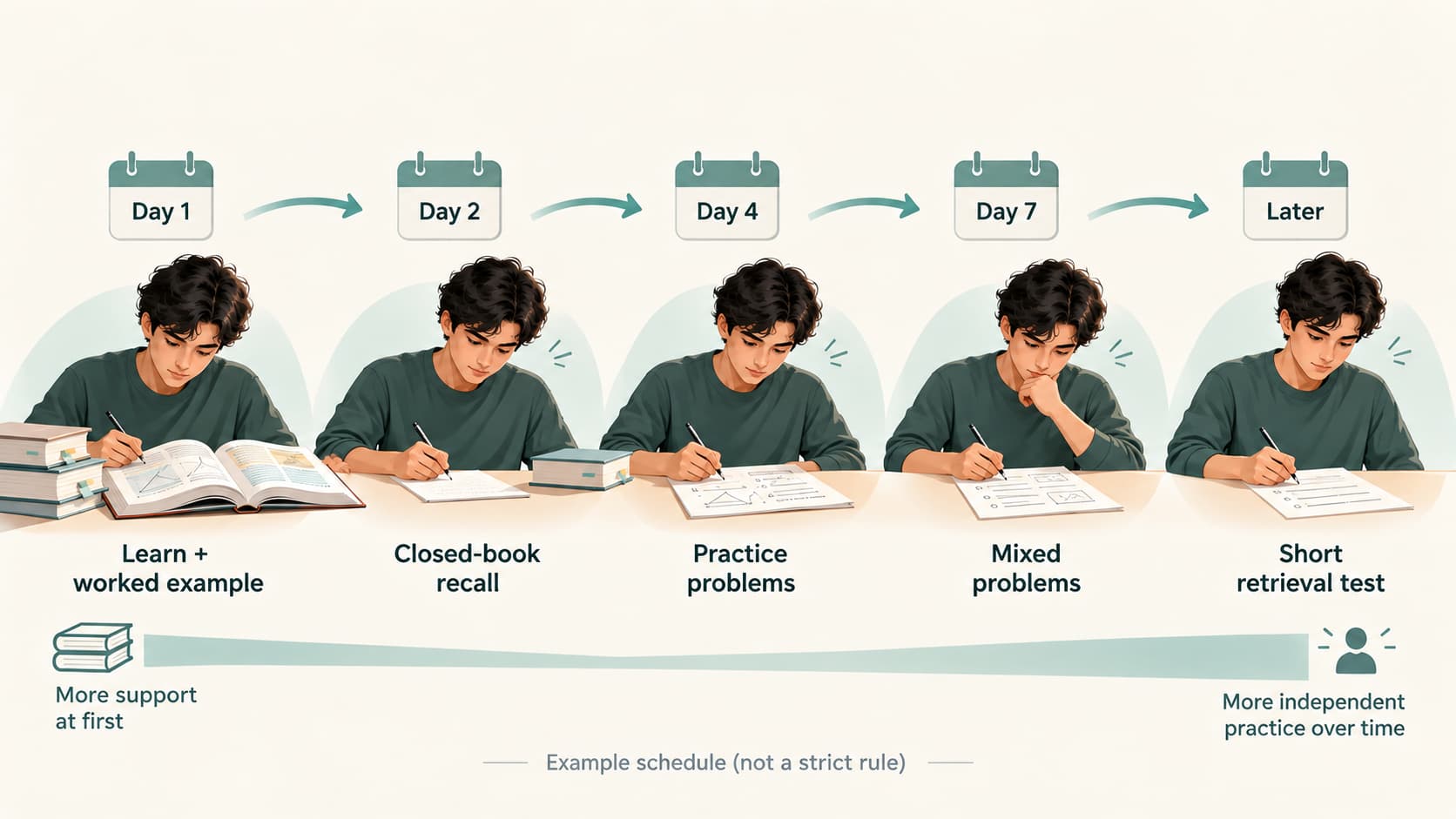
Study Difficult Subjects in Layers
Trying to achieve complete mastery in one pass is unrealistic.
Use layers.
Pass 1: Build the map
Ask:
- What are the major topics?
- Which ideas depend on earlier ideas?
- What terminology must I know?
You aren't trying to memorise everything yet.
Pass 2: Understand the core mechanism
Study explanations and worked examples.
Ask why each step happens.
Pass 3: Reconstruct from memory
Close the source.
Explain, draw or write the topic yourself.
Pass 4: Apply
Solve questions.
Start with structured ones and remove support gradually.
Pass 5: Diagnose
Study mistakes and weak areas.
Pass 6: Mix and space
Return later and mix the topic with related material.
Each pass demands more independence.
That is very different from reading the same pages five times.
Match the Method to the Subject
Not every subject should be studied in exactly the same way.
Mathematics and physics
Spend substantial time solving problems.
Use worked examples when learning a new method, then reproduce them without looking and move to unfamiliar questions.
Programming
Reading code is not enough.
Predict outputs, trace code manually, write programs from scratch, debug broken examples and explain why each line exists.
Computer science theory
Draw structures and processes from memory.
For example:
- scheduling algorithms
- network layers
- database normalization
- process states
- data structures
Then answer comparison and application questions.
Accounting and finance
Reconstruct rules, then practise transactions and numerical problems.
Focus heavily on why an entry goes to a particular account rather than memorising completed answers.
Biology and medicine
Use diagrams, causal chains, retrieval questions and spaced recall.
Ask how changing one component would affect the rest of the system.
Humanities and theory-heavy subjects
Don't reduce everything to flashcards.
Practise constructing:
- explanations
- comparisons
- causes and consequences
- arguments
- evidence-supported answers
Retrieval should resemble the final skill you need.
Use Questions Instead of Notes Whenever Possible
Traditional notes often preserve the textbook in shorter form.
That can still leave you with pages to reread.
A more usable system converts major ideas into questions.
Instead of writing:
TCP establishes a connection before data transfer.
write:
Why does TCP establish a connection before sending application data, and what does that allow it to provide?
Instead of:
Demand usually falls when price rises.
write:
Why does quantity demanded generally fall when price rises, assuming other factors remain constant?
Questions turn notes into prompts for thinking.
Good questions include:
- What is it?
- Why does it happen?
- How does it work?
- What is the difference between A and B?
- What would happen if X changed?
- When would I use this?
- What is a common mistake?
- Can I produce an example?
- Can I solve a problem using it?
The deeper the subject, the more useful "why" and "how" questions become.
A 90-Minute Session Could Look Like This
Suppose you have 90 minutes for a genuinely difficult topic.
A productive session might be:
20 minutes — Learn
Read a small section and study one or two worked examples.
15 minutes — Self-explain
Go through the material and explain why each important step works.
15 minutes — Closed-book reconstruction
Write or explain what you remember without looking.
25 minutes — Solve
Attempt several questions independently.
10 minutes — Correct
Check solutions and update your error log.
5 minutes — Schedule the next retrieval
Choose when you will revisit the topic.
The exact timings aren't scientifically special.
The principle is what matters:
Most of the session eventually shifts from receiving information to producing it.
How Do You Know When You Actually Understand Something?
Don't ask:
"Have I read this?"
Ask:
"Can I do something with it?"
A stronger checklist is:
- Can I explain it without notes?
- Can I give my own example?
- Can I distinguish it from a similar idea?
- Can I solve a straightforward problem?
- Can I identify when the idea applies?
- Can I solve a problem that looks different from the example?
- Can I still do this several days later?
The more "yes" answers you can give, the stronger the evidence that learning has moved beyond familiarity.
The Goal Is Not to Stop Reading
Reading has an important role.
The mistake is expecting reading to perform every stage of learning.
A textbook can introduce an idea.
A lecture can explain it.
A worked example can show how it operates.
But eventually you have to produce the knowledge.
You have to retrieve the definition.
Choose the formula.
Write the code.
Construct the argument.
Recognize the problem type.
Explain why one method works and another doesn't.
That is why difficult subjects often start improving when your study desk becomes less about consuming pages and more about doing things without the pages.
The book is still there.
You just stop allowing it to do all the thinking for you.