Why Active Recall Works Better Than Re-reading
Learn why active recall improves long-term memory more effectively than repeated reading, and how to use retrieval practice correctly while studying.

Imagine you have an exam tomorrow.
You read a chapter once. Then you read it again.
By the third reading, the page feels familiar. You recognize the headings. You know what sentence comes next. The material seems much easier than it did the first time.
Then you close the book and try to explain the chapter without looking.
Suddenly, much of it disappears.
This gap between recognizing information and being able to retrieve it is one of the main reasons re-reading can give students a misleading sense of preparation.
Active recall approaches studying from the opposite direction.
Instead of repeatedly putting information into your mind, you deliberately try to bring information back out of memory without looking at the answer first.
That might mean answering a question, using a flashcard, writing everything you remember on a blank page, solving a problem without checking the example or explaining a concept from memory.
Psychologists usually call this retrieval practice.
Decades of research show that retrieving previously learned information can improve later retention more than simply studying the same material again. A major review of learning techniques rated practice testing and distributed practice among the most broadly useful techniques it examined, while repeated re-reading received a much lower overall assessment.
But the useful lesson isn't that reading is bad.
You still have to understand something before you can retrieve it.
The important difference is what happens after the first exposure.
What Active Recall Actually Means
The term active recall is widely used by students, although research literature more commonly refers to the underlying technique as retrieval practice.
The idea is simple:
- Study something.
- Remove the source.
- Try to retrieve the information from memory.
- Check your answer.
- Correct what you missed.
- Retrieve it again later.
Suppose you are learning photosynthesis.
A re-reading approach might look like this:
Read the textbook section three times and highlight important sentences.
An active-recall approach might look like this:
Close the book and answer: "What are the inputs and outputs of photosynthesis? Where does each stage occur? Why is chlorophyll important?"
The difference isn't merely that the second method feels more difficult.
The mental operation itself is different.
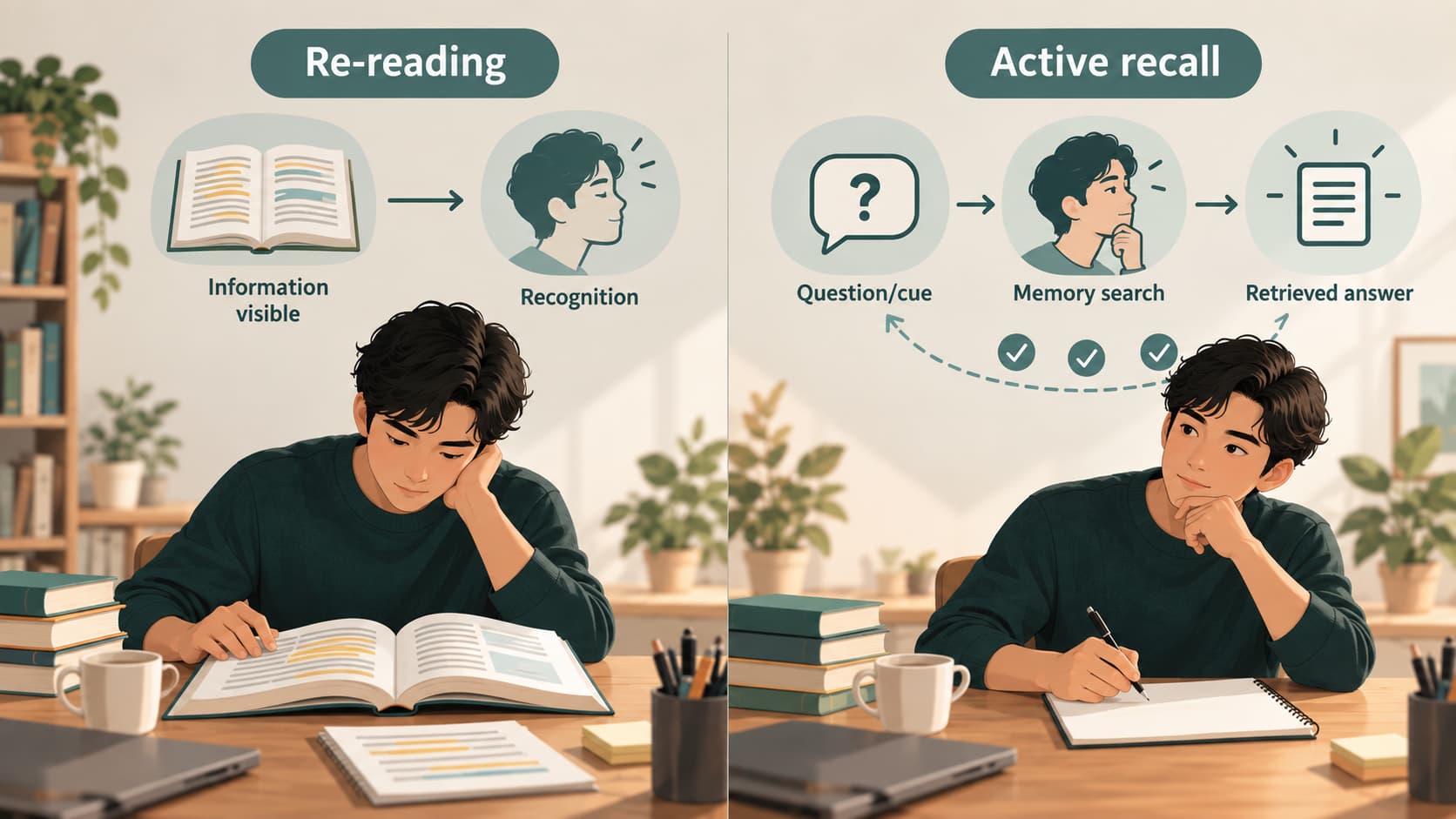
During re-reading, the answer is already in front of you.
During retrieval, your brain has to reconstruct the answer from stored knowledge.
That act of retrieval is part of the learning process.
Tests Don't Just Measure Memory — They Can Change It
Students usually think of a test as something that happens after learning.
You study first.
Then the test measures how much you learned.
Memory research shows that this picture is incomplete.
Retrieving information during a test can itself strengthen later memory.
This is sometimes called the testing effect.
In a well-known 2006 study, Henry Roediger and Jeffrey Karpicke had students study educational prose passages. Some repeatedly studied the material, while others spent more of their time retrieving it through tests.
When tested only a few minutes later, repeated study could perform well.
But after delays of two days or one week, previous retrieval practice produced substantially better retention than repeated study.
That difference is important.
Re-reading can make something highly accessible right now.
Active recall is particularly valuable because it helps make the information accessible later, when your notes are no longer in front of you.
An exam, interview or real-world problem requires retrieval.
So practicing retrieval is remarkably similar to practicing the ability you eventually need.
Why Re-reading Feels So Effective
If retrieval practice is powerful, why do so many people naturally prefer re-reading?
One reason is that re-reading feels productive.
The first time you read a difficult paragraph, processing it requires effort.
The second time is easier.
By the fourth reading, you move through it quickly.
That fluency can be interpreted as:
"I know this."
But sometimes what you actually know is:
"I recognize this when I see it."
Recognition is easier than recall.
Consider these two questions.
Recognition
Which planet is closest to the Sun?
- Venus
- Mercury
- Mars
- Jupiter
Recall
Which planet is closest to the Sun?
The knowledge being tested is essentially the same, but the second version gives your memory fewer clues.
Now remove the question entirely:
Write down all eight planets in order from the Sun.
That is harder again.
Re-reading repeatedly presents you with cues: the headings, words, diagrams and surrounding sentences.
When those cues disappear, the apparent mastery can disappear with them.
Researchers have also found that repeated studying can increase learners' confidence even when retrieval practice produces better delayed retention.
This is one reason effective studying can feel surprisingly uncomfortable.
Retrieval Makes the Memory Easier to Find Again
Memory isn't simply a collection of files stored somewhere in the brain.
Knowing something also means being able to access it when the right situation arises.
Imagine that you know a person's name but can't remember it during a conversation.
The information may not have vanished completely.
The problem is retrieval.
Active recall repeatedly practices the route from a cue to the information.
For example:
Question: What is opportunity cost?
↓
You search memory.
↓
Answer: The value of the next-best alternative given up when choosing something.
When you successfully perform that retrieval, you aren't simply checking whether the memory exists.
The act of retrieving can modify and strengthen the memory in ways that improve subsequent access.
Reviews of retrieval-practice research consistently conclude that retrieval itself can improve long-term retention beyond the benefit of additional exposure to the material.
Researchers continue to study the exact mechanisms responsible, so it would be an oversimplification to say that retrieval merely "strengthens a neural pathway" in one simple way.
But experimentally, the outcome is clear: successfully retrieving information changes the likelihood that you will retrieve it successfully again.
Active Recall Shows You What You Don't Know
Active recall has another advantage that has nothing mysterious about it.
It exposes weaknesses.
Suppose you spend 30 minutes re-reading a chapter.
Almost every paragraph starts looking familiar.
It can be difficult to distinguish between:
- what you understand
- what you vaguely recognize
- what you could actually explain
- what you have completely forgotten
Now close the book and write the five major ideas.
You remember only three.
That failure is useful information.
It tells you exactly what should receive your next few minutes of study.
In this sense, retrieval practice performs two jobs:
It strengthens learning
and
it diagnoses learning
That makes studying more efficient because you can concentrate on weak areas instead of repeatedly reviewing material you already know.
Why Struggling to Remember Can Be Useful
Active recall feels harder than re-reading.
That isn't necessarily a problem.
If you look at an answer immediately, almost no retrieval is required.
If you wait until tomorrow and try again, remembering requires more effort.
Under suitable conditions, effortful retrieval can produce strong learning.
This connects with the broader idea of desirable difficulties: some learning conditions that make practice feel harder in the moment can improve long-term retention.
However, "harder is better" is not a universal rule.
If a question is so difficult that you have no realistic chance of retrieving the answer, endlessly staring at a blank page isn't productive.
Retrieval practice works best when difficulty is manageable and mistakes can be corrected.
That is where feedback matters.
Active Recall Works Better With Feedback
Suppose a flashcard asks:
What is the function of the mitochondria?
You answer incorrectly.
If you simply move to the next card, you risk leaving the mistake unresolved.
A better sequence is:
Attempt → Check → Correct → Retrieve again later
Research shows that retrieval practice can benefit memory even without feedback, but providing correct-answer feedback generally improves its effectiveness because it allows errors and omissions to be corrected.
This makes a crucial distinction between testing for grades and testing for learning.
A low-stakes practice question isn't primarily trying to judge you.
Its job is to force retrieval and reveal what needs correction.
Getting a question wrong during practice can therefore be useful — provided you learn the correct answer afterwards.
Active Recall Is Not Just for Memorising Facts
One criticism of flashcards and quizzes is that they seem suited mainly to memorising definitions, dates and formulas.
Retrieval practice can certainly help with those things.
But the evidence isn't limited to simple factual recall.
In a 2011 study, Jeffrey Karpicke and Janell Blunt compared retrieval practice with an elaborative studying technique involving concept mapping. Students learned science-related texts.
Retrieval practice produced stronger performance not only on straightforward questions but also on questions assessing comprehension and inference.
Other reviews have similarly found evidence that retrieval practice can support transfer and meaningful learning, although how far knowledge transfers depends on the material, retrieval task and final task.
The key is to retrieve at the level at which you want to learn.
If your exam requires explanation, don't practise only one-word answers.
If you need to solve numerical problems, retrieve the method and solve problems without watching worked solutions.
If you need to compare theories, practise producing the comparison yourself.
Active recall is not synonymous with flashcards.
What Counts as Active Recall?
You can practise retrieval in many ways.
Flashcards
Look at the question side and genuinely attempt an answer before turning the card over.
A flashcard becomes much less useful when you flip it almost immediately.
Practice questions
Answer textbook questions, previous exam questions or questions you create yourself without first consulting your notes.
The blank-page method
After studying a topic, close everything and write:
"What do I remember?"
Then compare your reconstruction with the source.
Explain it aloud
Choose a concept and explain it without notes as though teaching another person.
When you become stuck, you've identified a gap.
Draw from memory
For subjects involving structures or processes, draw a diagram without looking.
For example:
- a computer network
- the human heart
- a supply-and-demand graph
- the OSI model
- a biological pathway
Then compare your drawing with the correct version.
Solve without following the example
In mathematics, programming, accounting or physics, looking at a worked solution can create the same familiarity problem as re-reading.
Close the solution and reproduce the method yourself.
All of these activities share one feature:
the answer isn't visible while you are trying to generate it.
Why Re-reading Is Not Useless
The argument for retrieval practice is sometimes turned into an unnecessary rule:
"Never re-read anything."
That isn't sensible.
Reading is essential when:
- encountering material for the first time
- trying to understand a difficult explanation
- correcting something you retrieved incorrectly
- revisiting a concept you have largely forgotten
- analysing details that require close reading
The problem is not reading.
The problem is using repeated exposure as the main test of whether learning has occurred.
A productive study session often alternates between the two:
Study → Retrieve → Check → Restudy weak areas → Retrieve again
Re-reading therefore becomes feedback for retrieval rather than the entire learning strategy.
Why Highlighting Can Have the Same Problem
Highlighting can help organize material or draw attention to important information.
But highlighting alone doesn't guarantee that you can retrieve the highlighted information later.
A page covered in yellow can look intensely studied while requiring relatively little retrieval.
A useful approach is to turn highlights into questions.
Instead of highlighting:
"The mitochondrion produces ATP through cellular respiration."
create the question:
"What is the main energy-related function of mitochondria?"
Now the highlighted information has become something you can retrieve.
The difference seems small, but the cognitive task has changed from recognition to reconstruction.
Combine Active Recall With Spacing
Retrieving information five times within ten minutes is not the same as retrieving it across several days.
Memory becomes less accessible with time.
That makes spaced retrieval useful.
Instead of:
Monday: recall, recall, recall, recall
use something closer to:
Monday → Tuesday → Friday → next week
The exact interval doesn't have one universally optimal value because it depends on how long you need to retain the material, how difficult it is and how well you already know it.
But distributed practice is supported by a large research literature, and the influential Dunlosky review rated both practice testing and distributed practice as high-utility learning techniques.
Spacing and active recall work naturally together.
Spacing allows some forgetting to occur.
Retrieval then requires more genuine reconstruction.
Don't Turn Active Recall Into Mindless Flashcard Grinding
A study technique can be evidence-based and still be used badly.
Imagine memorising this flashcard:
Q: What year did Event X occur?
A: 1947
You might become extremely good at producing "1947" whenever you see that exact question.
But if you never learn:
- what happened
- why it happened
- what caused it
- what followed
- how it relates to other events
your understanding remains shallow.
Good retrieval practice should match the knowledge you actually need.
For conceptual subjects, ask questions such as:
- Why does this happen?
- How does this process work?
- What would happen if this variable changed?
- How is A different from B?
- Can I give an example?
- Can I apply this rule to a new problem?
- Can I reconstruct the whole process?
Retrieval should not reduce education to memorising disconnected facts.
It should force you to reconstruct meaningful knowledge.
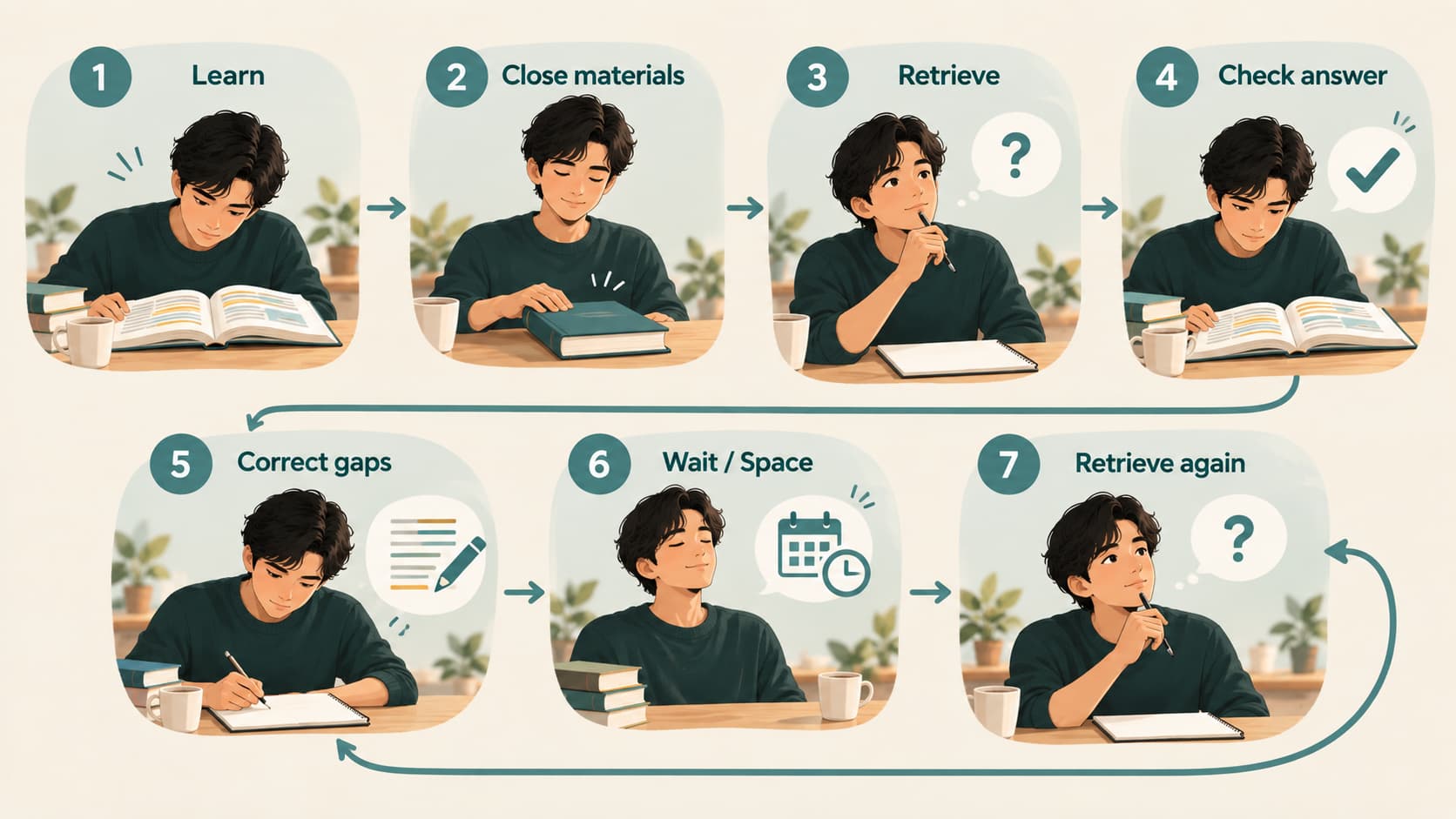
A Practical Study Cycle
A useful active-recall session can be surprisingly simple.
1. Learn the material
Read the section, watch the lesson or understand the worked example.
Don't try to retrieve something you haven't meaningfully encountered yet.
2. Close the source
Remove the textbook, notes or video.
3. Retrieve
Answer questions, write a summary from memory, explain the concept or solve a problem.
4. Check
Compare your response with the correct source.
5. Correct
Pay particular attention to missing or incorrect ideas.
6. Wait
Return later rather than immediately repeating the same material indefinitely.
7. Retrieve again
Make yourself reconstruct the answer.
A good sequence therefore looks less like:
Read → Read → Read → Read
and more like:
Learn → Retrieve → Check → Wait → Retrieve → Check
That is a fundamentally different way of studying.
Why It Can Feel Worse Even When It Works Better
There is one final psychological trap.
Active recall constantly exposes forgetting.
You ask yourself ten questions and miss four.
That can feel like a bad study session.
Re-reading does the opposite.
Everything is visible.
Everything seems familiar.
The session feels smooth.
That can feel like successful learning.
But ease during practice and retention later are not the same thing.
In retrieval-practice research, students sometimes judge repeated studying as more effective even when their later test results favour retrieval.
This creates an unusual situation:
the technique that reveals your weaknesses can make you feel less prepared while actually helping you become better prepared.
The Real Difference Between Re-reading and Active Recall
Both techniques involve the same information.
The difference is what your memory has to do.
During re-reading:
Information is present → you recognise it
During active recall:
Information is absent → you reconstruct it
And exams, conversations, problem solving and real-life use usually resemble the second situation.
You don't take your textbook into memory.
You take what you can retrieve from it.
That is why active recall is more than a study trick.
It changes studying from repeatedly asking:
"Does this look familiar?"
to asking the more useful question:
"Can I produce this knowledge when the answer is no longer in front of me?"
That is the ability you will eventually need — so it makes sense to practise it before the moment that actually counts.