IP67 vs IP68 vs IP69: How Water-Resistant Is Your Smartphone Really?
Understand what IP67, IP68 and IP69 actually test, why IP69 is not automatically better underwater, and how to protect your phone from water damage.
A phone slips into a sink. Another gets soaked during a monsoon downpour. A third is advertised with IP69, apparently a higher rating than the IP68 printed on a more expensive flagship.
Which phone is better protected?
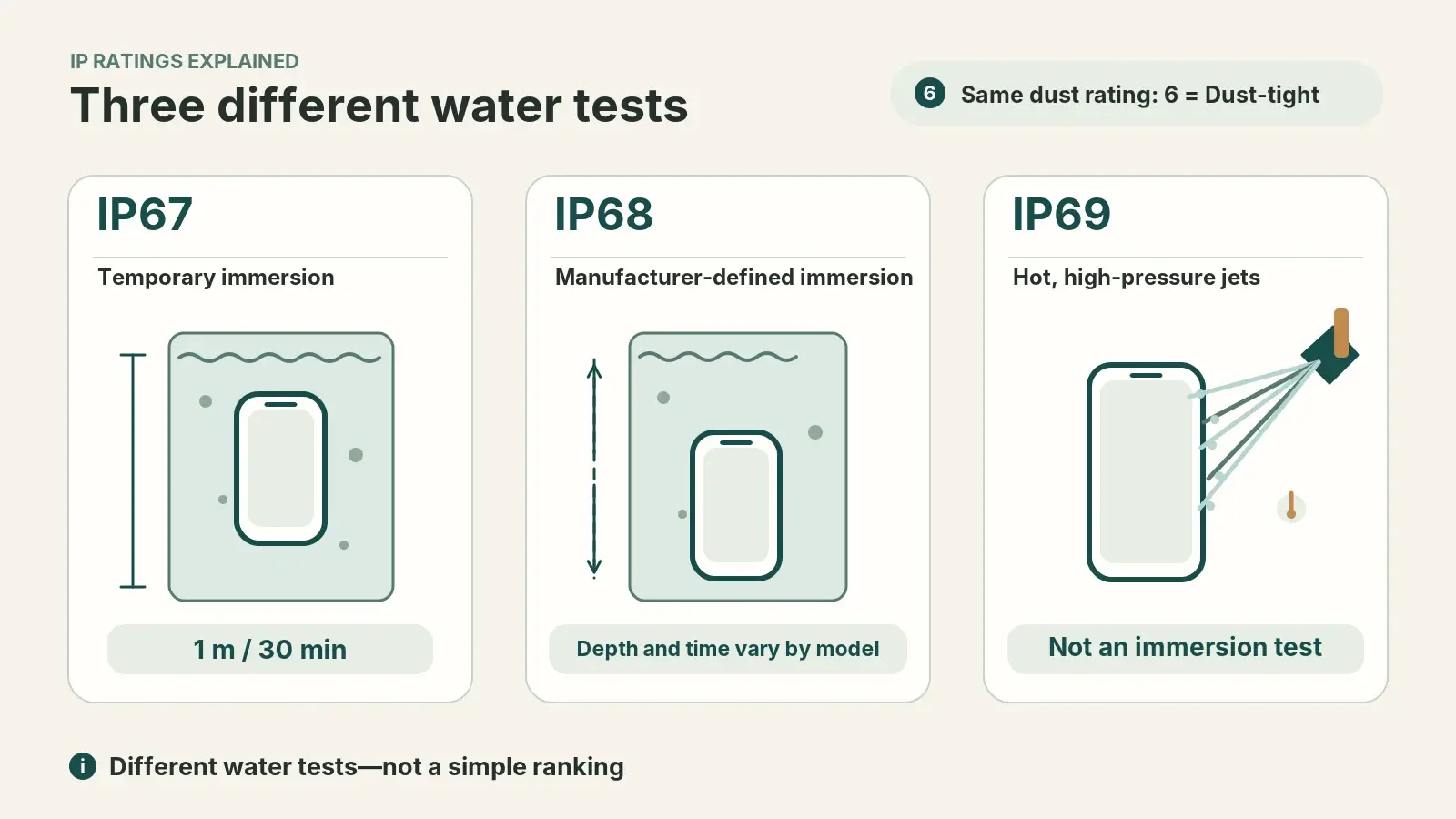
The answer is not as simple as choosing the biggest number. IP67 and IP68 describe resistance to water immersion; IP69 describes resistance to powerful, hot water jets. They test different hazards. An IP69 label by itself does not tell you how far underwater a phone can go, while an IP68 label does not establish that it can withstand a high-pressure spray.
For most smartphone buyers in India, understanding that distinction is more useful than memorising a ranking.
What does an IP rating actually mean?
IP stands for Ingress Protection. The rating system comes from IEC 60529, a standard for how well electrical enclosures resist the entry of solid objects and water. It describes performance in defined tests—not a promise that a phone is invulnerable to liquid damage.
Take IP68:
- 6, the first digit, means the enclosure is dust-tight under the relevant test.
- 8, the second digit, refers to protection against immersion under conditions specified for the product.
The 6 means the same thing in IP67, IP68 and IP69. It is the water-exposure test represented by the final digit that changes.
You may also see IPX8. The X means a solid-particle protection rating is not being specified in that code; it does not mean the product has failed a dust test. Similarly, an unrated phone is not necessarily fragile—it simply has no comparable published rating to rely on.
Importantly, these are enclosure tests. They do not measure screen-shattering resistance, drop survival, corrosion from seawater, or how well a touchscreen works while wet.
IP67 vs IP68 vs IP69: the essential comparison
| Rating | Dust protection | Water test it identifies | What it does not establish |
|---|---|---|---|
| IP67 | Dust-tight | Temporary immersion, commonly 1 metre for 30 minutes | Deeper immersion or powerful water-jet resistance |
| IP68 | Dust-tight | Immersion under manufacturer-specified conditions more severe than IPX7 | One universal depth, or resistance to high-pressure hot jets |
| IP69 | Dust-tight | High-pressure, high-temperature water jets under a specified test | Immersion performance at 1 metre, 1.5 metres or any other depth |
The table describes what each code establishes, not every exposure a particular phone might survive. Devices may be tested to multiple water-ingress ratings; when manufacturers list IP66, IP68 and IP69 together, they are reporting different protections rather than repeating the same test.
IP67: a defined temporary-immersion test
An IP67 phone is tested for protection against the effects of temporary immersion in freshwater, conventionally summarised as up to 1 metre for 30 minutes. It offers a meaningful margin against an accidental drop into shallow, clean water under comparable conditions.
That is not an invitation to use it underwater for half an hour. The result applies to a tested enclosure under specified conditions; a cracked or previously repaired phone may behave differently.
Nor does passing the immersion test automatically demonstrate that a phone can withstand a strong directed water jet. Jet exposure and immersion are distinct tests.
IP68: immersion protection, but check the small print
The 8 means immersion protection is assessed under conditions agreed or specified for the enclosure that are more demanding than the IPX7 test. The code does not prescribe one universal depth and duration for all IP68 phones.
That matters when comparing real products. Samsung India documents a typical Galaxy IPX8 test of 1.5 metres of still freshwater for 30 minutes. Apple lists several iPhone generations with IP68 at up to 6 metres for 30 minutes, while some older IP68 iPhones have lower specified depths.
Both manufacturers can legitimately use IP68 because their declared test conditions differ. For a buyer, “IP68, 6 metres for 30 minutes” tells you more than “IP68” alone. Even then, the figures describe laboratory exposure, not a recommended diving depth.
IP69: a jet test, not a deeper-water test
The 9 refers to resistance to high-pressure, high-temperature water jets. Under the IEC 60529 IPX9 procedure for small enclosures, testing involves hot freshwater—around 80°C—sprayed from specified angles while the enclosure rotates. India's Central Power Research Institute describes a setup using approximately 15 litres per minute, four nozzle angles and timed spraying.
That sounds extreme because it is: the test was designed to assess a very different challenge from a phone resting in still water.
It does not mean an IP69 phone is suitable for a hot shower, pressure-washer cleaning, boiling water or long underwater filming. It means the tested enclosure passed a defined jet-ingress procedure. Actual usage advice may be much more restrictive.
Is IP69 better than IP68?
Not automatically. The last digits are not a single ladder on which every higher number includes all the abilities below it.
Imagine two phones:
- Phone A: IP68, tested at 1.5 metres for 30 minutes.
- Phone B: IP69, with no published IP68 claim.
Phone A has a documented immersion test. Phone B has a documented hot-water-jet test. You cannot infer that Phone B is safer underwater just because 69 is larger than 68.
Now imagine Phone C: IP66 + IP68 + IP69. This is a broader statement: powerful water-jet resistance, specified immersion resistance and high-pressure/high-temperature jet resistance have each been claimed. Such combinations are not hypothetical. OPPO India introduced its F27 Pro+ 5G with all three ratings.
There is a related naming wrinkle. IP69 is the high-pressure/hot-water-jet designation in IEC 60529. IP69K, often seen on rugged or industrial products, comes from the road-vehicle-oriented ISO 20653 system. Both involve severe jet exposure, but you should check the cited standard rather than treating the labels as interchangeable certificates.
The practical rule: compare the complete set of ratings, the test standard and the manufacturer's written conditions—not only the largest number.
What does this mean in everyday Indian conditions?
Water exposure is not one uniform event. A rainy commute, a sink accident and a beach trip place different demands on a phone.
Monsoon rain and accidental splashes
An IP67- or IP68-rated phone is a sensible choice for everyday exposure, including the possibility of rain and accidental splashing. The rating is useful evidence of enclosure sealing, but the immersion code alone does not explicitly certify every possible rain or jet condition.
For people who frequently work outdoors, a phone with additional jet ratings such as IP66 or IP69 can offer more documented test coverage. Still, heavy rain is not the same laboratory event as an 80°C, high-pressure jet. Treat claims such as monsoon-ready as product positioning unless the manufacturer explains the applicable tests.
The most effective habit is also the simplest: keep the phone sheltered where practical, and dry it after getting wet.
Dropping your phone in a sink or bucket
This is the situation where immersion ratings are most directly relevant. A correctly sealed IP67 phone has been tested against temporary immersion; an IP68 phone has a manufacturer-defined, more demanding immersion condition.
Depth, duration, water cleanliness and device condition still matter. A sink containing detergent or hot water is not the same as the freshwater used in standard tests. Retrieve the phone promptly rather than waiting to see whether the advertised time limit is real.
Swimming pools, beaches and underwater videos
Do not equate an IP rating with a swimming or diving endorsement. Pool chemicals, salt, wave impact, movement and water pressure can introduce exposures that the advertised test does not establish. Both Samsung and Apple publish restrictions on water use despite IP-rated devices.
For planned underwater photography, use equipment specifically intended and rated for that activity, such as an appropriate waterproof housing. A phone marketed as IP69 does not remove that need.
Hot showers, steam and forceful sprays
An IP69 jet test does not turn a smartphone into washable industrial equipment. Heat, steam, detergents and prolonged exposure introduce variables outside the narrow claim. A high-pressure spray can also differ from the prescribed laboratory nozzle, distance and duration.
Keep phones away from steam rooms, saunas and directed pressure-washer jets—even when the specification sheet looks reassuring.
Why can a water-resistant phone still be damaged?
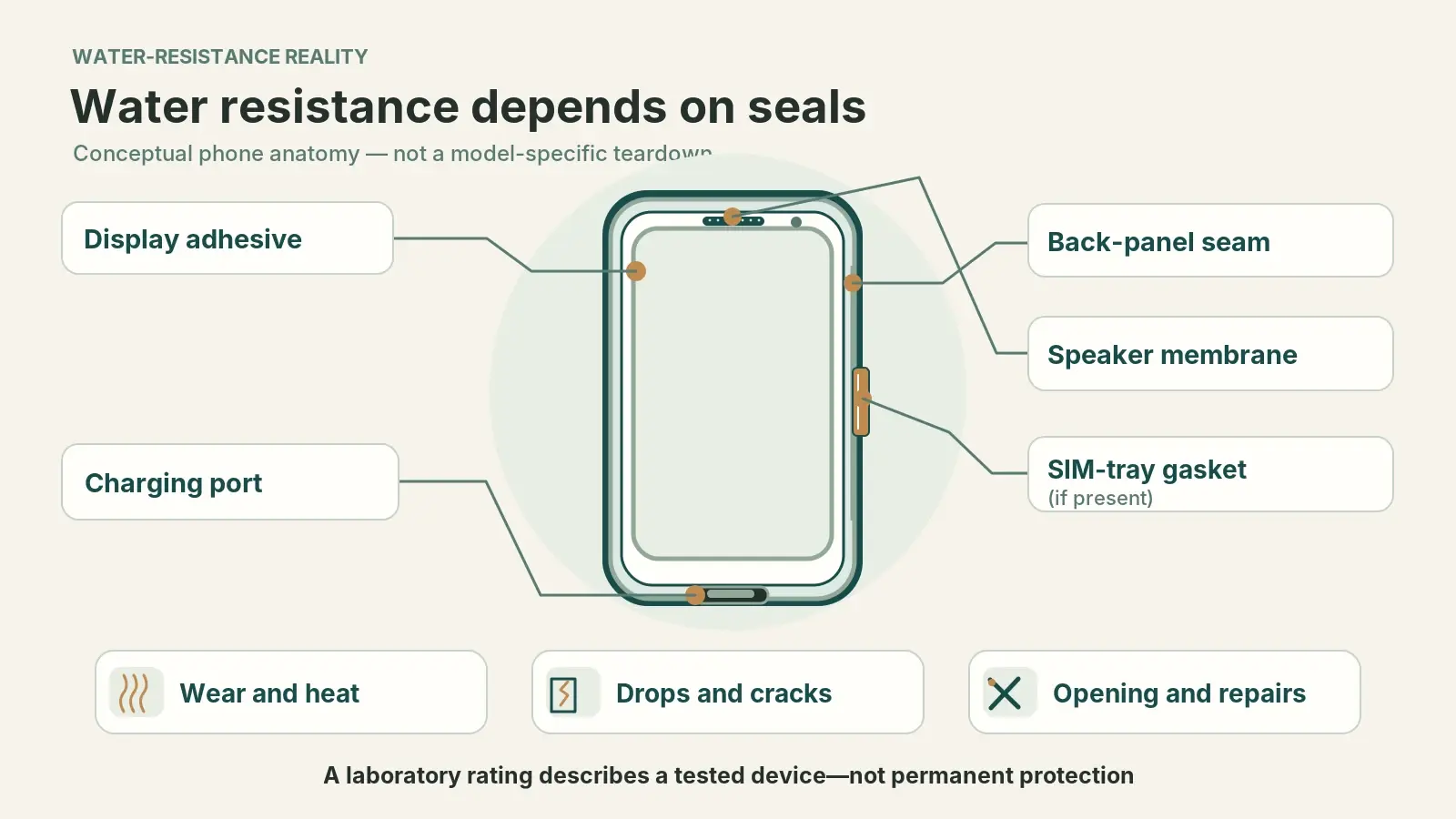
A new phone's resistance depends on physical sealing: adhesive bonds around the display and back panel, gaskets, protected openings and the fit of removable parts such as a SIM tray. These components are not a permanent force field.
Ageing matters. Adhesives and seals can deteriorate with heat, time and repeated environmental exposure. An older IP68 phone may no longer perform like a fresh laboratory sample.
Drops matter. A visible screen crack is an obvious warning, but an impact may also compromise a bond or frame without dramatic external damage. That is why an IP rating should not be confused with impact resistance.
Repairs matter. Opening the enclosure requires seals or adhesive bonds to be disturbed. The quality of resealing varies; do not assume a repaired phone retains its original resistance unless the repair provider can support that claim.
Contaminants matter. Saltwater, chlorinated water, soap, sunscreen and sugary drinks behave differently from clean test water. They can leave residues or promote corrosion even if the phone initially keeps working.
Finally, a phone remaining functional immediately after exposure is not proof that no moisture entered. Some symptoms appear later. If you suspect internal water ingress, avoid continuing to operate or charge the device and seek professional assessment.
Does an IP rating protect you under warranty?
Usually, no automatic guarantee of free repair follows from the rating.
Manufacturers distinguish between a product's performance in controlled testing and damage sustained during real-world use. Apple says liquid damage is not covered by its limited warranty, while noting that consumer-law rights may still apply. Motorola India likewise excludes liquid damage in its IP68 guidance. Some OPPO India product disclosures contain similar exclusions.
That does not settle every individual consumer claim. A manufacturing defect, applicable statutory rights and any separately purchased accidental-damage plan may change the position. Read the terms for your exact model and purchase rather than assuming that an IP69 logo is an insurance policy.
This is one reason not to test a phone's limits deliberately: the potential repair bill can be much larger than the value of the demonstration.
What should you do if your phone gets wet?
For a light freshwater splash on an undamaged, water-resistant phone, follow the manufacturer's drying guidance. If it has been submerged, exposed to another liquid, or appears damaged, be more cautious:
- Remove it from the water promptly. Disconnect any cable or accessory safely; do not plug it in to check whether charging works.
- Dry the exterior with a soft, clean cloth. Keep the charging port facing down where the manufacturer recommends it, and allow it to dry in a ventilated place.
- Avoid heat and improvised drying methods. Do not use a hair dryer, compressed air or aggressive tools inside ports. Do not rely on a bowl of rice to solve possible internal moisture.
- Follow model-specific instructions for contaminated liquids. Guidance on rinsing varies by device and liquid; do not add more water indiscriminately.
- If it behaves abnormally or you suspect internal ingress, switch it off and seek authorised service advice. Do not keep powering it on repeatedly to test it.
Muffled speakers shortly after a splash can result from moisture blocking the acoustic openings; this may improve after drying. Charging-port moisture alerts should be taken seriously. A working screen is not permission to connect a charger while the port is wet.
Which IP rating should you choose when buying a smartphone?
For most buyers, IP68 with clearly stated immersion conditions is an excellent practical target if the price and the rest of the phone suit your needs. IP67 remains meaningful protection and should not be dismissed merely because the number is smaller.
IP69 adds a distinct type of tested protection, and a phone with IP66 + IP68 + IP69 makes a stronger case for varied water exposures than one listing only a single code. But paying more solely for IP69 is hard to justify if your main concern is accidentally dropping the device into water and the competing phone has a well-documented IP68 specification.
Before buying, check five things:
- The exact model and regional variant: do not assume all variants in a product family share identical protection.
- The complete rating: one code, or several codes covering different exposure types?
- The stated immersion depth and duration: especially for IP68, where conditions differ by model.
- The exclusions: saltwater, hot water, swimming, cleaning sprays and damage after repair.
- The warranty and repair terms: what actually happens if liquid reaches the internals?
If you regularly work in wet environments, also assess grip, drop protection, port design and access to reliable repairs. Those practical factors can matter more than an extra digit.
The bottom line
IP67 tells you about temporary freshwater immersion. IP68 tells you about more demanding, manufacturer-defined immersion. IP69 tells you about resistance to powerful, hot water jets. They are useful but different promises—not a simple ranking from good to best.
For daily life in India, a properly documented IP67 or IP68 phone already provides valuable protection against accidents. Multiple ratings can add confidence across different laboratory exposures, but no rating makes a smartphone permanently waterproof. Buy for the hazards you actually face, protect the device from avoidable exposure, and read the warranty before treating any specification as a guarantee.
Sources and further reading
- IEC — IEC 60529: Degrees of protection provided by enclosures (IP Code)
- Central Power Research Institute, India — Ingress Protection Laboratory and IPX9 testing
- ISO — ISO 20653:2023, protection of road-vehicle electrical equipment
- Samsung India — Galaxy Phone Water Resistance
- Apple Support India — Splash, water and dust resistance of iPhone
- Motorola India — What IP68 water resistance means
- OPPO India — F27 Pro+ 5G and its IP66/IP68/IP69 ratings
- OPPO India — A5 Pro 5G water-resistance disclosures