OLED vs AMOLED: What's the Difference?
OLED and AMOLED sound like competing display technologies, but AMOLED is actually a type of OLED. Here is what the difference really means.
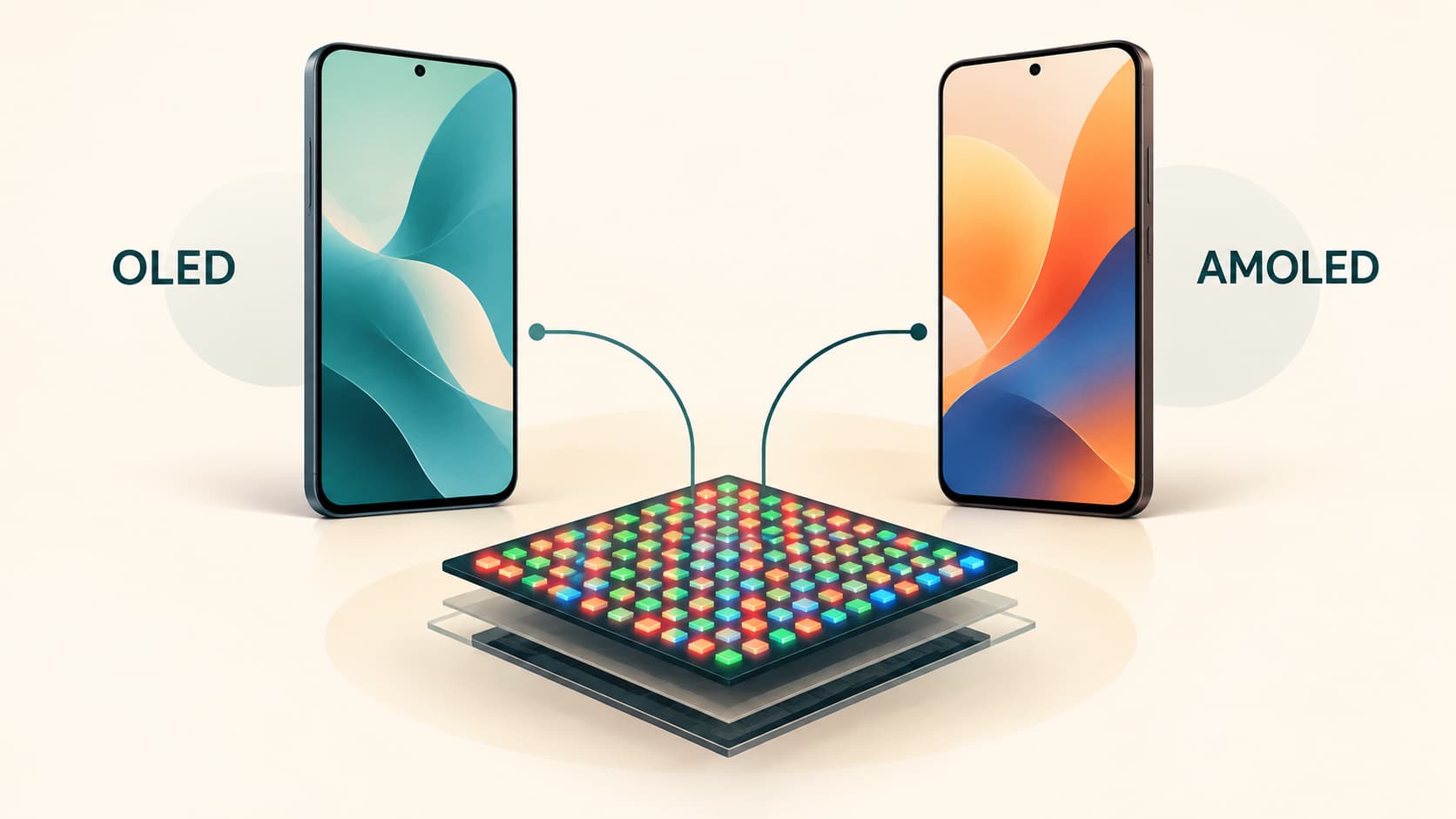
Look at two smartphone specification sheets and you might see one phone advertised with an OLED display while another proudly lists an AMOLED display.
That makes the comparison sound straightforward:
Which one is better, OLED or AMOLED?
The problem is that the question starts with a misleading assumption.
AMOLED is not a completely separate rival to OLED. AMOLED is a type of OLED.
OLED describes the light-producing display technology. AMOLED describes an OLED display that uses an active-matrix system to control the pixels.
And here is the part that causes most of the confusion: modern high-resolution smartphone OLED displays generally use active-matrix driving anyway. So a manufacturer may simply write "OLED" on the specification sheet even though the panel technically operates using an active matrix. Samsung Display itself describes AMOLED as shorthand for Active Matrix OLED, while its technical material notes that modern OLED panels use active-matrix pixel driving.
So if you're choosing between two phones, seeing OLED on one specification sheet and AMOLED on another does not automatically mean the AMOLED phone has the better screen.
To understand why, we first need to separate the two parts of the name.
What Is OLED?
OLED stands for Organic Light-Emitting Diode.
The important feature is that OLED is self-emissive.
That means the individual pixels produce their own light.
This is fundamentally different from a conventional LCD, where the liquid-crystal layer controls light coming from a separate backlight behind the screen.
An OLED panel does not need that traditional backlight.
When an OLED pixel needs to display black, it can reduce or effectively stop its light output. When it needs to display a bright colour, the appropriate subpixels emit light.
LG Display describes OLED as a self-emissive technology in which each pixel produces and controls its own light without requiring a backlight.
That basic structure gives OLED displays several familiar characteristics:
- very deep blacks
- high contrast
- thin panel construction
- fast pixel response
- wide viewing angles
- the potential for flexible and foldable screens
But "OLED" by itself doesn't explain how millions of those pixels are electrically controlled.
That is where the "AM" in AMOLED comes in.
What Does AMOLED Mean?
AMOLED stands for:
Active Matrix Organic Light-Emitting Diode
The OLED part describes how the pixels produce light.
The active matrix part describes how those pixels are controlled.
An AMOLED panel uses thin-film transistor circuitry, usually abbreviated TFT, to control individual pixels.
Each pixel or subpixel is associated with electronic circuitry that helps regulate the current driving the OLED material.
Rather than simply sending a signal across an entire row and waiting for the next row, the active-matrix circuitry allows the display to maintain precise control over a large number of pixels.
That becomes essential when you have a smartphone screen containing millions of pixels that must be updated rapidly.
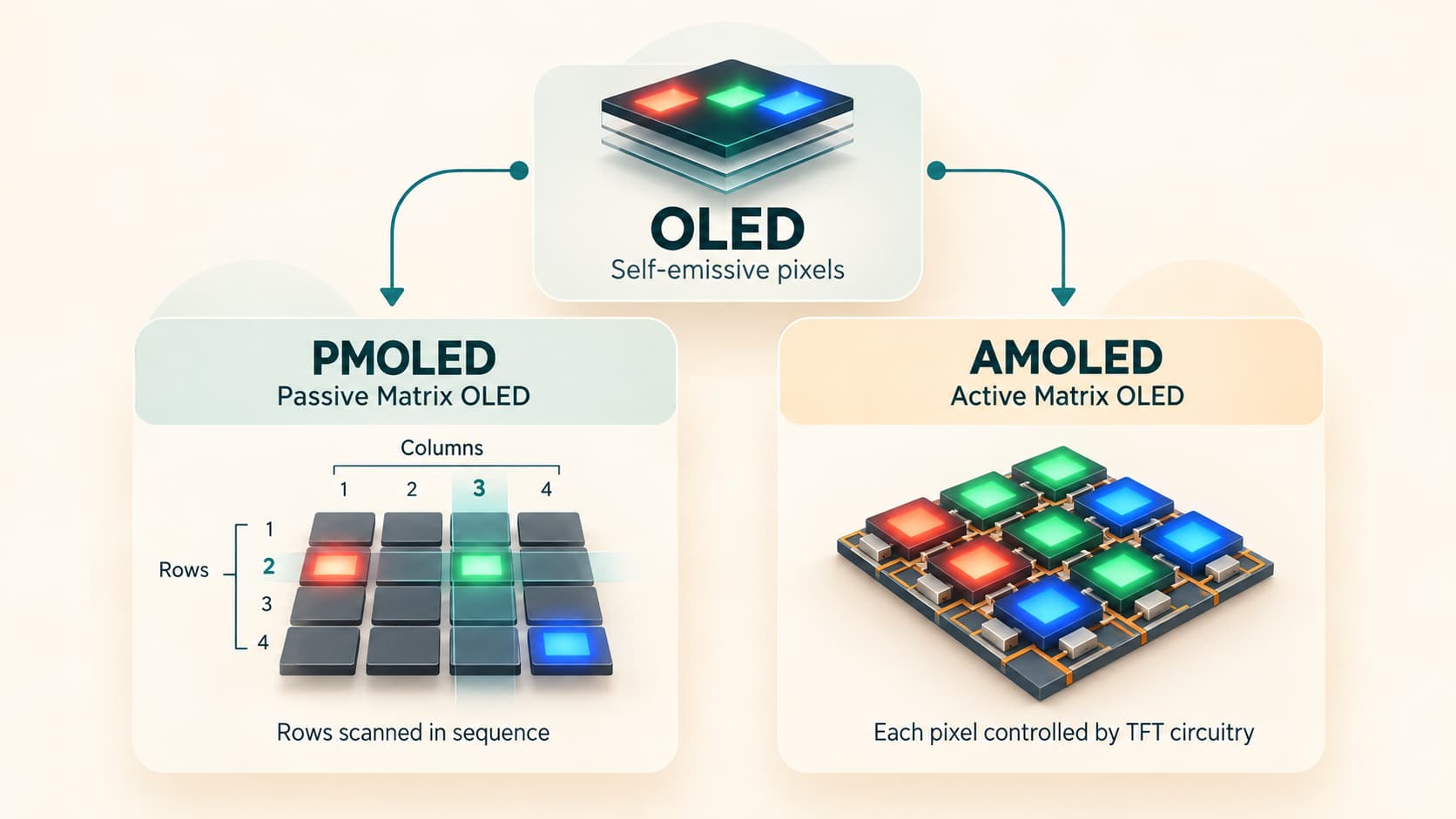
This is why active-matrix OLED became the practical approach for high-resolution smartphones, tablets and many other modern displays.
Samsung Display explains that OLED can broadly be divided by driving method into passive-matrix OLED, or PMOLED, and active-matrix OLED, or AMOLED. AMOLED uses TFT circuitry to control pixels individually, while passive-matrix displays operate rows sequentially.
So What Is PMOLED?
PMOLED stands for Passive Matrix OLED.
It uses the same broad OLED principle: organic light-emitting materials produce the light.
What differs is the way the display is driven.
In a passive-matrix system, rows and columns form a grid. The electronics activate intersections in that grid in sequence to illuminate the required pixels.
This approach can be relatively simple, but it becomes less practical as displays get larger, denser and more demanding.
PMOLED has therefore traditionally been better suited to smaller and simpler displays, such as basic information panels or older secondary screens.
AMOLED's active control is much better suited to the combination of:
- high resolution
- large pixel counts
- fast refresh
- video
- gaming
- complex smartphone interfaces
The important hierarchy is therefore:
OLED
├── PMOLED — Passive Matrix OLED
└── AMOLED — Active Matrix OLED
AMOLED sits inside the OLED family.
It isn't something outside OLED competing against it.
Then Why Do Some Phones Say OLED and Others Say AMOLED?
Mostly because consumer product naming isn't the same thing as an engineering taxonomy.
Different manufacturers choose different terminology.
Apple, for example, lists current iPhone displays simply as OLED in its technical specifications, while Samsung commonly markets displays using names such as Dynamic AMOLED 2X.
This doesn't mean an iPhone marked "OLED" is using some primitive passive-matrix display while the Samsung phone alone has active-matrix technology.
Modern smartphone OLED displays require sophisticated pixel-driving circuitry regardless of what consumer-facing label appears on the box.
This is one of the biggest mistakes people make when comparing display specifications.
They treat:
OLED vs AMOLED
as though it were comparable to:
LCD vs OLED
It isn't.
LCD and OLED describe fundamentally different display systems.
OLED and AMOLED describe a broader technology and one particular way of implementing it.
Does AMOLED Look Better Than OLED?
Not simply because the word "AMOLED" appears in the name.
Two OLED phones can have dramatically different display quality even if both technically use active-matrix OLED panels.
Picture quality depends on many other factors.
Brightness
Higher usable brightness makes a display easier to see outdoors and allows brighter highlights in HDR content.
But even brightness figures need context.
Manufacturers may quote:
- typical brightness
- high-brightness mode
- HDR peak brightness
- small-area peak brightness
- outdoor peak brightness
These aren't always directly comparable.
Refresh Rate
A 120 Hz screen can update the displayed image up to 120 times per second, allowing smoother scrolling and animation than a conventional 60 Hz screen when the software and content support it.
Some modern OLED panels can also change refresh rate dynamically to reduce unnecessary power consumption.
Samsung Display, for example, describes smartphone OLED technology that adjusts refresh rate according to the type of content being displayed.
Resolution and Pixel Density
Resolution determines how many pixels are available to form the image.
Higher resolution can improve text and fine detail, although beyond a certain density the practical difference on a small phone screen becomes harder to notice.
Colour Accuracy
A screen can produce extremely saturated colours and still be inaccurate.
Good calibration matters just as much as the ability to generate a wide colour range.
Reflections
A very bright screen can still be difficult to use outdoors if the surface reflects too much ambient light.
Anti-reflective treatments, panel design and cover glass therefore affect real-world readability.
None of these qualities is guaranteed simply because one manufacturer writes "AMOLED" instead of "OLED."
Why OLED Screens Have Such Good Blacks
This is one of the most noticeable advantages of OLED technology.
Consider a completely black area in an image.
An LCD still has a backlight producing light behind the liquid-crystal layer. The display tries to block that light, but some light may still pass through.
An OLED pixel generates its own light.
To display black, it can simply produce little or no light.
That difference allows OLED displays to achieve exceptionally dark blacks and very high contrast.
This also helps explain why OLED is well suited to features such as always-on displays and dark interfaces.
Only the pixels needed for text, icons or other content need to emit significant light.
However, that doesn't mean OLED automatically uses less power in every possible situation.
OLED power consumption depends partly on what is being displayed and how bright the pixels need to be. A predominantly dark screen can require very different power from a bright full-screen white image.
So the useful rule isn't:
OLED always uses less power.
It is:
OLED can control light at the pixel level, which creates opportunities for efficient display operation depending on the content and panel design.
Why AMOLED Works So Well in Smartphones
Smartphone displays place extreme demands on pixel control.
Consider what the screen may need to do within a few seconds:
- show a static webpage
- scroll smoothly
- play HDR video
- display a game at high refresh rate
- dim individual areas
- show an always-on clock
- respond immediately to touch
- vary brightness across millions of pixels
An active-matrix backplane allows the panel to manage individual pixels efficiently enough for these demanding applications.
Modern TFT technology can also support variable refresh rates and other power-saving techniques.
Samsung Display, for example, describes modern OLED panels that use improved TFT designs to reduce leakage current and permit very low refresh rates when appropriate.
This is one reason AMOLED became closely associated with smartphones.
But again, the technology has become so normal in smartphone OLEDs that manufacturers do not always bother putting the "AM" in the marketing name.
What Is Super AMOLED?
This is where branding adds another layer of confusion.
Super AMOLED is a Samsung term.
Samsung describes Super AMOLED as an AMOLED implementation in which the touch-sensing functionality is integrated more closely with the display rather than existing as a completely separate conventional layer above it.
That integration can contribute to thinner construction and improved optical characteristics.
But "Super AMOLED" should not be interpreted as a completely new light-emitting technology.
It is still based on AMOLED.
The family relationship is broadly:
OLED
└── AMOLED
    └── Samsung-branded AMOLED variants
        ├── Super AMOLED
        └── Dynamic AMOLED
What Is Dynamic AMOLED and Dynamic AMOLED 2X?
Samsung uses Dynamic AMOLED and Dynamic AMOLED 2X for later generations of its smartphone display technology.
Samsung describes Dynamic AMOLED as building on Super AMOLED with features such as HDR-related improvements, while Dynamic AMOLED 2X is associated with newer high-refresh-rate implementations.
These names describe Samsung's display generations and feature combinations.
They should not be interpreted as universal display-industry categories in the same sense as OLED or AMOLED.
Another manufacturer may use a technically advanced OLED panel without calling it Dynamic AMOLED because the branding belongs to Samsung's product ecosystem.
What About P-OLED?
You may also encounter the term P-OLED.
This is particularly confusing because the "P" does not necessarily mean passive matrix.
In products where P-OLED means Plastic OLED, the term refers to the substrate supporting the OLED structure.
Instead of using a rigid glass substrate, a plastic-based substrate can make the panel thinner, lighter or capable of bending.
LG has used P-OLED specifically to mean Plastic OLED, including flexible panels built on plastic substrates.
So don't confuse:
PMOLED = Passive Matrix OLED
with:
P-OLED = Plastic OLED in this usage
They describe completely different characteristics.
Do OLED and AMOLED Have the Same Burn-In Risk?
Because AMOLED is a form of OLED, it shares the fundamental characteristics of OLED's organic light-emitting materials.
Those materials age as they operate.
If particular pixels repeatedly display the same bright static elements for extremely long periods, they can age differently from surrounding pixels.
This can contribute to image retention or, in more persistent cases, burn-in.
Modern devices use several strategies to reduce the risk, including:
- automatic brightness management
- shifting static elements slightly
- dimming persistent interface elements
- screen savers
- pixel-compensation systems
- software interface changes
LG's OLED support documentation, for example, describes image-retention protection features such as pixel cleaning, screen shifting and brightness management for static content.
The key point for this comparison is that burn-in is not a unique "AMOLED problem" separate from OLED.
AMOLED uses OLED emitters, so it inherits OLED's underlying ageing considerations.
For typical smartphone use with changing content and modern protection mechanisms, this usually isn't something most users need to think about constantly. But keeping the same high-brightness static image on an OLED panel for exceptionally long periods is still not ideal.
Is AMOLED More Power Efficient Than OLED?
This question is slightly misleading for the same reason as the original comparison.
AMOLED is OLED.
If you're comparing two modern smartphones, power efficiency will depend on the specific panel technology rather than whether one manufacturer wrote OLED and the other wrote AMOLED.
Relevant factors include:
- luminous efficiency of the organic materials
- display brightness
- refresh rate
- TFT/backplane design
- resolution
- screen content
- software behaviour
- panel generation
A newer OLED panel labelled simply "OLED" could easily be more efficient than an older panel marketed as AMOLED.
The label by itself doesn't settle the question.
Which Is Better for Gaming?
Again, don't choose based on the words OLED or AMOLED alone.
For gaming, look at the actual specifications and independent testing.
Useful factors include:
- refresh rate
- touch latency
- pixel response
- brightness
- resolution
- adaptive refresh capability
- colour accuracy
- sustained phone performance
OLED's fast pixel response is useful for motion, but a 60 Hz OLED screen is still limited to a 60 Hz refresh rate.
A good 120 Hz OLED or AMOLED display can therefore offer a noticeably smoother gaming experience than a 60 Hz model.
The "120 Hz" tells you more about that particular difference than the presence or absence of the letters "AM."
What Should You Actually Compare When Buying a Phone?
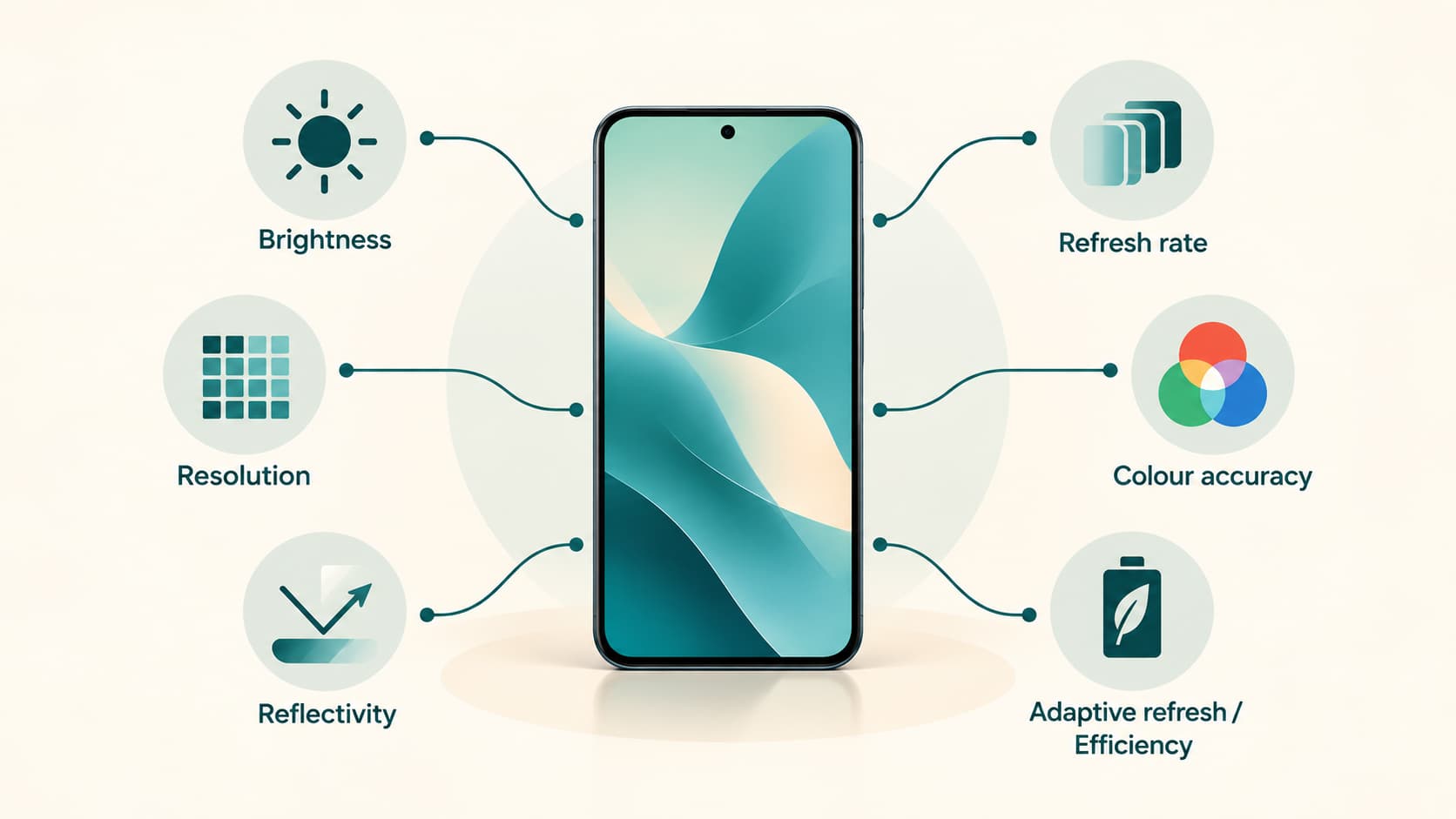
When two phones both use modern OLED-family screens, forget the marketing hierarchy for a moment.
Compare the actual panel characteristics.
| Specification | Why it matters |
|---|---|
| Brightness | Determines outdoor visibility and HDR highlight capability |
| Refresh rate | Affects scrolling and motion smoothness |
| Adaptive refresh | Can balance smoothness and power consumption |
| Resolution | Influences text and image sharpness |
| Colour accuracy | Determines how faithfully colours are reproduced |
| HDR support | Affects compatible high-dynamic-range content |
| Reflectivity | Influences visibility under strong ambient light |
| Minimum brightness | Matters when using the phone in darkness |
| PWM/flicker behaviour | Can matter to users sensitive to display flicker |
| Panel efficiency | Can influence battery consumption |
Independent display measurements can be more useful than the headline technology label.
A phone with an excellent panel labelled simply OLED can easily outperform a cheaper phone whose marketing emphasizes AMOLED.
OLED vs AMOLED: The Simple Answer
If you remember only one thing from this article, remember this:
OLED is the display family. AMOLED is one type of OLED.
OLED tells you that the display uses self-emitting organic light-emitting pixels.
AMOLED tells you that those OLED pixels are controlled using an active-matrix system.
Historically, that distinction mattered because OLED could be driven using passive or active matrix designs.
On modern smartphones, however, sophisticated OLED panels overwhelmingly rely on active-matrix control. That means the labels OLED and AMOLED on two phone specification sheets often tell you much less about their relative quality than you might expect.
One manufacturer might simply say "OLED."
Another might say "AMOLED."
Another might advertise "Super AMOLED," "Dynamic AMOLED 2X," or some other branded variation.
The name is useful for understanding the technology, but it isn't a quality score.
If you really want to know which phone has the better screen, compare the things you'll actually see: brightness, refresh rate, resolution, colour accuracy, reflections, efficiency and real-world display performance.