Which Smartphone Specifications Actually Matter?
Learn which smartphone specs really affect performance, camera quality, battery life and everyday use, and which numbers are mostly marketing.
Compare two smartphones online and you can quickly end up staring at dozens of numbers: 12 GB RAM, 50 MP camera, 120 Hz display, 5,000 mAh battery, 80 W charging, eight CPU cores, 3.4 GHz clock speed, 3,000 nits brightness.
The natural assumption is that the phone with the bigger numbers must be better.
It rarely works that way.
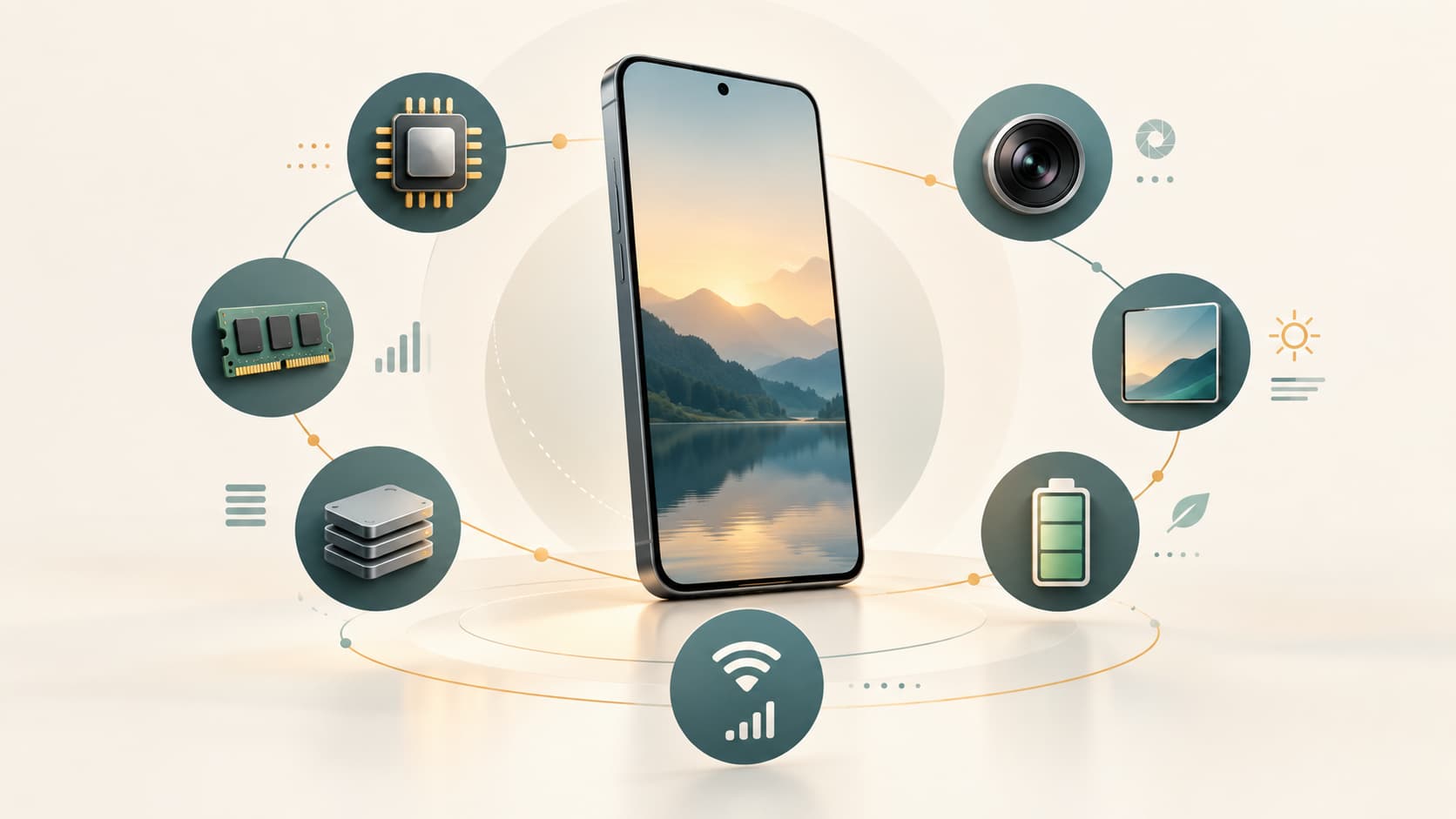
A smartphone is a collection of tightly connected systems. A powerful processor can perform poorly if the phone overheats. A huge battery can deliver ordinary battery life if the display and processor consume too much power. A 200 MP camera can produce worse photographs than a lower-resolution camera with better optics and image processing.
Specifications are useful, but only when you understand what each number actually tells you and what it leaves out.
If you're comparing phones, some specifications deserve close attention. Others are useful only in context. And a few impressive-looking numbers tell you surprisingly little about how good the phone will actually be.
Start With the Processor, but Ignore the Core Count
The processor is one of the most important components in a smartphone, but the line that says "octa-core processor" doesn't tell you very much.
Almost every modern smartphone processor contains several different computing components inside a system-on-chip, or SoC.
Depending on the platform, that can include:
- CPU cores for general computing
- a GPU for graphics and gaming
- an image signal processor for camera processing
- an NPU or other accelerator for AI workloads
- memory controllers
- video encoders and decoders
- a cellular modem or associated modem system
- security and sensor-processing hardware
Modern Qualcomm Snapdragon platforms, for example, integrate CPU, GPU, NPU, image-processing and connectivity capabilities rather than functioning as a CPU alone.
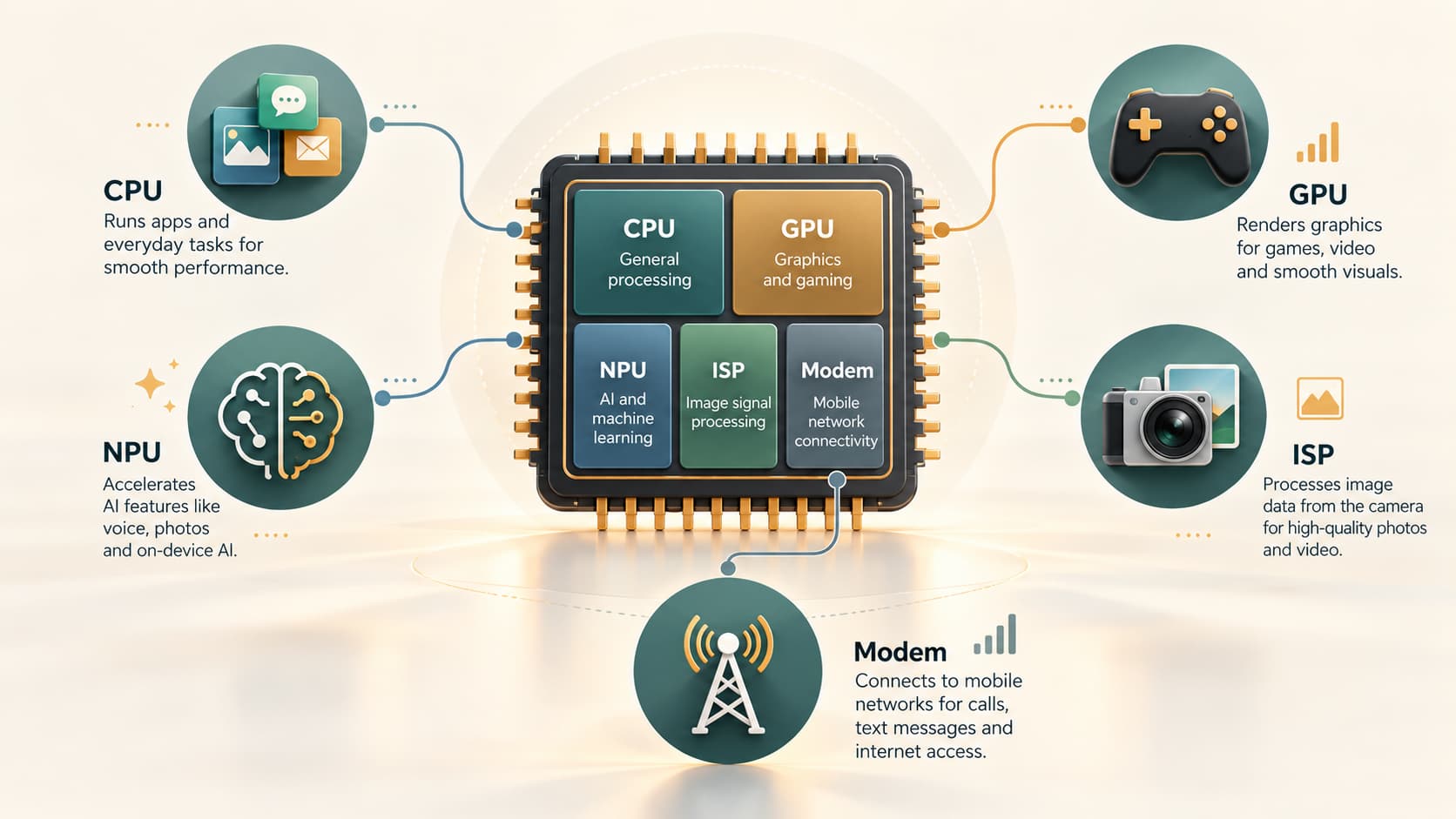
That means comparing processors by number of cores or GHz alone can be misleading.
A newer CPU architecture running at a lower clock speed can outperform an older design running at a higher frequency. GPU architecture matters enormously for games. Efficiency matters for battery life. Cooling determines how long the processor can sustain high performance.
What should you actually check?
Start with the exact processor model and generation.
Then look at trustworthy performance testing for:
- everyday responsiveness
- sustained performance
- gaming
- heat
- battery efficiency
Benchmark scores can help compare processors, but they shouldn't be treated as a complete rating of the phone. A short benchmark run doesn't necessarily tell you how the device will behave after 30 minutes of gaming in a warm room.
For most people, the processor's overall class, efficiency and age matter more than its advertised maximum clock speed.
RAM Matters, but More RAM Does Not Automatically Mean a Faster Phone
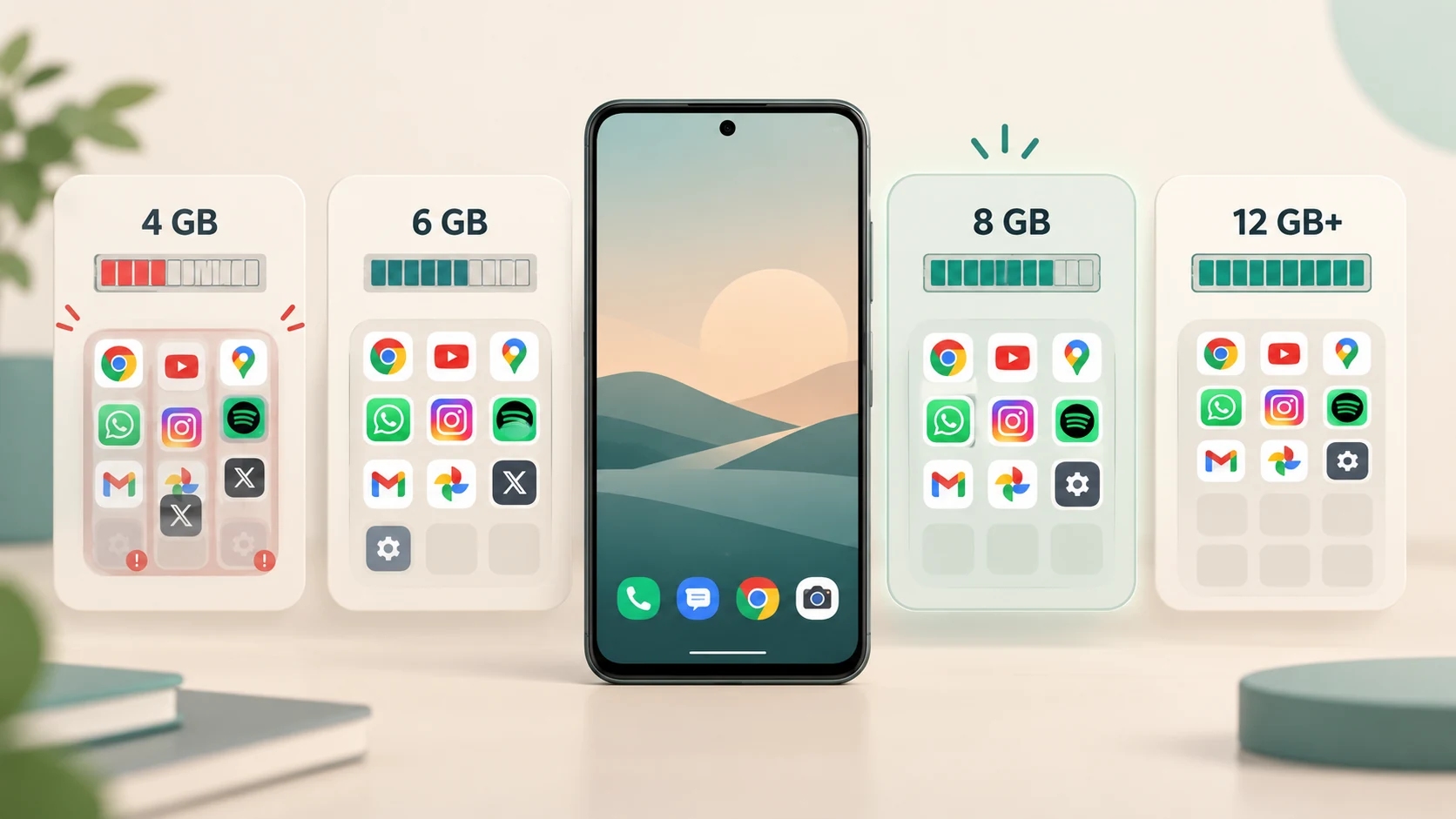
RAM is the phone's short-term working memory.
When applications are running, they place active data in RAM because it can be accessed much faster than normal storage.
If there isn't enough available memory, the operating system may need to close background applications more aggressively. When you return to them, they may reload instead of appearing exactly where you left them.
So more RAM can improve multitasking.
But this doesn't mean:
12 GB RAM is automatically faster than 8 GB RAM.
If both phones already have enough memory for what you're doing, adding more RAM won't suddenly make a webpage load twice as fast.
Memory management also differs across operating systems, software versions and individual applications, which makes direct RAM comparisons between different platforms less useful.
RAM becomes particularly relevant if you:
- keep many applications open
- play memory-intensive games
- edit photos or video
- use desktop-style multitasking
- plan to keep the phone for several years
Treat RAM as a capacity requirement, not a speed score.
Once you have enough, processor performance and software optimization usually matter more.
Storage Capacity Matters More Than Many Buyers Expect
Storage determines how much space you have for applications, photographs, videos, downloaded media and documents.
Unlike some performance specifications, this one is straightforward: running out of storage is inconvenient.
But two details deserve attention.
Advertised storage is not all available to you
A phone advertised with 256 GB of storage won't normally present the entire 256 GB as usable free space. The operating system, formatting and preinstalled software consume part of it.
For example, Samsung's current specifications for one 256 GB Galaxy model list less user-accessible storage than the nominal capacity.
So consider not just what you use today, but what you might accumulate over several years.
High-resolution video, offline streaming downloads and large games can consume storage surprisingly quickly.
Storage speed matters too
Smartphone storage isn't simply a container. Its speed influences tasks such as:
- installing applications
- opening large apps
- saving large files
- loading game assets
- transferring data
- processing high-resolution video
Different generations and implementations of flash storage can have substantially different performance.
Android's own documentation notes that sufficiently slow external storage can degrade application performance compared with internal storage.
Unfortunately, manufacturers don't always make the exact storage technology obvious on consumer specification pages.
If you're choosing between otherwise similar phones, independent storage-performance testing can therefore be more useful than simply comparing capacities.
The Display: Several Specifications Matter Together
The screen is the part of your phone you interact with constantly, which makes display quality more important than many less-visible specifications.
But no single display number determines quality.
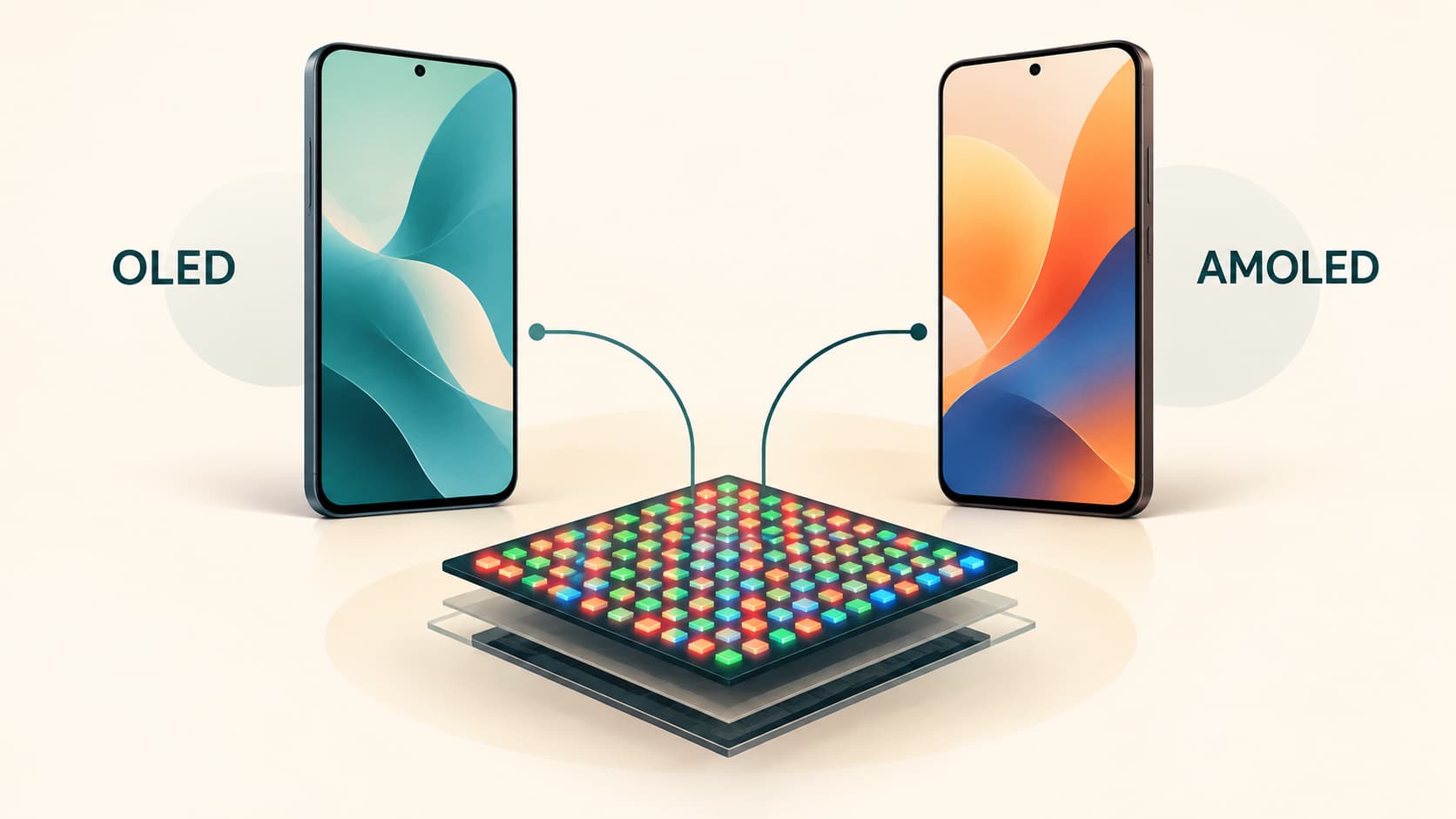
OLED vs LCD
Most premium smartphones now use OLED-family displays.
In an OLED display, individual pixels can produce their own light. This allows pixels displaying black to switch off, producing very deep blacks and high contrast.
A well-made LCD can still be perfectly good, particularly in lower-cost devices. But panel technology is worth considering alongside brightness, colour reproduction and refresh rate.
Refresh rate
A 60 Hz display can update the picture up to 60 times per second. A 120 Hz display can update it up to 120 times per second.
Higher refresh rates can make:
- scrolling look smoother
- animations appear more fluid
- supported games feel more responsive
Android supports devices that dynamically use rates such as 60, 90 and 120 Hz, and modern adaptive-refresh systems can lower refresh rate when high rates aren't needed to reduce power consumption.
The important word is adaptive.
A phone capable of intelligently varying its refresh rate can balance smoothness and battery consumption better than one that unnecessarily runs at its maximum rate all the time.
Resolution
Higher resolution means more pixels.
That helps up to a point.
But on a relatively small smartphone screen, increasing resolution indefinitely produces diminishing visible benefits while potentially increasing processing and power requirements.
Rather than buying whichever phone advertises the largest resolution, ask whether the screen looks sharp at normal viewing distance.
Brightness
Brightness matters particularly outdoors.
A brighter screen is easier to see in strong sunlight, but specification sheets can list several different brightness figures, including typical brightness, HDR peak brightness and outdoor peak brightness.
Those numbers don't necessarily describe the same test condition.
So brightness specifications are useful, but independent outdoor-visibility testing is often more informative than comparing the largest "nits" number in two advertisements.
Battery Capacity Is Useful, but mAh Is Not Battery Life
Battery specifications are commonly expressed in milliamp-hours, or mAh.
A larger capacity can help, but the number doesn't tell you how many hours the phone will actually last.
Battery life also depends on:
- processor efficiency
- display size and brightness
- refresh rate
- cellular signal conditions
- modem efficiency
- background applications
- camera and gaming use
- software optimization
- temperature
This is why two smartphones with batteries of similar capacity can have noticeably different endurance.
A smaller phone with an efficient processor and display may even outlast another device with a larger battery.
So use mAh as one piece of evidence.
For actual battery life, standardized independent battery tests are much more useful.
Charging Wattage Needs Context Too
A manufacturer may advertise 25 W, 45 W, 80 W or considerably higher charging power.
It is tempting to assume that twice the wattage means half the charging time.
It doesn't necessarily.
The headline wattage is usually the maximum charging power, not the amount delivered continuously from 0% to 100%.
Charging systems reduce power at different stages to manage heat and battery conditions. The phone, charger, cable and charging protocol also have to support the required combination.
USB Power Delivery itself uses negotiation between compatible equipment to provide different power levels rather than simply forcing the charger's maximum output into every connected device.
When comparing charging, look for a credible 0–50% or 0–100% charging-time test, not just the wattage.
Also check whether the necessary fast charger is included or must be purchased separately.
Camera Megapixels Are One of the Most Misunderstood Specifications
A 50 MP camera records approximately 50 million pixels when operating in that mode.
That tells you something about image resolution.
It does not tell you how good the photographs will look.
Smartphone photography depends on an entire imaging system:
- image sensor
- sensor size
- individual pixel characteristics
- lens quality
- aperture
- autofocus
- optical image stabilization
- focal length
- image signal processor
- exposure algorithms
- HDR processing
- noise reduction
- computational photography
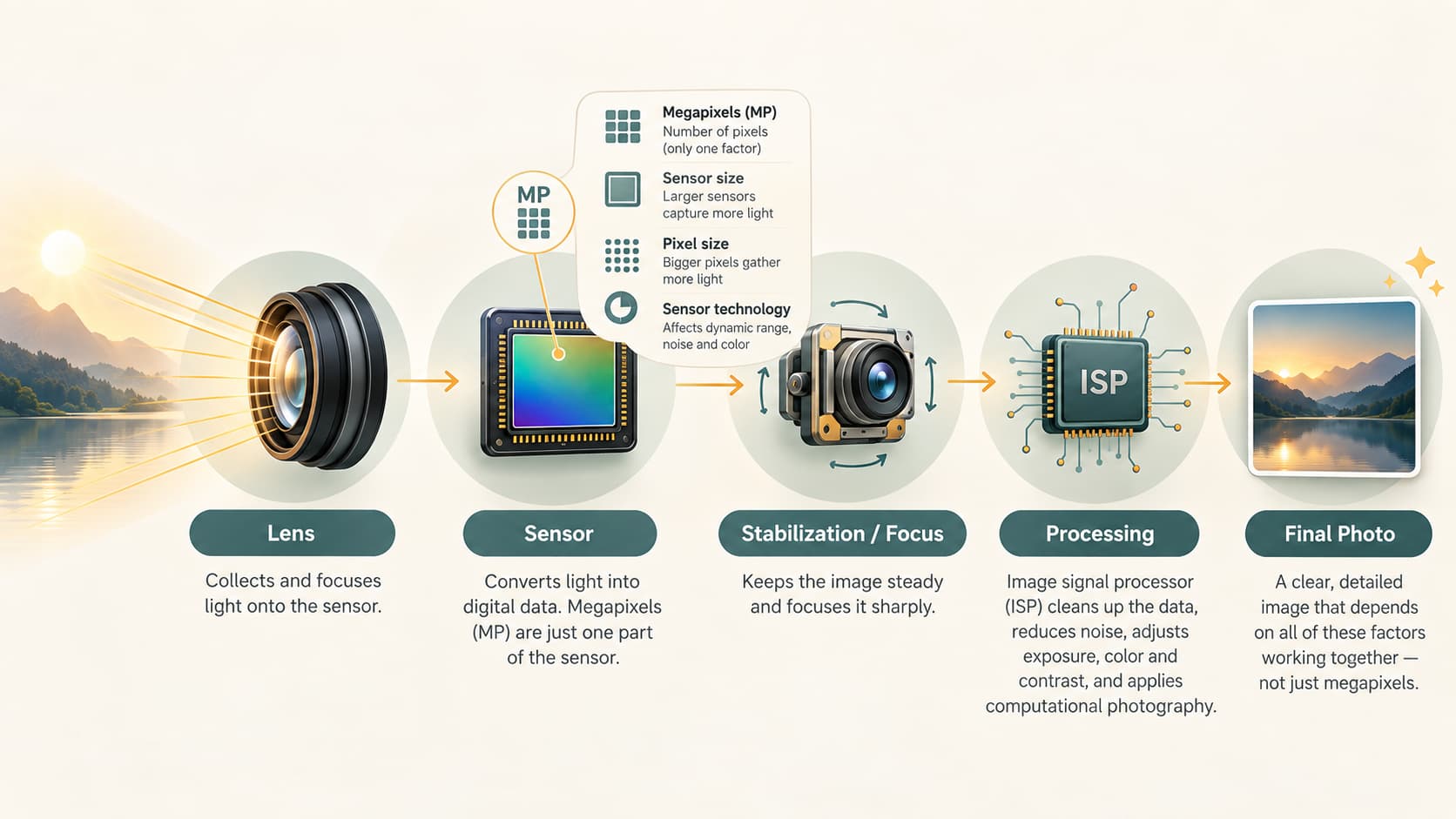
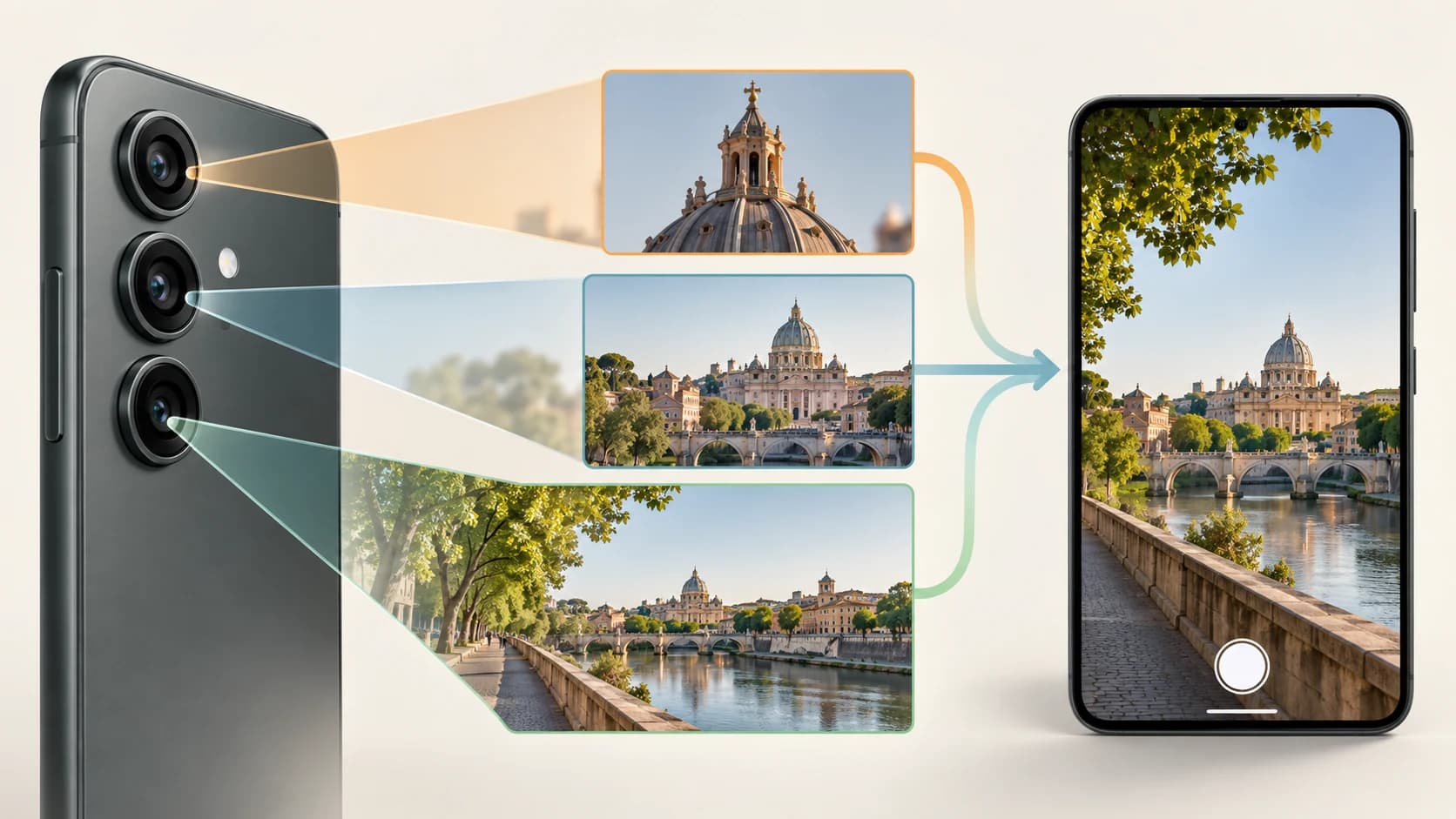
Modern phones often combine multiple exposures or information from several cameras and then process the result computationally.
Google's technical explanations of Pixel photography, for example, describe combining multiple images, HDR processing, sensor data and machine-learning algorithms to produce the final photograph.
This is why you can't reliably compare camera quality by saying:
Phone A has 200 MP. Phone B has 50 MP. Therefore Phone A has the better camera.
Look at the complete camera system
If photography matters to you, examine:
- main sensor performance
- low-light results
- autofocus reliability
- OIS
- ultrawide quality
- telephoto hardware
- video stabilization
- colour consistency between cameras
- actual sample photos and videos
A dedicated optical telephoto camera can also matter much more than a spectacularly large "digital zoom" number.
Megapixels matter. They simply aren't the whole camera.
5G Support Is Not Just a Yes-or-No Specification
Seeing "5G" on a specification sheet tells you that the phone supports some form of 5G connectivity.
It doesn't tell you everything about its radio capabilities.
A smartphone modem operates across supported frequency bands and network technologies. Actual performance also depends heavily on:
- your carrier
- local spectrum
- network congestion
- signal strength
- antenna design
- location
Modern high-end mobile platforms can advertise theoretical multi-gigabit peak speeds, but those figures describe technical maximums under suitable conditions, not the download speed you should expect everywhere. Qualcomm's current platforms, for instance, publish peak modem capabilities alongside detailed supported radio technologies and bands.
For a buyer, compatibility matters more than the biggest theoretical speed.
Check that the exact phone variant supports the important cellular bands and network features used in your country and by your carrier.
Don't Forget Wi-Fi, Bluetooth, NFC, USB and eSIM
These specifications rarely dominate advertisements, but they can directly affect how you use the phone.
Depending on your needs, check for:
- supported Wi-Fi generation
- Bluetooth version and audio support
- NFC for contactless services
- eSIM support
- dual-SIM capabilities
- USB data-transfer speed
- video output over USB, if you need it
- Ultra Wideband (UWB), if relevant to your accessories
Be careful with the physical USB-C connector in particular.
Two phones can both have USB-C ports while supporting very different data-transfer speeds and capabilities.
The shape of the connector doesn't tell you everything the port can do.
Software Support Is a Specification, Even If It Is Not in the Hardware Table
One of the most valuable smartphone specifications isn't measured in gigabytes, megapixels or gigahertz.
It is how long the manufacturer intends to support the device.
Operating-system and security updates can affect:
- security
- application compatibility
- bugs
- new features
- how long the phone remains practical to use
Support policies vary by manufacturer, model and sometimes region.
Longer support periods have become increasingly prominent. Google currently states that Pixel 8 and later phones receive seven years of OS and security updates from their original US Google Store availability, while Samsung announced seven generations of OS upgrades and seven years of security updates for the Galaxy S24 series.
That doesn't mean every phone from those companies receives the same policy.
Always check the policy for the specific model you are considering.
If you plan to keep a phone for four or five years, software support may be more important than a small advantage in benchmark performance.
Water Resistance and Durability Deserve Attention
Specifications such as IP67 or IP68 are more meaningful than vague phrases such as "water resistant."
IP ratings are based on the international IEC 60529 classification system for protection provided by enclosures.
But an IP rating still shouldn't be interpreted as permission to treat a smartphone as permanently waterproof.
Manufacturers specify particular laboratory conditions, and resistance can be affected by damage, repairs and normal wear.
Apple, for example, lists an IP68 rating for current iPhones alongside specific test conditions rather than making an unlimited waterproof claim.
Durability also includes less glamorous considerations:
- screen protection
- frame construction
- drop resistance
- availability and price of replacement parts
- repairability
- local service support
A phone that survives your ownership comfortably can be a better purchase than one with slightly better benchmark numbers.
What About AI Performance?
Smartphone manufacturers increasingly discuss NPUs, neural engines, AI accelerators and on-device generative AI.
The hardware is real. Dedicated processors can accelerate tasks such as image processing, speech recognition and machine-learning models.
But AI specifications are difficult to compare using one headline number.
A phone's useful AI capability depends on:
- supported models
- available memory
- processor architecture
- software
- operating-system integration
- whether processing happens on-device or in the cloud
- whether the feature is actually available in your language and region
If a manufacturer advertises an enormous AI-performance figure but you don't use any applications that benefit from it, the number has little practical value.
Focus on what the phone can actually do, not simply how many "AI" labels appear on its product page.
Specifications That Are Easy to Overvalue
Several numbers aren't useless, but they are frequently given more importance than they deserve.
| Specification | What it tells you | What it does not tell you |
|---|---|---|
| CPU GHz | Maximum clock frequency | Overall processor speed or efficiency |
| CPU core count | Number of CPU cores | Quality of the CPU architecture |
| RAM capacity | Available working memory | Overall phone speed |
| Megapixels | Image resolution | Overall camera quality |
| Battery mAh | Battery charge capacity | Actual battery life |
| Charging watts | Maximum supported charging power | Full charging time |
| Display resolution | Number of pixels | Overall display quality |
| Peak brightness | Maximum brightness under specified conditions | Typical brightness in every situation |
| Digital zoom | Maximum software-assisted magnification | Optical image quality |
| Peak 5G speed | Theoretical modem capability | Your everyday mobile-data speed |
The recurring pattern is simple:
a specification usually measures one property of one component, while your experience depends on the entire system.
Which Specifications Should You Prioritize?
There isn't one correct specification sheet for everyone.
A person who mostly uses WhatsApp, banking apps, browsing and YouTube needs something very different from someone who plays demanding games for hours.
For general everyday use
Pay particular attention to:
- reasonably modern processor
- sufficient RAM
- enough storage for several years
- good display
- proven battery life
- long software support
For gaming
Prioritize:
- GPU and processor performance
- sustained performance and cooling
- display refresh rate
- touch responsiveness
- battery endurance
- adequate RAM and fast storage
For photography
Prioritize:
- actual main-camera quality
- sensor and lens performance
- OIS
- useful telephoto and ultrawide cameras
- image processing
- video quality and stabilization
Don't start with megapixel count.
For long-term ownership
Look closely at:
- software-update commitment
- battery longevity and replacement options
- storage capacity
- durability
- service availability
- processor performance with some headroom for future software
A Better Way to Compare Two Smartphones
Instead of comparing every specification line by line, start with how you actually use your phone.
Then work through the specifications in this order:
- Does the phone have the size, design and operating system you want?
- How long will it receive software and security updates?
- Is the processor fast and efficient enough for your workload?
- Does it have enough RAM and storage for your expected ownership period?
- Is the display bright, smooth and comfortable to use?
- How long does the battery last in independent testing?
- Does the camera perform well in the situations you actually photograph?
- Does it support the connectivity features and network bands you need?
- How durable and repairable is it?
- Are the remaining premium features worth the extra money to you?
This approach turns a specification sheet from a scoreboard into what it should be: a description of whether the phone suits you.
The best smartphone isn't necessarily the one with the most RAM, the highest megapixel count or the fastest advertised charging.
It is the one in which the important components work well together.
That is harder to express in a single number, but it is much closer to what you'll notice every day.