What Does “Free” Really Mean on the Internet?
Free apps and websites still cost money to run. Learn how ads, data, freemium plans, subscriptions, ecosystems and open-source funding make “free” possible.
Search engines answer questions without charging you for every search.
Social networks let you create an account for ₹0.
Video platforms can provide millions of hours of content without demanding a subscription.
Apps offer free plans, cloud companies advertise free tiers, and software developers sometimes give away entire programs.
Yet none of these things are actually free to produce.
Someone has to pay for:
- developers
- servers
- electricity
- bandwidth
- storage
- customer support
- security
- content
- moderation
- marketing
So when an internet service says “Free,” what does that really mean?
Usually, it means only one specific thing:
you are not being charged money at that moment for that particular level of access.
It does not tell you how the service makes money, what limits apply, what information may be collected, whether you will eventually be asked to pay, or whether someone else is subsidising your use.
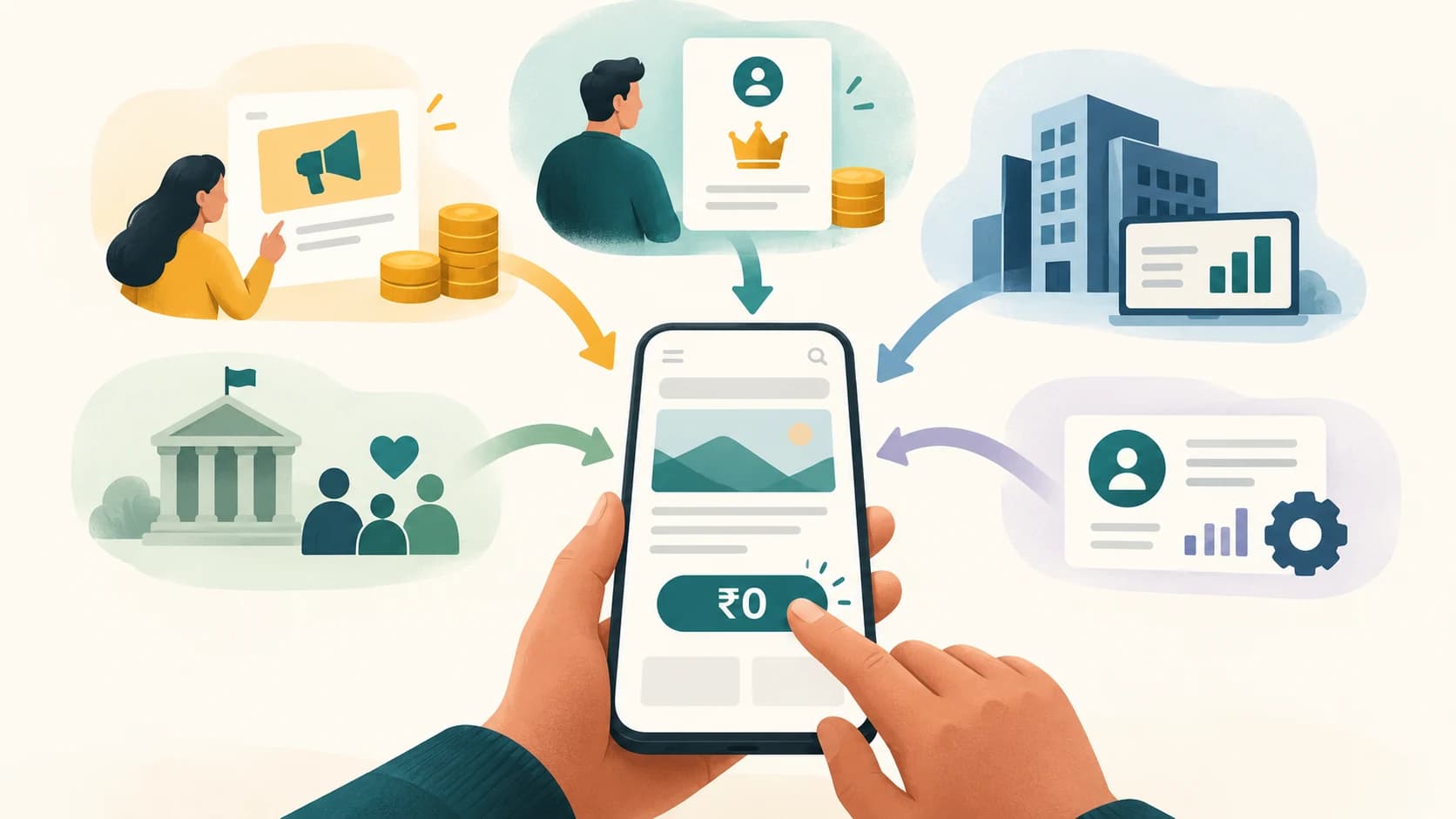
“Free” on the internet is therefore not one business model.
It is a label used for several very different arrangements.
The First Question: If You Are Not Paying, Who Is?
Running an internet service has real costs.
Suppose a company offers free email to 100 million people.
Every user needs some combination of:
- data storage
- network capacity
- software infrastructure
- backups
- spam filtering
- security
- engineering
- support
The service may charge users nothing, but those costs do not disappear.
Instead, the company needs another source of money.
That might be:
advertisers
paying subscribers
business customers
investors
another product sold by the same company
donors
governments or universities
or some combination of them.
Once you understand who pays, many apparently mysterious “free” services start making much more sense.
Model 1: Advertising Pays for the Service
The most familiar model is advertising.
You use a search engine, social network, news site or video platform without paying an entry fee.
Advertisers pay the platform for access to advertising opportunities.
The service can then use that revenue to fund the product.
The OECD has described online advertising as a source of funding for a wide range of services that consumers experience as free.
Google provides a particularly large example. Alphabet says its Google Services segment, which includes products such as Search, YouTube, Maps, Android and Chrome, generates revenue primarily from advertising, alongside subscriptions, app sales and devices.
Meta provides another. In its 2025 results, Meta reported about $196.2 billion in advertising revenue out of roughly $201.0 billion in total revenue, showing just how heavily its business still depended on advertising.
So when millions of people use a social platform for free, the company is not necessarily operating without revenue.
It may simply be charging a different group.
What Advertisers Are Actually Buying
A common phrase says:
“If you aren't paying for the product, you are the product.”
It captures something important, but it is too simplistic to be literally correct.
Advertisers normally are not buying a human being.
They are buying things such as:
- ad impressions
- clicks
- conversions
- placement
- access to selected audience categories
- opportunities to influence purchasing decisions
The platform's users make that advertising inventory valuable because advertisers want to reach them.
User activity can also help a platform decide:
- which ads to show
- who may be interested
- whether a campaign worked
- how much an ad opportunity may be worth
That does not necessarily mean the company literally sells a file containing your personal information to advertisers.
Google, for example, says it does not sell personal information and instead uses certain information to personalize advertising while allowing users to control ad personalization.
So a more accurate version of the slogan would be:
If you are not paying, understand what economic role your usage plays in the service.
Sometimes your attention is what makes the platform valuable to advertisers.
Your Attention Has Economic Value
An advertisement only works if someone sees it.
That makes human attention scarce and valuable.
Imagine two free video apps.
App A persuades users to spend ten minutes per day.
App B persuades users to spend two hours.
All else being equal, App B has many more opportunities to:
- display advertisements
- recommend sponsored content
- gather feedback about what keeps users engaged
- encourage purchases or subscriptions
This helps explain why online services often care intensely about:
- daily active users
- viewing time
- engagement
- retention
- notifications
- recommendations
A service does not need to charge you directly for your time to have economic value from that time.
Model 2: Freemium — Most People Use It Free, Some Pay
Another common model is freemium.
The basic product is free.
More advanced features require payment.
For example:
Free version
- basic functionality
- limited storage
- advertisements
- lower quality
- fewer exports
- restricted tools
Paid version
- more features
- more storage
- fewer or no ads
- advanced controls
- higher limits
The important idea is that free users and paying users are part of the same business model.
The free tier reduces the barrier to trying the product.
Some users later upgrade.
Those paying users help finance the service for everyone else.
Spotify is a familiar example of a company built around both subscription and advertising businesses; its investor materials explicitly distinguish paying subscribers while also operating an ad-supported service.
Freemium can be completely legitimate.
The important thing is to understand that the free product may deliberately be designed as an entry point rather than the final product.
Why Companies Give Away Something Valuable
Giving away software sounds irrational until you think about customer acquisition.
Suppose a company charged ₹1,000 before anyone could try its software.
Many potential users would never begin.
Now suppose it offers a genuinely useful free version.
Millions of people can test it.
A smaller percentage may later need:
- collaboration
- larger storage
- professional exports
- business controls
- advanced AI
- automation
The free version has now become part of the company's marketing and sales system.
The company is effectively saying:
Try the product first. Pay only when your needs become large enough.
That is why free plans are often generous enough to be useful but limited enough to create an upgrade path.
Model 3: “Free Tier” Does Not Mean Unlimited
Cloud computing makes this distinction particularly obvious.
A provider might offer:
- 5 GB storage free
- 1,000 API requests per month free
- limited computing hours free
Once you exceed the allowance, normal billing begins.
AWS, for example, documents free-tier limits and explains that eligible usage can be free within specified limits, while usage beyond the allowance may be charged at standard rates depending on the account and offer.
That means:
free price
does not equal
unlimited consumption.
The same pattern appears in:
- AI APIs
- cloud storage
- email marketing tools
- website builders
- database services
- design software
Whenever you see “Free Tier,” the next question should be:
Free up to what limit?
Model 4: The “Free Trial” Is Really Deferred Payment
A free trial is different from a free tier.
A free tier may continue indefinitely under certain limits.
A free trial normally ends.
For example:
Days 1–30: ₹0
Day 31 onward: ₹499 per month
There is nothing inherently deceptive about this if the terms are clear.
The danger appears when people confuse:
free now
with
free permanently.
The U.S. Federal Trade Commission warns that many free trials automatically become paid subscriptions unless the customer cancels before the trial expires. It advises consumers to check the duration, cancellation method and future price before signing up.
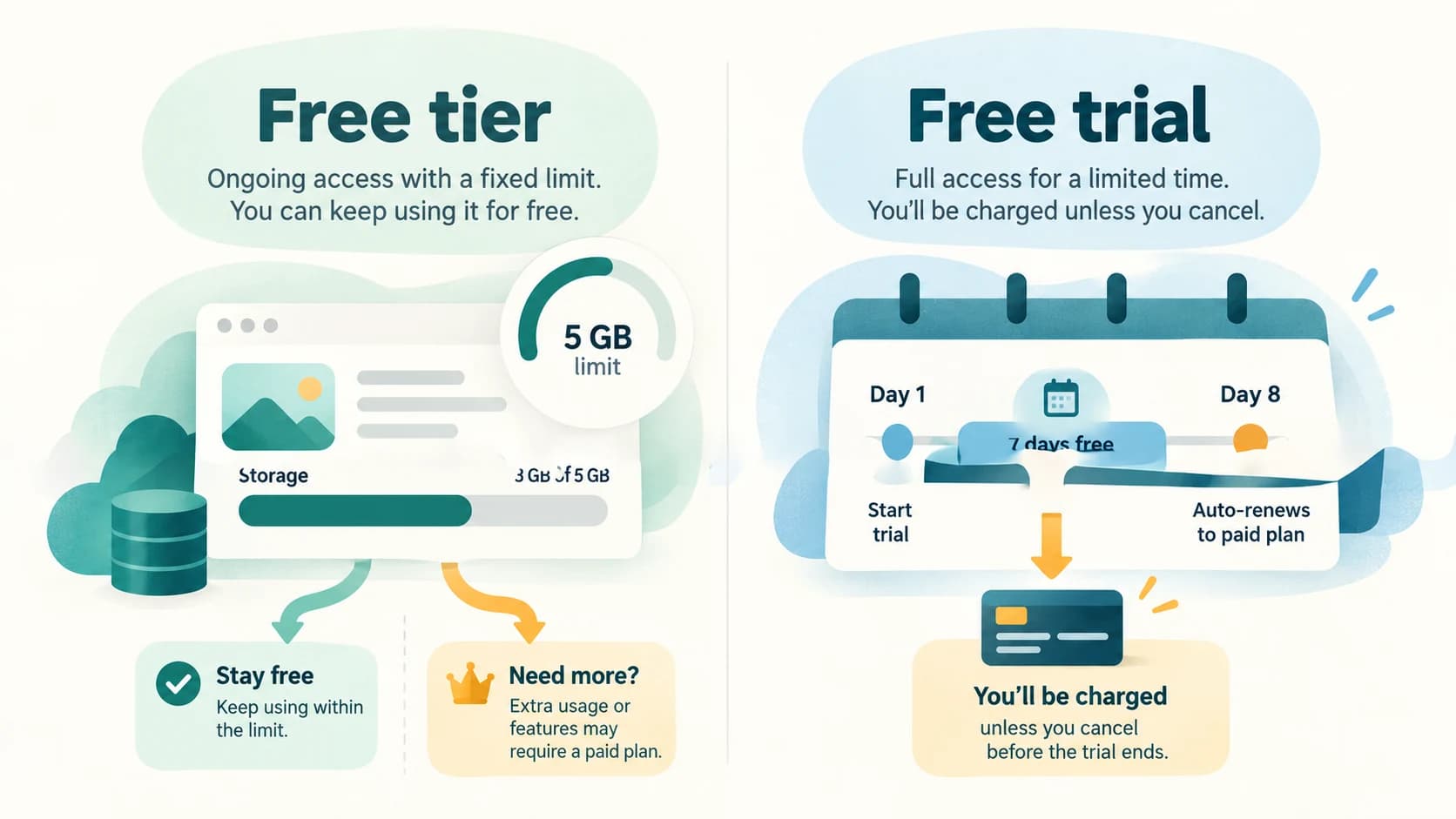
This is particularly important when the service asks for a payment card before the trial begins.
The card is a clue that the business expects a future transaction.
Why Cancellation Design Matters
A company can technically disclose a subscription while still making the experience confusing.
For example:
- the trial end date is hidden
- the renewal price is difficult to find
- cancellation requires many screens
- a large “Continue” button is paired with a tiny cancellation link
- checkboxes are selected by default
Regulators commonly describe manipulative interface techniques like these as dark patterns.
The European Commission notes that deceptive interface design can push users toward choices they might not otherwise make, and EU digital rules restrict such practices in covered contexts.
The FTC also warns specifically about misleading free trials and negative-option subscriptions in which silence becomes permission to continue charging.
A “free” offer is therefore only as useful as the conditions attached to leaving it.
Model 5: Data Can Help Finance a Service
Personal data is often discussed as though companies simply collect it and sell it to the highest bidder.
Reality is more complicated.
Data can have economic value without being directly sold.
A service may use information to:
- personalize recommendations
- target advertisements
- measure advertising performance
- improve products
- detect fraud
- rank content
- understand user behaviour
The European Commission explicitly notes that some services that appear free may monetize data rather than charge a subscription fee.
Online platforms also derive value from observing interactions between users, which can help them understand preferences and improve or monetize the service.
This does not mean every free service uses personal data in the same way.
Privacy practices vary enormously.
A weather app, search engine, encrypted messenger and open-source note-taking program may all be free while having completely different data practices.
So the right question is not:
Is it free?
It is:
What data does it collect, why, and what choices do I have?
Free Can Mean You Pay With Convenience or Lock-In
Not every non-monetary cost involves privacy.
Sometimes the cost appears later because switching becomes difficult.
Imagine a free cloud service that stores:
- all your documents
- photographs
- contacts
- calendar
- backups
After several years, leaving may require transferring hundreds of gigabytes and changing many habits.
You were not charged to enter.
But moving away has become expensive in terms of:
- time
- effort
- compatibility
- inconvenience
This is called switching cost or, in stronger cases, lock-in.
That does not automatically make the original free service unfair.
It simply means price is not the only cost worth considering.
Model 6: One Product Can Subsidise Another
Sometimes a free service exists because it makes another business more valuable.
A company might provide a free:
- operating system
- messaging app
- browser
- developer tool
- game
- cloud service
because it helps sell something else.
Perhaps it encourages people to buy hardware.
Perhaps it attracts developers to a platform.
Perhaps it makes an ecosystem harder to leave.
Perhaps it creates demand for enterprise products.
Economists often call this cross-subsidisation.
The free product does not necessarily need to make money by itself.
Its job may be to make the larger business stronger.
Network Effects Can Make Free Access Strategically Valuable
Some internet products become more useful as more people join.
A messaging platform with ten users is less useful than one used by everyone you know.
A marketplace becomes more attractive when it has more buyers and sellers.
The European Commission lists network effects as an important characteristic of online platforms: the presence of more users can increase the platform's value to other users.
Offering free access can therefore help a platform grow quickly.
Once a network becomes large, the company may have more opportunities to earn money through:
- advertising
- commissions
- subscriptions
- business tools
- transaction fees
- premium services
In that case, “free” is partly a growth strategy.
Some Things Really Are Free to the User
It would be a mistake to conclude that every free service has a hidden commercial catch.
Some online resources are provided free because someone genuinely wants them to be widely available.
Examples can include:
- government websites
- public datasets
- university resources
- charity-funded tools
- nonprofit projects
- volunteer-maintained software
- publicly funded research resources
The user may genuinely pay nothing.
There is still a cost to producing the service, but another organisation has chosen to bear it.
This is an important distinction.
Free to you does not mean free to produce.
Those statements can both be true.
“Free Software” Can Mean Something Completely Different
Technology adds another source of confusion.
In the free-software movement, the word free is not primarily about price.
The Free Software Foundation defines free software around users' freedoms to run, study, modify and redistribute software. It explicitly distinguishes freedom from zero price.
A program can therefore be:
free of charge but proprietary
or
free software that someone charges money to distribute or support.
Similarly, open-source software and freeware are not automatically the same thing.
“Free download” tells you the price.
It tells you almost nothing about what rights you have over the software.
A Useful Way to Classify “Free”
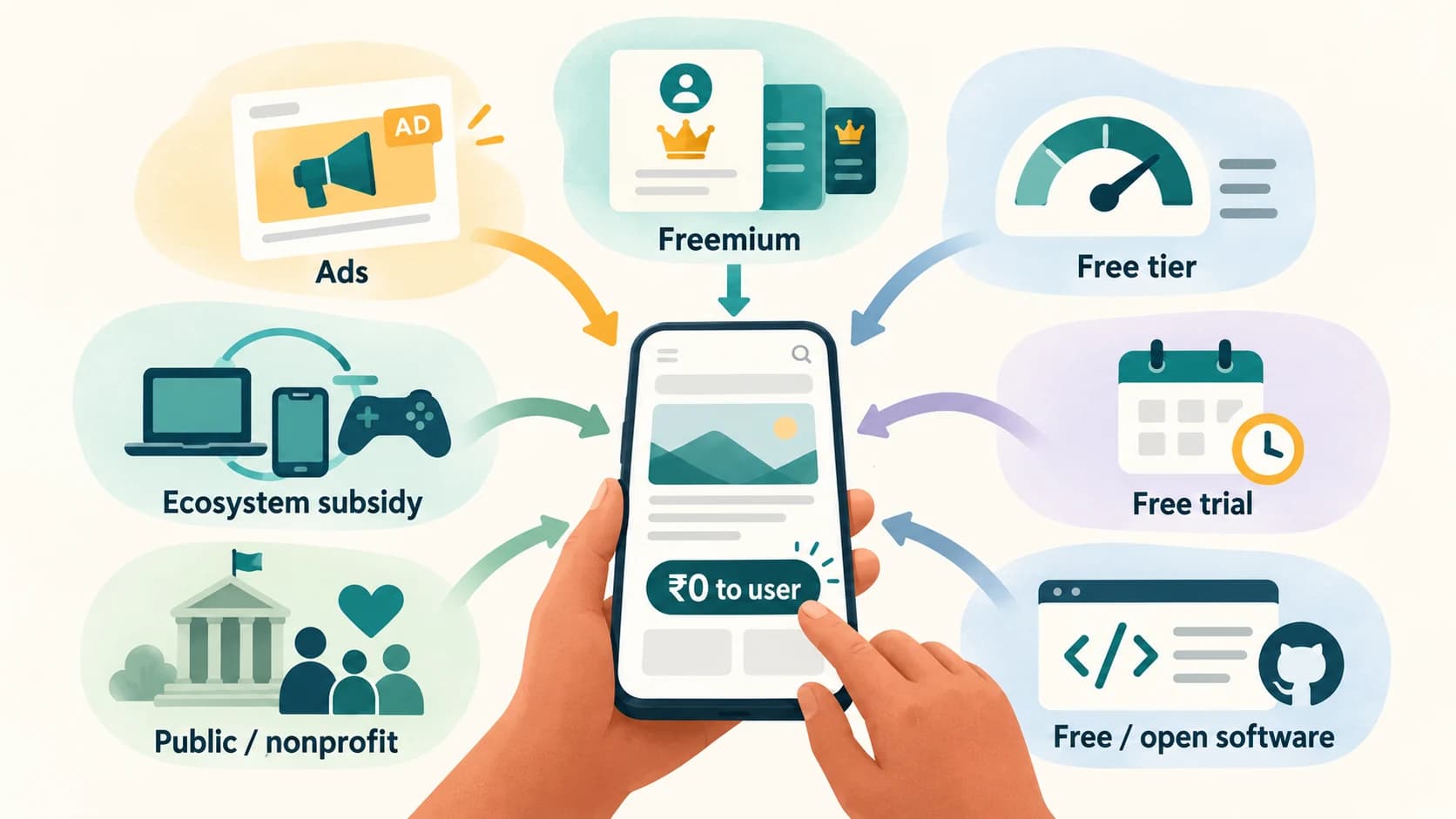
When something online says Free, try placing it into one of these categories:
| Type of “free” | How it is funded |
|---|---|
| Ad-supported | Advertisers pay |
| Freemium | A minority of users pay for premium features |
| Free tier | Usage is free below a limit |
| Free trial | Payment begins later unless cancelled |
| Ecosystem subsidy | Another product or business funds it |
| Data-driven service | Data helps improve or monetize the service |
| Public/nonprofit | Government, grants, donors or volunteers fund it |
| Free/open software | Distribution rights and freedoms matter; price may be zero or non-zero |
A service can belong to more than one category.
A platform might simultaneously have:
- advertising
- subscriptions
- data-driven personalization
- free access
- paid business tools
Real companies often combine business models.
What Should You Check Before Using a Free Service?
You do not need to become suspicious of everything that costs nothing.
You simply need to ask better questions.
What happens if I never pay?
Does the free plan continue indefinitely?
Or does it stop after seven days?
What are the limits?
Storage?
Uploads?
AI requests?
Export quality?
Number of users?
How does the company make money?
Advertising?
Subscriptions?
Commissions?
Enterprise customers?
What information does it collect?
Check the privacy policy and settings.
Particularly look for:
- location
- browsing activity
- contacts
- device identifiers
- purchase activity
Will I be charged automatically?
If a payment card is required, check:
- trial end date
- renewal amount
- billing frequency
- cancellation procedure
Can I leave easily?
Can you export your data?
Can you delete your account?
Do files use standard formats?
These questions reveal much more than the word Free ever will.
Is Paying Always More Private?
No.
A paid product can still collect extensive data.
A free product can be designed with strong privacy protections.
Price and privacy are different dimensions.
Likewise:
paid does not automatically mean good
and
free does not automatically mean exploitative.
The business model simply changes the incentives.
If a service earns money mainly from subscriptions, it has a strong incentive to convince users to keep paying.
If it earns money from advertising, it has an incentive to create valuable advertising inventory.
If it earns transaction fees, it wants more transactions.
If it sells hardware, software may exist partly to make that hardware attractive.
Understanding those incentives helps you understand why a product behaves the way it does.
So Is Anything on the Internet Truly Free?
From the user's perspective, yes.
You can genuinely use many useful things without paying money.
But from an economic perspective, almost nothing substantial is costless.
Servers still run.
Developers still work.
Videos still require bandwidth.
Software still requires maintenance.
The question is therefore not:
“Does this cost anything?”
The better question is:
“Who pays for this, and what do they receive in return?”
Sometimes the answer is advertisers.
Sometimes it is premium subscribers.
Sometimes it is investors trying to grow a company.
Sometimes it is taxpayers.
Sometimes it is donors or volunteers.
And sometimes you eventually become the paying customer.
The word Free tells you only the price displayed at the entrance.
To understand the real deal, you have to look at the business model behind the door.