What Is the Repo Rate and Why Does It Matter?
Learn what the RBI repo rate actually is, why it changes, and how it can affect home loans, EMIs, deposits, inflation and the wider economy.
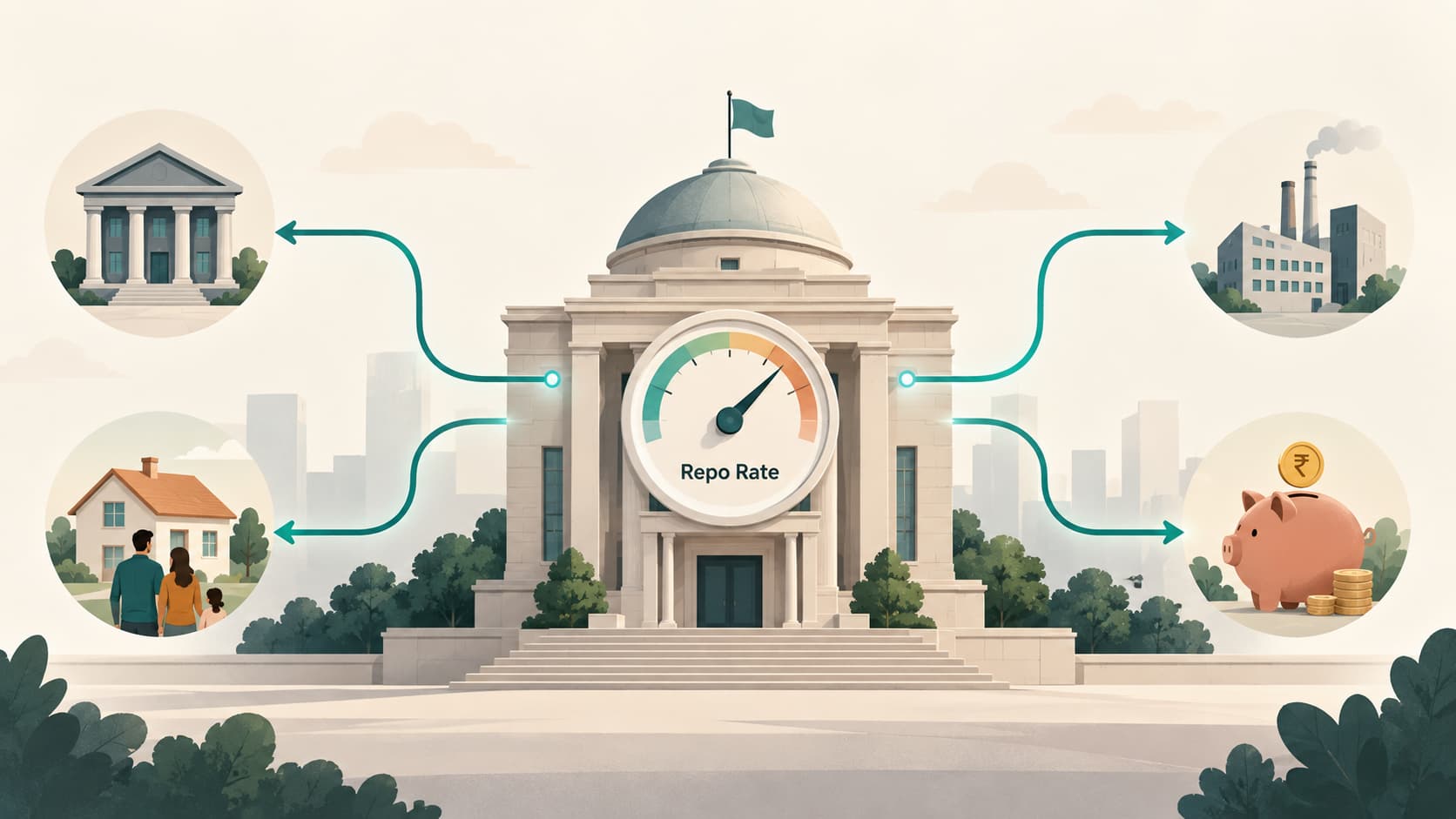
You hear it regularly in financial news:
"RBI cuts the repo rate."
Within minutes, headlines begin discussing cheaper home loans, lower EMIs, deposit rates, inflation and economic growth.
That can make the repo rate sound like a master interest-rate switch that directly controls every bank loan in India.
It doesn't work quite that simply.
The policy repo rate is the interest rate at which the Reserve Bank of India provides liquidity to eligible participants under its Liquidity Adjustment Facility against government and other approved securities. More importantly, it is the central policy rate around which the RBI operates its monetary-policy framework. (rbi.org.in)
Changes in that rate influence short-term financial-market interest rates and can gradually work their way through bank funding costs, deposit rates, lending rates, consumption, investment and ultimately inflation.
As of the RBI's latest published policy-rate information following its August 2026 monetary-policy meeting, the policy repo rate is 5.25%. The Standing Deposit Facility rate is 5.00%, while the Marginal Standing Facility and Bank Rate are 5.50%. (rbi.org.in)
The number itself matters.
But understanding how that 5.25% travels through the economy is much more useful.
What Does "Repo" Actually Mean?
The word repo comes from repurchase agreement.
A repo is essentially a collateralised borrowing arrangement.
Imagine a bank temporarily needs funds.
In the economic substance of a repo transaction, the borrower provides eligible securities and receives money, with an agreement that the transaction will be reversed later at an agreed price.
The difference between the two prices incorporates the interest cost of borrowing.
RBI describes a repo as an arrangement for borrowing funds by selling securities with an agreement to repurchase them on an agreed future date. Under the RBI's Liquidity Adjustment Facility, eligible institutions can obtain liquidity against approved collateral such as government securities. (rbi.org.in)
The important idea is:
RBI provides liquidity; the borrowing institution provides eligible securities as collateral.
The repo rate is the policy rate associated with this liquidity framework.
Does RBI Simply Give Banks Cheap Loans at the Repo Rate?
This is one of the most common oversimplifications.
You will often hear:
"Repo rate is the rate at which RBI lends money to banks."
That is useful as a first explanation, but incomplete.
The policy repo rate also acts as an anchor for short-term interest rates in the financial system.
RBI actively manages banking-system liquidity so that the operating target for monetary policy, the weighted average overnight call money rate, remains aligned with the policy rate. (rbi.org.in)
Banks don't finance every home loan, car loan or business loan by borrowing an equivalent amount directly from RBI at the repo rate.
They fund themselves from many sources, including:
- customer deposits
- wholesale market borrowing
- their own capital and retained funds
- interbank borrowing
- central-bank liquidity facilities
That is why changing the repo rate influences lending conditions without mechanically determining every lending rate.
Who Decides the Repo Rate?
The policy repo rate is decided by India's Monetary Policy Committee, or MPC.
The MPC operates under the Reserve Bank of India Act and determines the policy rate required to achieve India's inflation target.
The committee has six members.
Each member has one vote. If the vote is tied, the RBI Governor has a casting vote. RBI states that the MPC must meet at least four times a year, although in practice scheduled monetary-policy meetings are generally held more frequently. (rbi.org.in)
The committee considers a wide range of information before deciding whether rates should rise, fall or stay unchanged.
That includes:
- inflation and inflation expectations
- economic growth
- consumer demand
- employment and investment conditions
- food and commodity prices
- global economic developments
- financial-market conditions
- exchange-rate and external-sector developments
- risks to future inflation and growth
So a repo-rate decision is not based on one month's inflation number alone.
Monetary policy is forward-looking because changes in interest rates take time to affect the economy.
What Is RBI Trying to Achieve?
The statutory primary objective of monetary policy is price stability while keeping in mind the objective of growth. (rbi.org.in)
India operates a flexible inflation-targeting framework.
For the five-year period from April 1, 2026 to March 31, 2031, the Central Government, in consultation with the RBI, has retained a CPI inflation target of:
- Target: 4%
- Upper tolerance level: 6%
- Lower tolerance level: 2%
The target was notified by the Department of Economic Affairs on March 25, 2026 under Section 45ZA of the RBI Act. (gazettetracker.com)
The repo rate is one of the main tools the MPC uses to influence financial conditions so that inflation moves toward that target over time.
Why Would RBI Increase the Repo Rate?
Suppose inflation is running too high and demand across the economy is strong.
People are borrowing and spending heavily.
Businesses are investing aggressively.
Credit is growing quickly.
If demand for goods and services grows faster than the economy's ability to supply them, prices can come under upward pressure.
Raising the repo rate makes monetary conditions tighter.
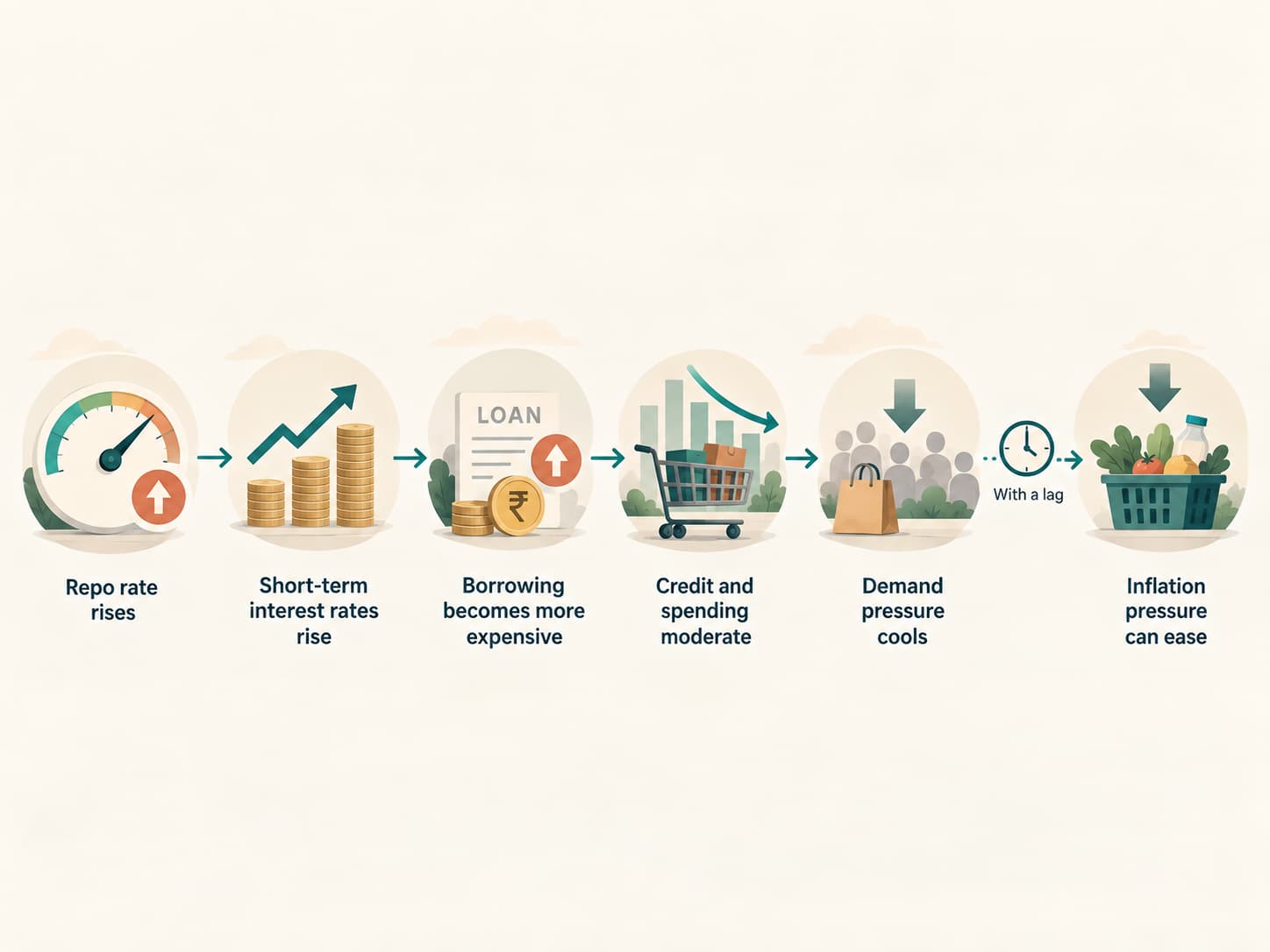
The process can broadly work like this:
RBI raises policy rate
↓
Short-term market interest rates tend to rise
↓
Funding and lending conditions become tighter
↓
Some loans become more expensive
↓
Borrowing and spending may slow
↓
Demand pressure moderates
↓
Inflationary pressure can ease over time
The phrase over time is important.
Increasing the repo rate today does not make tomorrow's grocery prices immediately fall.
Monetary policy works with lags.
RBI's own empirical analysis has found that policy-rate changes can take several quarters to exert their strongest effects on inflation. (rbi.org.in)
Why Would RBI Cut the Repo Rate?
Now imagine the opposite situation.
Economic growth is weak.
Consumers are cautious.
Businesses are delaying investment.
Inflation is sufficiently controlled.
In such circumstances, the MPC may decide that lower interest rates are appropriate.
A repo-rate reduction can encourage easier financial conditions.
The broad chain becomes:
RBI cuts repo rate
↓
Short-term interest rates tend to fall
↓
Banks' funding and lending conditions may ease
↓
Borrowing can become cheaper
↓
Households and businesses may borrow and spend more
↓
Investment and demand may strengthen
That can support economic activity.
But there is a trade-off.
If monetary policy becomes too loose while inflationary pressure is already strong, additional demand can make inflation harder to control.
That is why central banks continually balance inflation risks against economic activity.
How Does the Repo Rate Affect Your Home Loan?
This is where monetary policy becomes personal.
Suppose you have a floating-rate home loan.
Your interest rate may be expressed conceptually as:
Loan interest rate = Benchmark rate + Bank spread
For many new floating-rate retail loans from scheduled commercial banks, the benchmark must be an approved external benchmark.
RBI's current regulatory framework allows benchmarks including:
- RBI policy repo rate
- 3-month Government of India Treasury Bill yield published by FBIL
- 6-month Treasury Bill yield published by FBIL
- another specified market benchmark published by FBIL
RBI requires floating-rate retail and MSME loans covered by the external-benchmark framework to reset at least once every three months. (rbi.org.in)
If your loan is directly linked to the RBI repo rate, a repo-rate change therefore has a relatively clear route into your loan benchmark.
But your final rate is still not simply equal to the repo rate.
The bank adds a spread.
And the impact depends on your loan contract and reset date.
Does a Repo Cut Always Reduce Your EMI Immediately?
No.
Several possibilities exist.
Your loan may be repo-linked
If the loan's external benchmark is the RBI repo rate, the benchmark should reflect the policy-rate change according to the applicable reset schedule.
The bank may respond by adjusting:
- the EMI
- the remaining loan tenure
- or some combination of the two, depending on the loan arrangement
Your loan may use a different external benchmark
A floating loan could instead be linked to an eligible Treasury Bill or another approved benchmark.
In that case, the repo rate can influence market conditions, but your benchmark is not literally the repo rate.
Your older loan may be MCLR-linked
Some existing floating-rate loans continue under the Marginal Cost of Funds Based Lending Rate, or MCLR, framework.
Changes in the repo rate can influence MCLR indirectly through banks' funding costs, but the transmission can be slower and less direct.
You may have a fixed-rate loan
A genuinely fixed-rate loan does not automatically change simply because RBI changes the repo rate.
That is the key point:
A repo-rate cut does not mean every existing borrower immediately receives an identical rate cut.
RBI itself notes that lending rates remain subject to the relevant loan-pricing framework and bank pricing rules rather than being universally identical to the repo rate. (rbi.org.in)
What Does "Monetary Policy Transmission" Mean?
The journey from an RBI decision to your EMI has a name:
monetary policy transmission.
It describes how changes in central-bank policy pass through financial markets and eventually influence the wider economy.
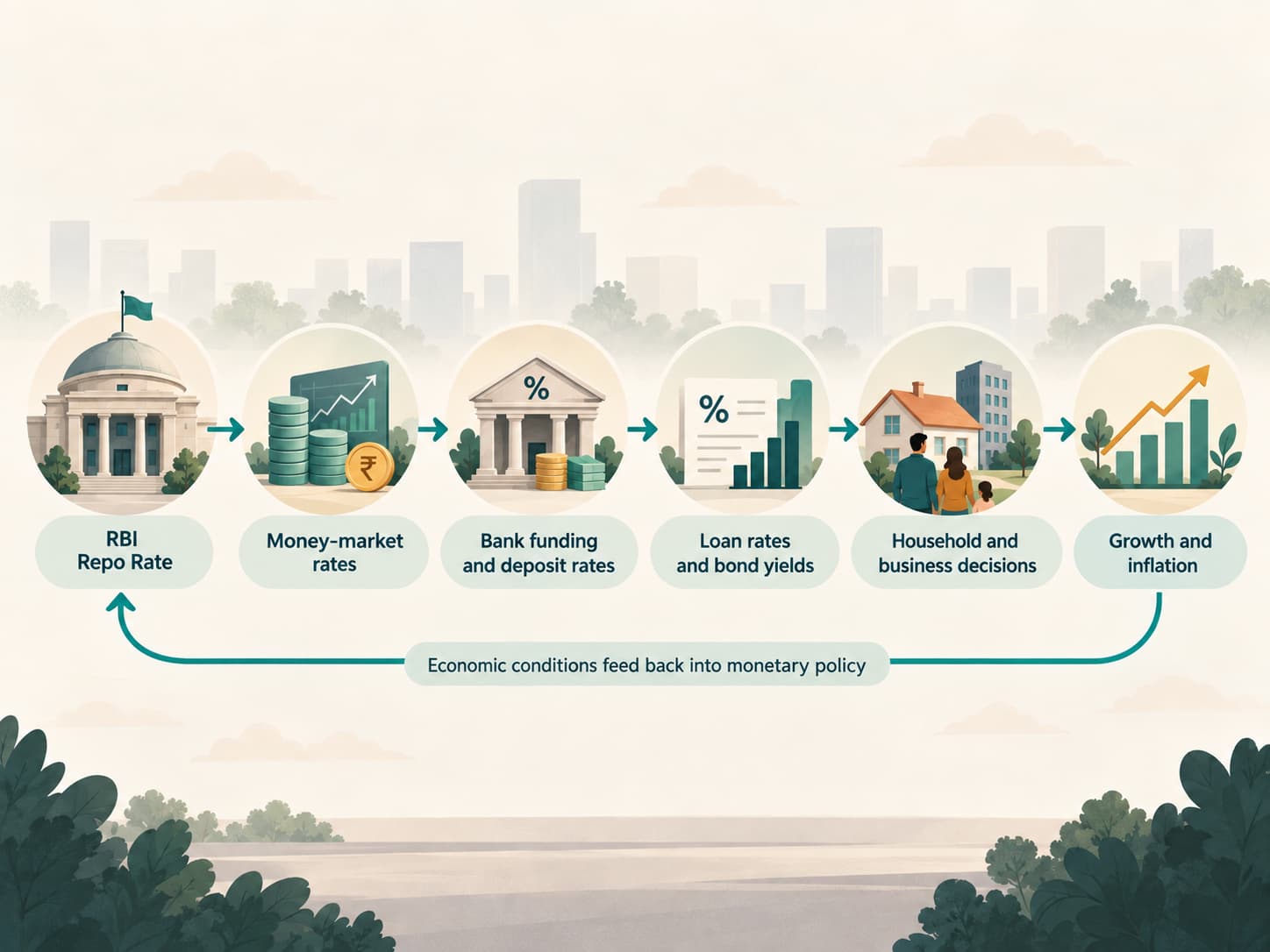
A simplified transmission chain looks like this:
Repo rate
↓
Overnight and short-term market rates
↓
Bank funding and deposit rates
↓
Loan rates and bond yields
↓
Borrowing, saving and investment decisions
↓
Consumer and business demand
↓
Economic growth and inflation
The chain isn't instantaneous.
Different parts of the financial system react at different speeds.
Financial-market rates can move very quickly.
Bank deposit rates may change more gradually.
Existing loans might only reset periodically.
And household spending decisions may take months to respond.
Why Was External Benchmarking Introduced?
Before external benchmarking became mandatory for certain categories, many bank loans were linked mainly to benchmarks calculated internally by the banks.
The RBI found that policy-rate changes were not always passing through to borrowers quickly or transparently.
From October 2019, banks were required to link new floating-rate personal and retail loans, including housing and automobile loans, and certain MSME loans to specified external benchmarks. Medium-enterprise floating-rate loans were included from April 2020. (rbi.org.in)
The aim was to improve transparency and strengthen transmission.
If the benchmark is publicly observable, borrowers can more easily see when it changes.
That doesn't remove the bank's spread, but it makes the benchmark portion of the pricing structure clearer.
What Happens to Fixed Deposits When Repo Rates Fall?
Borrowers tend to like lower interest rates.
Savers may not.
When repo rates and broader market rates fall, banks may eventually reduce the rates they offer on new fixed deposits.
Why?
Banks don't set deposit rates independently of their overall funding needs.
If credit demand is weak, liquidity is abundant and market funding becomes cheaper, a bank may have less reason to offer high interest rates to attract deposits.
The reverse can happen when rates rise or banks need more deposits.
However, deposit rates are not mechanically linked one-for-one to the repo rate.
A 0.25 percentage-point repo change does not legally require every bank to change every FD rate by exactly 0.25 percentage point.
Banks consider:
- liquidity needs
- credit growth
- competition for deposits
- maturity of deposits
- market interest rates
- funding strategy
An existing fixed deposit also normally continues at the contracted interest rate until maturity unless its terms provide otherwise.
It is mainly new or renewed deposits that reflect changing rates.
What About Savings Accounts?
The same principle applies.
Savings-deposit rates can be influenced by overall monetary conditions, but they do not automatically move every time the MPC changes the repo rate.
Banks determine deposit rates within the applicable regulatory framework and their own funding strategies.
That is why two banks can offer different deposit rates even though both operate under the same RBI repo rate.
Does a Higher Repo Rate Reduce Inflation by Reducing Money Supply?
You will sometimes see the mechanism reduced to:
Higher repo rate = less money supply = lower inflation.
That is too simplistic.
Modern monetary-policy transmission operates through several channels.
A higher policy rate can affect:
- the cost of borrowing
- willingness to take loans
- returns on savings
- bond yields
- asset prices
- financial conditions
- exchange-rate dynamics
- expectations about future inflation
The objective is to influence overall demand and financial conditions, not simply to remove a fixed quantity of money from circulation.
Liquidity management and monetary-policy rate decisions are related, but they are not exactly the same thing.
RBI has several separate tools for managing liquidity, including repo operations, the Standing Deposit Facility, variable-rate operations, open-market operations, foreign-exchange swaps and the Cash Reserve Ratio. (rbi.org.in)
Repo Rate, SDF and MSF: The Interest-Rate Corridor
The repo rate sits at the centre of an operating corridor.
As of August 2026:
| RBI policy rate | Rate |
|---|---|
| Standing Deposit Facility | 5.00% |
| Policy Repo Rate | 5.25% |
| Marginal Standing Facility | 5.50% |
The Standing Deposit Facility, or SDF, forms the lower boundary.
It allows eligible institutions to place surplus overnight funds with RBI without collateral.
The Marginal Standing Facility, or MSF, forms the upper boundary.
It gives banks a safety-valve mechanism for obtaining overnight funds from RBI at a higher rate under specified conditions.
RBI currently places the SDF 25 basis points below the policy repo rate and the MSF 25 basis points above it. (rbi.org.in)
Together, these facilities help RBI keep overnight market rates around its desired policy setting.
Then What Happened to the Reverse Repo Rate?
Older articles often describe the reverse repo rate as the rate RBI pays banks when they park excess funds with it.
Historically, the fixed reverse repo rate was the floor of RBI's Liquidity Adjustment Facility corridor.
That is no longer the best description of the current operating framework.
In April 2022, RBI introduced the Standing Deposit Facility, which replaced the fixed reverse repo rate as the floor of the LAF corridor. (rbi.org.in)
The fixed reverse repo rate remains part of RBI's toolkit and is still published, but it is no longer the regular corridor floor.
This distinction matters because a large number of basic explanations of repo and reverse repo still describe the pre-2022 framework.
Does the Repo Rate Affect the Stock Market?
It can, but the relationship isn't simple enough to say:
Repo cut = stocks rise
or:
Repo hike = stocks fall
Lower interest rates can support equity valuations by:
- reducing borrowing costs
- potentially improving company profits
- making fixed-income investments comparatively less attractive
- supporting economic demand
Higher rates can produce the opposite pressures.
But markets react to expectations.
If investors already expected a rate cut, it may have been priced into shares before the announcement.
And a surprise cut motivated by severe economic weakness can sometimes worry investors rather than encourage them.
Repo-rate decisions are one factor among many.
What About the Rupee?
Interest-rate changes can also influence currencies.
Higher domestic interest rates can, under some circumstances, make rupee-denominated financial assets more attractive relative to alternatives.
But exchange rates depend on many other factors:
- global interest rates
- foreign capital flows
- crude-oil prices
- trade balances
- geopolitical events
- investor risk appetite
- RBI intervention
- expectations about future policy
So the repo rate can influence the rupee, but it does not directly set its exchange rate.
Why Doesn't RBI Just Keep Rates Low Permanently?
Because cheap credit has costs.
Very low interest rates can encourage borrowing and investment, but keeping policy too loose when demand is already strong can contribute to inflationary pressure.
Persistent inflation reduces purchasing power.
₹100 still says ₹100 on the note, but it buys less.
On the other hand, keeping rates unnecessarily high can suppress:
- home purchases
- business investment
- consumption
- credit demand
- economic activity
The job of monetary policy is therefore not to make interest rates permanently low or permanently high.
It is to set financial conditions appropriate to the economic situation.
The Repo Rate Is a Signal as Well as a Price
There is another reason financial markets pay so much attention to MPC meetings.
A repo-rate decision says something about how the central bank sees the economy.
A rate increase may signal concern about persistent inflation.
A rate cut may indicate that inflation conditions allow more support for economic activity.
Keeping rates unchanged can mean the MPC wants more evidence before moving either way.
The accompanying monetary-policy statement can therefore matter almost as much as the numerical decision.
Markets listen for what policymakers say about:
- future inflation
- economic growth
- liquidity
- global risks
- food prices
- crude oil
- financial stability
- future policy direction
The repo rate is one number inside a much larger policy message.
The Simplest Way to Understand the Repo Rate
Think of the process as a chain.
RBI and the MPC assess inflation and economic conditions
↓
The MPC sets the policy repo rate
↓
RBI's liquidity operations help anchor short-term market rates around that policy setting
↓
Financial institutions adjust funding, lending and deposit rates over time
↓
Borrowing and saving behaviour changes
↓
Consumer spending and business investment respond
↓
Demand, growth and inflation are affected
That is why a small change measured in just 25 basis points can receive national attention.
It isn't because every bank immediately changes every loan by the same amount.
It is because the policy repo rate sits near the beginning of a chain that reaches mortgages, corporate finance, deposits, financial markets and eventually everyday economic activity.
When the RBI changes it, the central bank isn't simply changing the price at which some banks can obtain liquidity.
It is adjusting one of the most important reference points for the cost of money in the Indian economy.