Why Doesn't a Bigger Engine Always Mean a Faster Car?
Engine size is only one part of performance. Learn how turbocharging, horsepower, weight, gearing, traction and aerodynamics determine how fast a car is.
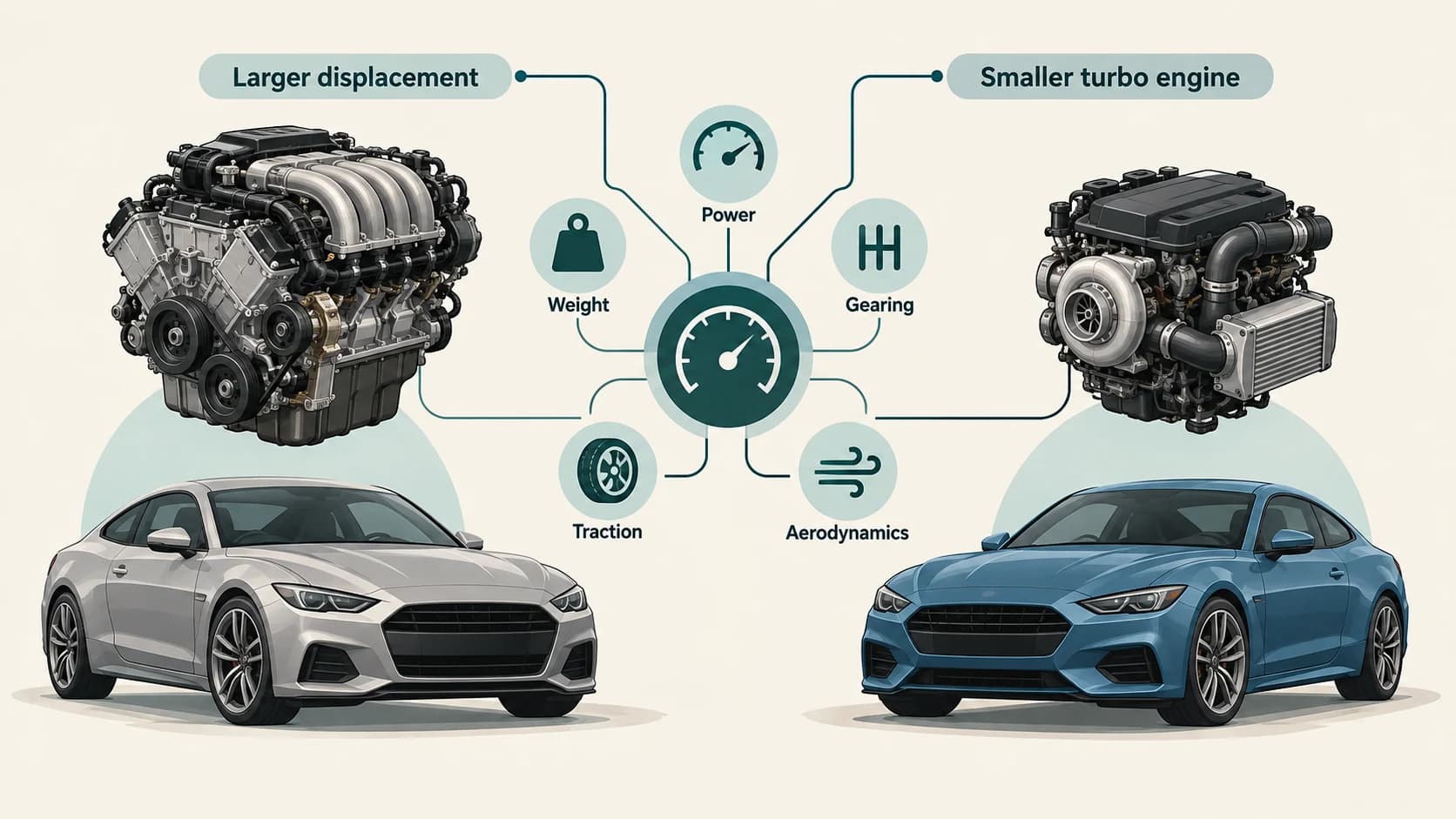
Imagine two cars.
One has a 3.0-litre engine.
The other has a 1.6-litre engine.
Without knowing anything else, which one is faster?
It is tempting to choose the 3.0-litre car. After all, its engine is almost twice as large.
But engine size is not a speed rating.
Toyota's 2026 GR Corolla, for example, uses a turbocharged 1.6-litre three-cylinder engine producing 300 horsepower. Mazda's 2026 CX-50 with a naturally aspirated 2.5-litre four-cylinder produces 187 horsepower. These are very different vehicles and should not be compared as a direct performance contest, but their engines make the point clearly: more displacement does not automatically mean more power.
And even horsepower does not tell you everything about how fast an entire car will be.
To understand why, we need to separate three questions that are often mixed together:
How big is the engine?
How much power does the engine produce?
How effectively can the car turn that power into speed?
They are related.
They are not the same thing.
What Does “Engine Size” Actually Measure?
When a car is described as having a:
- 1.0-litre engine
- 1.5-litre engine
- 2.0-litre engine
- 5.0-litre engine
that number refers to engine displacement.
Displacement is the total volume swept by all the engine's pistons as they move through their cylinders.
Ford defines engine displacement as the total cylindrical volume through which the pistons move from one end of their stroke to the other.
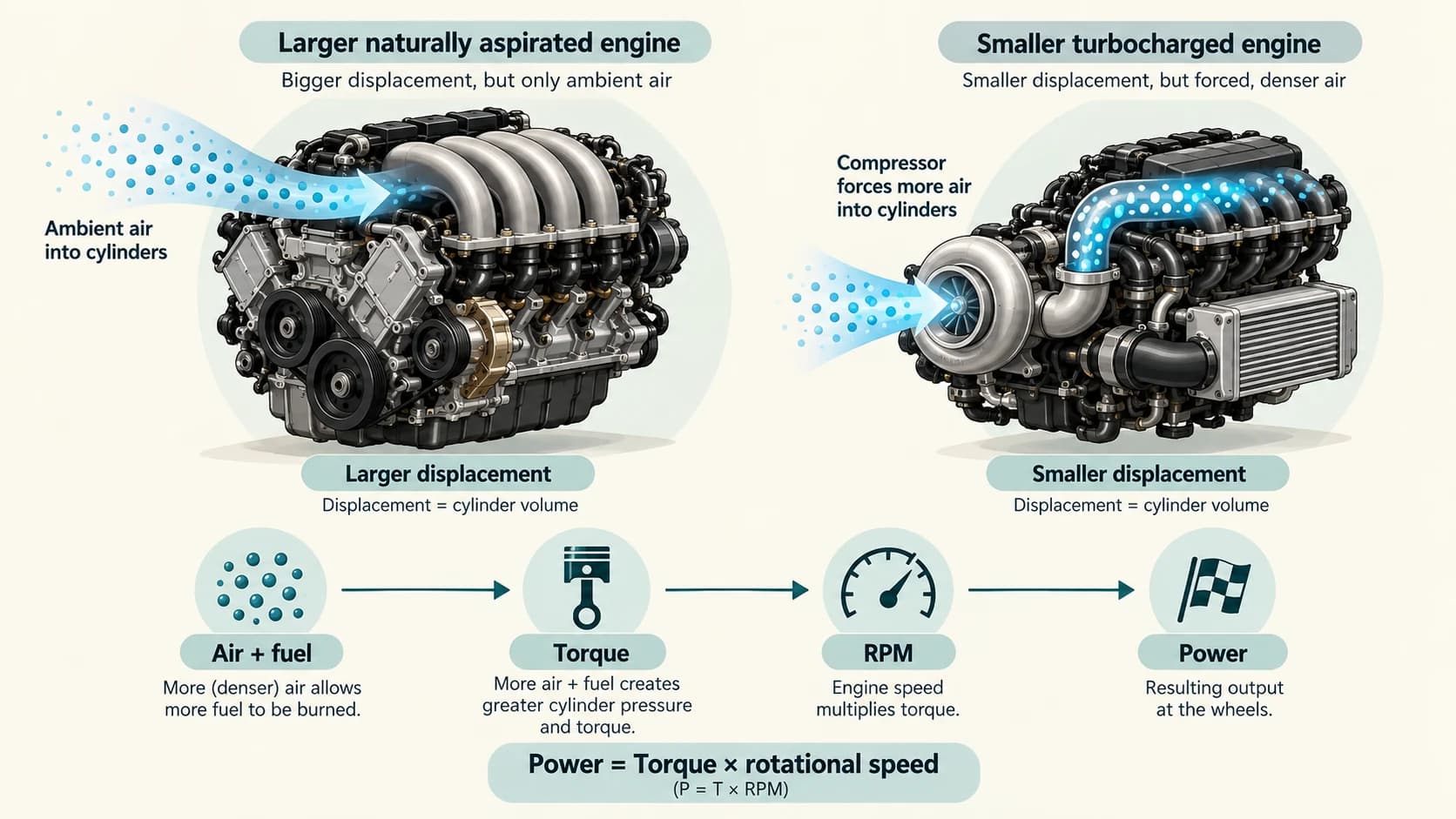
Very roughly, a larger naturally aspirated engine has room to draw in more air during each cycle.
More air allows more fuel to be burned.
More fuel burned effectively can produce more energy.
This is why, all else being equal, increasing displacement can increase power.
The important phrase is:
all else being equal.
Modern engines are rarely equal in everything else.
A Bigger Engine Has More Capacity, Not Guaranteed Performance
Think of displacement as the physical capacity of an engine's cylinders.
A large engine has the potential to move a large quantity of air.
But actual power depends on how effectively the engine fills those cylinders, how much fuel it can burn, how efficiently combustion energy becomes mechanical work and how quickly the engine can repeat that process.
Two engines of exactly the same size can therefore produce very different outputs.
Mazda provides a particularly clear real-world example.
Its 2026 CX-50 offers two 2.5-litre gasoline engines:
- naturally aspirated 2.5L: 187 hp
- turbocharged 2.5L: up to 256 hp on the specified premium fuel
Same displacement.
A difference of almost 70 horsepower.
The turbocharger is a major reason.
Turbocharging Changed the Meaning of Engine Size
A naturally aspirated engine relies mainly on atmospheric pressure and piston movement to draw air into its cylinders.
A turbocharged engine actively compresses the incoming air.
A turbo uses energy in the exhaust gases to drive a turbine, which powers a compressor on the intake side.
That compressor forces denser air into the engine.
Garrett explains the underlying principle: engine power depends heavily on how much air and fuel can enter the cylinders. Compressing the intake air allows a greater mass of air into the same fixed cylinder volume, which allows additional fuel to be burned and therefore more power to be produced from the same displacement.
Conceptually:
1.6L naturally aspirated
might inhale one amount of air
while
1.6L turbocharged
can force substantially more air into the same cylinders.
The physical displacement is unchanged.
The amount of air processed at high load is not.
The U.S. EPA similarly describes turbochargers as forcing additional air—and therefore allowing additional fuel—into an engine so that a turbocharged engine can produce more power than an identically sized naturally aspirated engine.
That is why a modern small turbo engine can sometimes produce power once associated with much larger engines.
This Has Been Happening Across the Car Industry for Decades
The change is not limited to a few performance cars.
The EPA's 2026 Automotive Trends Report found that average gasoline-engine displacement has fallen substantially over the long term while horsepower has generally increased.
For model-year 2024 vehicles in its dataset, average engine displacement was about 2.6 litres, compared with just under five litres in 1975. At the same time, the EPA reports that specific power, or horsepower produced per unit of displacement, more than doubled between 1975 and 2024.
Technologies contributing to this include:
- turbocharging
- direct fuel injection
- higher compression ratios
- improved valve timing
- better combustion control
- improved cooling
- more sophisticated engine management
So comparing two engines purely by litres increasingly tells you less about their actual output.
Horsepower and Torque Matter More Than Displacement
Once you know engine size is not the same as output, the next numbers to examine are usually:
torque
and
power.
They describe related but different aspects of the engine.
Torque is twisting force
The engine's crankshaft rotates.
Torque describes the turning effect the engine produces at the crankshaft.
A strong torque output can help a vehicle:
- accelerate
- pull a load
- climb gradients
once the transmission converts that torque into force at the wheels.
Power tells you how quickly work can be done
Power combines torque with rotational speed.
In rotational machinery:
Power = Torque × Angular Speed
For the familiar U.S. automotive units, Ford gives the relationship as:
Horsepower = Torque (lb-ft) × RPM ÷ 5252.
This is why engine speed matters.
Imagine two engines producing the same torque.
If one can maintain that torque at much higher RPM, it can produce more power.
So a smaller engine that:
- breathes efficiently
- uses turbocharging
- produces strong torque
- continues producing it at higher engine speed
can make considerably more power than a larger, less aggressively tuned engine.
Peak Torque Alone Doesn't Tell You Which Car Accelerates Faster Either
Suppose one engine produces 400 Nm.
Another produces 350 Nm.
Does the 400 Nm car automatically accelerate faster?
No.
The transmission sits between the engine and the road.
Gear ratios can multiply engine torque before it reaches the wheels.
A shorter first gear can produce much more wheel torque than a taller gear from the same engine.
Toyota describes the close ratios in the GR Corolla's eight-speed automatic as helping maximize delivery of engine power and torque to the wheels while keeping the engine in useful RPM ranges.
That is why two cars with similar engines can feel very different depending on:
- gear ratios
- final-drive ratio
- shift speed
- number of gears
- transmission programming
The engine produces the power.
The transmission determines how that power is converted into wheel speed and wheel torque at a particular moment.
Weight Can Undo a Large Power Advantage
Now imagine two hypothetical cars.
Car A
400 hp
2,100 kg
Car B
320 hp
1,300 kg
Which accelerates faster?
You cannot answer reliably from horsepower alone.
Car A has more power.
But it also has much more mass to accelerate.
Newton's second law tells us:
Force = mass × acceleration
or:
acceleration = force ÷ mass.
For a given net driving force, increasing mass reduces acceleration.
This is why power-to-weight ratio is often much more informative than raw horsepower when thinking about acceleration.
A lightweight sports car does not necessarily need an enormous engine to feel quick.
A heavy luxury SUV may need hundreds of horsepower simply to achieve similar acceleration.
The EPA also treats power, weight and acceleration as interconnected vehicle attributes rather than assuming horsepower by itself determines acceleration performance.
The Tires Must Be Able to Use the Power
Even an extremely powerful engine is useless for acceleration if the tires cannot transfer that force to the road.
Imagine a rear-wheel-drive performance car accelerating hard on a wet road.
The engine may have enough power to spin the rear tires.
Once the tires lose traction, additional engine output does not necessarily produce equivalent forward acceleration.
It may simply produce:
wheelspin.
This is why high-performance cars pay so much attention to:
- tire compound
- tire width
- suspension geometry
- differential design
- traction control
- all-wheel drive
- weight transfer
At low speeds in particular, a car can be traction-limited rather than power-limited.
A less powerful all-wheel-drive car with excellent launch traction can sometimes accelerate more effectively from rest than a more powerful car struggling to put its power down.
“Faster” Can Mean Several Different Things
This is another reason engine-size comparisons become confusing.
When someone says:
“Which car is faster?”
they might mean:
Faster from 0–100 km/h
This depends heavily on:
- power-to-weight ratio
- traction
- gearing
- launch control
- shift speed
Faster when overtaking
For example:
80–120 km/h
This depends on available power at that road speed, transmission behaviour and which gear the car selects.
Higher top speed
At high speed, aerodynamics become increasingly important.
Faster around a racetrack
Now you also have to consider:
- brakes
- tires
- suspension
- cornering grip
- cooling
- weight distribution
- aerodynamics
A bigger engine might help in all of these situations.
It does not decide any of them by itself.
Aerodynamics Become Increasingly Important at High Speed
Driving faster means pushing air out of the way faster.
The aerodynamic drag equation is:
Drag = ½ × air density × drag coefficient × frontal area × velocity²
NASA's explanation of the drag equation shows that, for the same shape and air conditions, aerodynamic drag rises with the square of speed.
So if speed doubles, aerodynamic drag becomes roughly four times as large.
And because power is force multiplied by velocity, the power required to overcome aerodynamic drag rises roughly with the cube of speed, all else being equal.
This is why top speed becomes expensive in terms of power.
An additional 50 horsepower that creates a dramatic difference at moderate speed may produce a much smaller increase in maximum speed.
It also explains why a sleek lower-powered car can sometimes achieve an unexpectedly high top speed, while a powerful but aerodynamically inefficient vehicle encounters enormous resistance.
Engine displacement tells you nothing about:
- drag coefficient
- frontal area
- body shape
Yet those factors become critical when discussing top speed.
A Large Engine Can Be Designed for Something Other Than Speed
Imagine a large engine in:
- a pickup truck
- luxury sedan
- off-road vehicle
Its designers may prioritize:
- low-RPM torque
- towing
- smoothness
- durability
- effortless cruising
rather than maximum horsepower per litre.
A smaller performance engine may be tuned much more aggressively.
It might use:
- high boost pressure
- higher engine speed
- aggressive valve timing
- stronger internal components
- sophisticated cooling
to extract far more power from each litre of displacement.
Neither design is inherently better.
They were engineered for different jobs.
Fuel Type and Engine Calibration Can Change Output Too
Even the same physical engine can produce different power figures under different operating conditions or calibrations.
The 2026 Mazda CX-50 2.5 Turbo, for example, is rated at 256 hp on 93-octane premium fuel but 227 hp on regular 87-octane fuel.
The engine remains 2.5 litres.
Its output changes.
Modern engine computers constantly control variables such as:
- ignition timing
- boost pressure
- fuel delivery
- valve timing
- knock protection
So even after you know displacement and hardware, software calibration still matters.
Hybrid Assistance Makes Engine Size Even Less Useful
Now add an electric motor.
A hybrid performance car might combine:
small gasoline engine
plus
electric motor
plus
battery
The combustion engine's displacement now tells you only part of the vehicle's performance capability.
Mercedes-AMG's C 63 S E PERFORMANCE is an extreme example: its powertrain combines a 2.0-litre turbocharged four-cylinder engine with an electric motor for a quoted combined system output of 500 kW / 680 PS in the version introduced by Mercedes-AMG.
This should not be compared directly with a conventional combustion engine purely by displacement because the electric motor contributes to the system output.
That is precisely the point.
Once electrification enters the picture, the question:
“How many litres is the engine?”
becomes an even weaker shortcut for predicting vehicle performance.
Engine Size Still Matters
None of this means displacement is meaningless.
If two engines use broadly similar technology, operate at similar RPM and have comparable tuning, the larger engine will usually have an inherent advantage in moving air.
Garrett summarizes the basic relationship clearly: all else being equal, larger engines flow more air and therefore tend to produce more power.
A larger displacement engine can also offer advantages such as:
- strong torque without heavy turbo boost
- less need for extremely high RPM
- relaxed power delivery
- capacity for substantial output
That is why large engines remain useful in many high-performance and heavy-duty applications.
The mistake is not believing displacement matters.
The mistake is treating displacement as if nothing else matters.
A Better Way to Compare Two Cars
Suppose you want to know which of two cars will actually be faster.
Instead of asking only:
Which has the bigger engine?
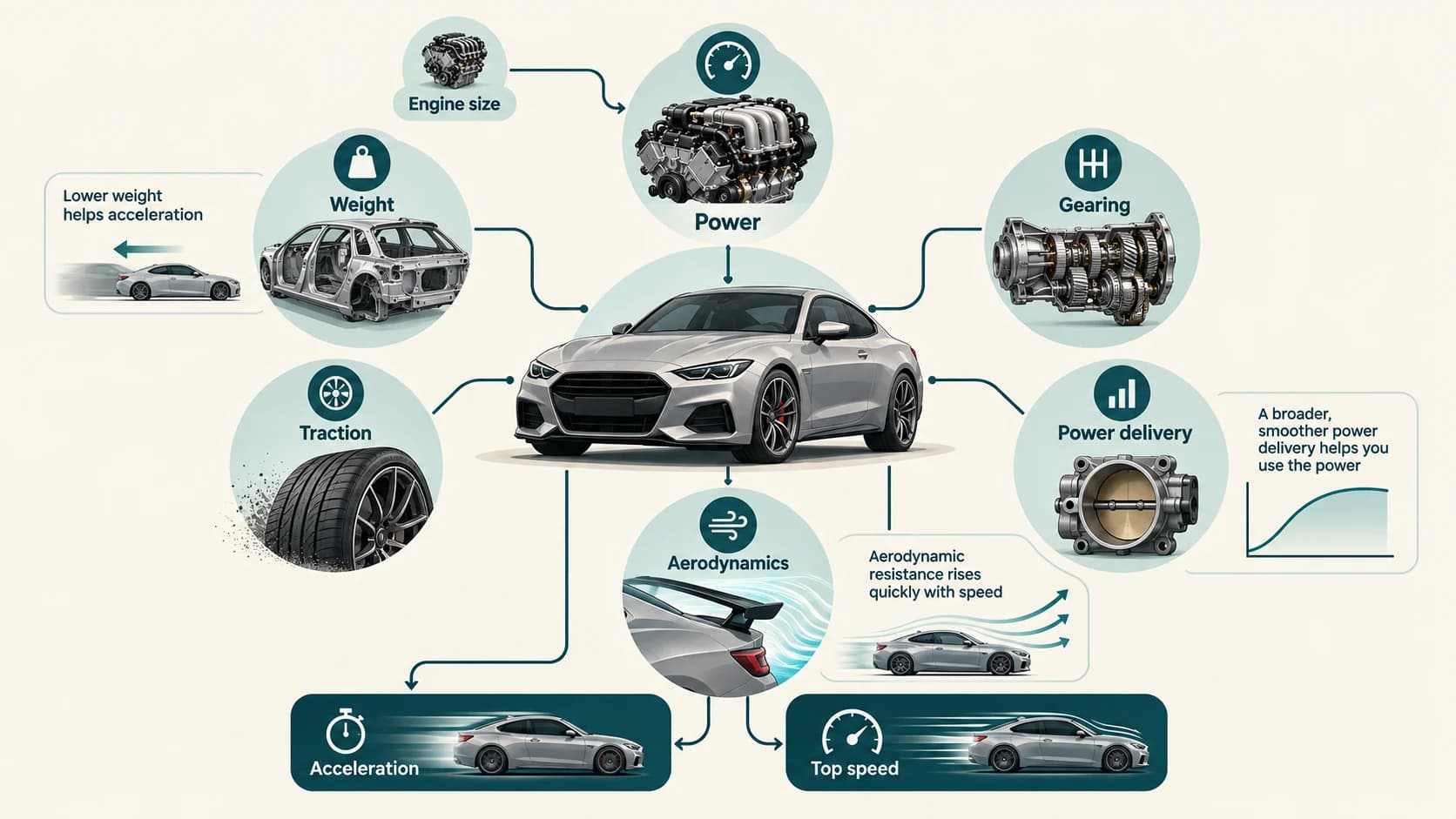
Look at the complete chain.
1. Engine or powertrain output
Check:
- horsepower or kW
- torque
- where that output occurs in the RPM range
2. Vehicle weight
A lighter vehicle needs less force to achieve the same acceleration.
3. Transmission
Consider:
- gear ratios
- number of gears
- shift speed
- transmission type
4. Driven wheels and traction
Ask:
- front-wheel drive?
- rear-wheel drive?
- all-wheel drive?
- what tires does it use?
5. Aerodynamics
Especially important for high-speed performance.
6. Power delivery
A wide torque curve can make a vehicle respond strongly over a broader range of engine speeds.
7. Actual performance testing
Ultimately, measurements such as:
- 0–100 km/h
- rolling acceleration
- quarter-mile time
- top speed
tell you more about the finished car than displacement alone.
What a Small Engine Can Do That Once Required a Big One
The evolution of the automobile itself provides perhaps the best answer to the original question.
The EPA's long-term data show that modern gasoline engines are producing far more power per unit of displacement than engines did decades ago. Between model years 1975 and 2024, specific power in non-hybrid gasoline engines more than doubled.
That happened because engineers found ways to make each litre of engine capacity work harder.
A litre is still a litre.
What changed is:
how much air enters it
how precisely fuel is delivered
how efficiently it burns
how quickly it can operate
how well the engine is controlled
And once that output reaches the crankshaft, the rest of the car matters too:
weight
gearing
traction
aerodynamics
So a 3.0-litre badge may tell you that one engine is physically larger than a 1.6-litre engine.
It does not tell you which car wins a race.
Engine displacement describes size.
Horsepower describes rate of work.
Torque describes turning force.
And actual vehicle speed is what happens when the entire machine manages to turn that output into motion.
That is why the better question is not:
“How big is the engine?”
It is:
“How effectively does the whole car turn its available power into performance?”