Why Does Your Car Get Different Mileage in the City and on the Highway?
Learn why cars usually use more fuel in city traffic, why highways can be more efficient, and why very high speeds can reduce mileage again.
You fill the tank, reset the trip computer and drive around town for several days.
The display shows:
11 km/l
Then you take the same car on a long highway trip and suddenly see:
17 km/l
Nothing changed about the engine. The fuel is the same. The car weighs almost the same.
So where did those extra kilometres per litre come from?
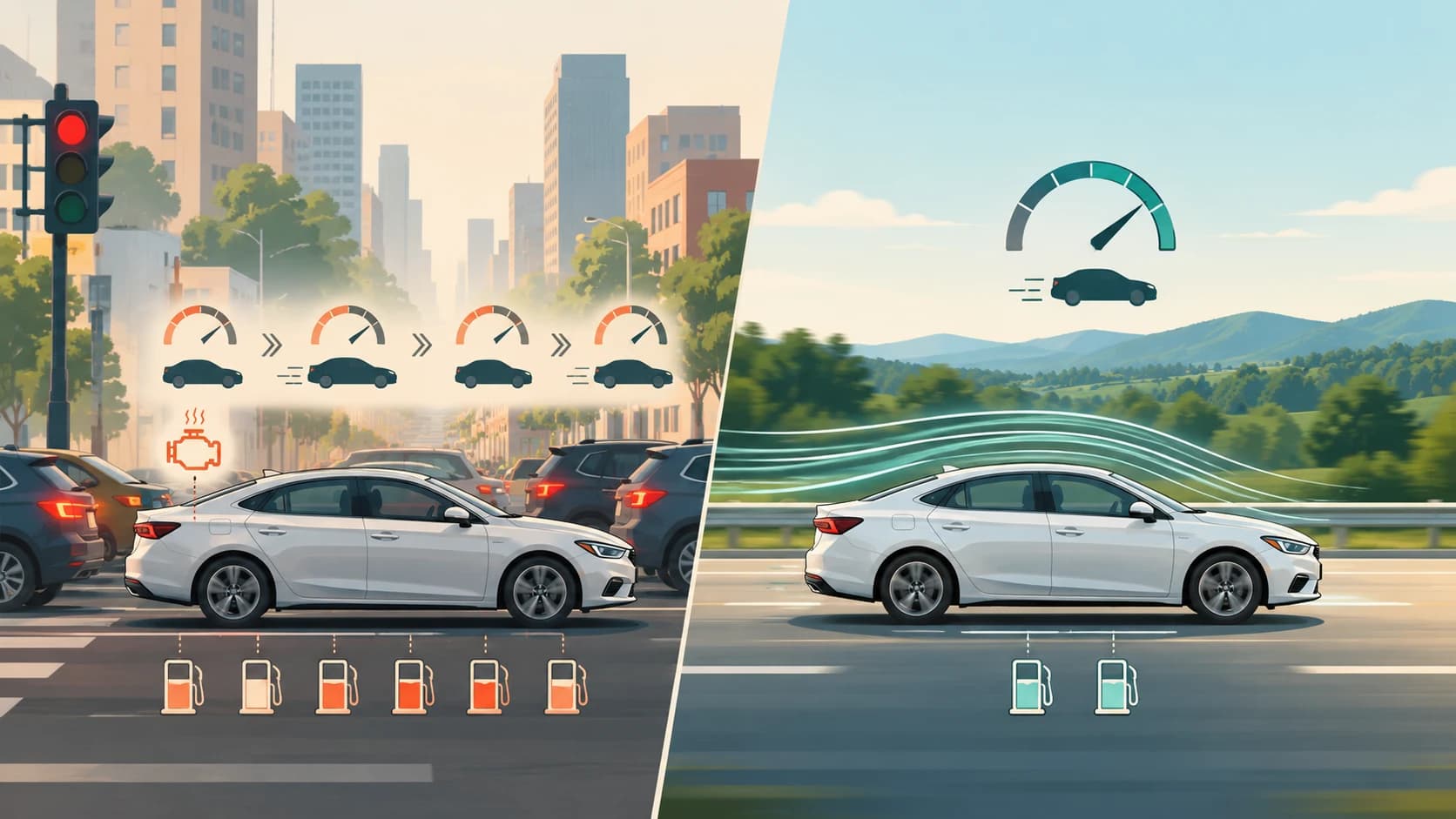
For a conventional petrol or diesel car, the biggest difference is usually how often the vehicle has to change its speed.
City driving repeatedly asks the engine to accelerate a heavy car, slow it down, sit in traffic and accelerate again. On an open highway, the car can often settle into a high gear and maintain nearly constant speed for long periods.
That is generally a much easier operating condition for the powertrain.
But the story has an important twist.
Drive fast enough on the highway and fuel economy starts falling again because pushing air out of the way becomes increasingly difficult. Hybrids complicate the picture further because they can recover some of the energy normally wasted during braking.
So “city mileage” and “highway mileage” are not two fixed properties of the engine.
They are the result of two very different patterns of energy use.
First, What Does “Mileage” Actually Measure?
In India, fuel economy is commonly expressed as:
kilometres per litre — km/l
A car returning 18 km/l travels approximately 18 kilometres for every litre of fuel consumed.
Other countries may express the same idea as miles per gallon, or MPG.
Whatever unit is used, fuel economy is affected by far more than the engine itself.
The car needs energy to:
- accelerate its mass
- overcome rolling resistance from the tyres
- push through the air
- climb hills
- operate accessories
- run the engine while stationary
How much energy goes into each of those jobs changes dramatically between urban traffic and open-road driving.
City Driving Keeps Throwing Away Speed
Imagine leaving home in city traffic.
You accelerate from rest.
Drive 300 metres.
Brake for a red light.
Wait.
Accelerate again.
Slow for traffic.
Accelerate.
Brake for another junction.
This cycle can happen dozens of times in a relatively short journey.
Every time you accelerate, the engine has to add kinetic energy to the vehicle.
A heavier car or a stronger acceleration demands more energy.
Then you press the brake pedal.
In a conventional non-hybrid car, most of that kinetic energy is ultimately converted into heat by the brakes and dissipated into the surroundings.
You paid for that energy with fuel.
Now it is gone.
At the next green light, the engine has to create the vehicle's speed again.
This repeated pattern is one of the fundamental reasons conventional cars generally consume more fuel in stop-and-go traffic. The U.S. Department of Energy specifically identifies stop-and-go driving as a condition that lowers fuel economy for conventional vehicles.
Maintaining Speed Is Easier Than Regaining It
Once a car is already moving at a steady moderate speed, the engine does not need to recreate its entire kinetic energy every few seconds.
It mainly has to replace the energy being lost to:
- tyre rolling resistance
- aerodynamic drag
- drivetrain losses
- accessories
- gradients
That can require much less fuel than repeatedly accelerating the entire vehicle.
This is why smooth driving matters.
If two drivers travel along the same urban road, the driver who repeatedly accelerates hard and brakes late will usually consume more fuel than someone who anticipates traffic and changes speed more gradually.
DOE guidance notes that aggressive acceleration and braking can significantly reduce fuel economy, particularly in stop-and-go conditions.
Idling Produces Zero Kilometres per Litre
Now consider what happens at a traffic signal.
The car is stationary.
The engine may still be:
- pumping air
- overcoming internal friction
- driving accessories
- running the air conditioner
- producing electrical power
Fuel is being consumed.
Distance travelled:
0 kilometres
During that period, your effective fuel economy for forward movement is therefore zero.
That is an unavoidable disadvantage for a conventional engine that continues running while the car is stopped.
DOE notes that idling consumes fuel, which is why automatic stop-start systems shut the engine off during suitable stationary periods.
One traffic light does not destroy your fuel economy.
Hundreds of stops across repeated urban trips add up.
Highway Driving Removes Many of Those Losses
Now imagine a relatively clear highway.
You accelerate to cruising speed once.
The transmission selects a high gear.
The engine settles at a relatively stable operating point.
You may then travel tens of kilometres without:
- stopping
- repeatedly accelerating from rest
- sitting at traffic lights
- constantly changing gears
The EPA's city and highway test cycles illustrate this contrast directly: its urban test represents stop-and-go operation, while the highway schedule represents freer-flowing driving with much less idling and no routine stops.
The highway does not magically make the engine more efficient.
It creates a driving pattern in which less of the engine's work is repeatedly being discarded.
High Gears Help Too
At cruising speed, the transmission can usually use one of its taller gears.
That means the wheels can turn quickly while the engine runs at a comparatively moderate RPM.
Modern automatic transmissions, CVTs and multi-speed gearboxes are designed partly to keep the engine operating in efficient regions whenever the driver does not demand high power.
For example, cruising at a steady 80 km/h may require only a fraction of the engine's maximum output.
The throttle can remain relatively stable, gear changes become infrequent and the engine does not have to repeatedly climb through its rev range.
This is one reason an open-road trip can produce surprisingly good fuel-economy figures.
So Is Slower Always More Efficient?
No.
If that were true, the best mileage would occur while barely moving.
Real cars have several competing losses.
At very low speeds, the engine still has to:
- remain running
- overcome internal friction
- power accessories
while covering little distance.
As speed increases, the vehicle covers more ground for each unit of time.
There is therefore usually a moderate-speed region where the vehicle is particularly efficient.
DOE data based on testing of multiple light-duty vehicles found that many reached their best fuel economy around moderate cruising speeds, while efficiency declined substantially at higher speeds. The exact optimum varies by vehicle.
And this brings us to the highway's biggest enemy.
Air Resistance Gets Much Worse as Speed Rises
At 20 km/h, aerodynamic drag is relatively small.
At 60 km/h, it matters much more.
At 100 or 120 km/h, the engine is spending a significant amount of its output simply pushing air around the vehicle.
Aerodynamic drag depends strongly on vehicle speed.
In simplified form:
Drag force ∝ speed²
So if speed doubles, aerodynamic drag can become roughly four times as large, assuming other factors remain the same.
DOE technical material identifies aerodynamics as a dominant energy-loss mechanism at higher vehicle speeds.
That produces an important result:
Highway driving can be more efficient than city driving without faster highway driving always being more efficient.
There is a difference between:
steady cruising
and
very high-speed cruising.
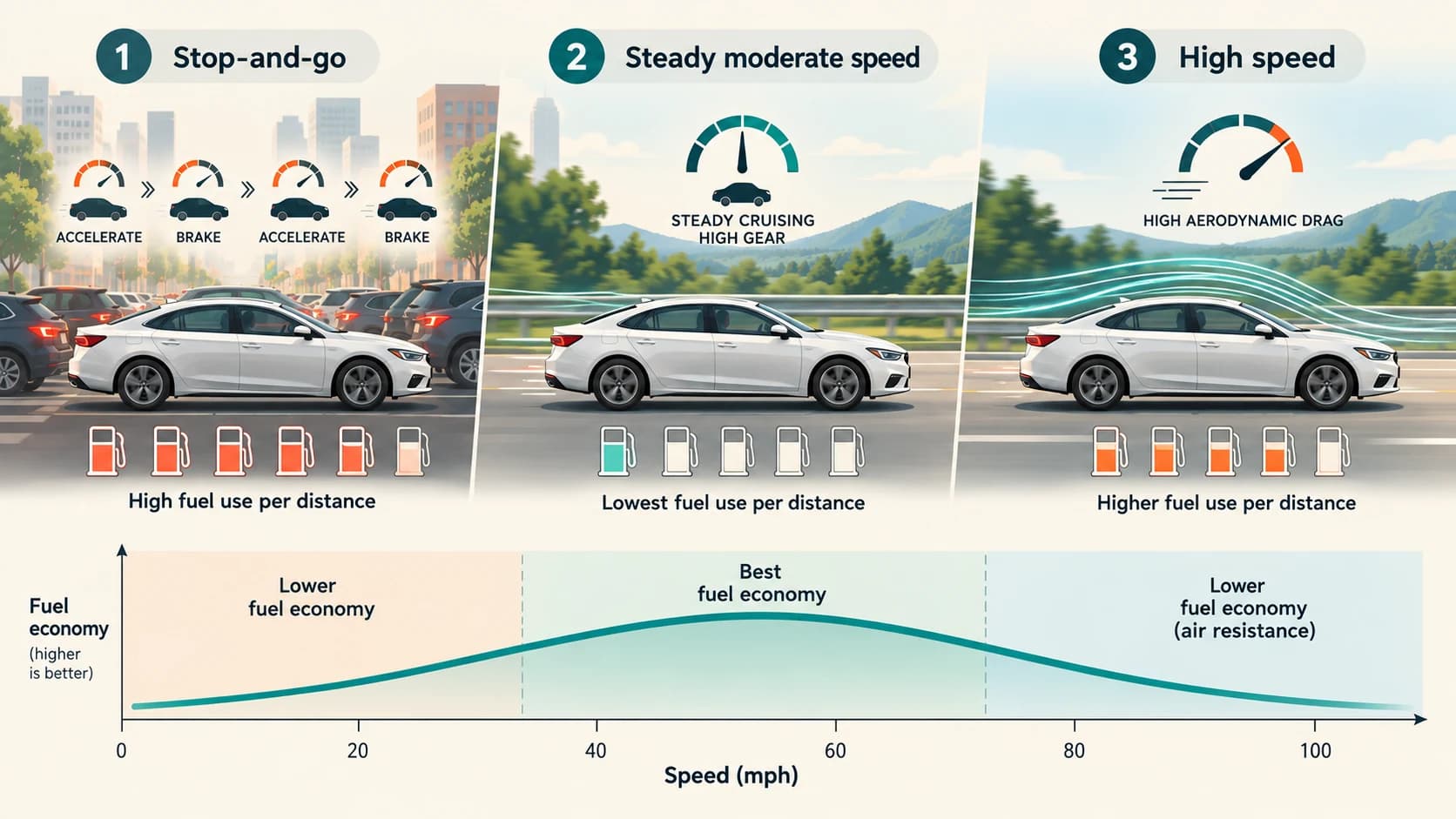
Why 80 km/h May Beat 120 km/h
Suppose your car travels at a steady 80 km/h.
The engine must overcome rolling resistance and aerodynamic drag.
Now increase the speed to 120 km/h.
You are covering ground 50% faster.
But the aerodynamic force has increased much more sharply than that.
The engine therefore needs substantially more power just to maintain the higher speed.
DOE cites testing in which average light-duty vehicle fuel economy fell significantly as cruising speed increased beyond the most efficient range.
This explains something many drivers notice:
A long drive at a relaxed highway speed may produce excellent mileage.
A long drive on the same highway at much higher speeds can give noticeably worse mileage even though you never encounter traffic.
City Traffic Also Keeps the Engine Away From Its Ideal Operating Point
Combustion engines do not operate at equal efficiency under every combination of:
- RPM
- load
- temperature
- throttle position
City driving constantly moves between different operating conditions.
One moment the engine is lightly loaded.
Then you accelerate hard.
Then you lift off.
Then you idle.
Then you accelerate again.
Highway cruising is often much more stable.
The engine and transmission can settle into a relatively efficient combination of gear, RPM and load.
This is another reason that two journeys covering the same number of kilometres can require different amounts of fuel.
Short Trips Make City Mileage Even Worse
Urban driving often consists of short journeys.
Start the car.
Drive three kilometres.
Park.
Start it again later.
A cold engine does not immediately operate exactly like a fully warmed one.
Oil, coolant, catalytic-converter temperature and engine-management strategy all change during warm-up.
The EPA includes cold-temperature and cold-start conditions in fuel-economy testing precisely because real-world economy varies with conditions that simple warm-engine testing would miss.
Short trips can therefore be especially inefficient because a larger percentage of the journey takes place before the entire powertrain has reached normal operating conditions.
A 300-kilometre highway journey warms the vehicle once.
Ten short city trips may involve ten separate starts and warm-up periods.
Air Conditioning Can Change the Numbers Too
Your mileage is not determined only by propulsion.
Accessories consume energy.
Air conditioning is a particularly noticeable example in hot weather.
In a conventional combustion car, the compressor ultimately places an additional load on the engine.
That means more fuel may be required.
EPA fuel-economy procedures account for air-conditioning operation because it can materially affect real-world fuel use.
The effect can appear larger during slow city journeys because:
- journey times may be long relative to distance
- the cabin may repeatedly heat up while parked
- the compressor may work hard despite the car covering few kilometres
But highway A/C still consumes energy too.
Why Heavy Traffic Is Worse Than Normal City Driving
There is a major difference between:
urban driving at 40–50 km/h with relatively few stops
and
crawling through congestion at 5–15 km/h.
In severe traffic, the car may spend much of its time:
- idling
- creeping
- accelerating a few metres
- braking again
The engine is running for a long period while very little distance appears on the odometer.
That can produce extremely poor km/l figures.
This is also why average speed on the trip computer often gives useful context.
An urban trip averaging 35 km/h is very different from one averaging 12 km/h even if both are labelled “city driving.”
Hills Can Change Highway Mileage Dramatically
Not every highway is flat.
Driving uphill increases the vehicle's gravitational potential energy.
The engine has to provide that energy, so fuel consumption rises.
Driving downhill gives some of it back, but a conventional car may not recover all the energy used during the climb.
Braking on the descent can dissipate some of that energy as heat.
EPA guidance specifically notes that hilly or mountainous driving can reduce real-world fuel economy.
So:
flat highway ≠ mountain highway
even if traffic and average speed are similar.
Tyres Matter in Both City and Highway Driving
A tyre deforms as it rolls.
That deformation consumes energy and creates rolling resistance.
Low tyre pressure generally increases rolling resistance because the tyre deforms more.
Your engine must then provide additional energy to keep the car moving.
EPA therefore recommends proper tyre inflation as one factor that helps maintain fuel economy.
At low and moderate speeds, rolling resistance can represent a particularly important share of the forces opposing the vehicle.
At higher speeds, aerodynamic resistance becomes increasingly dominant.
Why Hybrids Can Reverse the Usual Pattern
Here is the interesting exception.
Some hybrid cars can achieve similar or even better fuel economy in the city than on the highway.
Why?
Because several things that hurt a conventional car become opportunities for a hybrid.
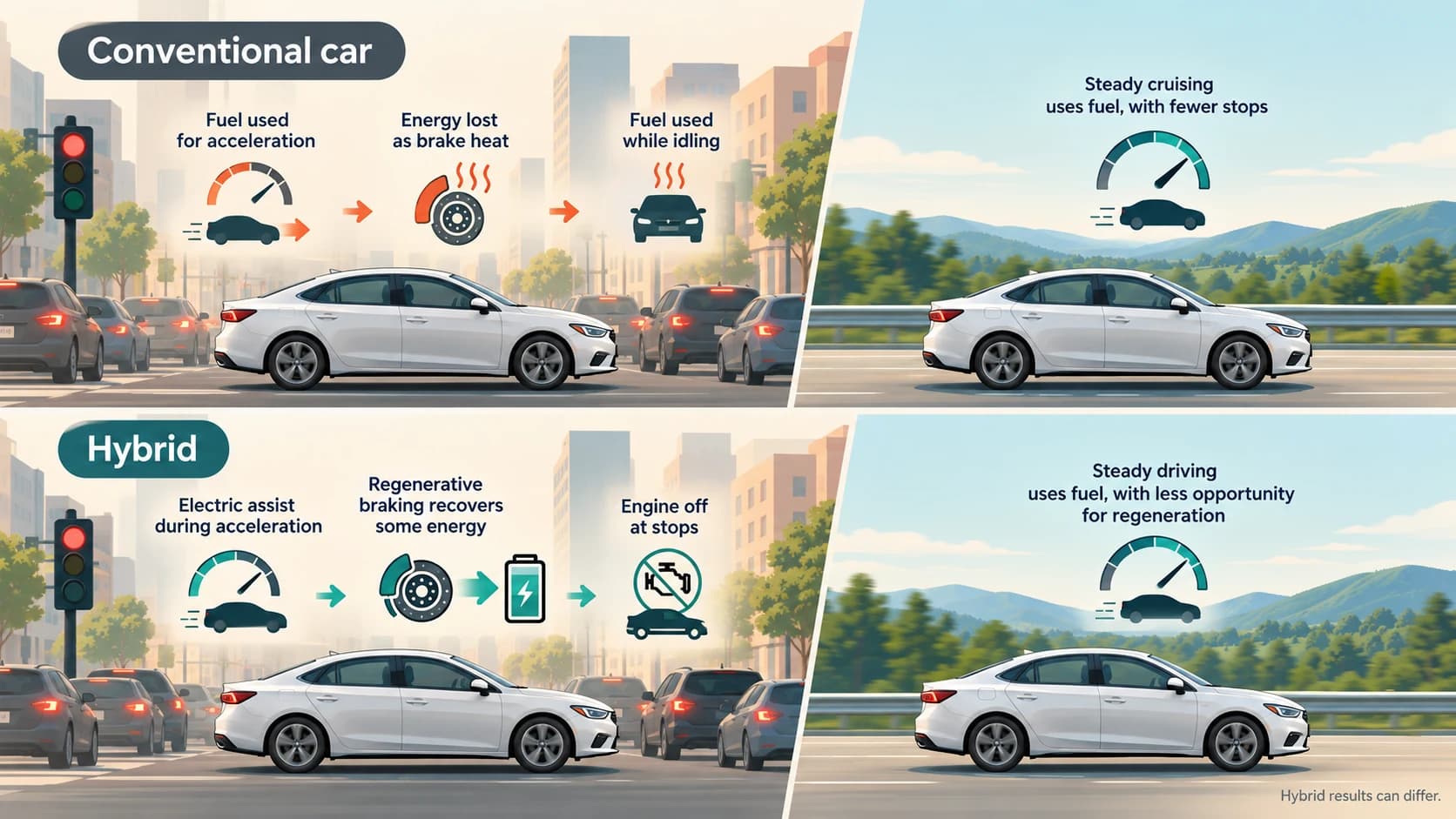
Regenerative braking recovers some energy
When a conventional car brakes, kinetic energy is largely converted to heat.
A hybrid can use its electric motor as a generator during some braking events.
The wheels drive the motor.
The motor generates electricity.
The battery stores part of that energy.
Later, the electric motor can use the recovered electricity to help move the car again.
DOE describes regenerative braking as recovering energy that would otherwise be lost during braking, which makes it particularly useful in stop-and-go driving.
The engine can shut off while stopped
A full hybrid does not necessarily need to keep the combustion engine running at every traffic light.
That reduces idle fuel consumption.
Electric motors work well at low speed
Some hybrids can move short distances using electric power alone or use the electric motor to assist the engine during acceleration.
These advantages are especially useful in urban traffic.
DOE specifically notes that hybrids can achieve strong efficiency gains in stop-and-go conditions because of regenerative braking and reduced idling.
So the common rule:
city mileage worse, highway mileage better
works reasonably well for many conventional petrol and diesel cars.
It is not universal.
Electric Cars Behave Differently Too
Battery-electric vehicles create another reversal.
They do not idle a combustion engine at traffic lights.
Their electric motors are highly efficient.
And regenerative braking can recover energy during deceleration.
At high highway speeds, however, aerodynamic drag still rises rapidly.
DOE therefore notes that EVs are often more efficient in city driving than highway driving because urban operation benefits from regenerative braking while highway driving requires more energy to overcome higher aerodynamic drag.
The road is the same.
The powertrain changes which parts of the driving cycle are wasteful.
Why Your Real Mileage Doesn't Match the Brochure Exactly
Fuel-economy ratings are useful because they provide standardized comparisons between vehicles.
But they are not promises that every owner will see exactly the same number.
EPA testing uses defined city, highway, high-speed, air-conditioning and cold-temperature cycles, then adjusts the results to better reflect real-world operation.
Your real drive may involve:
- heavier traffic
- different speeds
- steeper roads
- more passengers
- more luggage
- stronger A/C use
- different tyres
- aggressive acceleration
- unusually short journeys
- weather that differs from the test conditions
That is why two owners of the same model can report noticeably different fuel economy.
What Actually Determines Your City-to-Highway Difference?
For a conventional combustion car, the difference can be summarized like this:
| City driving | Highway driving |
|---|---|
| Frequent acceleration | Long periods at steady speed |
| Frequent braking | Little braking |
| More idling | Very little idling |
| Often lower gears | Often higher gears |
| More short journeys | Longer continuous journeys |
| Lower aerodynamic drag | Higher aerodynamic drag |
| Engine repeatedly changes load | More stable engine operation |
This is why highway economy often wins.
But highway speed matters.
Once you drive fast enough, increasing aerodynamic drag starts taking back some of the advantage.
The fuel-economy curve therefore looks less like:
faster = better
and more like:
very slow / stop-start → inefficient
↓
steady moderate speed → efficient
↓
very high speed → increasingly inefficient
The exact curve differs between vehicles.
How Can You Improve City Mileage?
You cannot remove traffic lights, but you can avoid wasting additional energy.
Accelerate smoothly
You still need to reach traffic speed.
The goal is not painfully slow acceleration.
It is avoiding unnecessary bursts of throttle followed immediately by braking.
Look farther ahead
If the light ahead is already red, maintaining full throttle until the last moment only means converting more fuel into brake heat.
Avoid unnecessary idling
If your car has a factory stop-start system, it exists specifically to reduce fuel consumed while stationary under suitable conditions.
Combine short journeys
One longer trip can avoid repeated cold starts.
Keep tyres correctly inflated
Follow the pressure specified by the vehicle manufacturer, normally listed on the vehicle placard or in the manual.
How Can You Improve Highway Mileage?
Maintain a steady speed
Repeated acceleration and braking wastes energy even on an open road.
Do not assume faster is more efficient
Once aerodynamic drag becomes substantial, additional speed costs fuel rapidly.
Remove unnecessary external drag
Roof boxes, racks and objects mounted outside the vehicle can disturb airflow.
EPA lists roof racks among factors that can reduce fuel economy.
Avoid carrying unnecessary weight
Extra mass increases the energy needed during acceleration and on climbs.
The Real Difference Is What Happens to the Energy
The simplest way to understand city and highway mileage is to follow the energy from the fuel tank.
In city traffic:
Fuel
↓
Engine creates motion
↓
Car accelerates
↓
Brakes turn much of that motion into heat
↓
Car stops
↓
Engine may consume fuel while going nowhere
↓
Repeat
On a clear highway:
Fuel
↓
Engine creates motion
↓
Car reaches cruising speed
↓
Engine mainly replaces rolling and aerodynamic losses
↓
Car continues covering distance
The second pattern usually wastes less energy in a conventional car.
But increase highway speed enough and aerodynamic resistance grows until it begins consuming much more of the engine's output.
And introduce hybrid regenerative braking, and the stop-start equation changes again.
That is why your car can produce 11 km/l on Monday's commute, 17 km/l on Sunday's highway journey and something entirely different on a mountain road.
The engine did not forget how efficient it was.
You gave it a different job.