Why Can Two People Receive Different Search Results for the Same Google Query?
Why does Google show different results for the same search? Understand location, language, personalization, timing and how to compare results fairly.

Two people sit next to each other, open Google and type exactly the same words: best laptop for students.
One sees buying guides and stores that sell laptops nearby. The other sees a different mix of articles, videos and shopping results. Even the order of the familiar websites may differ. Both searches were legitimate. Neither person necessarily did anything wrong.
Why doesn't Google return one identical list to everyone?
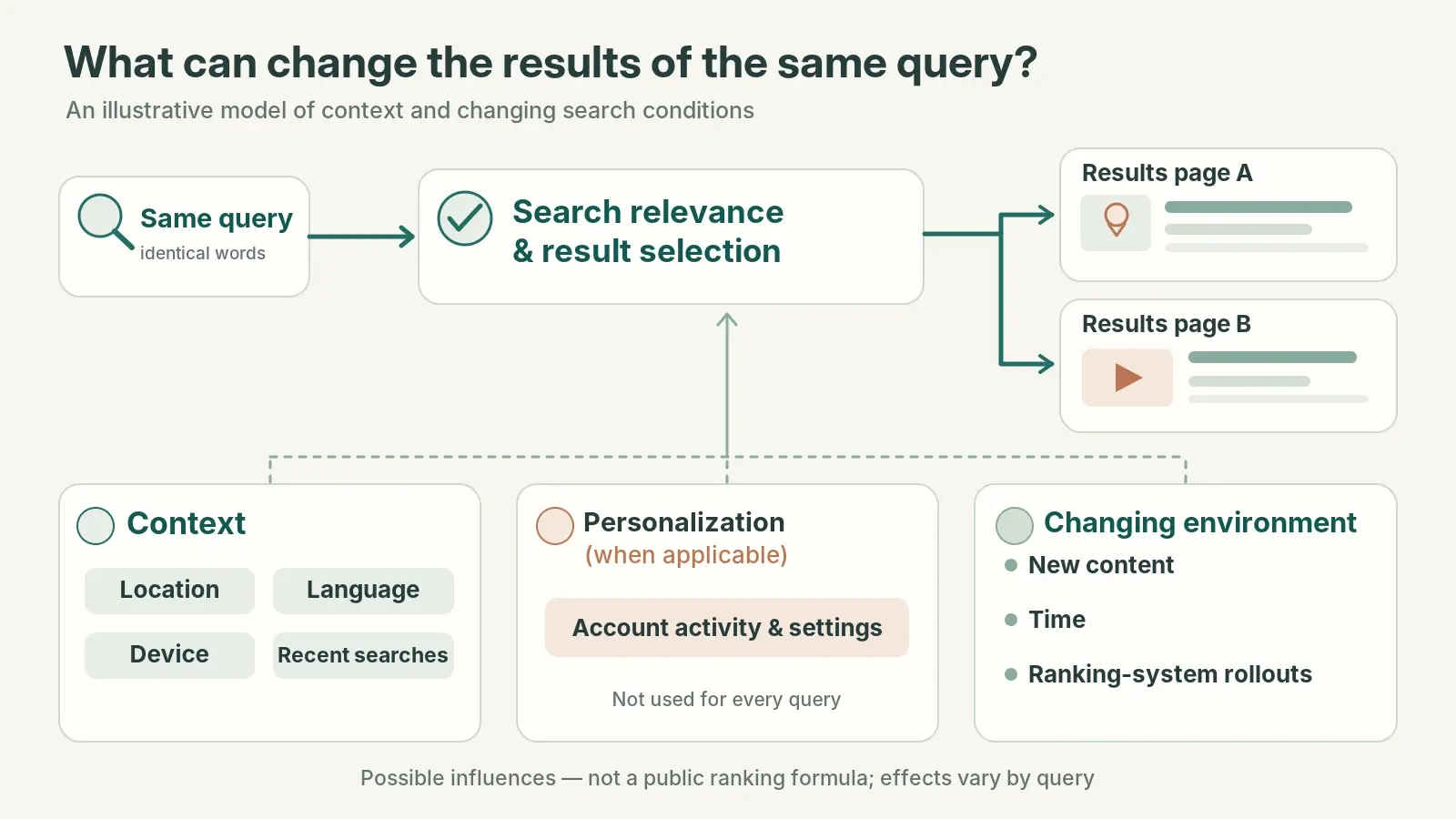
Because a search query is not the entire input to Google Search. The system also considers context such as location, language, device and the availability of recently indexed content. In some circumstances, past activity and personalization settings can influence individual results or how result groups appear. And the results themselves are not frozen: Google continuously changes what content is available and how its systems evaluate it.
The crucial distinction is that different results do not automatically mean personalization. Two people can see different pages even when personalized recommendations are disabled. Understanding the difference helps you search more effectively—and prevents misleading conclusions about privacy, search-engine bias and a website's position in Google.
Google Does Not Keep One Universal List for Every Query
Think about what a search engine has to do after you enter a phrase such as python tutorial.
It first needs to find candidate material in an enormous index of web content. Then it has to interpret what you probably want, assess which pages are relevant and useful, and assemble an appropriate results page. Depending on the query, that page might include ordinary website links, videos, images, local listings, products or other search features.
Google describes its process in three broad stages: crawling, indexing and serving search results. Its Search Central explanation says that relevance can depend on hundreds of factors, including the searcher's location, language and device.
This means two separate things can change:
- Which pages or content types Google selects. A local business listing might be helpful for one searcher but irrelevant to someone in another city.
- How the selected results are arranged. The same websites may appear at different positions, or a video group might appear before ordinary links in one search experience and after them in another.
You are not seeing a permanent leaderboard attached to those words. You are seeing a response generated for a particular query in a particular context at a particular time.
1. Location Can Change the Meaning of an Otherwise Identical Search
Location is the easiest difference to understand.
Search for dentist near me from two cities, and identical results would be a poor outcome. Someone in Chandigarh should normally see different nearby services from someone in Bengaluru.
But location matters even when the query does not contain the words near me.
Consider best vegetarian restaurant, weather, electricity complaint number or laptop repair. The most useful answer may depend on where the search is made. Searches about legal requirements, availability, prices or local events can also have regional relevance.
Google says it can obtain or estimate location using several signals. With permission, a device or Google service may provide a more precise location. Otherwise, Google may still estimate a general area from information such as the device's internet address. The Google Search location guide explains these distinctions.
Turning off GPS does not necessarily remove localization
This surprises people. Denying precise location permission is not the same as hiding your approximate geographic area from a website. Your internet connection still has an IP address that may indicate a city or region, though IP-based location can be imperfect.
So two people using different networks can receive different locally relevant results even if neither has given Google precise GPS access.
Example: Someone searching bank holiday today in one Indian state may have a different local need from someone searching the same words elsewhere. Whether Google actually interprets that particular query locally will depend on its systems and the available information; the example illustrates why region can matter, not a guaranteed ranking rule.
2. Language Is More Complicated Than a Single Setting
Searchers do not always use one language consistently.
A person might use an English-language phone, have a browser set to Hindi, and search for a topic using a mix of Hindi and English terms. Another might type the same English query but normally read articles in a different language.
Google's technical explanation of multilingual Search makes an important distinction: the display language controls interface elements such as buttons and menus, while Google's selection of search-result languages draws on several signals. Choosing English for the interface does not force every result to be in English.
That matters in multilingual countries such as India. A query like computer networking notes could plausibly be satisfied by a range of English or regional-language resources. Search systems try to match the language of the material to the user's likely needs rather than obeying a simplistic one-setting rule.
There are language filters if you specifically need results in one language, but Google's own documentation notes that these filters are not perfect for mixed-language material or every search feature.
The practical lesson: two people using the same search words can still have different language and regional contexts.
3. Recent Searches Can Supply Context Without Being Permanent Personalization
Imagine opening Google and searching for Jaguar.
Without more context, the word could refer to an animal or a car brand. Now imagine that, immediately beforehand, one person searched for wildlife habitats while another searched for luxury-car maintenance.
That illustrative sequence shows why context from recent searches can help a system interpret an ambiguous query. It does not prove which result Google will actually show for Jaguar in either session.
Google explicitly lists recent searches and related results after a user clicks a page and returns among the contextual factors that can affect an experience. These are distinct from the broader, account-based idea of personalization.
A search session can therefore matter because the system is trying to work out what the current task is. A user comparing programming courses, for example, might get different follow-on suggestions from a user comparing hardware stores—even where some query terms overlap.
A useful distinction is:
| Type of signal | What it can help with | Why it should not be confused with the others |
|---|---|---|
| Query context | Understand the words being searched now | Exists even when the searcher has little account history |
| Recent-session context | Understand the task or sequence of searches | May involve actions taken shortly before the current query |
| Account-based personalization | Tailor some results or recommendations based on saved account information and activity, when enabled | Depends on applicable personalization controls and whether Google uses it for that query |
Google does not disclose a complete formula specifying the weight of every signal for every search. A visible change alone cannot tell you which factor caused it.
4. Personalization Can Matter—but Not for Every Search
Personalization is the explanation people often reach for first: Google knows my interests, so my results must be unique to me.
There is some truth behind that idea, but it is easy to exaggerate it.
Google's Search Help page on differing results says that personalization may sometimes affect the order of individual results and sometimes the position of content groups, such as video results compared with ordinary website links. But not every query receives personalized results. In some cases, turning personalization off produces a page that looks almost the same.
Account activity and search-service history can contribute when the relevant settings allow it and Google considers it helpful. Personalization is one influence—not a guarantee that two account holders will live inside completely separate versions of the internet.
What does “Results are personalized” actually tell you?
Depending on the account, interface and current settings, Google may show a message near the bottom of Search indicating whether results are personalized. Where available, a Try without option lets you view a version of the query without that personalization. Google says using that one-time option does not change your account settings.
The distinction is valuable: if the results hardly move, personalization was not a major visible influence on that particular query. If some results move, that is evidence that it did affect the experience, but it does not reveal all other ranking factors.
Google is updating its Search-services settings, so the wording and placement of personalization controls may change. Its personalization help documentation should be consulted for the current interface.
Crucially, turning off personalized recommendations does not mean every searcher gets an identical results page. Location, language, device and current search context still exist.
5. Time Can Change Results Even When Both People Have the Same Settings
Suppose two people search for the same cricket match at different moments. A result published just before the second search may not have existed during the first. Google may have discovered a new page, updated its understanding of a page, or changed which information is most relevant because the event progressed.
Time is especially important for breaking news, live events, stock or currency information, product announcements and rapidly developing stories. But it also matters for apparently evergreen searches as new material enters the index.
Google's own explanation of why results differ explicitly identifies two less obvious sources of variation:
- Newly available web content can produce different results within minutes or hours.
- Improvements to ranking systems can take time to roll out across Google's data centers, so the data center answering each request may produce a different result during that process.
A shift in search results therefore does not necessarily imply that somebody changed a setting, searched anonymously or received a targeted response. Sometimes the underlying search environment changed.
That is also why taking two screenshots hours apart and attributing the difference to one person's account history is a weak experiment.
6. Device Type and Search Features Can Make Two Pages Look Different
A Google results page is not always a list of ten blue links.
Depending on the topic and the searcher, it can contain local listings, videos, images, shopping content or other features. Google notes that device type can influence context—for example, showing relevant app-store links—and that its results-page layout can differ between phone and desktop.
Imagine the same person searching from a laptop and a phone. Even if the principal organic webpages largely agree, the amount of screen space, result formatting and prominence of different content blocks may differ.
This creates a measurement trap: “I don't see the same thing at the top of the screen” is not always the same as “Google ranked the websites differently.” A search feature can push an ordinary web link farther down the page without that link disappearing from Google's organic results.
When comparing screenshots, distinguish the order of ordinary web results from the overall appearance of the results page.
Google's visual elements documentation describes how results can be presented differently by device, country and query language.
7. Filters, SafeSearch and Ads Create Other Kinds of Differences
Search settings can change the set of results a person is allowed or choosing to view.
For example, SafeSearch can filter or blur certain explicit content according to the selected mode and applicable account or network controls. A results page viewed through a Web, Images, Videos or News search filter is not necessarily comparable to an unfiltered All view.
Ads are another source of confusion. A sponsored placement can differ between users or search occasions, but a sponsored result is not an ordinary organic ranking position. Google states that buying search advertising does not buy a better position in its organic Search results.
So a fair comparison should record whether each person is looking at:
- the same query and search vertical or filter;
- the same SafeSearch and region/language settings;
- the same type of result (organic link, sponsored listing, local result or another feature).
Otherwise you may conclude that a website has changed position when you are comparing two different interfaces or result categories.
Can Incognito Mode Make Everyone's Results Identical?
No. Incognito can be useful for comparison, but it is not a switch that removes every influence on Search.
In a fresh Chrome Incognito session, ordinary browser cookies and previously signed-in account sessions are separated from your normal browsing session. That can reduce some account- and browser-history effects—provided you do not sign into the same account again.
However, Incognito does not make the internet connection invisible. Google can still have access to search context such as your approximate location from the connection, the language of the query and the device type. Results can also change over time regardless of browser mode.
In other words, Incognito may remove one variable while leaving several others untouched.
A VPN does not solve this comparison problem either. By changing the route of a connection, it may change the apparent network location—a factor that could make more results differ. Neither Incognito nor a VPN guarantees a universal or neutral ranking.
For the privacy distinction, see Does Incognito Mode Really Make You Anonymous?.
A Practical Experiment: Compare the Same Query Fairly
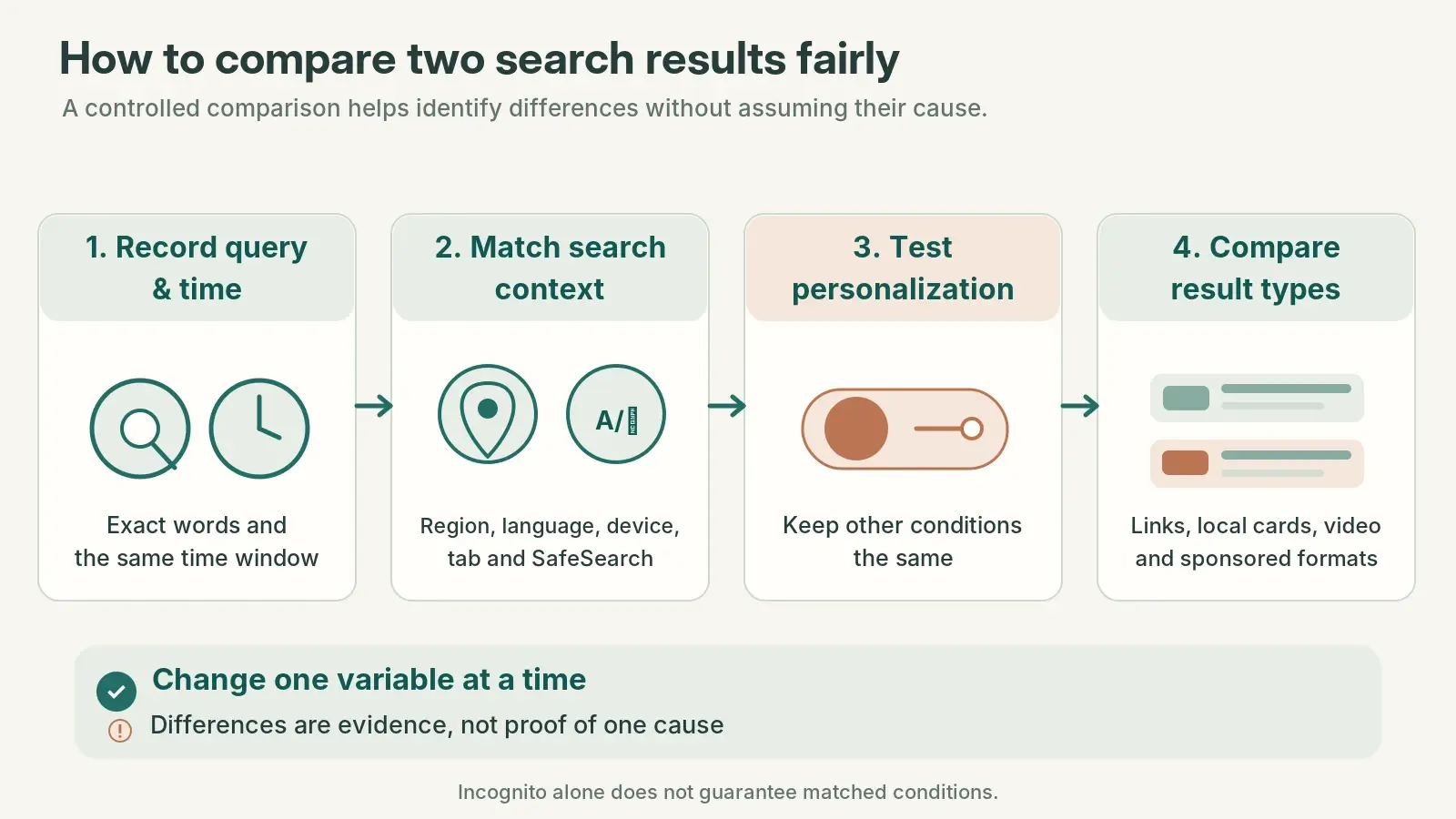
If you and a friend notice different results, a small controlled comparison can help identify possible causes. The aim is not to reverse-engineer Google's proprietary algorithm. It is to change fewer things at once.
Step 1: Capture the starting conditions
Write down the exact query, approximate time, country/region, whether you were signed in, device type, the search tab or filter, and SafeSearch status. Include screenshots if helpful. Do not compare a mobile All page with a desktop Web view and call it a ranking difference.
Step 2: Look at the location and language settings
Check the location indicated by Google and any relevant search-language or result-language settings. Note whether one person is on a home network and another on mobile data. You do not have to disclose precise locations to one another to establish that the regional contexts differ.
Step 3: Compare personalization on the same device
Where available, use Google's Try without link for the same query and compare the results. This is more informative about the effect of personalization than merely switching to a different device that also has different location and language signals.
If the option is not present, follow Google's current help instructions for personalization controls; do not assume every account has the same menu labels.
Step 4: Repeat quickly and change one variable
Compare as close in time as possible. If feasible, keep the device, region, language and search type constant while changing only one element—such as the signed-in state or personalization setting. Then reverse the change.
A result moving after a change is an observation, not conclusive proof of causation: ranking and index conditions can change independently, and Google does not reveal all inputs.
Step 5: Compare like with like
Record whether the difference is in organic web-link ranking, local results, videos, sponsored results or some other element. These are different kinds of variation and should not be collapsed into one number.
Here is how the experiment might be interpreted:
| Observation | A plausible explanation | What it does not prove |
|---|---|---|
| Local businesses differ between cities | Geographic relevance | Google used personal interests to reorder results |
| A newly published news page appears later | Content freshness or index changes | Either account was profiled |
| Results change with Try without | Personalization affected that query | All other results were personalized |
| Mobile shows prominent app or local features | Device context or results-page composition | Organic ranking must be entirely different |
| Incognito still shows local results | Location or other non-account context remains | Incognito has failed to separate ordinary browser history |
These are interpretation examples, not measurements from a controlled study of Google Search.
What Does This Mean for Someone Researching Important Information?
Differences in Search are not inherently bad. Local relevance is useful when finding a nearby hospital or an official government office. Language-aware results can help a student find explanations they can actually understand.
But the most convenient result is not automatically the most accurate or independent source. When researching a consequential question, compare original documents with summaries, inspect the source and its date, and consider whether your query is strongly local or time-sensitive.
For example, when researching a regulation, start with the relevant regulator's publication rather than assuming the first forum discussion represents the current rule. When comparing scientific claims, look for the underlying study and what it actually tested. A different ranking is a reason to evaluate the evidence—not automatically a sign of manipulation.
If you specifically want a broader view, try changing query wording, checking source types and using the appropriate date, language and region filters. Those actions may uncover useful material that was not prominent in your first search.
What Does It Mean for Website Owners and SEO?
A publisher may search for their own article and see it near the top, while a friend sees it farther down—or does not see it in the first screen of results. That single comparison is not a reliable measure of the article's ranking for everyone.
Google Search Console reports average position across actual search impressions. Google's documentation explicitly notes that a link's position can be different each time it appears and that the reported value is an average. The measure also depends on how results and result types are counted.
For a more meaningful picture, inspect Search Console performance over time and, where useful, segment by query, page, country, device and date. Pair position with impressions and clicks. If one reader's screenshot differs from the report, the two observations may simply be measuring different contexts.
The important editorial implication is not to chase an imagined universal “number one” screenshot. It is to write pages that meet real search intent, communicate clearly, cite reliable information and remain useful across the audiences who actually need them.
For official definitions, see Google's Search Console position documentation and Performance report guide.
The Takeaway: Same Words, Different Search Conditions
Two people can enter exactly the same Google query and see different results because they may be searching from different locations, in different language contexts, on different devices or at different moments. Recent search activity and personalization can sometimes alter results or the order of content groups too.
The mistake is to interpret every difference as proof of tracking or personalization. Some differences are geographic, some are due to timing, some reflect how the results page is assembled, and some may genuinely involve a searcher's activity.
The most useful question is not “Why didn't we get the one true list?” It is: “Which search conditions differ, and which of those conditions would reasonably change what is most relevant?”
Sources and Further Reading
- Google Search Help — Why your Google Search results differ from others: personalization, context, timing and data-center rollout differences.
- Google Search Central — How Google Search works: crawling, indexing and the contextual factors involved in serving results.
- Google Search — How results are ranked: relevance, location, language and search settings.
- Google Search Help — Personalization & Google Search results: personalized recommendations, controls and the Try without option.
- Google Search Help — Understand & manage your location when you search: precise and approximate location signals.
- Google Search Central — How Google Search handles multilingual searches: interface language versus result-language selection.
- Google Search Central — Visual elements gallery: why search-result presentation differs.
- Google Search Help — SafeSearch: filtering settings.
- Google Search — Ads on Search: sponsored placements versus organic rankings.
- Google Search Console Help — What are impressions, position and clicks?: position reporting and its limitations.