Why Is a Keyboard QWERTY Instead of ABCDE?
Why aren't keyboard letters arranged alphabetically? Learn how QWERTY evolved from early typewriters, why its exact origin is debated and why we still use it.
Look at the keyboard in front of you.
The first row begins:
Q W E R T Y
not:
A B C D E F
If you were designing a keyboard from scratch for someone who had never typed before, alphabetical order would seem like the obvious choice. Everyone already knows the alphabet, so finding a letter should be easy.
Instead, we use an arrangement that initially appears almost random.
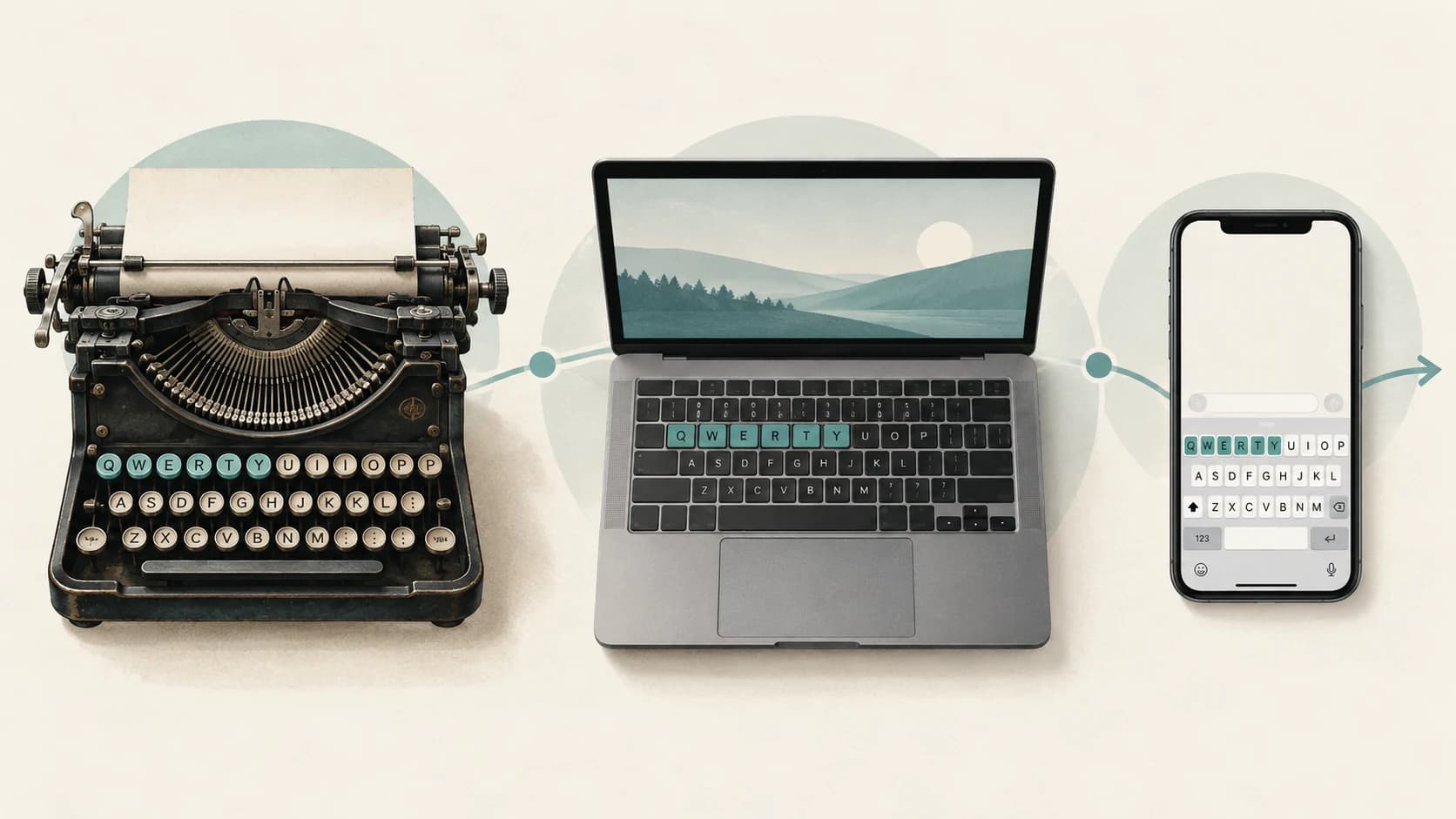
And we use essentially the same arrangement on:
- desktop keyboards
- laptops
- tablets
- smartphones
- touchscreen keyboards
That seems even stranger when you realize QWERTY was developed for a mechanical machine built more than 150 years ago.
So why are the letters arranged this way?
The short answer is that QWERTY grew out of the engineering and working practices of early typewriters, then became so widely established that replacing it became increasingly difficult.
The longer answer is more interesting because one of the most repeated explanations for QWERTY is not as certain as it is often presented.
Keyboards Did Not Begin With QWERTY
The earliest typewriters did not arrive with the modern keyboard layout already solved.
Inventors experimented.
Christopher Latham Sholes, Carlos Glidden and Samuel Soule developed an early practical typewriting machine in Milwaukee during the 1860s. Their 1868 patent model is preserved by the Smithsonian's National Museum of American History. (si.edu)
The early layouts were much closer to arrangements that a modern reader might expect.
Smithsonian's history of QWERTY shows one early Sholes layout with letters proceeding largely in alphabetical sequence across two rows. (smithsonianmag.com)
So the inventors did not begin by asking:
How can we arrange these letters as strangely as possible?
The strange-looking layout emerged gradually while the machine itself was being developed.
Why Mechanical Typewriters Made Keyboard Design Complicated
A mechanical typewriter is very different from a computer keyboard.
Pressing a modern key sends an electronic signal.
Pressing a key on an early typewriter moved a mechanical linkage connected to a typebar carrying a metal character.
The typebar swung toward the paper and struck an inked ribbon, producing the letter.
That meant typing was not merely an information-input problem.
It was a mechanical-motion problem.
Many typebars had to:
- move rapidly
- converge on the same printing point
- strike the paper
- return to position
- avoid interfering with one another
The Smithsonian notes that designing a reliable typewriter required solving problems involving typebars, the paper carriage, ribbon movement and mechanisms that could operate repeatedly without jamming. (invention.si.edu)
This leads to the most famous explanation for QWERTY.
The Famous Explanation: QWERTY Prevented Typewriter Jams
The story is usually told like this:
Early typists became too fast.
Frequently used letter combinations caused neighbouring typebars to rise one after another and collide.
Sholes therefore rearranged the letters so common combinations were separated, reducing jams.
That explanation appears in many histories of the typewriter, including Smithsonian material. (si.edu)
There is an important correction, however.
The goal would not necessarily have been:
make people type slowly.
A better description would be:
arrange the mechanism so that commonly occurring sequences were less likely to create mechanical interference.
Those are not the same thing.
If separating certain typebars allowed someone to type more reliably, the design could actually support faster practical typing by causing fewer interruptions.
But even that explanation is not completely settled.
The Exact Reason for QWERTY Is Still Debated
This is where the history becomes less tidy than the popular story.
Smithsonian's more recent treatment explicitly notes that historians disagree about why Sholes and his collaborators eventually settled on QWERTY. The anti-jamming explanation is one theory, while another argues that the layout developed partly around the requirements of telegraph operators. (smithsonianmag.com)
Why telegraph operators?
In the nineteenth century, professional operators often received messages in Morse code and transcribed them.
Certain Morse sequences could be ambiguous until additional signals arrived. Researchers have argued that placing particular letters near one another helped operators respond quickly while interpreting incoming messages.
Smithsonian summarizes this alternative theory as the idea that QWERTY evolved partly through feedback from telegraphists who needed to transcribe Morse efficiently. (smithsonianmag.com)
There is another reason to be cautious about the simplistic “separate every common pair” story.
Look at QWERTY itself.
The letters E and R sit beside each other even though “er” is a common English sequence.
If the entire keyboard had been mathematically optimized simply to separate every frequent letter combination, we would expect a much more systematic result.
The historical evidence suggests something messier:
QWERTY evolved through repeated experiments involving mechanics, typing practice and the needs of early users.
There may not be one elegant rule that explains every key.
Where Did the Actual QWERTY Pattern Appear?
Sholes continued developing his typewriter through the 1870s.
A U.S. patent granted to him on August 27, 1878—Patent No. 207,559—contains a keyboard arrangement recognizable as the ancestor of modern QWERTY. (patents.google.com)
By then, commercial typewriters based on the Sholes design were already being produced by E. Remington & Sons.
The Sholes and Glidden machine reached the market in 1874 as the Remington No. 1 and became the first commercially successful typewriter. (smithsonianmag.com)
That commercial success changed the question.
The issue was no longer merely:
What is the theoretically best keyboard?
It became:
What keyboard are people already learning to use?
That distinction helps explain almost everything that followed.
Why Didn't They Just Use ABCDE?
Alphabetical order has one very obvious advantage:
beginners already know it.
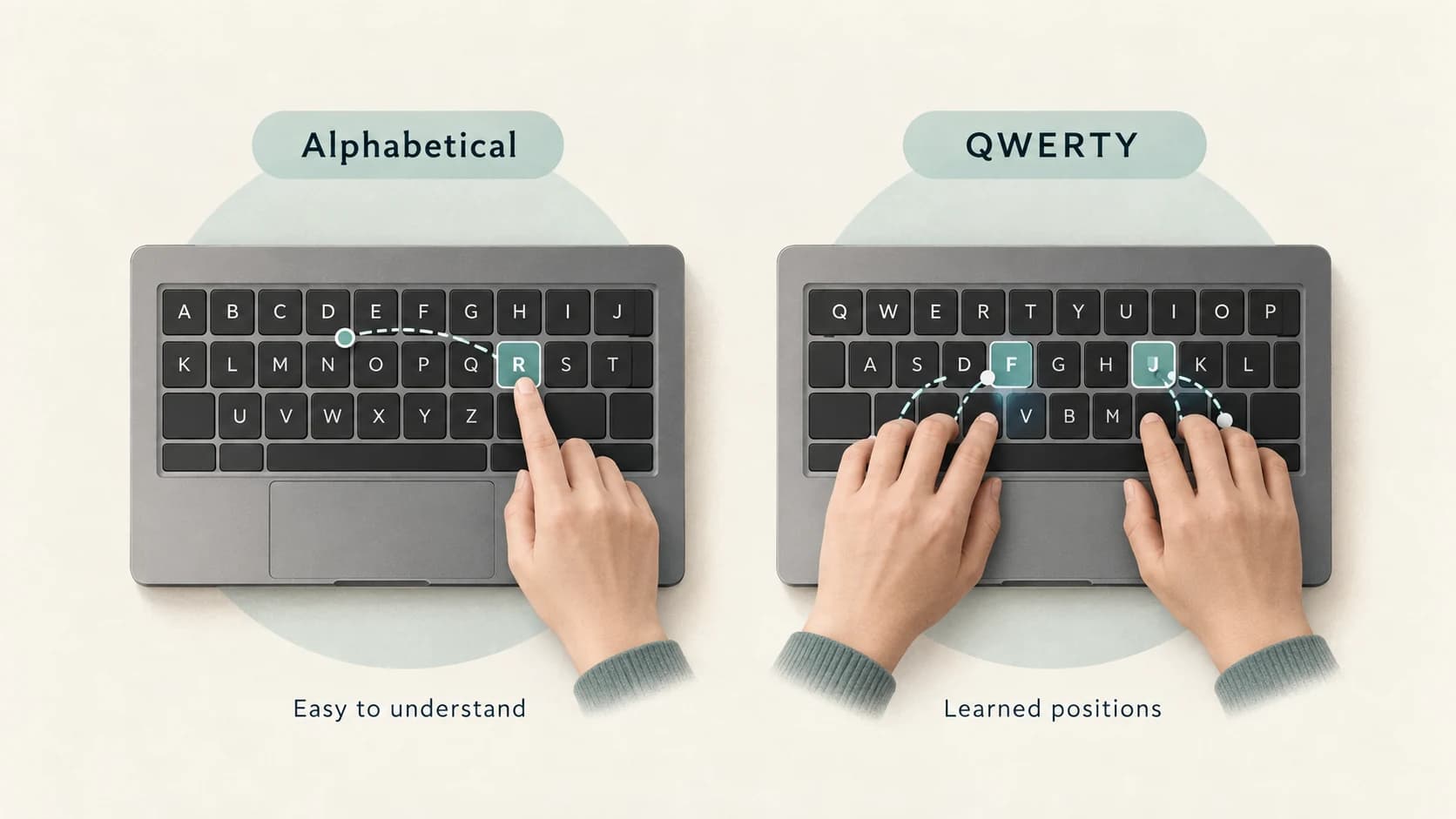
Someone who has never typed can search:
A... B... C... D...
That makes an alphabetical keyboard attractive for finding individual letters visually.
But once a person learns touch typing, they no longer search alphabetically.
An experienced typist does not think:
“M comes after L, so I should look farther along the alphabet.”
Instead, the brain learns the physical location of each key.
The word keyboard becomes a pattern of finger movements.
At that point, alphabetical order offers much less benefit.
More importantly, alphabetic order was designed to organize the alphabet, not to optimize the physical act of typing English words.
The alphabet does not arrange letters according to:
- how frequently they occur
- which letters commonly follow one another
- which fingers should press them
- which hand should be used
- how much finger movement is required
So ABCDE is easy to understand conceptually, but that does not automatically make it an efficient layout for skilled typing.
Is QWERTY Actually the Best Layout for Typing?
Probably the wrong question is:
Is QWERTY perfect?
Clearly, it is not the only workable arrangement.
One famous alternative is the Dvorak Simplified Keyboard, developed decades after QWERTY.
Dvorak places many frequently used English letters on the home row and was deliberately designed around typing efficiency rather than nineteenth-century typewriter mechanics. Smithsonian notes that Dvorak was created as a major alternative to QWERTY in the twentieth century. (smithsonianmag.com)
Other alternatives have appeared as well.
But claims that one alternative will automatically make everyone dramatically faster should be treated cautiously.
Typing performance depends on:
- practice
- familiarity
- language
- keyboard design
- individual technique
Research on alternative keyboards also shows the obvious practical problem: users have to learn them. A human-factors study comparing alternative layouts found substantial learning requirements, including for Dvorak. (pubmed.ncbi.nlm.nih.gov)
That learning cost is one reason a theoretically attractive alternative can struggle against an established standard.
The Real Power of QWERTY Is That Everyone Already Knows QWERTY
Imagine that a new layout appeared tomorrow and laboratory testing demonstrated that, after enough training, it could make many people somewhat more efficient.
Would every office immediately replace its keyboards?
Probably not.
Think about the transition cost.
People would have to relearn:
- typing
- keyboard shortcuts
- gaming controls
- muscle memory
Schools would need new training.
Businesses would have employees using different systems.
Public computers would become confusing.
Keyboard manufacturers would need to support multiple layouts.
People moving between devices would constantly have to switch mental maps.
That creates what economists and technology historians often describe as a switching-cost or installed-base problem.
Once millions of people learn one standard, the standard becomes valuable partly because it is already standard.
The Typewriter Created an Ecosystem Around QWERTY
QWERTY's survival was not based only on the machine itself.
As typewriters spread, an ecosystem developed around them.
Businesses bought QWERTY machines.
Typing schools trained people on QWERTY.
Employers hired people who already knew the layout.
Manufacturers had an incentive to make machines compatible with the skills typists already possessed.
Smithsonian describes typing schools expanding during the 1880s as commercial typewriters became increasingly important in office work. (invention.si.edu)
By the late nineteenth century, QWERTY had moved beyond being one inventor's arrangement.
It had become a professional skill.
Changing the keyboard would now mean changing the people using it.
Then Computers Inherited the Typewriter Keyboard
By the time electronic computers needed practical text input, people already knew how to type.
There was little reason to force millions of trained users to learn a completely different keyboard layout merely because the mechanical typebars had disappeared.
The Computer History Museum notes that researchers at MIT were experimenting with direct keyboard input to computers by the 1950s, including the use of devices based on electrically controlled typewriters. (computerhistory.org)
The computer therefore did not invent its keyboard culture from scratch.
It inherited one.
The mechanical reason behind a nineteenth-century design could disappear while the human training built around that design remained.
This is one of the most interesting things about QWERTY.
Technology changed completely underneath it.
The habit survived.
And Then Touchscreens Copied Computers
A touchscreen phone has no typebars.
It cannot mechanically jam.
Its keys do not even physically exist.
Software could arrange them in:
- alphabetical order
- Dvorak
- frequency order
- a circular layout
- almost anything else
Yet the default English keyboard on smartphones still looks recognizably QWERTY.
Why?
Because a new touchscreen is immediately useful to someone who has already learned QWERTY.
The phone does not have to teach the user a new typing system.
In effect:
typewriters trained computer users
↓
computer keyboards trained smartphone users
The original machine vanished.
The learned spatial pattern remained.
QWERTY Is Not Exactly the Same Everywhere
The broader story becomes even clearer when you look outside English-language keyboards.
Different languages use modified layouts.
For example:
- QWERTZ is common in parts of Central Europe
- AZERTY is associated with French-language typing
- many language-specific layouts add or reposition characters
Modern operating systems also allow users to install and change keyboard/input layouts. Windows, for example, provides controls for adding and switching between multiple keyboard layouts and languages. (support.microsoft.com)
So QWERTY is not a law of computing.
It is a convention.
And conventions can be modified when language requirements justify doing so.
Why Not Switch Everyone to a Better Layout Now?
There are two separate questions.
Could we design a different keyboard today?
Absolutely.
Modern keyboards have none of the mechanical limitations of an 1870s typewriter.
Software allows practically any arrangement.
Would replacing QWERTY for everyone be worth it?
That is much harder.
Any benefit would have to outweigh:
- retraining millions or billions of users
- temporary loss of productivity
- incompatible public/shared keyboards
- altered shortcut locations
- hardware labeling problems
- years of accumulated muscle memory
A new user starting from zero does not have those costs.
Someone who has typed QWERTY for twenty years does.
That is why old technological standards can survive long after their original environment disappears.
They become embedded not only in machines but in people.
Why Does QWERTY Feel Natural Now?
This is perhaps the strangest part.
Look at the layout:
Q W E R T Y U I O P
 A S D F G H J K L
  Z X C V B N M
There is no obvious alphabetic logic.
Yet ask an experienced typist where the letter F is, and the finger can often find it without conscious thought.
The layout has moved from being something the user remembers intellectually to something the body remembers physically.
This is muscle memory.
The keyboard no longer feels arbitrary because repeated practice has turned arbitrary positions into familiar movements.
Change those positions and even very experienced typists can initially become surprisingly slow.
That is the hidden advantage of QWERTY today.
Not that every key is ideally positioned.
Not that nineteenth-century mechanical constraints are still relevant.
But that billions of learned movements already assume those positions.
A 150-Year Journey in One Diagram
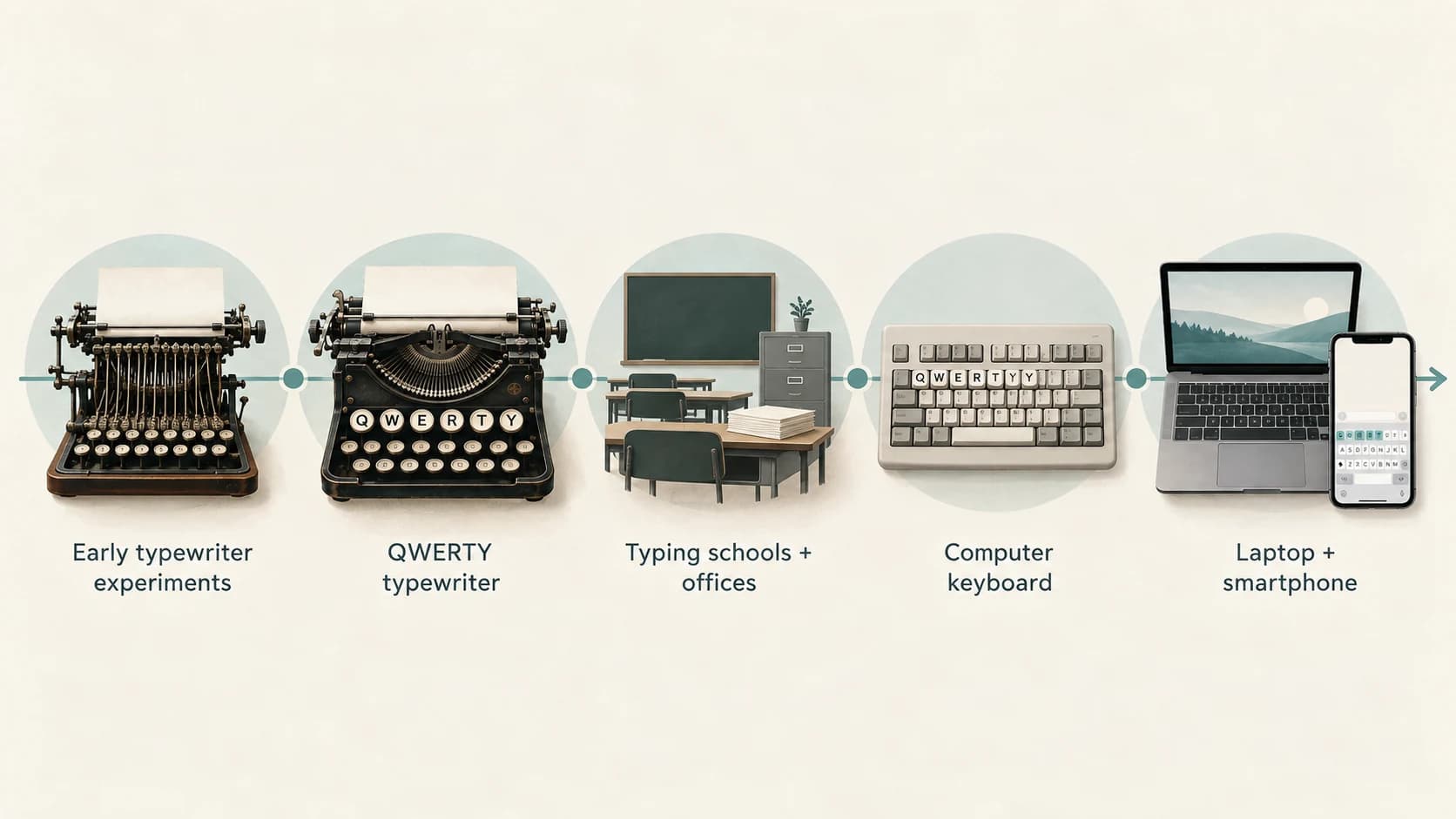
The story can be simplified like this:
Early experimental typewriters
↓
Alphabetical and semi-alphabetical layouts
↓
Mechanical and user-workflow experimentation
↓
QWERTY emerges
↓
Remington commercializes the typewriter
↓
Typing schools and businesses teach QWERTY
↓
QWERTY becomes the expected standard
↓
Electronic computers inherit the familiar keyboard
↓
Laptops inherit computer keyboards
↓
Touchscreen phones imitate QWERTY
What began as a solution developed in the age of levers, springs and ink ribbons eventually became a software keyboard made of pixels.
The Keyboard Is a Piece of Technological History You Touch Every Day
The strange ordering of your keyboard is not evidence that nobody thought of putting letters alphabetically.
They did.
Early typewriter inventors experimented with layouts much closer to alphabetic order.
QWERTY emerged while those inventors were trying to build a practical machine, although historians still debate exactly how much of the final arrangement came from mechanical jamming, telegraph operators or other experimental decisions.
What happened afterward is much clearer.
QWERTY became commercially successful.
People learned it.
Companies standardized around it.
New generations of technology inherited it because millions of users already knew where the keys were.
That is why your touchscreen phone in the twenty-first century still carries the fingerprints of a nineteenth-century typewriter.
The mechanical typebars are gone.
The ink ribbon is gone.
The paper carriage is gone.
But Q W E R T Y remains.