
Analog, Digital and Hybrid Computers
Analog, Digital and Hybrid Computers. Foundational Computer Awareness explanations, examples and explained practice questions for banking and recruitment exam preparation.
By Akhilesh Saini
What you will learn
- The difference between representing quantities continuously and discretely.
- The basic meanings of analog, digital, and hybrid computers.
- Examples and common exam misconceptions.
- Why a digital computer can read analog measurements without becoming a hybrid computer in the classical sense.
Why this topic matters
This is a short but confusion-prone chapter. Questions may mention an analog signal, a digital computer, or a special-purpose hybrid system. The key is to classify the computing method, not merely the appearance of a dial or display.
Another way to classify computers
The previous lesson classified computers mainly by traditional size and workload. This lesson uses a different basis: the way quantities are represented and processed.
Analog computers
An analog computer represents and processes quantities using continuously varying physical quantities, such as electrical voltage, rotation, or motion. The physical behaviour of part of the system corresponds to a mathematical or physical quantity being modelled.
Historical or specialist applications: Engineering simulations, control studies, and certain scientific calculations. Earlier analog computing equipment could model dynamic systems by configuring physical components.
Example: In a classical electronic analog computer, a changing voltage may represent a changing variable in a mathematical model.
Fact to remember: Analog → continuous physical representation.
Important distinction: A traditional analog dial or thermometer is not automatically an analog computer. A measuring or display device must actually perform computational operations to qualify as a computer.
Digital computers
A digital computer represents and manipulates information as discrete symbols or states, commonly binary digits 0 and 1. It follows digital instructions to process data.
Examples: Desktops, laptops, smartphones, and most modern banking computers.
A digital computer may represent text, numbers, images, and sounds as digital data. It can also accept measurements from the physical world using suitable input electronics.
Fact to remember: Digital → discrete values; binary is standard in modern electronic digital computers.
Hybrid computers
A hybrid computer, in the classical computer-awareness sense, combines analog computing elements and digital computing elements in one system to take advantage of both approaches.
Illustrative application: Some specialized medical, industrial, and simulation systems have combined analog computation with digital control, reporting, or analysis. The exact architecture determines whether a system is genuinely hybrid.
Fact to remember: Hybrid → combines analog and digital computing.
A modern digital computer connected to an analog sensor is not automatically a classical hybrid computer. Most digital devices convert analog sensor signals into digital measurements and then carry out the computation digitally. The mere presence of an analog-to-digital converter is not sufficient to establish a separate analog-computing section.
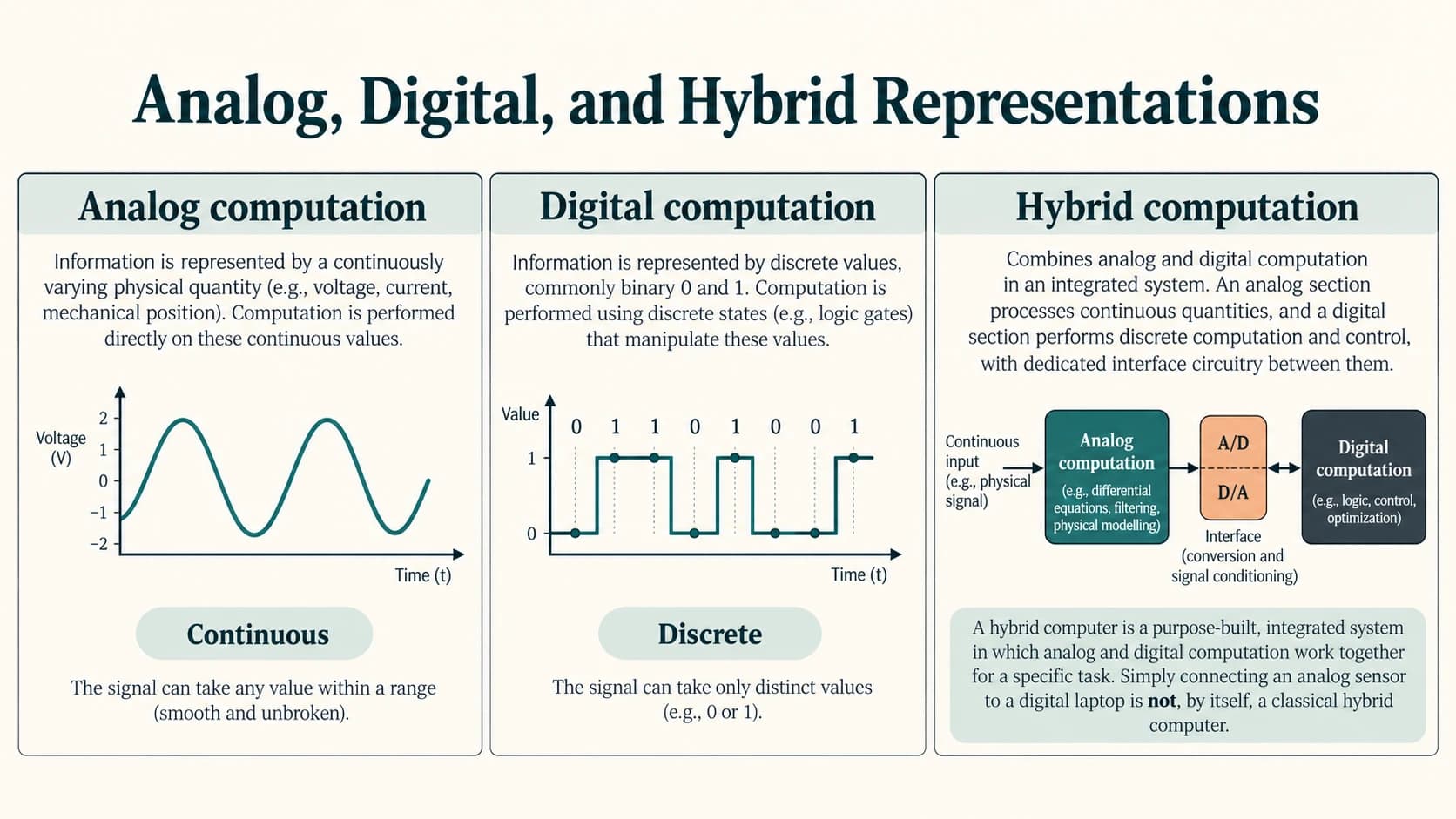
A simple comparison
| Basis | Analog computer | Digital computer | Hybrid computer |
|---|---|---|---|
| Fundamental representation | Continuously varying physical quantities | Discrete symbols/states | Analog and digital computational representations |
| Common form of work | Physical or mathematical models using continuous variables | Calculations and operations on digital data | Tasks intentionally combining both forms of computation |
| Typical example | Classical electronic analog simulator | Laptop or smartphone | Specialist analog–digital computing arrangement |
| Exam keyword | Continuous | Discrete / binary | Combination |
Worked examples
Example 1 — laptop with a spreadsheet: A laptop stores a numerical value in digital form and computes a total. It is a digital computer, even if the real-world amount being represented can vary continuously.
Example 2 — analog physical simulation: A configurable electronic network represents model variables as changing voltages and performs the modelled operations. It is an analog computer.
Example 3 — a deliberately combined system: An analog circuit directly performs a part of a mathematical model, while a digital computing part controls and analyses the process. This is a hybrid computer in the classical sense.
Important terms
| Term | Meaning |
|---|---|
| Continuous quantity | Value that can vary through a range rather than only through separate fixed steps. |
| Discrete value | Value represented by distinct states or symbols. |
| Binary | Representation using two symbols, generally 0 and 1. |
| Analog computing | Computing using continuously varying physical representations. |
| Digital computing | Computing on discretely represented values. |
| Hybrid computing | Intentionally combining analog and digital computation. |
Common confusions
- Analog signal ≠ analog computer: A sensor can produce analog signals without performing computing.
- Digital display ≠ proof of digital computing method in every subsystem: The display alone does not reveal the architecture.
- Hybrid computer ≠ hybrid cloud: These are completely different uses of the word “hybrid.”
- Any device with analog input and digital processing ≠ necessarily a classical hybrid computer.
- “Continuous” and “discrete” describe representation, not whether a machine is physically large or small.
Quick revision
| Clue | Classification |
|---|---|
| Continuous voltage used to represent variables in computation | Analog |
| Processing information as discrete binary states | Digital |
| Both analog and digital computing sections deliberately combined | Hybrid |
| Normal laptop | Digital |
| Analog thermometer with no computing function | Measuring instrument, not automatically an analog computer |
Practice questions — CA-01-05
Q1. An analog computer is chiefly associated with:
A. Continuously varying physical quantities
B. Only alphabetic letters
C. Only punch cards
D. No representation of quantities
Q2. Modern electronic digital computers commonly represent data using:
A. Binary states
B. Water pressure only
C. Roman numerals exclusively
D. Mechanical gears only
Q3. A conventional laptop is best classified by processing method as a:
A. Classical analog computer
B. Digital computer
C. Hybrid cloud
D. Mechanical calculator only
Q4. A classical hybrid computer combines:
A. Two keyboards
B. A mouse and a printer
C. Analog and digital computing elements
D. Two web browsers
Q5. Which is the clearest example of analog computation?
A. A changing voltage directly representing a variable in an electronic simulation
B. A saved PDF on a laptop
C. An email attachment
D. A digital password
Q6. Which is not enough by itself to make a device a classical analog computer?
A. Computing with continuously varying physical quantities
B. Using an analog dial to show a measurement
C. Performing a mathematical operation by an analog circuit
D. Representing a model using electrical quantities
Q7. The term discrete in digital computing means:
A. Based on distinct representable states or values
B. Always invisible
C. Always continuously varying without steps
D. Never stored
Q8. Which statement is most accurate?
A. Every phone with an analog microphone must be a classical hybrid computer.
B. A digital computer can take analog sensor input and still compute digitally.
C. A digital computer cannot represent sound.
D. Analog computers can process only text.
Q9. Which set correctly matches the keywords?
A. Analog—binary; Digital—continuous; Hybrid—paper only
B. Analog—continuous; Digital—discrete; Hybrid—combined
C. Analog—discrete; Digital—continuous; Hybrid—no computation
D. Analog—wireless; Digital—wired; Hybrid—offline
Q10. An analog-to-digital converter primarily helps to:
A. Convert measured analog signals into digital representations
B. Turn every laptop into a historical mainframe
C. Remove all need for software
D. Replace a computer's processor
Q11. Analog and digital computers are classified mainly by their:
A. Screen colour
B. Price alone
C. Mode of data representation and computation
D. Keyboard brand
Q12. Which statement about a hybrid computer is best?
A. It necessarily means two personal computers connected by a cable.
B. It can combine analog computation and digital processing/control in one design.
C. It cannot use any digital elements.
D. It is the same as a supercomputer.
Answers and explanations — CA-01-05
| Q | Answer | Explanation |
|---|---|---|
| 1 | A | Analog computing uses physical quantities that vary continuously. |
| 2 | A | Binary 0 and 1 are the standard discrete states in modern electronic digital systems. |
| 3 | B | A normal laptop performs digital computation. |
| 4 | C | Classical hybrid designs use both analog and digital computing mechanisms. |
| 5 | A | The circuit is carrying out computation through a continuously represented variable. |
| 6 | B | An analog display can show a value without performing computation. |
| 7 | A | Discrete means represented as distinct states or values. |
| 8 | B | Input conversion does not itself establish a classical hybrid computer. |
| 9 | B | Continuous, discrete, and combined are the key distinctions. |
| 10 | A | An ADC translates an analog signal into a digital representation. |
| 11 | C | This taxonomy is about representation/computation, not size or price. |
| 12 | B | Hybrid computation integrates analog and digital computing functions intentionally. |
Previous lesson: CA-01-04 — Types of Computers: Micro, Mini, Mainframe, Supercomputer.
Next lesson: CA-01-06 — Computer System Components: Hardware, Software, Users and Data.