
Generations of Computers
Generations of Computers. Foundational Computer Awareness explanations, examples and explained practice questions for banking and recruitment exam preparation.
By Akhilesh Saini
What you will learn
- The conventional five-generation classification of electronic computers.
- The main hardware innovation used to identify each of the first four generations.
- Historical examples often discussed in objective examinations.
- Why the fifth-generation label requires extra care.
Why this topic matters
Recruitment exams frequently test simple associations: vacuum tube → first generation, transistor → second, integrated circuit → third, and microprocessor → fourth. A clear historical explanation helps you remember the order rather than mixing it up.
What does “generation” mean?
Computer generations are a teaching framework for grouping major developments in electronic computing. Each of the first four commonly taught generations is associated with an important change in the basic electronic technology used to build computers. These changes generally made computers smaller, more capable, more economical, and more accessible over time.
Accuracy note: The generations are a simplified educational classification. Their dates are approximate, developments overlap, and not every computer fits neatly into one time period. The fifth generation is especially a research-oriented and AI-associated label, not a universally agreed replacement hardware technology.
First generation — vacuum tubes
Approximate period: mid-1940s to late 1950s.
Core hardware association: Vacuum tubes, used as electronic switches and amplifiers.
These early electronic computers were typically very large and expensive, consumed substantial power, produced much heat, and required complex maintenance. Programming commonly involved machine-level instructions or other low-level arrangements.
Example: ENIAC, publicly unveiled in 1946, is a well-known early general-purpose electronic digital computer. It used thousands of vacuum tubes. UNIVAC I is another significant early commercial example.
Fact to remember: First generation → vacuum tube.
Second generation — transistors
Approximate period: late 1950s to mid-1960s.
Core hardware association: Transistors in place of many vacuum-tube functions.
Transistors were generally smaller, more reliable, and less power-hungry than vacuum tubes. This supported more practical computer systems. High-level programming languages became increasingly important during this broader era, although software advances do not line up perfectly with hardware-generation boundaries.
A key historical point: the transistor was demonstrated at Bell Laboratories in 1947, before transistorized computers became widespread. An invention date and a computer-generation period are not the same thing.
Fact to remember: Second generation → transistor.
Third generation — integrated circuits
Approximate period: mid-1960s to early 1970s.
Core hardware association: Integrated circuits (ICs), which combine multiple electronic components on a chip.
ICs made it possible to place more circuitry into less space. Computer systems became more powerful and reliable, and operating-system capabilities expanded. IBM System/360 is often used as an example of this era, particularly for its compatible family of computers.
Fact to remember: Third generation → integrated circuit.
Fourth generation — microprocessors
Approximate period: beginning in the early 1970s and continuing through modern microprocessor-based designs.
Core hardware association: Microprocessors, which place central processing functions on a single chip.
The microprocessor was an important step toward affordable small computers, personal computers, and many embedded systems. The Intel 4004, introduced in 1971, is a landmark early commercial microprocessor.
The term microprocessor identifies a chip; microcomputer is a kind of computer built around microprocessor-based processing. They are related but are not the same word.
Fact to remember: Fourth generation → microprocessor.
Fifth generation — AI-oriented computing (conventional textbook label)
Common association: Artificial intelligence (AI), knowledge-based systems, natural-language processing, advanced parallel processing, and related research goals.
Many exam books refer to a fifth generation of “intelligent computers.” This is useful as an exam convention. It is not a settled statement that all contemporary computers use a new fifth-generation physical switch equivalent to a vacuum tube or transistor. Modern AI software may run on fourth-generation-descended semiconductor processors and other specialized hardware.
A historical example is Japan's Fifth Generation Computer Systems (FGCS) project, launched in the early 1980s to pursue logic-based intelligent computing.
Fact to remember: Fifth generation → AI-associated research and advanced computing, with the above qualification.
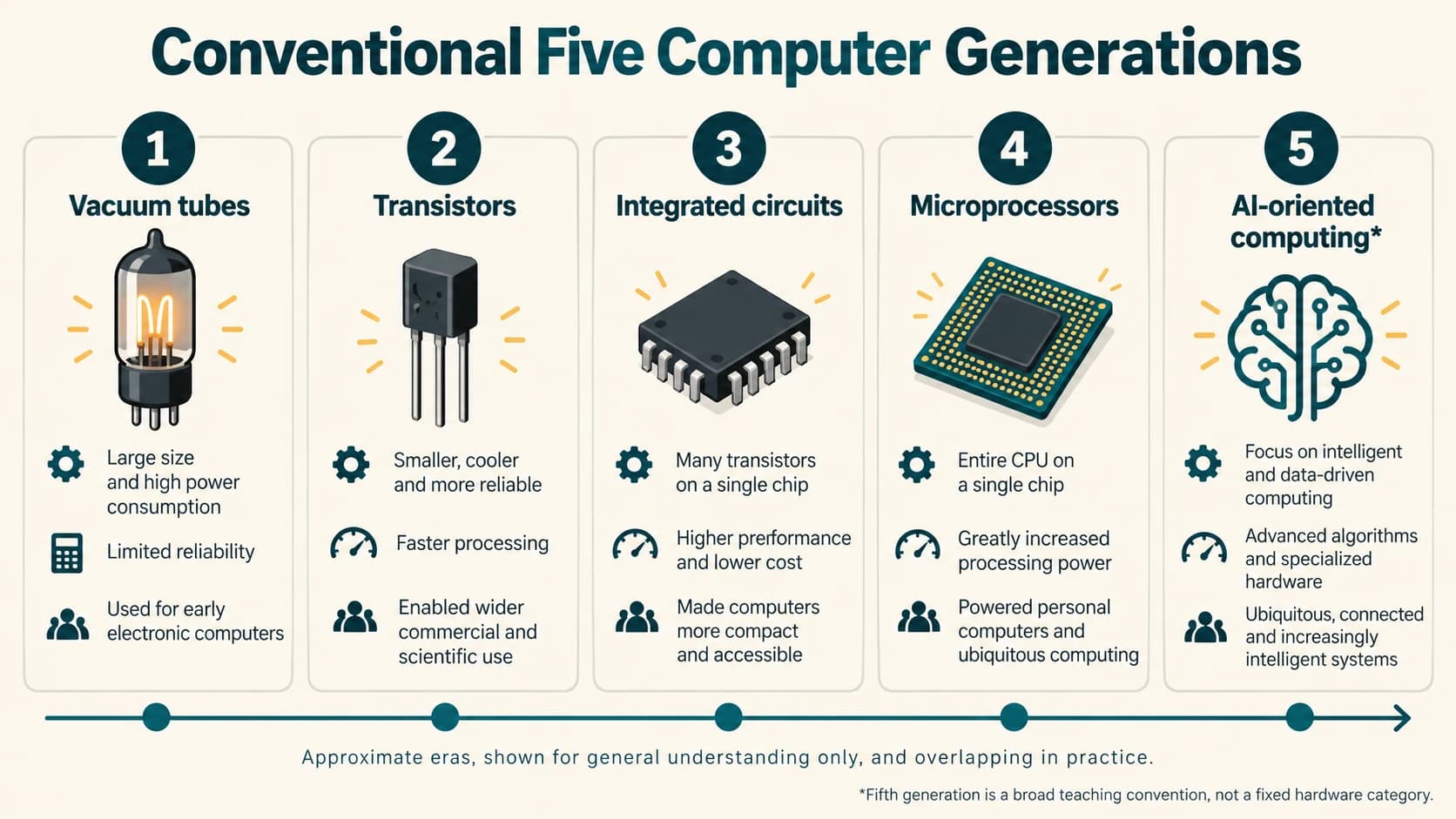
Compare the generations
| Generation | Conventional main association | Typical broad development |
|---|---|---|
| First | Vacuum tubes | Large early electronic computers |
| Second | Transistors | Smaller, more reliable transistorized systems |
| Third | Integrated circuits (ICs) | More compact, complex and capable systems |
| Fourth | Microprocessors | Personal and embedded computing at scale |
| Fifth | AI-oriented computing | Goals of intelligent processing; overlapping hardware eras |
Why these changes mattered
Imagine trying to fit a computer into an ordinary office. Early vacuum-tube machines often occupied large spaces. Transistors reduced bulk and power needs; ICs put many components into compact packages; microprocessors helped make desktop and portable computers practical. Each advance changed what people could afford and where computing could be used.
Important terms
| Term | Meaning |
|---|---|
| Vacuum tube | Early electronic device used for switching/amplification. |
| Transistor | Semiconductor component used for switching/amplification. |
| Integrated circuit (IC) | Multiple electronic components fabricated together on a chip. |
| Microprocessor | Integrated circuit containing central processing functionality. |
| Generation | Broad historical teaching category for computing developments. |
| Artificial intelligence (AI) | Field focused on systems performing tasks associated with intelligent behaviour. |
Common confusions
- Transistor invention (1947) ≠ second-generation start in 1947. Adoption took time.
- IC ≠ microprocessor: A microprocessor is a particular kind of complex integrated circuit.
- Computer generations are not exact calendar boxes. Technologies and systems overlapped.
- AI does not prove a separate fifth-generation hardware architecture. The fifth-generation label is a conventional classification.
- First electronic computer is a contested phrase. Claims depend on criteria such as programmable, general-purpose, fully electronic, working, and publicly demonstrated. Avoid unqualified “first ever” statements.
Fact to remember
Memorize the order: Vacuum Tube → Transistor → Integrated Circuit → Microprocessor → AI-associated Fifth Generation.
For classic objective questions, the four firm hardware pairings are the most important. Remember ENIAC → early vacuum-tube computer and Intel 4004 → landmark microprocessor.
Quick revision
| Question clue | Answer |
|---|---|
| First-generation hardware | Vacuum tubes |
| Second-generation hardware | Transistors |
| Third-generation hardware | Integrated circuits |
| Fourth-generation hardware | Microprocessors |
| Fifth-generation common exam association | Artificial intelligence |
| ENIAC | First-generation-era electronic digital computer |
| Intel 4004 | Early commercial microprocessor |
Practice questions — CA-01-03
Q1. Vacuum tubes are most closely associated with which conventional generation?
A. First
B. Second
C. Third
D. Fourth
Q2. The transistor is the defining textbook technology of the:
A. First generation
B. Second generation
C. Third generation
D. Fifth generation
Q3. Integrated circuits are most closely associated with the:
A. First generation
B. Second generation
C. Third generation
D. Fifth generation
Q4. Which technology is most strongly associated with the fourth generation?
A. Punch cards alone
B. Vacuum tubes
C. Microprocessors
D. Mechanical gears
Q5. In the standard five-generation chart, the fifth generation is commonly associated with:
A. Artificial intelligence
B. Vacuum tubes
C. Abacuses
D. Paper tape only
Q6. ENIAC is best associated with:
A. Early electronic digital computing using vacuum tubes
B. A smartphone operating system
C. A fourth-generation personal computer
D. A modern cloud storage service
Q7. What is an integrated circuit?
A. A paper document used by accountants
B. Multiple electronic components fabricated on a chip
C. A computer monitor connector
D. A networking cable
Q8. Which chronological sequence is correct?
A. IC → Transistor → Vacuum Tube → Microprocessor
B. Vacuum Tube → Transistor → IC → Microprocessor
C. Microprocessor → IC → Transistor → Vacuum Tube
D. Transistor → Vacuum Tube → Microprocessor → IC
Q9. The Intel 4004 is significant as an early commercial:
A. Vacuum tube
B. Printer
C. Microprocessor
D. Network switch
Q10. Which statement about generation dates is most accurate?
A. Every computer changes generation on the same day.
B. Generation dates are approximate and technologies can overlap.
C. No two technologies have ever coexisted.
D. Generations are defined only by a computer's colour.
Q11. Which statement best describes the “fifth generation”?
A. It is universally defined by a single new switching component.
B. It commonly refers to AI-related goals rather than one universally fixed hardware boundary.
C. It means every computer is a supercomputer.
D. It preceded vacuum tubes.
Q12. Which statement is correct?
A. The transistor was invented only after all second-generation computers were sold.
B. The invention of a technology and its widespread adoption in computers can occur at different times.
C. Microprocessors were common before vacuum tubes.
D. ICs cannot contain transistors.
Answers and explanations — CA-01-03
| Q | Answer | Explanation |
|---|---|---|
| 1 | A | Vacuum tubes are the hallmark of the conventional first generation. |
| 2 | B | Transistors replaced many vacuum-tube functions in second-generation machines. |
| 3 | C | Integrated circuits are the standard third-generation association. |
| 4 | C | Microprocessors enabled the development of many smaller, affordable systems. |
| 5 | A | The exam convention links fifth-generation goals with AI and related research. |
| 6 | A | ENIAC is a celebrated vacuum-tube electronic digital computer. |
| 7 | B | An IC integrates electronic components into one manufactured chip. |
| 8 | B | This is the commonly taught first-to-fourth-generation technological sequence. |
| 9 | C | Intel introduced the 4004 microprocessor in 1971. |
| 10 | B | Historical development and adoption do not respect exact textbook boundaries. |
| 11 | B | The AI-oriented fifth-generation label is less precisely defined than the earlier hardware-based categories. |
| 12 | B | The transistor existed before transistor-based computers were widely adopted. |
Previous lesson: CA-01-02 — Data, Information and the Data-Processing Cycle.
Next lesson: CA-01-04 — Types of Computers: Micro, Mini, Mainframe, Supercomputer.