
PAN, LAN, MAN and WAN
PAN, LAN, MAN and WAN. Foundational Computer Awareness explanations, examples and explained practice questions for banking and recruitment exam preparation.
By Akhilesh Saini
What you will learn
- The common network classifications based on typical geographical scope.
- Recognize PAN, LAN, MAN and WAN in exam scenarios.
- Why a Wi-Fi network is not automatically a WAN or the Internet.
- How an organization can operate local networks connected through a wider network.
Why this topic matters
One of the most common Computer Awareness patterns is to match a coverage area or scenario to PAN, LAN, MAN or WAN. The important words are personal, local, metropolitan and wide; do not invent exact kilometre limits that all networks must obey.
PAN — Personal Area Network
A PAN (Personal Area Network) connects devices around an individual or within their immediate personal workspace. Examples include a smartphone communicating with Bluetooth earbuds, a computer and nearby wireless peripherals, or a personal device acting as a connection point for other devices.
PAN connections are usually short-range, but not every PAN uses Bluetooth, and some PAN implementations use cables or other radio technologies. The category describes the scope and purpose of the connection, not one mandatory protocol.
LAN — Local Area Network
A LAN (Local Area Network) connects devices within a relatively limited area such as a home, office, branch, building, or nearby connected buildings under one administrative arrangement. Wired Ethernet and Wi-Fi are common ways to connect devices inside a LAN.
Bank example: PCs, a printer and an internal file server within a branch can share one or more LAN segments. A wired or wireless connection does not change the definition: the emphasis is a local network.
WLAN (Wireless LAN) is a LAN with wireless radio access, commonly Wi-Fi. A Wi-Fi access point may provide connectivity to a wired LAN; it does not need to supply Internet access for the WLAN to be a WLAN.
MAN — Metropolitan Area Network
A MAN (Metropolitan Area Network) typically connects networks across a city or metropolitan region. For example, an institution may arrange communications among several offices within the same urban area through service-provider links or its own network infrastructure.
MAN is an editorial/educational coverage category, not one fixed modern protocol with universally agreed distance boundaries. A given service-provider network may be described differently based on its design and commercial offering.
WAN — Wide Area Network
A WAN (Wide Area Network) interconnects networks over a much larger geographical area, possibly across cities, states, countries or continents. It often uses communication services provided by telecom/network operators, dedicated private links or secure logical networks carried over public infrastructure.
A bank may connect multiple branches, a zonal office and a data centre through a WAN arrangement. Traffic between branches may travel through routers and provider infrastructure. The Internet is a major example of a global interconnection of networks and may be discussed as an example of wide-area networking, but not every WAN is the public Internet.
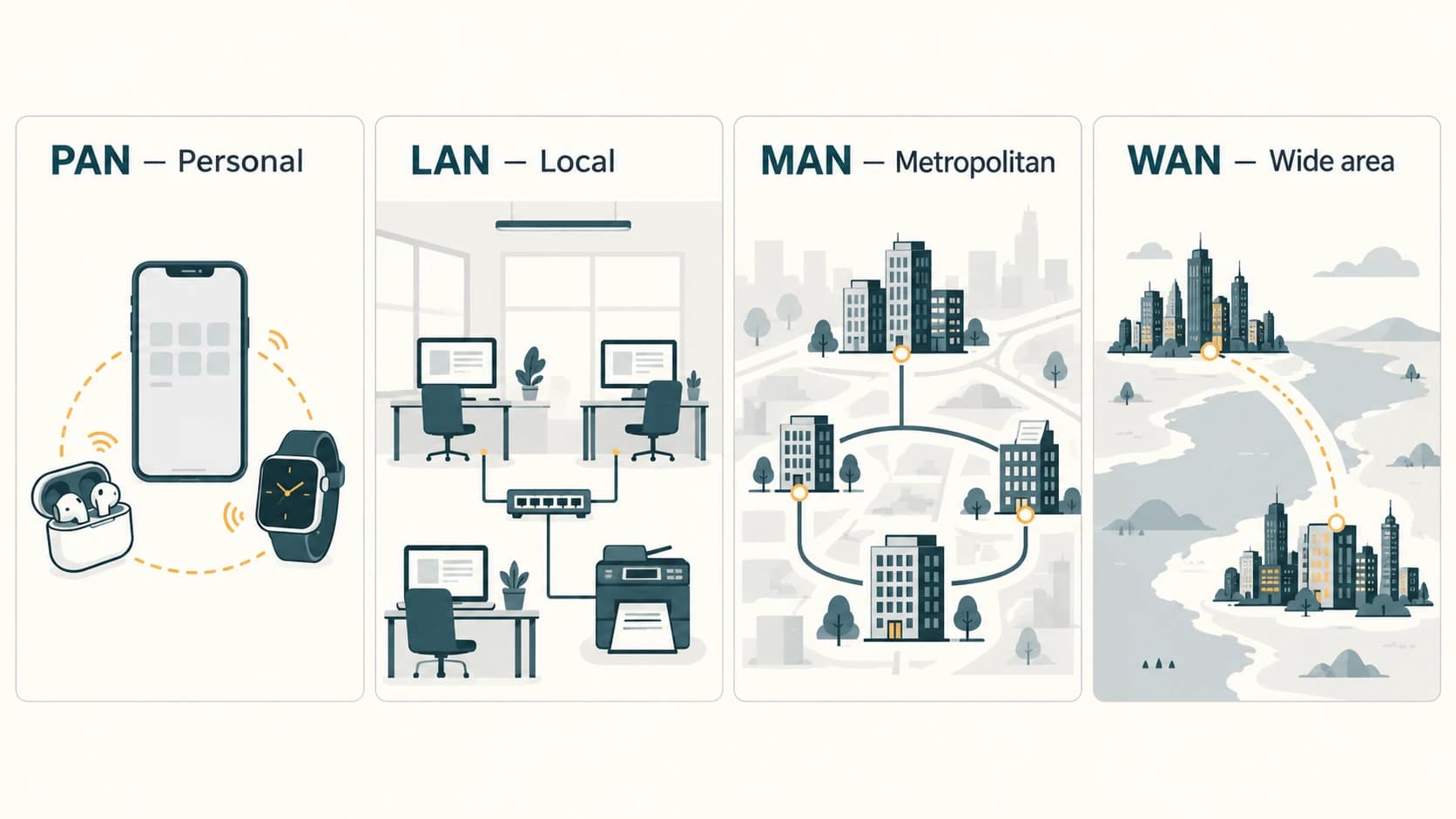
Coverage comparison
| Type | Full form | Typical scope | Illustrative example |
|---|---|---|---|
| PAN | Personal Area Network | Immediate personal environment | Phone linked to earbuds |
| LAN | Local Area Network | One office/building/local site | Branch computers sharing printer |
| MAN | Metropolitan Area Network | City/metropolitan region | Multiple offices across one city |
| WAN | Wide Area Network | Broad geographical area | Branches across several states |
Remember: Relative coverage helps classification, but there is no universal fixed minimum/maximum distance in kilometres defining these categories. A company may also operate several LANs joined by a WAN.
Connecting categories in practice
A person can use a Bluetooth PAN for their earbuds while connected by Wi-Fi to the office LAN. The office's router can then reach a WAN or the Internet. Several network categories can therefore operate together without conflict.
- LAN to WAN: Local traffic stays inside an office when possible; routers send traffic to other networks as needed.
- WAN to cloud service: A branch may use a provider connection to reach an authorized remotely hosted service.
- PAN to phone: A wearable syncs with a phone, and the phone may separately communicate over Wi-Fi or mobile broadband.
Worked examples
Example 1: An employee pairs wireless earbuds with a laptop. For exam-level classification, the short personal-device connection is a PAN.
Example 2: Twenty computers on the same office floor access a local printer. That is a typical LAN application.
Example 3: A city authority links several offices distributed around one city. At textbook level, MAN is the strongest match.
Example 4: A business exchanges data among distant branches in multiple states through managed links. This is a WAN example.
Example 5: A person connects to Wi-Fi but the Internet is down. The WLAN may still be available; WLAN is not synonymous with Internet access.
Important terms
| Term | Meaning |
|---|---|
| PAN | Personal Area Network |
| LAN | Local Area Network |
| WLAN | Wireless Local Area Network |
| MAN | Metropolitan Area Network |
| WAN | Wide Area Network |
| Ethernet | Family of technologies used commonly in wired LANs |
| Wi-Fi | Wireless local-network connectivity technology |
| Backhaul | Link carrying traffic between access/local networks and a wider network |
| Site-to-site connection | Link or secure network connecting separate locations |
Common confusions and exam traps
- Wi-Fi is not the Internet: It usually supplies a local wireless access link.
- WAN is not necessarily public: An organization may use private or logically separated wide-area services.
- LAN does not require cables: A WLAN is a wireless local network.
- MAN is not a mandatory layer between every LAN and WAN: It is an approximate scope category.
- PAN does not always mean Bluetooth: Bluetooth is a common example, not the definition of PAN.
- Geographical size is not a complete security model: Public/private access is a separate issue.
Objective-exam facts to remember
| Clue | Best-fit network |
|---|---|
| Devices around one person | PAN |
| Computers within an office | LAN |
| Wireless network serving an office/site | WLAN (a type of LAN) |
| Offices across a city | MAN |
| Branches across countries | WAN |
Quick revision
- PAN: personal; LAN: local; MAN: metropolitan; WAN: wide-area.
- WLAN describes wireless local-area connectivity, typically Wi-Fi.
- One institution can operate many LANs interconnected by a WAN.
- WAN and the public Internet are not identical.
- Coverage terms are approximate descriptions, not strict distance cut-offs.
Practice questions — CA-07-02
1. Bluetooth earbuds paired with a smartphone are a typical example of a:
A. MAN
B. PAN
C. Satellite network
D. WAN
2. Computers within a single bank branch share a local printer. The network is most likely a:
A. WAN
B. LAN
C. Global Internet backbone
D. MAN
3. Which abbreviation expands to Metropolitan Area Network?
A. WLAN
B. PAN
C. MAN
D. WAN
4. A company interconnects branches in several distant states. The best coverage-based classification is:
A. WLAN only
B. WAN
C. PAN
D. Single-room LAN
5. Which technology commonly provides a Wireless LAN?
A. Wi-Fi
B. OCR
C. USB flash storage
D. HDMI
6. Which statement is correct?
A. A WAN can interconnect private organizational networks
B. All WANs are publicly accessible
C. A PAN covers an entire country
D. A LAN must use only coaxial cable
7. A city department joins offices across the same urban area. A common textbook classification is:
A. Keyboard network
B. Single-device loopback
C. PAN
D. MAN
8. Which of these best describes a WLAN?
A. A universal fixed distance between cities
B. A cellular provider core network
C. A wireless local area network
D. Any Internet website
9. An employee uses Bluetooth headphones while the laptop connects to office Wi-Fi. This shows that:
A. The two links must both be WAN
B. Bluetooth automatically supplies Internet
C. Wi-Fi is a kind of wired Ethernet cable
D. PAN and WLAN links can coexist
10. Which term focuses most clearly on devices in a person's immediate environment?
A. PAN
B. VPN
C. WAN
D. MAN
11. Which statement about network area categories is safest?
A. Every MAN begins exactly 5 km from a device
B. A WAN can never include a LAN
C. They have typical scopes, not universal exact distance cut-offs
D. All LANs must be under 100 metres
12. A device is connected to Wi-Fi but cannot reach the Internet. Which conclusion is justified?
A. It must be a MAN
B. Wi-Fi cannot work without cellular data
C. The device cannot communicate locally
D. The local WLAN may still be working
Answers and explanations — CA-07-02
1. B — PAN. A personal-area network commonly connects nearby personal devices, including Bluetooth peripherals.
2. B — LAN. A LAN is used for relatively local networking within a branch, building or nearby site.
3. C — MAN. MAN is a city/metropolitan-area classification at textbook level.
4. B — WAN. A WAN connects networks across broad geographical distances.
5. A — Wi-Fi. Wi-Fi is a common WLAN technology; it is not itself identical to public Internet service.
6. A — A WAN can interconnect private organizational networks. Wide-area networks can be private or logically separated; WAN describes geographical scope.
7. D — MAN. MAN is a convenient description for city-scale network coverage, without strict kilometre limits.
8. C — A wireless local area network. WLAN refers to local wireless connectivity, often using Wi-Fi.
9. D — PAN and WLAN links can coexist. One person can use a personal Bluetooth link and a Wi-Fi local-network link simultaneously.
10. A — PAN. The P in PAN means Personal; the network ordinarily serves nearby personal equipment.
11. C — They have typical scopes, not universal exact distance cut-offs. Coverage descriptions are approximate; actual organizational and provider designs vary.