
Wi-Fi, Bluetooth, NFC and Mobile Networks
Wi-Fi, Bluetooth, NFC and Mobile Networks. Foundational Computer Awareness explanations, examples and explained practice questions for banking and recruitment exam preparation.
By Akhilesh Saini
What you will learn
- The typical purposes of Wi-Fi, Bluetooth and NFC.
- Why cellular/mobile networks are different from an office WLAN.
- The meaning of access point, pairing, contactless and mobile generation labels.
- Banking and everyday use cases without equating short radio range with guaranteed security.
Why this topic matters
Exam questions often describe a device connecting to wireless earbuds, joining an office WLAN, tapping a contactless reader, or accessing mobile data while travelling. The best answer depends on the technology's typical use, not merely the fact that the signal travels through air.
Wi-Fi: common wireless local-area access
Wi-Fi refers to a family of wireless local-area networking technologies based on the IEEE 802.11 family of standards and industry interoperability certification. Wi-Fi can connect laptops, phones and printers to a local network through a wireless access point, or in supported arrangements provide more direct communication among devices.
Example: A tablet joins a branch's approved wireless network and accesses an internal service. Wi-Fi provides the local radio link; the internal service may require authentication and additional network connectivity.
Key distinction: Wi-Fi ≠ automatically Internet access. A device can be successfully connected to a Wi-Fi WLAN while the wider Internet link is unavailable. Different Wi-Fi generations, bands and router models vary, so memorizing one exact speed or coverage radius as universal would be misleading.
Bluetooth: short-range personal-device links
Bluetooth is a family of short-range wireless technologies used widely for personal devices: earbuds, keyboards, mice, smartwatches and certain data-sharing or control functions. It includes different operating modes and application profiles; modern Bluetooth connections can support features beyond just streaming audio.
Pairing is a process used by many Bluetooth devices to establish a trusted relationship or negotiate connection settings. Not all Bluetooth use cases follow one identical pairing procedure, and Bluetooth's useful range depends on device power, radio environment and application.
Example: Wireless headphones communicate with a smartphone over Bluetooth while the smartphone itself reaches the Internet over cellular data. Two radio technologies may work at the same time for different jobs.
NFC: close-proximity contactless communication
NFC (Near Field Communication) enables close-range interactions using a radio frequency of 13.56 MHz. Common uses include contactless cards, supported phone payments, reading NFC tags and exchanging small amounts of control/data information at very short range.
In a contactless payment, the NFC radio link helps a compatible card or device communicate with a reader. The wider payment process also involves the wallet/card application, payment credentials, authentication rules, processing networks and issuer decisions. NFC is not the entire UPI, card or banking system.
NFC's short operating distance can reduce certain exposure opportunities, but short distance alone is not a guarantee of secure payment. Application-layer security, tokenization, authentication and terminal policies remain important.
Mobile/cellular networks: wide-area radio access
A cellular/mobile network provides connectivity through operator-managed radio infrastructure divided into coverage areas called cells. Mobile devices communicate with appropriate base stations and the operator's wider network. Cellular service can supply voice, messaging and mobile data and supports movement between coverage areas.
2G / 3G / 4G / 5G are broad generation labels associated with successive mobile-network technology families. Higher generations have introduced new capabilities and improved performance potential, but actual throughput, latency and coverage depend on local deployment, spectrum, equipment, load and device support.
4G LTE is strongly associated with mobile broadband and IP-based networking; 5G adds newer radio/core-network capabilities in supported deployments. Do not present one data-rate number as guaranteed for every device or country, or claim that 5G coverage exists everywhere.
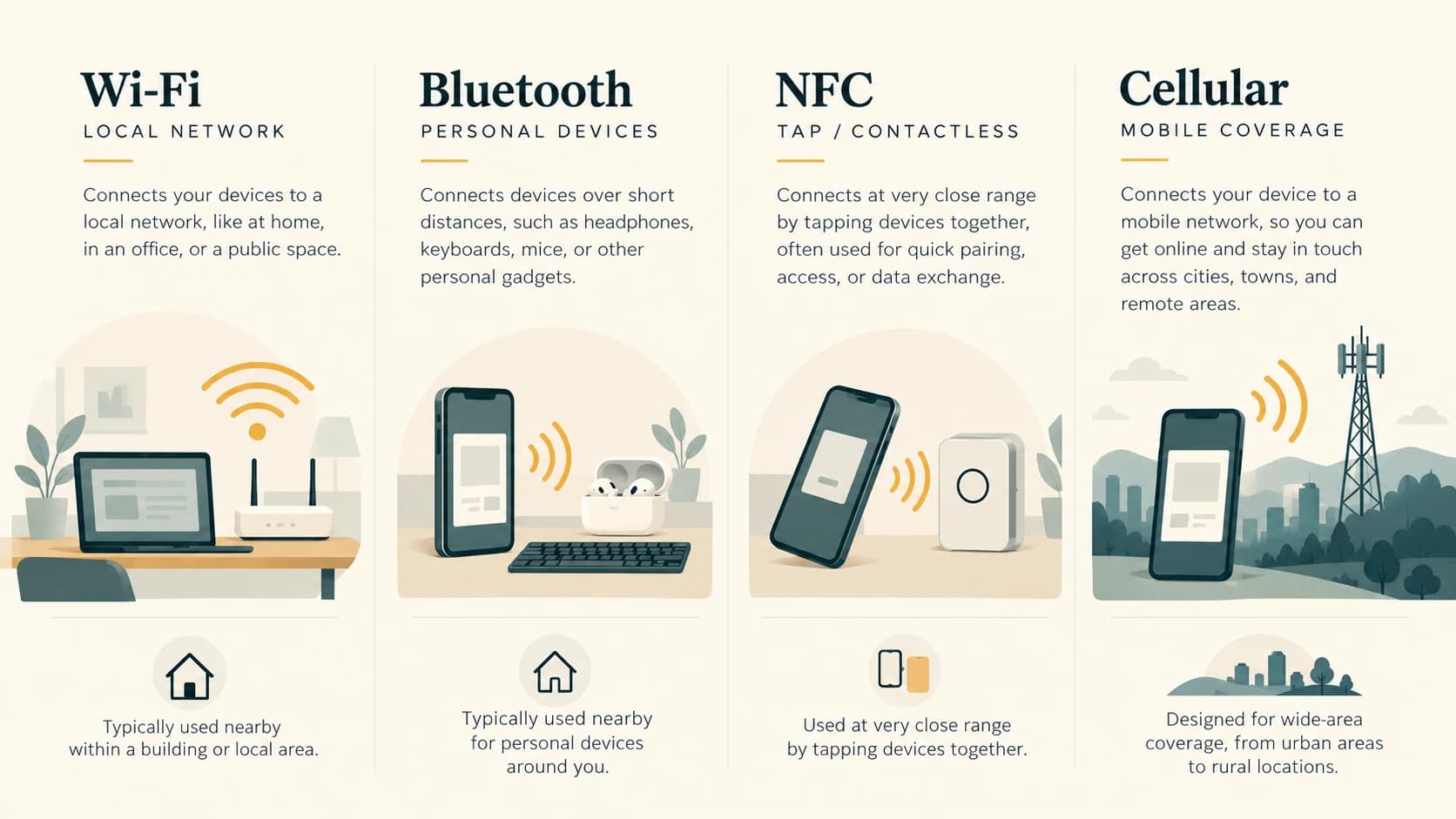
Compare four common wireless technologies
| Technology | Typical setting | Familiar example | Important distinction |
|---|---|---|---|
| Wi-Fi | Local wireless network | Laptop joins office WLAN | WLAN may work without Internet |
| Bluetooth | Personal-area links | Phone to earbuds | Often low-power, short-range personal devices |
| NFC | Very close contactless interaction | Tap compatible payment terminal | Close range, not a full payment system |
| Cellular/mobile | Operator wide-area service | Phone uses mobile data while travelling | Needs suitable provider coverage/subscription |
How the technologies can work together
A person may wear Bluetooth earbuds, keep a phone connected to Wi-Fi inside the office, tap a contactless payment terminal using NFC, and switch to cellular data when travelling outside. These are different access and communication mechanisms, not four names for the same type of network.
QR code versus NFC: A QR code is a visual machine-readable pattern interpreted by a camera/scanner. NFC is a short-range radio communication technology. A QR-based payment flow and an NFC contactless interaction may both lead to payments, but the underlying interaction method differs.
Worked examples
Example 1 — Mouse: A wireless mouse connected through Bluetooth is a common PAN/peripheral use.
Example 2 — Guest network: A visitor connects to a building's Wi-Fi but is denied access to internal resources. Wi-Fi is the radio mechanism; permissions are controlled separately.
Example 3 — Tap to pay: A phone or card communicates closely with a supported terminal using NFC. Transaction approval involves more than NFC alone.
Example 4 — Travelling: A phone accesses Internet services through its cellular provider when no usable Wi-Fi is nearby.
Example 5 — Offline Wi-Fi: A printer and laptop can sometimes communicate over local Wi-Fi even if their broadband Internet service is not working.
Important terms
| Term | Meaning |
|---|---|
| Wi-Fi | Wireless LAN technology family (IEEE 802.11 based) |
| Bluetooth | Short-range wireless family for personal devices |
| NFC | Near Field Communication |
| AP | Access Point; WLAN connection equipment |
| SSID | Service Set Identifier; name/identifier used for a Wi-Fi network |
| Pairing | Establishment of a relationship/settings between supported devices |
| Cellular network | Provider-managed radio network divided into cells |
| Base station | Infrastructure communicating with mobile devices in a coverage area |
| LTE | Long Term Evolution, a mobile communications technology family |
| QR code | Visual two-dimensional code, not a radio link |
Common confusions and exam traps
- Wi-Fi ≠ mobile data: Wi-Fi is generally local-network radio; cellular uses operator radio infrastructure.
- Bluetooth ≠ Wi-Fi: Both use radio, but have different ecosystems and common purposes.
- NFC ≠ QR code: NFC is radio; QR is optical/visual.
- NFC ≠ every digital payment: Payment methods can use QR codes, Internet applications and other mechanisms.
- 5G ≠ a guaranteed speed everywhere: Local conditions control performance.
- Short range ≠ guaranteed security: Authentication and application protection still matter.
Objective-exam facts to remember
| Clue | Answer |
|---|---|
| IEEE 802.11 WLAN | Wi-Fi |
| Earbuds, wireless keyboard, small personal link | Bluetooth |
| Near Field Communication | NFC |
| Contactless close-proximity radio frequency | 13.56 MHz (NFC) |
| Operator-managed radio cells | Cellular/mobile network |
| Wireless LAN identifier/name | SSID |
| Visual matrix code scanned with camera | QR code |
Quick revision
- Wi-Fi provides common wireless local-network access.
- Bluetooth commonly serves short-range personal devices.
- NFC supports very close contactless interactions at 13.56 MHz.
- Cellular networks provide operator-based wide-area connectivity.
- The presence of a radio link does not establish whether Internet service or application-level security is available.
Practice questions — CA-07-08
1. Which wireless technology is closely associated with IEEE 802.11 local networking?
A. Bluetooth
B. QR code
C. NFC
D. Wi-Fi
2. A wireless headset connected to a smartphone commonly uses:
A. VGA
B. Coaxial Ethernet
C. Bluetooth
D. Fibre optic LAN
3. Which technology supports very close contactless radio interactions such as a tap at a compatible reader?
A. HDMI
B. Ethernet
C. OCR
D. NFC
4. Which infrastructure typically supplies mobile data while a phone travels between towns?
A. Local printer cable
B. Operator cellular network
C. Only an office Ethernet switch
D. A short-range QR image
5. Which frequency is most closely associated with NFC operation?
A. 2.4 kHz
B. 28 GHz exclusively
C. 13.56 MHz
D. 50 Hz mains frequency
6. Which term usually describes a Wi-Fi network name or service-set identifier?
A. SSID
B. ROM
C. MAC randomization
D. OCR
7. Which statement is correct about Wi-Fi connectivity?
A. It requires a SIM card
B. A local WLAN may work even without Internet access
C. It always includes working public Internet
D. It is the same as a cellular base station
8. A customer scans a displayed QR code to initiate a supported payment. The information is detected by:
A. Bluetooth frequency hopping
B. NFC radio exclusively
C. An Ethernet switch
D. A camera/optical scanner
9. Which is a common use of Bluetooth?
A. A short-range wireless keyboard or mouse
B. Connecting continents with submarine fibre
C. Publishing web pages by HTTP
D. Replacing the IP protocol
10. Which comparison is accurate?
A. Bluetooth is always the name of a WAN
B. Cellular connects through provider infrastructure; Wi-Fi is a local wireless-network family
C. NFC is always a faster long-range Internet link than Wi-Fi
D. QR is a radio protocol; NFC is a printed image
11. Which statement about 5G is responsible and correct?
A. It cannot carry mobile data
B. It works only through Bluetooth
C. Actual coverage and data rates depend on deployment and conditions
D. It guarantees identical speed everywhere
12. Which claim about NFC payments is incorrect?
A. NFC proximity alone guarantees that every transaction is fraud-proof
B. NFC is used in some contactless card/phone interactions
C. Payments may include authorization and other security checks
D. NFC is not the complete payment-processing system
Answers and explanations — CA-07-08
1. D — Wi-Fi. Wi-Fi is the familiar WLAN technology based on IEEE 802.11 standards.
2. C — Bluetooth. Bluetooth is widely used for nearby personal devices such as headsets and keyboards.
3. D — NFC. NFC is designed for close-proximity contactless radio interactions.
4. B — Operator cellular network. Cellular networks use provider-managed radio cells and supporting core infrastructure to serve moving devices.
5. C — 13.56 MHz. NFC communication uses a 13.56 MHz carrier frequency.
6. A — SSID. SSID is the Service Set Identifier associated with a wireless LAN.
7. B — A local WLAN may work even without Internet access. Wi-Fi can connect devices on a local network without a public Internet connection.
8. D — A camera/optical scanner. A QR code is an optical matrix code, not an NFC radio signal.
9. A — A short-range wireless keyboard or mouse. Bluetooth is common for personal wireless peripherals.
10. B — Cellular connects through provider infrastructure; Wi-Fi is a local wireless-network family. Cellular and Wi-Fi serve different typical connectivity contexts, though devices can use both.
11. C — Actual coverage and data rates depend on deployment and conditions. 5G describes mobile-network technologies, not a universal guaranteed throughput at every location.