
Data, Database and DBMS
Data, Database and DBMS. Foundational Computer Awareness explanations, examples and explained practice questions for banking and recruitment exam preparation.
By Akhilesh Saini
Learning objectives
By the end of this lesson, distinguish raw data from processed information, explain why databases are used, and identify the main functions of a database management system (DBMS).
From scattered facts to useful information
Suppose a branch has transaction records showing the amounts 500, 1200 and 300. By themselves, the numbers are data—recorded values that still need context. If a report states that three qualifying cash deposits total ₹2,000 during a particular period, the figures have been organized and interpreted as information. A database may hold the source transactions; a reporting program can calculate the total.
Data means raw or recorded facts, measurements, symbols or observations. It need not be meaningless: a recorded date or account status can already be understandable. Information is data processed, organized or interpreted for a useful purpose. Data can be numerical (1250), textual ("Approved"), a date, a Boolean value, or even an image or document.
A database is an organized collection of related data that a computer system can store, access and manage. A bank may store customer records, accounts and transactions in separate but related structures. Organized storage supports tasks such as finding a customer, updating a status, creating a statement and preparing reports.
A database management system (DBMS) is software that creates, maintains and provides controlled access to databases. In ordinary usage, database refers to the stored collection, while DBMS refers to the software that operates on the collection. The whole combination of data, software and supporting infrastructure is sometimes called a database system.
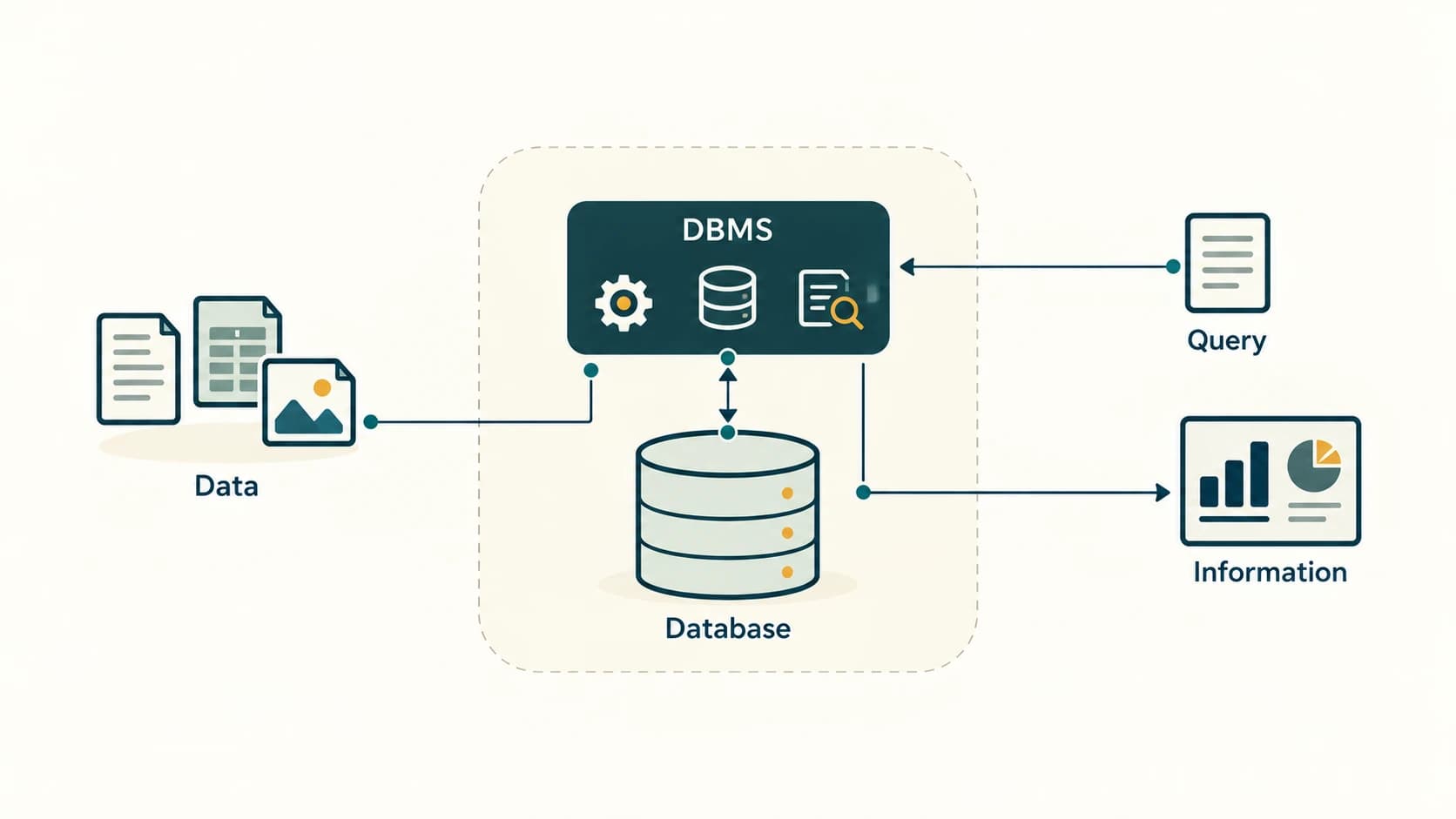
What does a DBMS do?
| Function | Meaning in everyday language | Illustrative banking task |
|---|---|---|
| Store and organize data | Arrange information according to a defined structure | Keep account and transaction records |
| Retrieve/query | Find records matching a condition | Look up transactions for one account |
| Insert, update, delete | Add, modify or remove permitted records | Correct an outdated mailing address |
| Enforce rules/integrity | Help prevent invalid or inconsistent entries | Reject a duplicate value in a unique key |
| Control access | Allow appropriate operations for authorized roles | Restrict sensitive records to permitted staff |
| Support concurrent use | Coordinate work by multiple users/processes | Serve many branch and online requests |
| Backup and recovery support | Help recover information following a failure | Restore to a recoverable database state |
| Manage transactions | Group operations into logical units | Complete or undo a multi-step transfer |
These are capabilities, not automatic guarantees: security requires correct permissions, recovery requires a functioning backup strategy, and integrity rules must be designed and configured.
Why not store every record in an ordinary text file?
A set of unrelated files can work for a very small task. At larger scale, it becomes harder to search consistently, update the same fact in many places, prevent conflicts, share records safely and coordinate multiple users. Databases provide organized methods for these operations. They do not magically eliminate every repeated value or error; good design and data-entry practices still matter.
Common database models include relational (tables), document-oriented (documents), key–value, graph and other models. For the Computer Awareness exam, relational DBMS (RDBMS) is the main focus. Examples of widely used DBMS products include PostgreSQL, MySQL, SQLite, Microsoft SQL Server, Oracle Database and IBM Db2. These are DBMS software/products, not names for an individual customer's database.
Transactions and ACID at awareness level
A database transaction is a logical group of database operations treated as one unit. Imagine moving ₹500 between two accounts in a simplified ledger: the debit and credit should be coordinated rather than leaving only one recorded. Database systems can use transaction mechanisms to help preserve consistency.
The classical ACID properties are:
| Letter | Meaning | Beginner interpretation |
|---|---|---|
| A | Atomicity | A transaction's changes act as an all-or-nothing unit |
| C | Consistency | Declared integrity rules remain satisfied across transactions |
| I | Isolation | Concurrent transactions are coordinated according to a defined isolation level |
| D | Durability | Committed changes are designed to survive specified failures |
ACID is useful to recognize in exam questions, but not every database provides identical guarantees, and applications must still handle operational errors properly. A transaction in a DBMS is also not identical to the everyday business meaning of a bank transaction.
Worked everyday example
A bank stores a customer name, account identifier, account type and account status. The records are data. An organized set of those records is a database. A DBMS controls permitted inserts, searches and updates. An account-summary screen or report uses retrieved values to present information to staff or customers.
Important terms
| Term | Exam-friendly meaning |
|---|---|
| Database | Organized collection of data |
| DBMS | Software for managing databases |
| RDBMS | DBMS based on the relational model |
| Query | Request to retrieve or manipulate data |
| Schema | Description of database structures and rules |
| Metadata | Data describing other data, such as a column name/type |
| Integrity | Accuracy and consistency rules for stored data |
| Concurrency | Multiple users/tasks accessing a resource in overlapping periods |
| Transaction | Logical group of database operations |
| Backup | Retained recoverable copy of data |
Common confusions and exam traps
- Database ≠ DBMS: records versus the software that manages them.
- DBMS ≠ SQL: DBMS is software; SQL is a language supported by many relational DBMSs.
- Database ≠ Internet: an isolated computer can use a local database without Internet access.
- Security is not automatic: a DBMS offers controls, but weak configuration can expose data.
- Backup ≠ a second live screen: a backup must be suitable for recovery, not merely another view.
- Data ≠ only numbers: text, dates and other recorded values are also data.
Objective-exam facts to remember
| Question clue | Common answer |
|---|---|
| Software used to manage a database | DBMS |
| Table-oriented database model | Relational |
| Software managing a relational database | RDBMS |
| Request made to a database | Query |
| Description of the database structure | Schema |
| All-or-nothing transaction property | Atomicity |
| ACID 'D' | Durability |
Quick revision
- A database stores related data; a DBMS manages access and operations on it.
- Data may become useful information after it is organized or analyzed.
- Relational databases use tables and relationships; other database models also exist.
- DBMSs support searching, changes, concurrency, access controls and recovery mechanisms.
- ACID names Atomicity, Consistency, Isolation and Durability.
Practice questions — CA-08-01
1. Which best describes a database?
A. A device that only prints reports
B. An organized collection of related data
C. A web browser
D. A spreadsheet formula
2. DBMS stands for:
A. Data Business Monitoring Service
B. Digital Backup Memory System
C. Database Management System
D. Database Mapping Syntax
3. Which pair correctly distinguishes the database from the DBMS?
A. Data collection / managing software
B. Printer / monitor
C. Input device / output device
D. Browser / search engine
4. Three amounts are combined into a monthly deposit total. The useful total is an example of:
A. A network switch
B. A foreign key
C. System firmware
D. Processed information
5. Which action is typically performed by a DBMS?
A. Replacing a CPU fan
B. Retrieving rows that match a query
C. Detecting paper size
D. Increasing display brightness
6. Which is a widely used relational DBMS product?
A. HDMI
B. Bluetooth
C. PostgreSQL
D. JPEG
7. A description of a database’s tables and defined columns is part of its:
A. Schema
B. Screenshot
C. Wallpaper
D. Browser cache
8. In ACID, atomicity means:
A. Every transaction must use a wireless network
B. Records are automatically public
C. All reports are error-free
D. Transaction changes are treated as a single all-or-nothing unit
9. In ACID, the letter D represents:
A. Duplication
B. Durability
C. Downloading
D. Data mining
10. Which statement about DBMS security is accurate?
A. Every database is secure by default
B. Databases cannot contain private data
C. A DBMS offers access controls that still need correct configuration
D. Only paper files require permissions
11. Which one is NOT necessarily required for a local database to work?
A. Public Internet access
B. Storage
C. Database software
D. Computer resources
12. What is a transaction in DBMS terminology?
A. Always a payment at a bank counter
B. A printed receipt
C. A web domain
D. A logical set of database operations handled as one unit
Answers and explanations — CA-08-01
1. B — An organized collection of related data. A database is the organized stored collection; a report, application or device can use it but is not the database itself.
2. C — Database Management System. A Database Management System is software that manages storage, retrieval and controlled operations on databases.
3. A — Data collection / managing software. The database is the stored information; DBMS is the software that manages it and provides operations.
4. D — Processed information. Data can be organized, calculated and interpreted into information, such as a monthly summary.
5. B — Retrieving rows that match a query. A DBMS provides query and data-management capabilities; the other choices concern hardware or interface controls.
6. C — PostgreSQL. PostgreSQL is database-management software using the relational model, while the other choices are connection/image technologies.
7. A — Schema. A schema describes the organized structure and rules of a database, including tables and their attributes.
8. D — Transaction changes are treated as a single all-or-nothing unit. Atomicity coordinates the operations of one transaction so it is not left partially applied under its transaction rules.
9. B — Durability. Durability concerns preserving committed transaction changes according to the database system’s failure guarantees.
10. C — A DBMS offers access controls that still need correct configuration. Permissions and access-control features help protect records but can be misconfigured or misused.
11. A — Public Internet access. Many local and embedded databases function without access to the public Internet.
12. D — A logical set of database operations handled as one unit. Database transactions describe a coordinated unit of database work; they need not represent a financial transaction.