
Common Online-Fraud and Digital-Payment Safety Concepts
Common Online-Fraud and Digital-Payment Safety Concepts. Foundational Computer Awareness explanations, examples and explained practice questions for banking and recruitment exam preparation.
By Akhilesh Saini
Learning objectives
Recognize frequent digital-payment and online-fraud lures, distinguish credit from debit authorization, know why UPI PIN/OTP secrecy matters, and follow a practical response path for suspected financial fraud.
Common fraud situations
Digital services are useful because they allow transactions without visiting a branch; the same convenience lets criminals contact many people quickly. A fraudster can impersonate a buyer, merchant, courier, recruiter, bank employee or official. The attempted deception may involve a fake payment notification, tampered payment QR, unsolicited 'collect' request, remote screen-sharing app, investment promise or a fake technical-support website.
| Fraud concept | Typical deceptive situation | Safety principle |
|---|---|---|
| Fake KYC/account-alert message | 'Account will freeze; verify now at this link' | Use independently verified official channels |
| OTP/credential theft | Caller asks for sign-in or transaction code | Do not share OTP, PIN, passwords or recovery codes |
| Collect-request / payment approval | Someone says 'approve to receive a refund' | Review whether approval authorizes a debit |
| QR-code payment trap | Buyer asks seller to scan code and authorize payment to receive funds | Receiving money normally does not need a UPI PIN/QR scan |
| Remote-access scam | 'Install support app to fix bank problem/refund' | Do not grant unknown parties device control |
| Fake marketplace/refund proof | Edited screenshot says payment has arrived | Confirm status in your own bank/payment application |
| Investment / task / advance-fee fraud | Promises unusually easy guaranteed returns | Verify independently; do not pay advances or disclose credentials |
| SIM-swap/account takeover | Attacker gains control of registered number/account | Protect SIM, passwords, device and recovery channels |
UPI and QR: what the user is actually authorizing
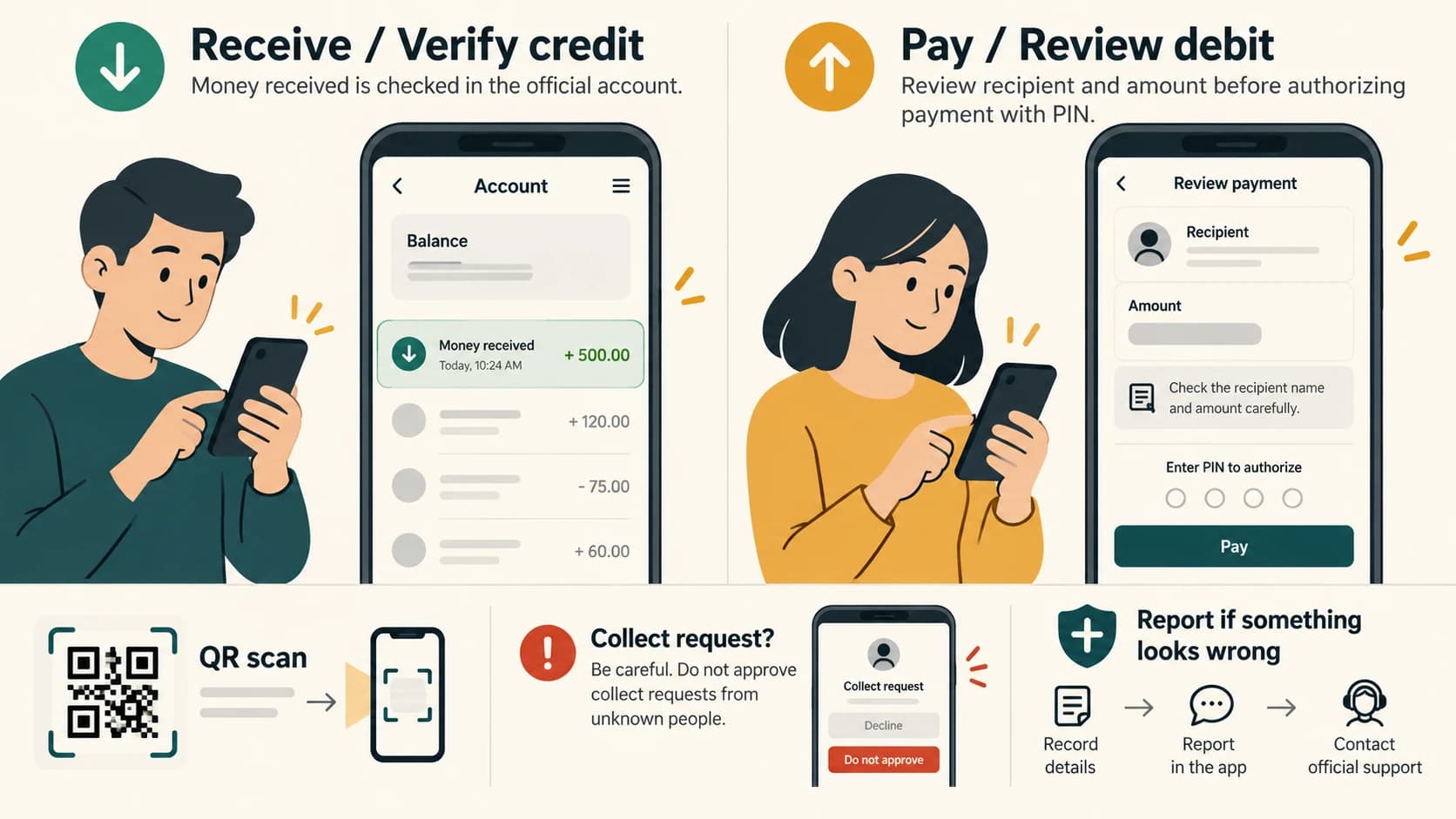
UPI (Unified Payments Interface) facilitates bank-account payments through compatible services in India. UPI PIN is an authorization secret used for defined debit/payment operations in UPI apps. A person receiving an ordinary incoming UPI payment does not need to reveal their UPI PIN or approve a collection request. The screen in a legitimate payment app should clearly show the intended payee/payer and debit amount; examine it before approving. App details vary, so the reliable rule is to understand the operation, not memorize a particular button color.
A QR code is an optical code that may contain payment-address information or a link; scanning it does not guarantee a safe destination. A payment request can ask the recipient to authorize sending money. A request for money and a receipt of money are opposite directions and should never be confused.
What to do when fraud may have occurred
- Stop additional authorizations. Do not disclose further credentials or approve follow-up 'reversal' requests.
- Use the bank’s official app, card controls or independently verified phone channel to report the incident and request appropriate account protections. Do not call a number provided by the suspected scammer.
- Report promptly through the appropriate official cybercrime/police reporting channel. In India, the National Cyber Crime Reporting Portal and the financial-fraud helpline are official routes; check current contact details at the official portal because channels and procedures can change.
- Keep evidence safely, such as transaction IDs, communications, timestamps and screenshots, without sharing further sensitive secrets publicly.
- Change compromised credentials and review devices/sessions using safe official channels, and seek assistance from relevant providers.
No particular response guarantees money will be recovered; prompt reporting can help relevant authorities and financial intermediaries act sooner. A financial fraud investigation and a routine payment dispute are not necessarily the same workflow.
Worked cases
Case A — Selling an item: The buyer says 'scan my QR to receive your payment'. Since scanning a payment QR in a payer app often initiates a payment outward, the seller should refuse and verify credit in their own account instead. Sharing a UPI ID or other legitimate receiving details for payment is different from sharing a PIN.
Case B — Refund caller: Someone offers a refund only if a 'request money' prompt is approved. That may authorize debit. Do not approve an unexpected request or disclose a PIN.
Case C — Edited transfer screenshot: A seller receives an image saying '₹4,000 sent' but their official account shows no credit. An image is not a bank settlement confirmation; use the trusted account record.
Case D — Scam after a mistake: A fraudster offers recovery for an advance fee. Treat such contact as a new potential fraud and deal through official reporting/support.
Objective-exam facts
| Question clue | Recognition answer |
|---|---|
| Unified Payments Interface | UPI |
| QR code is scanned using | Camera/optical reader in supported apps |
| UPI PIN is for | Authorizing specified payment/debit actions |
| Unexpected request to approve payment | Check debit direction and payee; reject if unintended |
| Claim that PIN is needed to receive normal transfer | Fraud red flag |
| Fake payment screenshot | Independently verify actual credit |
| Fraud reporting in India | Official bank and National Cyber Crime Reporting Portal |
Common confusions and exam traps
- Receiving money ≠ entering UPI PIN: Do not enter PIN merely to receive ordinary credit.
- QR ≠ NFC: QR scanning uses optical recognition; NFC uses short-range radio.
- Payment screenshot ≠ verified credit: Check your own bank/payment records.
- OTP or UPI PIN ≠ support credentials: Genuine support should not demand these secrets on an unsolicited call.
- Prompt reporting ≠ promised refund: Assistance and outcomes vary by facts and procedure.
Quick revision
- Check transaction direction and the account being debited before authorizing payment.
- Do not share passwords, OTPs, UPI PINs or remote device control with unexpected contacts.
- Review QR destination/payee; scan a code only when you understand the resulting action.
- Confirm payments in official account records rather than screenshots.
- On suspected fraud, stop additional authorizations and report promptly through independently verified official channels.
Practice questions — CA-09-08
1. Someone says you must enter your UPI PIN simply to receive an ordinary incoming payment. This is:
A. Normal for all receipts
B. A fraud warning sign
C. Mandatory proof of income
D. The same as checking account balance
2. A request in a payment app asks you to approve sending ₹2,000. Before approval you should:
A. Confirm whether it is an intended debit to the correct party
B. Assume it is a refund
C. Ignore recipient details
D. Share the PIN with caller
3. A buyer sends only a screenshot saying they transferred payment. Which is safest?
A. Trust the screenshot completely
B. Scan buyer’s QR to get funds
C. Check credited amount in your official account records
D. Read transaction OTP to the buyer
4. QR stands for:
A. Quick Restore
B. Quality Routing
C. Query Record
D. Quick Response
5. Scanning a printed QR code typically uses:
A. A camera/optical reader
B. An NFC radio only
C. A firewall
D. A bank database engine
6. Which payment detail must never be disclosed to an unexpected support caller?
A. Public shop address
B. UPI PIN or transaction OTP
C. Product description
D. Published business hours
7. An unknown person requests installation of a remote-access application to process a refund. Best action?
A. Install and share all permissions
B. Give bank login immediately
C. Decline and use official support
D. Turn off account alerts
8. What is the most appropriate next step after suspected financial fraud?
A. Wait indefinitely
B. Reply to the scammer for a guarantee
C. Pay another fee to recover funds
D. Promptly contact the bank and report through verified official channels
9. Which organization operates the UPI framework in India?
A. NPCI
B. IEEE
C. W3C
D. ICANN
10. An investment message promises guaranteed large returns for a small advance fee. This is:
A. Automatically regulator-approved
B. A reason for heightened fraud skepticism
C. A normal secure authentication
D. A type of encryption
11. Which statement about recovery of fraud losses is accurate?
A. Calling a helpline always guarantees a refund
B. Scammers can reverse anything for a fee
C. Prompt reporting helps but does not guarantee recovery
D. Keeping evidence is never useful
12. Which combination best protects a customer?
A. Share OTP, approve unknown collect request, trust screenshot
B. Install remote control, disclose PIN, ignore alerts
C. Use same password everywhere, click every link
D. Verify account credit, guard authorization secrets, report suspicious activity
Answers and explanations — CA-09-08
1. B — A fraud warning sign. Receiving a normal incoming UPI transfer does not require the recipient to reveal or enter UPI PIN for that credit.
2. A — Confirm whether it is an intended debit to the correct party. Approval may authorize money leaving the account; direction and payee must be checked.
3. C — Check credited amount in your official account records. Independent account/transaction status is more reliable than an easily altered screenshot.
4. D — Quick Response. QR is the abbreviation for Quick Response code.
5. A — A camera/optical reader. QR is an optical matrix code, separate from NFC contactless radio.
6. B — UPI PIN or transaction OTP. Payment authorization secrets must not be supplied to callers.
7. C — Decline and use official support. Unsolicited remote access can expose financial apps and sensitive information.
8. D — Promptly contact the bank and report through verified official channels. Timely official reporting and account protection reduce the risk of further loss.
9. A — NPCI. The National Payments Corporation of India developed and operates UPI arrangements.
10. B — A reason for heightened fraud skepticism. Advance fees and improbable guaranteed returns are common online-fraud indicators.
11. C — Prompt reporting helps but does not guarantee recovery. Authorities/providers may act on reports, but outcomes depend on the circumstances.
12. D — Verify account credit, guard authorization secrets, report suspicious activity. Independent verification and protection of transaction approval details help reduce fraud exposure.