
MIS and Information Systems Basics
MIS and Information Systems Basics. Foundational Computer Awareness explanations, examples and explained practice questions for banking and recruitment exam preparation.
By Akhilesh Saini
Learning objectives
Define an information system and MIS; identify the role of TPS, MIS and DSS in simple business examples; recognize the difference between recording data and reporting for management.
Information systems combine people and technology
An information system is an organized arrangement of people, processes, data and technology that collects, processes, stores and shares information for a purpose. The computer and its software are important components, but the full system also needs reliable input, defined workflows, permissions and users who interpret the results.
For instance, a branch service system may collect permitted transactions, validate entries, save records, show customer-facing outcomes and produce reports. A computer alone cannot make the business process trustworthy: the quality of data and human controls also matter.
A Management Information System (MIS) helps managers obtain organized information for monitoring, control, planning and routine decision-making. In many textbook descriptions it creates periodic, summary and exception reports by using data produced by operational systems.
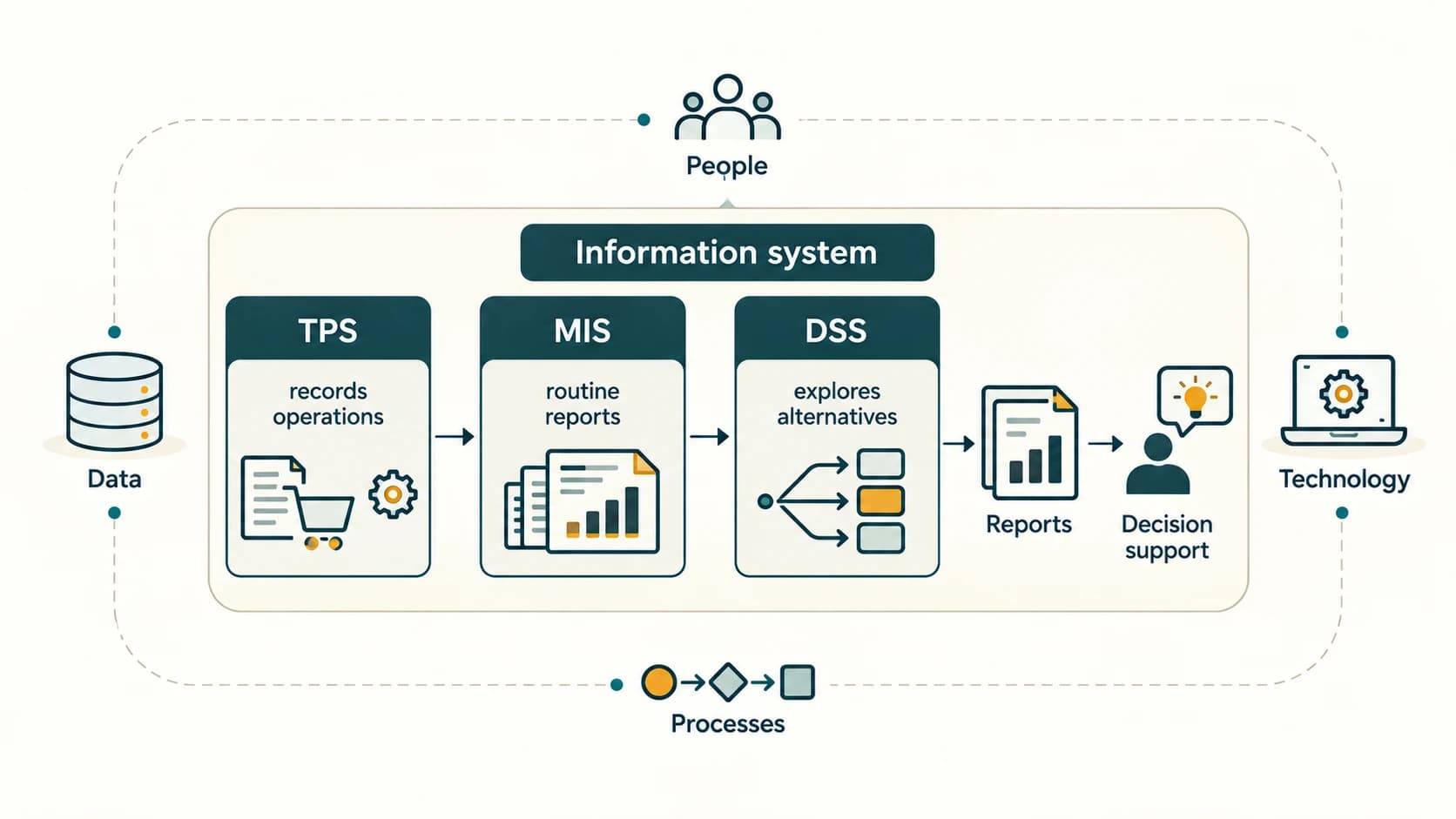
The difference between data capture and management information
Imagine a fictitious organization that records daily service requests:
- Employees enter requests through an approved application; each action becomes an operational record.
- A processing/database system checks and stores those records.
- A report summarizes requests by branch, category or period.
- Managers use the summarized information to plan staffing or investigate service delays.
Stages 1–2 are focused on recording and operating the service, while stages 3–4 illustrate management reporting and decision support. The data should be checked for completeness, correct time periods and permitted access before managers rely on it.
Related information-system categories
| Abbreviation | Full form | Typical focus | Illustrative question |
|---|---|---|---|
| TPS | Transaction Processing System | Record routine operational events | Was this authorized transaction recorded? |
| MIS | Management Information System | Regular summaries and management reporting | How many requests arrived per branch? |
| DSS | Decision Support System | Analytical support for less-routine decisions | What if staff allocation changed? |
| ESS/EIS | Executive Support / Executive Information System | High-level, often strategic views for senior leaders | What are the overall trends and indicators? |
These labels describe typical roles, and real products frequently blend capabilities. A single software platform may support TPS, MIS and analytics together. DSS supports decision-makers rather than automatically replacing human judgment.
Reports commonly associated with MIS
- Periodic report: produced on a regular schedule, such as a weekly summary.
- Summary report: aggregates many operational records into totals or trends.
- Exception report: highlights values outside defined rules or thresholds, such as unusually delayed requests.
- Ad hoc report: prepared on demand for a particular question.
- Dashboard: presents selected indicators visually; whether it is part of MIS, BI or another platform depends on usage.
A useful report specifies what is being counted, the period, filters and any data limitations. A visually attractive dashboard built from incorrect data remains misleading.
BI, ERP and CRM: recognition only
BI (Business Intelligence) refers broadly to tools and practices that turn business data into reporting, visualization and analysis. ERP (Enterprise Resource Planning) systems integrate important enterprise activities such as finance, procurement, inventory and human resources in a coordinated suite. CRM (Customer Relationship Management) systems focus on managing customer-related interactions and information. These categories can overlap and integrate with databases and MIS; none is simply a synonym for a database.
A KPI (Key Performance Indicator) is a measure used to track progress toward an objective. A KPI dashboard might display percentage of requests resolved within a target time. The measure must be clearly defined; a metric is not automatically meaningful merely because it appears in a graph.
Information quality and responsible use
Managers depend on accurate, complete, timely, relevant and accessible information. The correct audience also matters: access should follow applicable permissions, confidentiality requirements and organizational policy. A report should not expose personal information simply because the underlying database technically contains it.
Garbage in, garbage out (GIGO) is a useful reminder: poor-quality inputs can produce misleading outputs even when software performs calculations correctly. Strong systems combine appropriate validation, controls and human review.
Worked example: identify the system
A branch logs a permitted transaction: TPS function. A regional supervisor sees a weekly summary of totals: MIS function. An analyst compares possible staffing scenarios: DSS function. Senior management reviews broad organizational trends: ESS/EIS function. A shared platform may perform more than one of these roles.
Common confusions and exam traps
- MIS ≠ database: MIS uses information sources; a database is a way to organize data.
- MIS ≠ only hardware: it combines information, processes, people and technology.
- TPS records events; MIS commonly summarizes them.
- DSS supports decisions, not automatic guaranteed decisions.
- ERP ≠ CRM: enterprise-wide process integration versus customer relationships.
- Charts and KPIs can still mislead when data or definitions are poor.
Objective-exam facts and quick revision
| Exam clue | Term |
|---|---|
| Regular management summary | MIS |
| Recording routine operational events | TPS |
| Scenario and what-if support | DSS |
| High-level executive reporting | ESS/EIS |
| Customer interaction management | CRM |
| Integrated enterprise processes | ERP |
| Performance metric linked to an objective | KPI |
| Poor input produces poor output | GIGO |
- An information system joins people, procedures, data and technology.
- MIS emphasizes useful management information, typically via reports.
- TPS records operations; DSS helps analyze alternatives; ESS/EIS supports high-level views.
- Business intelligence can feed dashboards, but dashboards still need reliable data.
- Information should be accurate, relevant, timely and shared only with appropriate users.
Practice questions — CA-08-07
1. MIS most commonly stands for:
A. Memory Input System
B. Management Information System
C. Mobile Internet Service
D. Mainframe Instruction Set
2. Which system category emphasizes routine operational event recording?
A. DSS
B. EIS
C. TPS
D. Presentation software
3. DSS stands for:
A. Decision Support System
B. Data Storage Screen
C. Digital Security Service
D. Document Sorting Software
4. A weekly regional summary report is a typical example of:
A. Firmware startup
B. NFC pairing
C. Monitor calibration
D. MIS reporting
5. Which system label commonly refers to high-level executive reporting?
A. BIOS
B. ESS/EIS
C. DHCP
D. CSV
6. A report listing transactions above a defined review threshold is a(n):
A. Optical medium
B. Operating system
C. Exception report
D. Device driver
7. GIGO stands for:
A. Garbage In, Garbage Out
B. Graph Input, Graph Output
C. General Internet Gateway Operation
D. Guaranteed Information Generation Only
8. An information system typically includes:
A. Only CPUs
B. Only databases
C. Only a printer
D. People, processes, data and technology
9. ERP is best associated with:
A. Short-range personal radio
B. Integrated enterprise processes such as finance and inventory
C. A query keyword only
D. A monitor cable
10. CRM is primarily concerned with:
A. Processor fan speed
B. SQL sorting only
C. Customer-related information and interactions
D. Optical fibre transmission
11. What is a KPI?
A. A measure connected to monitoring progress toward an objective
B. A mandatory database password
C. A type of Wi-Fi tower
D. An SQL encryption key
12. Which statement about MIS and decision making is accurate?
A. Software outputs are always correct
B. A colorful dashboard guarantees good data
C. Managers need no data-quality checks
D. MIS supports informed decisions, but information quality and human judgment still matter
Answers and explanations — CA-08-07
1. B — Management Information System. A management information system supports managers through organized information, reports and monitoring.
2. C — TPS. Transaction Processing Systems are associated with collecting and processing routine operational events.
3. A — Decision Support System. A DSS supports evaluation of choices, alternatives and analytical scenarios.
4. D — MIS reporting. MIS commonly provides periodic or summarized information used by management.
5. B — ESS/EIS. Executive Support/Information Systems provide broad indicators and reports to senior leaders.
6. C — Exception report. An exception report highlights items outside a chosen condition or threshold.
7. A — Garbage In, Garbage Out. Poor-quality input data can yield poor or misleading results even when software computes correctly.
8. D — People, processes, data and technology. Information systems include human workflows and data policies alongside software and hardware.
9. B — Integrated enterprise processes such as finance and inventory. Enterprise Resource Planning integrates core functions and processes within an organization.
10. C — Customer-related information and interactions. Customer Relationship Management tools organize customer-facing activities and relationships.
11. A — A measure connected to monitoring progress toward an objective. A Key Performance Indicator measures something relevant to assessing progress against a defined goal.
12. D — MIS supports informed decisions, but information quality and human judgment still matter. MIS helps by organizing information; responsible decisions still depend on trustworthy inputs and relevant interpretation.