
Compiler, Interpreter and Assembler
Compiler, Interpreter and Assembler. Foundational Computer Awareness explanations, examples and explained practice questions for banking and recruitment exam preparation.
By Akhilesh Saini
What you will learn
- The difference between source code, machine code and executable programs.
- How a compiler, interpreter and assembler relate to language translation.
- Why the familiar classroom definitions are useful but simplified.
- Basic terms such as object code, linking and debugging.
Why this topic matters
Questions often say: Which translator converts assembly language? or Which usually translates source into machine-oriented form before execution? The answers are easier if you begin with the language the program is written in and the form the computer needs to run it.
Why programs need translation
A processor ultimately executes machine instructions, typically encoded in binary patterns for its instruction set. Humans normally create software using higher-level programming languages such as C, Java or Python, or assembly language mnemonics representing low-level instructions. Various translation and execution tools bridge that gap.
- Source code: human-readable program text written in a programming language.
- Machine code: instructions in a form executable by a particular processor architecture.
- Object code/object file: output produced during a compilation/assembly workflow; may need linking to form the final runnable program.
- Executable: a program form suitable for loading/execution in a particular environment.
Compiler
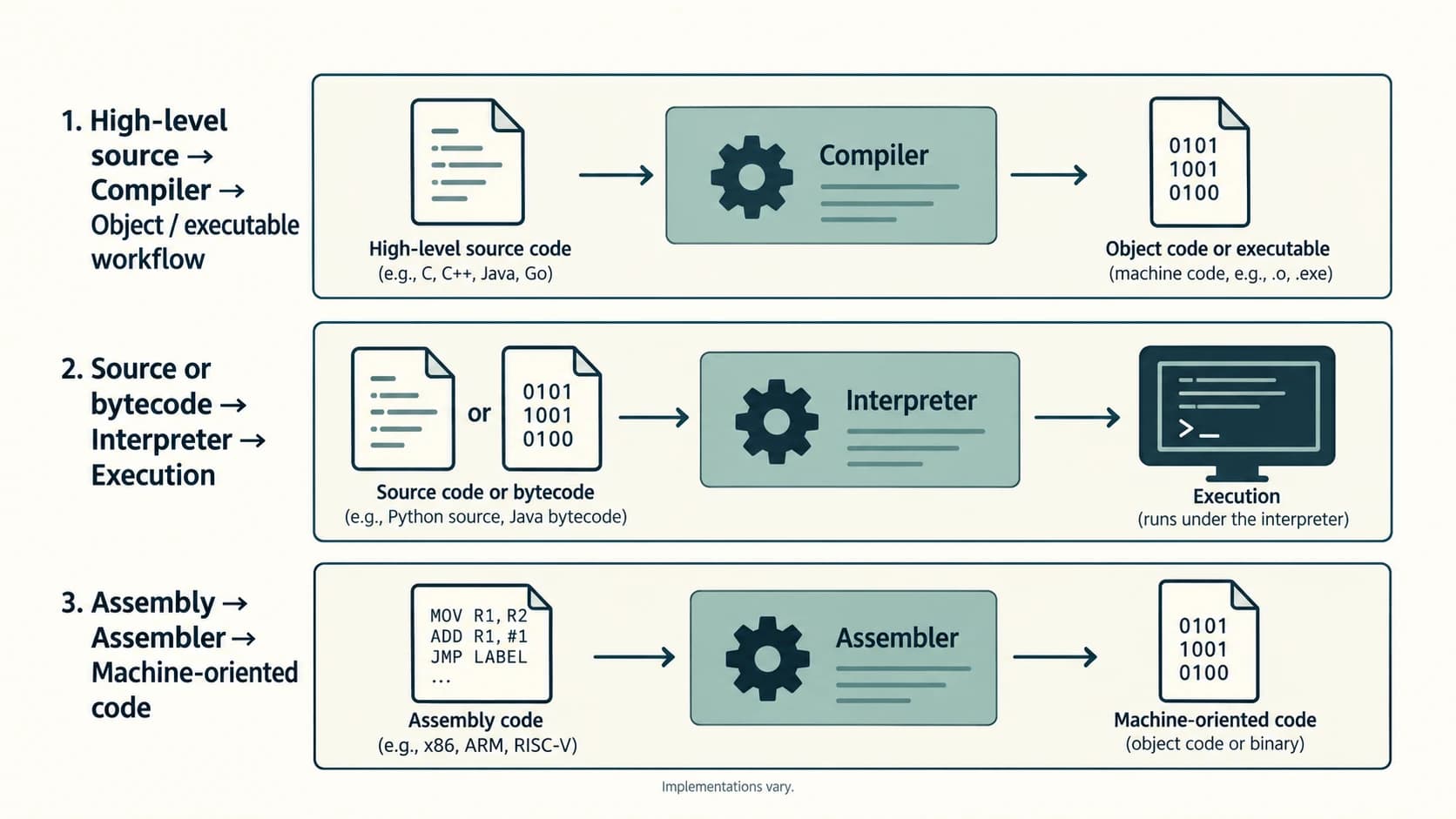
A compiler translates source code into another representation, commonly object or machine code, sometimes bytecode or other intermediate representations. In the simplest textbook model, it translates the whole program before execution. For C and many C++ workflows, the compiler toolchain commonly produces object files that may later be linked into an executable.
Important: Compilation can catch some errors before execution, but it does not guarantee a program is free of logical bugs or unsafe behavior. A compiler does not automatically make its output portable across every computer.
Interpreter
An interpreter executes program behavior using language-processing software, often reading and evaluating code or executing an intermediate form. Traditional exam notes say that an interpreter translates and executes line by line. That phrase helps distinguish basic classroom models, but is not a universal description of modern interpreters.
For example, the usual CPython implementation first compiles Python source to bytecode and executes that bytecode with an interpreter. Some language implementations use just-in-time (JIT) compilation during execution. Therefore, a language is not permanently restricted to exactly one translation method.
Assembler
An assembler translates assembly-language instructions—human-readable mnemonics closely tied to a processor architecture—into machine-oriented code. For example, an assembly mnemonic such as an instruction to move data has a processor-specific encoding. Assembly language is not the same as an ordinary high-level language.
Comparison table
| Translator/tool | Typical input | Typical output/behavior | Common exam answer |
|---|---|---|---|
| Compiler | Source in a supported programming language | Translated program/object or intermediate representation | Translates source before typical compiled execution workflow |
| Interpreter | Source or intermediate program form | Executes operations through an interpreter/runtime | Executes/interprets program instructions |
| Assembler | Assembly language | Machine-oriented instructions/object code | Translates assembly language |
Do not treat the table as proof that compilers always produce one final .exe, or interpreters never use compiled intermediate code.
Linking and loading: the next stages
Compiling several source files can produce multiple object files. A linker combines relevant object files and libraries into a final program representation. A loader or OS program-loading mechanism prepares an executable to run. An assembler and linker serve different roles: assembler translates assembly; linker combines program components.
Worked examples
Example 1 — C program: A learner writes a simple C program. The compilation toolchain may compile it into object code and link it with required libraries. The resulting executable runs on a compatible environment. Any compiler messages about syntax are not evidence that all later execution will be correct.
Example 2 — Python program: A learner runs a Python file. The common CPython implementation compiles code to bytecode and interprets that bytecode. This still qualifies Python as a commonly interpreted language in classroom shorthand, but explains why "exactly one line at a time without prior compilation" is inaccurate.
Example 3 — Assembly file: An assembler processes instructions expressed as assembly mnemonics. It is the correct answer to the question Which translator converts assembly language to machine-oriented form?
Important terms
| Term | Meaning |
|---|---|
| Source code | Program expressed in a source language |
| Machine code | Processor-executable instructions |
| Object code | Translated program representation often used before linking |
| Compiler | Translates a source program to another code form |
| Interpreter | Runs code through an interpreting environment |
| Assembler | Translates assembly-language instructions |
| Linker | Combines compiled/assembled components and library references |
| Debugger | Tool to investigate a program's execution and defects |
| Syntax error | Violation of the language's form/grammar rules |
| Logic error | Program runs but performs the wrong intended calculation/behavior |
Common confusions
- Compiler versus interpreter: A familiar distinction of workflow, not a strict property of every language implementation.
- Assembler versus compiler: An assembler expects assembly language; many compilers start from a higher-level language.
- Linker versus translator: Linker resolves/combines components; it does not replace the compiler or assembler.
- Error detected ≠ error fixed: A compiler's diagnostic helps locate problems but does not necessarily correct them.
- Machine code ≠ assembly: Assembly uses human-readable mnemonics; machine code is processor instruction encoding.
Fact to remember
Compiler: translates source; interpreter: executes through a runtime; assembler: translates assembly. The classic "compiler = whole program, interpreter = line-by-line" formula is a beginner comparison—not a law for all implementations.
Quick revision
| Exam clue | Answer |
|---|---|
| Translates assembly-language mnemonics | Assembler |
| Produces object code from source in a typical C toolchain | Compiler |
| Executes code in an interpreting environment | Interpreter |
| Combines object files | Linker |
| Finds execution defects step by step | Debugger |
| Instructions directly recognized by a processor | Machine code |
| Human-readable program text | Source code |
Practice questions — CA-03-07
Q1. Which translator most directly converts assembly-language instructions to machine-oriented code?
A. Assembler · B. Web browser · C. Printer driver · D. Spreadsheet
Q2. Which tool is commonly used to translate C source to object code?
A. Antivirus · B. Compiler · C. Image viewer · D. BIOS settings
Q3. What does an interpreter primarily do?
A. Supply wall power · B. Turn monitors on · C. Execute program behavior through an interpreting runtime · D. Print bank cheques
Q4. Which component typically combines object files into a usable program?
A. Assembler only · B. Keyboard · C. Firewall · D. Linker
Q5. Human-readable instructions written in a programming language are:
A. Source code · B. Ink toner · C. Keyboard signals · D. A disk platter
Q6. Processor-executable instruction encodings are commonly called:
A. File icons · B. Machine code · C. Scanner marks · D. Application shortcuts
Q7. Why is saying "all interpreters strictly execute source one line at a time" inaccurate?
A. There is no such thing as an interpreter · B. Every program is an assembly file · C. Some runtimes compile to bytecode or use other execution techniques · D. No source code can have errors
Q8. What typically occurs when CPython runs a Python program?
A. Python is executed by a printer · B. Only assembly mnemonics are allowed · C. Source is always directly machine code with no intermediate step · D. Source is compiled to bytecode that an interpreter executes
Q9. Which statement about compiler success is correct?
A. Successful compilation does not guarantee logical correctness · B. A compiled program can never crash · C. All compilers automatically fix every bug · D. Compilation is the same as scanning a PDF
Q10. What does a debugger primarily help investigate?
A. Colour of paper · B. Program behavior and defects during execution · C. CPU manufacturer's logo · D. Optical disk scratches
Q11. Which is an example of a logic error?
A. A missing required punctuation token caught by parser · B. A broken monitor · C. Code correctly runs but calculates an incorrect discount · D. An unplugged power cable
Q12. Which statement about compilers and interpreters is best?
A. A language always has exactly one execution method · B. Interpreters can never use compiled code · C. Compilers only translate English prose · D. Translation/execution methods can differ among implementations
Answers and explanations — CA-03-07
| Q | Correct answer | Explanation |
|---|---|---|
| 1 | A. Assembler | An assembler translates assembly mnemonics and related directives into object/machine-oriented representation. |
| 2 | B. Compiler | A C compiler translates source during the compile stage; linking may still be required. |
| 3 | C. Execute program behavior through an interpreting runtime | An interpreter runs language operations, possibly from source or intermediate bytecode. |
| 4 | D. Linker | A linker combines compiled/assembled units and library references; it is separate from compilation. |
| 5 | A. Source code | Source code is the program text used by programmers before processing/execution through suitable tools. |
| 6 | B. Machine code | Machine code uses binary-encoded instructions appropriate for a processor instruction set. |
| 7 | C. Some runtimes compile to bytecode or use other execution techniques | Modern language systems may translate source to bytecode, use JITs or interpret structures other than one source line at a time. |
| 8 | D. Source is compiled to bytecode that an interpreter executes | The common CPython implementation compiles Python source to bytecode and evaluates that bytecode. |
| 9 | A. Successful compilation does not guarantee logical correctness | A compiled program may still contain logic errors, runtime errors or vulnerabilities. |
| 10 | B. Program behavior and defects during execution | Debuggers help inspect control flow, values and program execution to locate faults. |
| 11 | C. Code correctly runs but calculates an incorrect discount | Logic errors occur when intended computations are wrong even if the program is syntactically valid and runs. |
| 12 | D. Translation/execution methods can differ among implementations | A language may have multiple compilers, interpreters and runtime approaches, so implementation matters. |