Fixed vs Floating Home Loan Interest Rates: Which Is Better When Rates Change?
Compare fixed and floating home loans in India, understand how rate changes affect EMIs and tenure, and learn when switching or prepayment makes sense.

A ₹50 lakh home loan at 8.5% for 20 years has a monthly instalment of roughly ₹43,391. Now imagine that three years later, the interest rate increases to 9.5%. Your lender might keep collecting the same EMI, yet your loan could take more than three additional years to repay.
This is one of the less obvious risks of a floating-rate home loan: an unchanged monthly payment does not necessarily mean an unchanged borrowing cost. A fixed-rate loan can protect you from such increases, but that protection may come at a higher initial rate and prevent you from automatically benefiting when rates fall.
A floating-rate home loan can be a sensible choice for borrowers who can absorb rate increases and want repayment flexibility. A genuinely fixed rate can be preferable when predictable borrowing costs matter more than potential savings. Neither is automatically cheaper. The decision depends on the actual offer, the future path of interest rates, your cash flow and how long you expect to keep the loan.
Fixed and floating interest rates: what is the difference?
A home loan is normally repaid through equated monthly instalments (EMIs). Each instalment contains interest on the outstanding loan and a repayment of principal. As the outstanding principal falls, less interest is payable at the same rate, leaving more of the EMI to reduce the balance.
The type of interest rate determines whether the rate used in this calculation can change.
| Feature | Fixed rate | Floating rate |
|---|---|---|
| Interest rate | Contractually unchanged for the full term of a genuinely fixed loan | Revised according to the applicable benchmark and loan terms |
| Monthly EMI | Normally predictable under the original repayment schedule | Can change; the lender may instead revise the remaining tenure |
| When market rates rise | Existing fixed rate remains unchanged | Borrowing cost can rise at a reset |
| When market rates fall | No automatic reduction | Borrowing cost can fall at a reset |
| Initial pricing | May include a premium for rate certainty | Can start lower, but compare actual offers |
| Early repayment | Charges may apply, depending on lender, contract and applicable rules | Generally protected from prepayment charges for individual non-business floating-rate home loans under applicable RBI rules |
A fixed interest rate does not mean the interest amount within every EMI stays constant. It is the percentage rate that stays fixed. Interest in rupees generally falls as principal is repaid.
Is a fixed-rate loan really fixed for 20 years?
Read the sanction letter carefully. A product advertised with a fixed rate for the first two or three years and a floating rate thereafter is a hybrid or dual-rate loan, not a fully fixed loan. The RBI's commercial-bank directions define fixed-rate loans by reference to the entire loan tenure.
Some offers also have contractual reset clauses. Ask for written confirmation of the duration of the fixed period, whether the rate can be revised, and what benchmark and spread will apply when the fixed period ends. A low introductory rate is not enough to determine the cost of a 20-year commitment.
A hybrid product may provide useful short-term certainty, for example while a household adjusts to new housing expenses, but it does not remove the subsequent exposure to rate movements.
How floating home loan rates change in India
A floating rate is typically constructed from a reference benchmark and a spread. The benchmark is a reference interest rate; the spread is the lender's margin above it, reflecting factors such as operating costs and borrower risk.
For example, suppose a repo-linked home loan has the following pricing:
- Illustrative benchmark: 6.00%.
- Contractual spread: 2.50 percentage points.
- Applicable home loan rate: 8.50%.
If the benchmark falls to 5.50% and the spread is unchanged, the loan rate becomes 8.00% at the relevant reset. If the benchmark rises to 6.50%, the rate becomes 9.00% instead. These figures are hypothetical, not current RBI policy rates or advertised offers.
Repo rate, EBLR and MCLR are not interchangeable
The repo rate is an RBI policy rate. An external benchmark lending rate (EBLR) is a lending-rate framework using a reference outside the bank's internal cost calculation. It may reference the repo rate or another permitted market benchmark. The final rate paid by a borrower also depends on the spread.
Under the RBI's commercial-bank framework, new floating-rate retail loans covered by the external-benchmark mandate have been linked to external benchmarks since October 2019. External-benchmark loan rates must be reset at least every three months. This does not mean the rate changes on the same day as every RBI policy announcement.
Older loans may be linked to the Marginal Cost of Funds based Lending Rate (MCLR), Base Rate or another legacy benchmark. MCLR reflects a bank's own funding-cost framework, so its movement need not mirror the repo rate point for point. The reset interval for MCLR loans can be up to one year. Housing finance companies and other lenders may have different benchmark arrangements; do not assume every floating home loan is repo-linked.
Even with an external benchmark, a spread is not necessarily immutable. Under commercial-bank rules, changes in the credit-risk premium require a substantial change in credit assessment consistent with the contract. Other spread components are subject to regulatory restrictions, including a provision allowing certain earlier reductions for customer retention. Check both the benchmark and the spread when investigating a change in your rate.
A worked example: ₹50 lakh home loan over 20 years
Consider two hypothetical offers for a fully disbursed ₹50 lakh home loan:
- Floating rate: initially 8.5% per year.
- Fully fixed rate: 9% per year for 20 years.
- Both loans use monthly reducing-balance repayment over 240 months.
- No processing fees, insurance premiums, prepayments, missed instalments or other charges are included.
| Initial offer | Monthly EMI | Total interest if the initial rate remains unchanged for 20 years |
|---|---|---|
| Floating at 8.5% | ₹43,391 | ₹54.14 lakh |
| Fixed at 9% | ₹44,986 | ₹57.97 lakh |
The fixed-rate offer initially costs about ₹1,595 more each month. If the floating rate remains at 8.5% throughout, the fixed offer costs approximately ₹3.83 lakh more in interest over the full term. This is the illustrative price of certainty, not a universal premium charged by lenders.
For these calculations, EMI is determined using P × r × (1 + r)^n ÷ [(1 + r)^n − 1], where P is principal, r is the annual interest rate expressed as a decimal divided by 12, and n is the number of monthly payments. Actual lender schedules may differ because of rounding, disbursement dates and interest conventions.
What happens after three years?
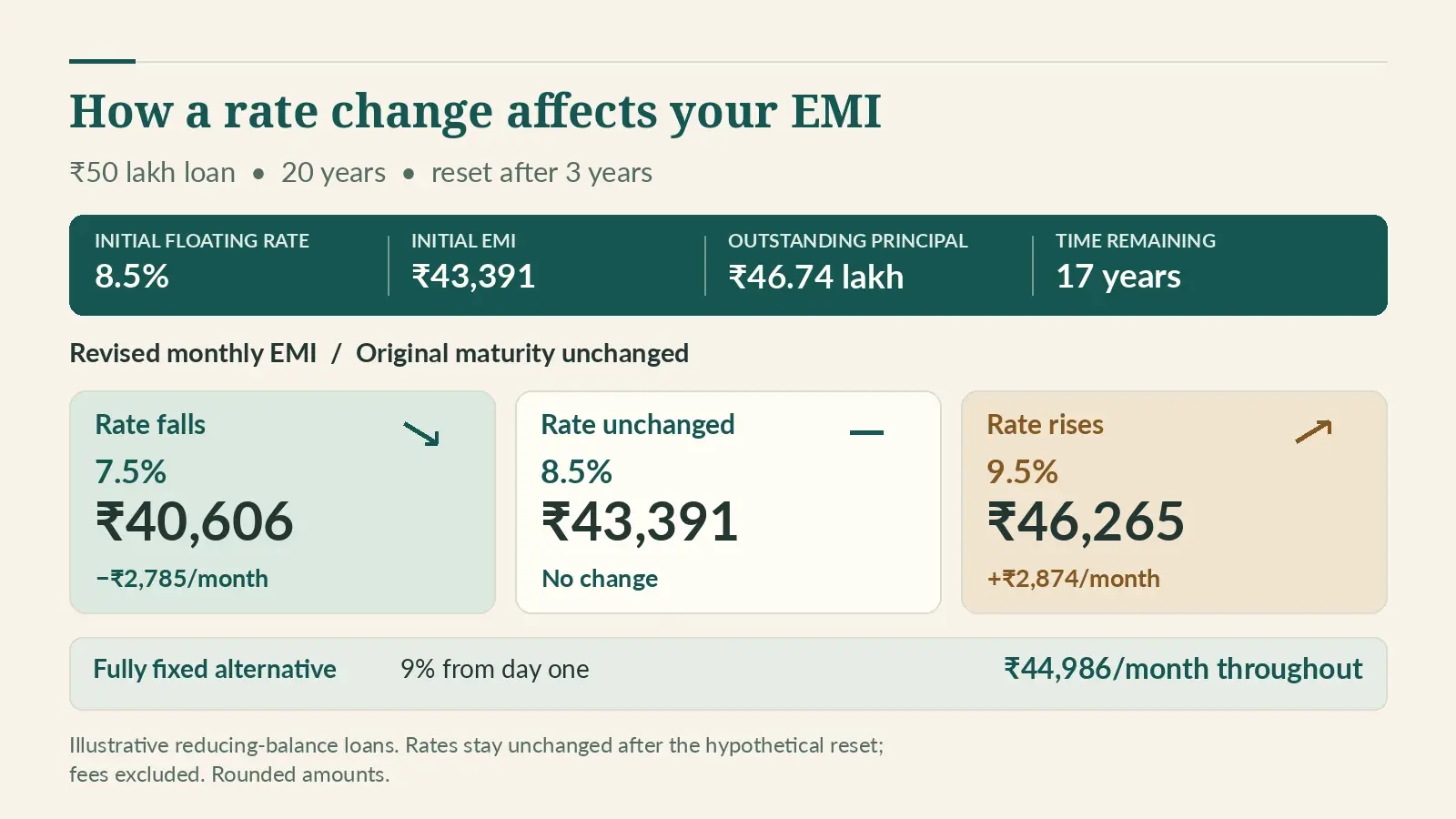
After 36 monthly payments at 8.5%, the floating-rate borrower's outstanding principal is approximately ₹46.74 lakh. The remaining scheduled tenure is 204 months (17 years).
Assume the rate now resets once to one of three levels and remains there until repayment. If the original end date is preserved, the results are:
| Rate after three years | Revised EMI | Total interest over the entire loan |
|---|---|---|
| 7.5% | ₹40,606 | ₹48.46 lakh |
| 8.5% | ₹43,391 | ₹54.14 lakh |
| 9.5% | ₹46,265 | ₹60.00 lakh |
| Fully fixed alternative at 9% from the start | ₹44,986 throughout | ₹57.97 lakh |
In the falling-rate scenario, the floating loan saves approximately ₹9.51 lakh in interest compared with the fixed alternative. In the rising-rate scenario, it costs around ₹2.03 lakh more. Neither outcome is a forecast; the example shows how the same two starting offers can produce very different results.
The timing of the change matters as well. A rate increase early in the term applies to a larger remaining balance for longer. A rise when only a few instalments remain is generally less consequential. Comparing simple averages of annual interest rates can therefore give a misleading picture of total cost.
Why your EMI can stay unchanged while your loan gets longer
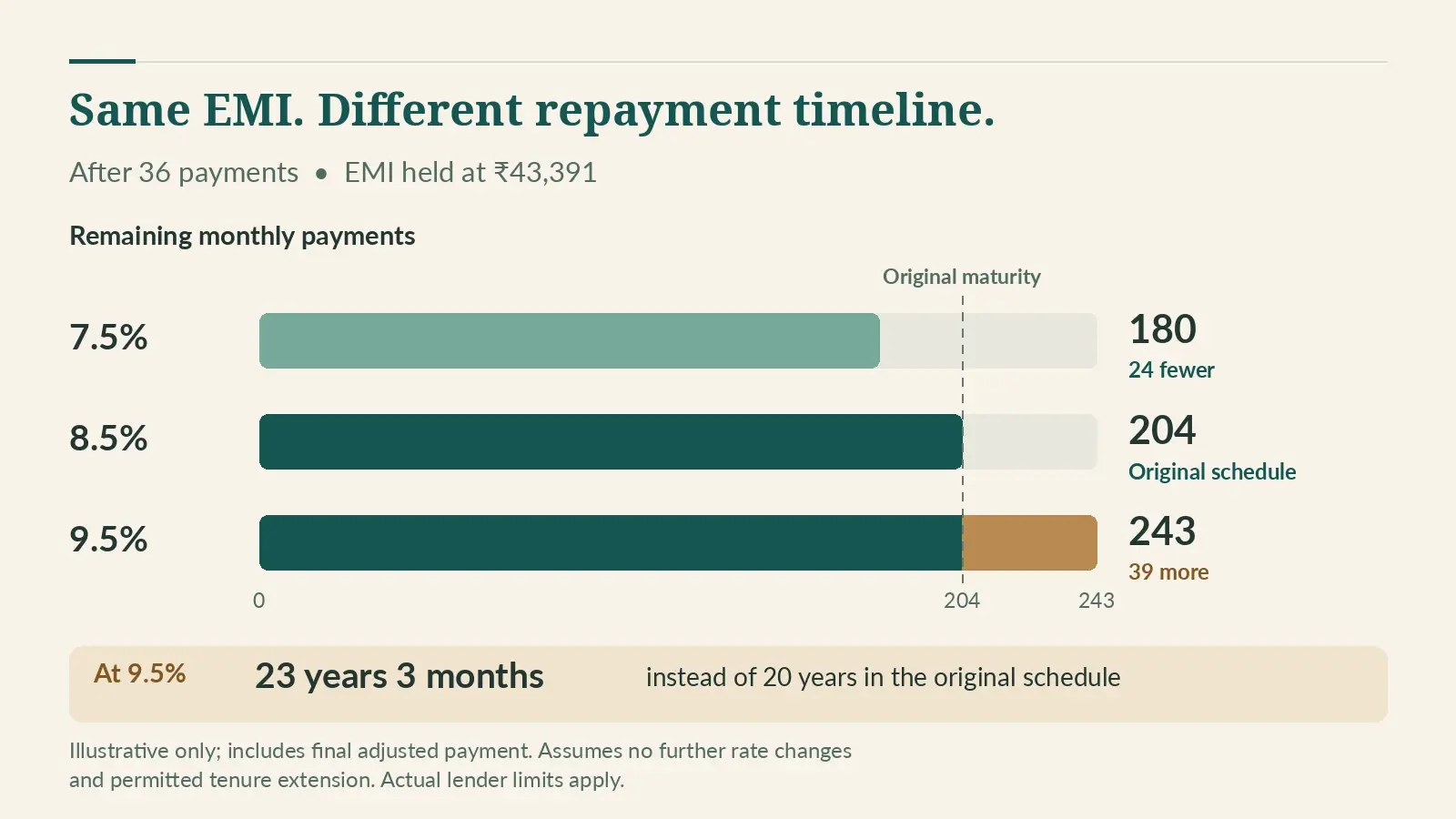
Suppose the lender keeps the original EMI of ₹43,391 instead of raising it after the reset. With the same outstanding principal and no further rate changes, the approximate repayment schedule becomes:
| New interest rate | Remaining monthly payments (including final adjusted payment) | Change from original 204 payments |
|---|---|---|
| 7.5% | 180 | 24 fewer |
| 8.5% | 204 | No change |
| 9.5% | 243 | 39 more |
At 9.5%, the total loan duration would become approximately 279 months, or 23 years and 3 months, rather than 20 years. This mathematical outcome assumes the lender permits that extension within its applicable tenure and borrower-age limits.
Here is why that happens. In the first month after the reset, interest on ₹46.74 lakh at 8.5% would be about ₹33,110, leaving roughly ₹10,282 of the original EMI for principal. At 9.5%, monthly interest rises to about ₹37,005, leaving only ₹6,386 for principal. The payment is unchanged, but the debt falls much more slowly.
There is a limit to this approach. If an EMI is not enough to cover the interest accruing during the period, the unpaid interest could cause the loan balance to grow. This is called negative amortisation. RBI's floating-rate reset rules prohibit tenure extensions that produce negative amortisation. Even before reaching that point, a lender's maximum permitted tenure may require a higher EMI or another repayment solution.
What options do borrowers have when rates rise?
The RBI introduced specific protections for instalment-based floating-rate personal loans, including housing loans, in August 2023. The rules apply to the relevant internal- and external-benchmark loans. The current commercial-bank and NBFC responsible-business-conduct directions incorporate this framework.
Lenders must explain the potential effect of rate changes when sanctioning a covered loan and communicate resulting changes in EMI or tenure. When benchmark increases cause resets, borrowers have options to adjust the instalment, extend repayment or combine those responses, and may repay part or all of the outstanding debt.
There is an important change to older guidance: from 1 October 2025, offering a switch to a fixed rate became discretionary for regulated lenders under the amended framework. A borrower should not assume a fixed-rate conversion must be offered on demand. Where available, the terms and any applicable conversion charges should be examined before accepting.
The framework also requires accessible quarterly information showing payments towards principal and interest, the EMI, remaining instalments and annualised interest rate or APR. Use this statement to identify unexpected extensions.
Should you increase your EMI or extend the tenure?
If your income and emergency savings comfortably support a higher EMI, preserving the original maturity date can limit the additional interest caused by a rate rise. Extending the tenure may be appropriate if a higher instalment would strain essential spending or make default more likely. A combination can offer a middle ground.
Ask for a revised amortisation schedule for each option, showing the projected final repayment date and total remaining interest. Do not decide solely on the smallest monthly instalment. If a later rate reduction brings relief, consider retaining the higher EMI to accelerate repayment, subject to the lender's procedures.
Prepayment, switching and balance transfer
A part-prepayment reduces outstanding principal, so future interest is charged on a smaller balance. It can be particularly valuable earlier in the loan term, provided you retain sufficient liquidity for emergencies and other obligations.
Prepayment charges: the 2026 rules
RBI's Pre-payment Charges on Loans Directions, 2025 apply to loans sanctioned or renewed from 1 January 2026. For covered floating-rate loans to individuals for non-business purposes, including ordinary personal home loans, regulated lenders cannot charge a prepayment fee. The protection extends to partial and full repayment without a minimum lock-in period and regardless of how the repayment is funded. For a dual-rate product, the rate type applicable at the time of prepayment determines the protection under these directions.
Older individual non-business floating-rate home loans also generally benefit from earlier regulatory protections; consult the rules relevant to your lender and original sanction. A genuinely fixed-rate loan is not automatically entitled to the same exemption. Ask for the written charge schedule and applicable exceptions.
Switching is not the same as refinancing
An internal conversion changes the rate type or pricing arrangement with the existing lender. A balance transfer generally involves a new lender paying off the old loan. The latter can involve legal, valuation, registration, documentation and processing costs even if the old lender cannot charge a foreclosure penalty.
For eligible older commercial-bank borrowers with a legacy benchmark-linked term loan, RBI directions provide for a move to an external benchmark without fees other than reasonable administrative or legal expenses, subject to the relevant conditions. This is distinct from the discretionary floating-to-fixed conversion.
Consider a borrower with ₹40 lakh outstanding who can reduce the annual rate from 9% to 8.5% by transferring the balance at a total cost of ₹20,000. The initial interest saving is approximately ₹1,667 per month (₹40 lakh × 0.5% ÷ 12). Dividing ₹20,000 by that figure suggests a rough 12-month recovery period. It is not an exact break-even calculation: the balance declines, rates may change, and different repayment schedules affect savings. Compare actual cash flows over the same remaining term, especially if you plan to sell the property soon.
Which home loan rate should you choose?
| Your situation | What to consider |
|---|---|
| You have a tight but stable monthly budget | A genuinely fixed rate may provide useful certainty if its EMI is already affordable. |
| You can handle higher instalments and want to make part-prepayments | A floating rate may offer useful flexibility. |
| You expect rates to fall | Floating pricing may pass on reductions, but timing and magnitude are uncertain. |
| You worry about rising rates | Compare the fixed-rate premium with your ability to absorb rate increases. |
| You expect to sell or repay early | Compare prepayment terms and upfront costs rather than projecting all 20 years. |
| You have been offered a low introductory fixed rate | Find out the reset date and the pricing formula after the introductory period. |
Do not base a long-term housing decision on a single forecast of the next RBI policy meeting. A home loan may run through multiple interest-rate cycles. The affordability of your home matters more than correctly predicting the direction of the next rate change.
Stress-test the loan before signing
Use the lender's quoted floating rate, then calculate EMIs at one and two percentage points higher, using the same principal and tenure. For the ₹50 lakh, 20-year example, the starting EMI at 8.5% is ₹43,391; at 9.5% it would be ₹46,607, and at 10.5% about ₹49,919, if those higher rates applied from origination. These are different scenarios from the three-year reset illustrated earlier.
Check whether those instalments leave enough for household expenses, other loans, insurance, repairs and emergency savings. If not, a smaller loan or larger down payment may be more effective than choosing a particular rate type. Avoid exhausting your entire savings to make the down payment or a prepayment.
What to check in the Key Facts Statement and sanction letter
RBI's Key Facts Statement (KFS) framework applies to new covered retail term loans sanctioned from 1 October 2024. It requires disclosure of the annual percentage rate (APR), which reflects the interest rate and associated charges, and a repayment schedule. For a floating-rate loan, the disclosed APR and schedule are based on stated assumptions rather than a guarantee of future borrowing cost.
Before accepting an offer, obtain written answers to these questions:
- Is the rate fixed for the entire term, temporarily fixed, or floating?
- Which benchmark is used, what is the spread, and when will the rate reset?
- Under what conditions can the spread or risk premium change?
- What happens to the EMI and tenure after a benchmark increase or decrease?
- What are the maximum tenure and age-at-maturity limits?
- What fees apply to conversion, balance transfer and prepayment, if permitted by applicable rules?
- What does the KFS disclose about APR, third-party charges and insurance costs?
- How will you receive reset notices and quarterly repayment statements?
If your existing lender raises a rate unexpectedly, request the benchmark value, applicable spread, effective date and revised schedule in writing. Compare them with the contract. If a discrepancy remains unresolved, use the lender's grievance channel and the applicable RBI complaint mechanism where eligible.
The bottom line
A floating home loan offers exposure to both falling and rising rates; a fully fixed loan exchanges that uncertainty for predictable pricing. The right choice is not determined by the initial EMI alone. Compare the actual rate premium, repayment flexibility, fees, reset mechanism and your ability to handle an adverse change.
For many borrowers, a competitively priced floating rate with an adequate cash buffer and a disciplined prepayment plan can be attractive. For households that cannot tolerate repayment surprises, a genuinely fixed and affordable rate may justify its additional cost. In either case, understand the contract before signing and monitor the remaining loan tenure, not just the EMI.
Related reading: how the RBI repo rate works.
Sources and Further Reading
- RBI — Commercial Banks: Interest Rates on Advances Directions, 2025 — definitions, external benchmarks, spreads and resets.
- RBI — Commercial Banks: Responsible Business Conduct Directions, 2025 — KFS, floating-rate resets and prepayment.
- RBI — NBFC Responsible Business Conduct Directions, 2025 — borrower protections for applicable NBFC loans.
- RBI — Reset of Floating Interest Rate on EMI-based Personal Loans, updated October 2025.
- RBI — Interest Rate on Advances Amendment Directions, 29 September 2025 — fixed-rate switch amendment.
- RBI — Pre-payment Charges on Loans Directions, 2025 — applicability from January 2026.
- RBI — Key Facts Statement for Loans and Advances, April 2024.
Regulatory references reviewed on 24 November 2026. RBI published a draft harmonised interest-rate framework on 12 August 2026; this article does not treat the consultation draft as an operative rule. All loan rates and financial examples above are illustrative, not current lender quotations or personalised borrowing advice.