A Loan You Never Took Appears on Your Credit Report: How to Dispute It in India
Found an unknown loan on your CIBIL or other credit report? Learn how to dispute incorrect accounts, report identity theft, claim delay compensation and escalate to RBI.
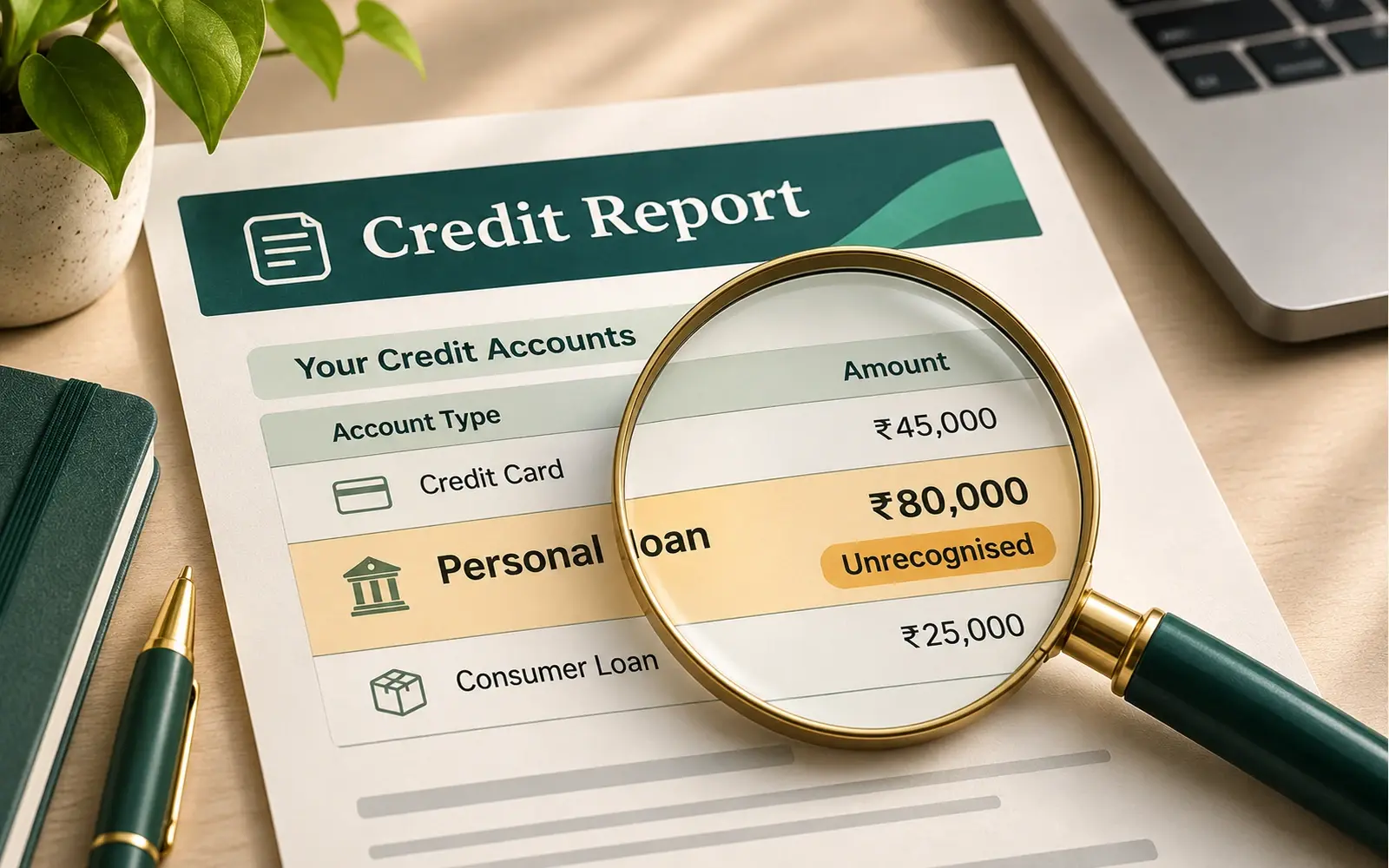
You apply for a home loan and discover that your credit report contains an overdue personal loan of ₹80,000. The lender's name is unfamiliar, and you have never received the money. Yet the account appears against your identity, potentially making you look like a borrower who has failed to repay a debt.
What should you do? Paying the outstanding amount might seem like a quick way to protect your credit score, but that could mean paying a debt that is not yours. Ignoring the entry is also risky: it may remain visible to future lenders.
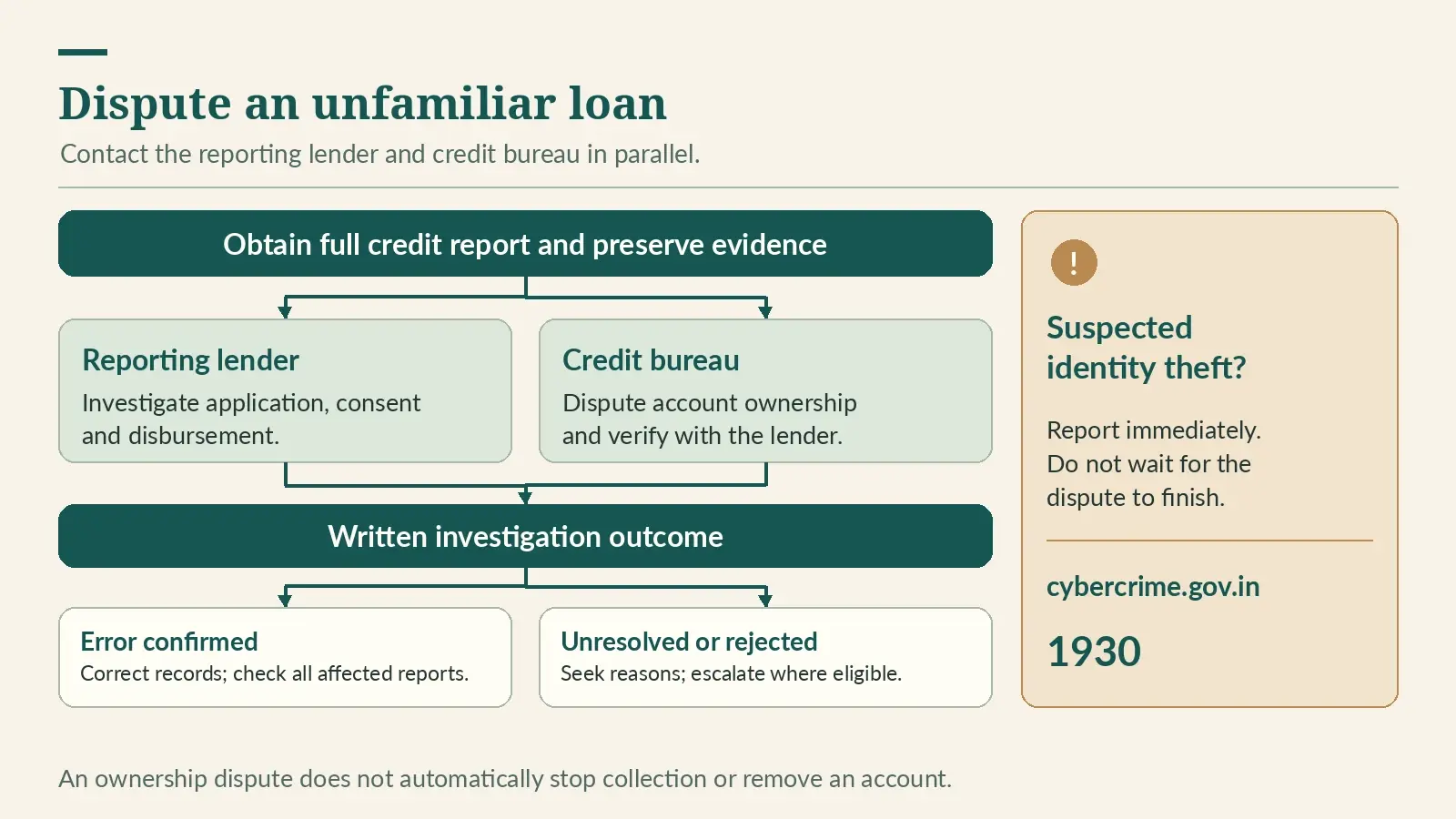
If a loan does not belong to you, dispute its ownership with the credit bureau and lodge a written complaint with the reporting lender. If you suspect identity theft, report the fraud immediately rather than waiting for the credit-report dispute to finish.
India has a formal process for correcting inaccurate credit information, with a resolution period and compensation for certain delays. Understanding that process can help you obtain a correction without paying a credit-repair agency or accepting responsibility for an unfamiliar debt.
How does someone else's loan appear on your credit report?
A credit information report (CIR) is assembled from records supplied by banks and other credit institutions. In India, the four registered credit information companies (CICs), commonly called credit bureaus, are TransUnion CIBIL, Experian, Equifax and CRIF (formerly CRIF High Mark).
A credit score is a numerical assessment derived from credit information. The report itself contains the underlying accounts, balances, repayment history, enquiries and identifying information. A wrong loan account is therefore a problem with the underlying data, not necessarily a problem with the scoring formula.
There are several possible explanations for an unfamiliar account:
| Possible cause | What may have happened |
|---|---|
| Incorrect identity mapping | Another borrower's account was associated with your credit profile because of inaccurate identifiers or matching errors. |
| Reporting error | A lender submitted an incorrect PAN, account reference, ownership status or other record. |
| Unfamiliar lender name | A loan taken through an app, retailer or buy-now-pay-later service was financed by a different bank or NBFC. |
| Joint or guaranteed borrowing | You may be recorded as a co-borrower or guarantor rather than the primary borrower. |
| Identity theft | Someone obtained credit by misusing your identity or impersonating you. |
A genuine loan may also be listed under the name of a new lender following a portfolio transfer. An unfamiliar name alone does not establish fraud. Conversely, matching personal details alone do not prove that you authorised the borrowing.
The investigation should establish whether the account really belongs to you and, if it does, whether its reported details are accurate.
Step 1: Obtain your full credit report and identify the error
Start with the actual report, not just a score displayed in a payment or lending app. A score can tell you that something changed; it cannot tell you exactly what must be corrected.
Under RBI's Credit Information Companies Directions, an individual with an available credit score can request one free full report, including the score, from each CIC in a calendar year, subject to identity authentication. Additional reports may be available under the bureau's own terms.
Save a dated copy of the report and note the following details:
- Bureau name, report reference number and generation date.
- Reporting lender, loan type and account reference (even if partly masked).
- Account opening date, sanctioned or original loan amount, outstanding balance and overdue amount.
- Ownership classification, account status and repayment history, including days past due (DPD).
- Any unfamiliar enquiry, address, phone number or other identity detail.
Do not publish your full report on social media. It contains sensitive personal and financial information. Share only the necessary details through verified institutional channels.
Distinguish an account from an enquiry
An enquiry generally records a lender's access to your credit report for a credit-related purpose. It is not proof that a loan was sanctioned or disbursed. An unfamiliar loan account, on the other hand, is a record of a reported credit facility.
| What you find | What to dispute |
|---|---|
| A personal loan you never authorised | Account ownership |
| A genuine loan incorrectly shown as overdue | Payment history or overdue balance |
| A repaid loan still shown as active | Closure status and balance |
| A genuine account reported twice in error | Duplication of account information |
| An unfamiliar credit enquiry | Enquiry ownership or validity |
Check whether the report has confused a genuine account with another record before requesting a specific correction. For example, a legitimate loan account does not normally disappear just because you have repaid it: its historical record may remain, with the appropriate closed status.
If the whole account is not yours, do not merely ask the bureau to change its overdue balance to zero. That leaves the more fundamental ownership error unresolved.
Step 2: Complain to the reporting bank or NBFC
The reporting lender is usually best placed to examine the underlying loan application, identity verification and disbursement. Use the grievance channel listed on the institution's official website. If the lender is unknown, ask the bureau to identify the reporting institution and the lender to trace the account from the report reference.
State clearly that you deny having authorised or taken the loan. Ask the institution to investigate the account's origin and your alleged connection with it. Relevant records may include:
- The loan application, sanction details and executed loan agreement.
- The KYC records and evidence linking you to the borrower, co-borrower or guarantor role.
- The available records of consent, authentication or electronic signing.
- The disbursement date, destination and transaction reference.
- Any mandate or repayment authorisation purportedly given by you.
Request the records or relevant extracts that the lender can lawfully disclose. A lender may need to redact another person's information; the goal is to establish the basis of the claim against you, not to obtain a stranger's private records.
If collection calls or payment demands have started, notify the lender that ownership is disputed. Ask it to suspend collection activity and further adverse reporting of the disputed account during investigation, where appropriate, and confirm its decision in writing. Filing a dispute does not automatically guarantee a collection or reporting freeze.
If the lender confirms that the account is not yours, request correction of the source records and transmission of the corrected information to every affected bureau, together with written confirmation that you are not liable for that account.
Keep the complaint acknowledgement and original date. A phone conversation may be useful, but a written record is much easier to rely on if you have to escalate.
Step 3: Raise an ownership dispute with the credit bureau
You can submit a correction request directly to a credit institution or to a CIC under Section 21 of the Credit Information Companies (Regulation) Act, 2005. In practice, contacting both is often useful when a loan is unfamiliar. Cross-reference the complaint numbers so the parties know that the requests concern the same error.
The bureau coordinates verification of reported data with the source lender. It generally cannot unilaterally delete lender-supplied information without the requisite confirmation. If the problem is the bureau's own matching of records, ask it to investigate the identity linkage as well.
How to dispute a loan on your CIBIL report
- Sign in to your account on the official CIBIL website and access your current report.
- Open its dispute-resolution facility and select the relevant account or enquiry.
- Select the ownership-related dispute option if the entry does not belong to you. For a genuine account with inaccurate details, select the affected fields instead.
- Provide a concise explanation and complete the required verification or supporting-document steps.
- Record the dispute reference number and track the outcome through the official channel.
CIBIL may flag a disputed entry during investigation. That indicator does not mean the account has been removed or that a lender must disregard it. CIBIL's dispute FAQs distinguish ownership disputes from requests to amend particular fields. Its dispute guide also advises using a report no more than 60 days old when initiating a dispute.
Where to dispute information with other credit bureaus
| Credit bureau | Official consumer channel |
|---|---|
| TransUnion CIBIL | Consumer dispute resolution |
| Experian India | Consumer services and dispute facility |
| Equifax India | Consumer grievance redressal |
| CRIF | Consumer dispute portal |
Check your reports from the other bureaus as well. An inaccurate loan can appear in more than one report, and a correction in one bureau does not by itself establish that all other databases have been corrected. Raise disputes with each affected bureau if necessary.
Where one complaint concerns inaccurate reporting by several lenders, RBI's framework requires the consumer to register it with the relevant CIC so that the bureau can coordinate the response.
Step 4: Act immediately if you suspect identity theft
A loan disbursed through impersonation is not merely a credit-reporting problem. Correcting the bureau entry does not itself investigate the crime, reverse the money movement or prevent additional borrowing.
If the lender's investigation or other evidence suggests misuse of your identity, take these steps without waiting for the normal dispute period:
- Inform the lender's fraud or grievance team and ask it to preserve the loan application and transaction records.
- Report suspected online financial fraud using the government's National Cyber Crime Reporting Portal at cybercrime.gov.in or helpline 1930. For other forms of impersonation, contact the appropriate police authority. Retain the acknowledgement and any subsequent police reference.
- Review your other credit reports, genuine bank accounts and credit alerts for further suspicious activity. Notify the relevant account provider immediately if an unauthorised transaction has occurred.
- Secure affected accounts, change compromised passwords and check registered phone numbers and email addresses. If Aadhaar authentication misuse is suspected, review the relevant facilities on the official UIDAI portal, including biometric locking where appropriate.
- Preserve messages, call details, screenshots and complaint records. Do not send OTPs, passwords or PINs to anyone claiming to investigate the loan.
A cybercrime complaint acknowledgement is not necessarily an FIR or proof that the investigation has established fraud. Continue pursuing the lender and bureau correction independently. Obtain legal advice if recovery proceedings, a court notice or a substantial disputed liability is involved.
How long should a credit-report dispute take?
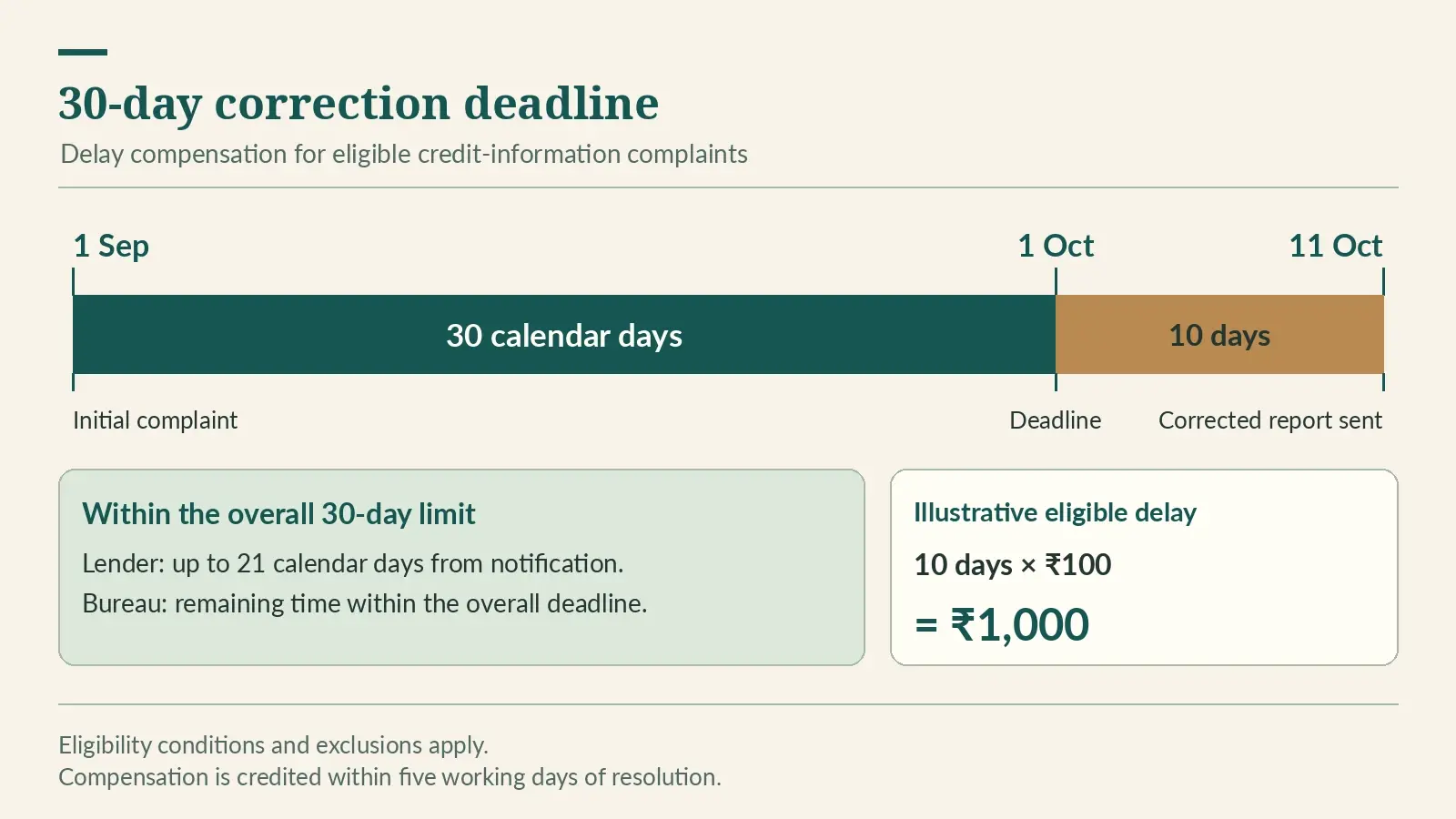
The statutory correction framework sets a combined 30-calendar-day period for resolving a credit-information complaint, counted from its initial filing with the lender or CIC. It is not a fresh 30-day allowance for each institution.
The source lender has up to 21 calendar days from notification of the error to transmit the corrected information. The CIC handles the remaining time within the overall 30-day limit; in the straightforward case where the lender is informed at the beginning and takes its full allowance, this leaves nine days for the bureau. These are not two independent deadlines that can be extended by passing the complaint back and forth.
A faster routine reporting schedule does not replace this grievance deadline. Since 1 July 2026, RBI's revised reporting directions use the 9th, 16th, 23rd and final day of each month as credit-information reference dates, with submission and processing deadlines. This does not mean every correction appears immediately on every consumer app.
When can you claim ₹100 per day in compensation?
RBI's delayed-correction compensation framework provides ₹100 for each calendar day beyond the permitted 30-day resolution period for eligible complaints. It applies to delays in resolving inaccuracies rather than simply to the presence of a low credit score.
Consider a hypothetical ownership dispute:
| Milestone | Date |
|---|---|
| Initial complaint filed | 1 September |
| End of 30-day period | 1 October |
| Corrected report sent | 11 October |
| Delay beyond deadline | 10 calendar days |
| Compensation, if eligible | ₹1,000 |
The delay is counted from the applicable deadline, not from the day you discovered the wrong account. Where both institutions contributed to the delay, responsibility is allocated under the RBI framework; the amount is not automatically doubled because two parties were involved.
For a correction, the relevant resolution date is when the corrected report is sent to your supplied email or postal address, not merely an internal system update. Eligible compensation should reach your account within five working days of resolution. Provide accurate payout details through the institution's verified channel, never your internet banking password or an OTP.
When the compensation rule does not apply
The framework excludes disputes about the calculation of the credit score or scoring model itself, certain matters falling under Section 18 of the 2005 Act, and complaints pending or already decided in specified other forums. It also excludes certain administrative or commercial matters. A properly resolved and reasoned rejection is not automatically an overdue correction simply because you disagree with the conclusion.
If the lender rejects your claim, ask for the grounds and the records supporting its position. If an eligible correction is delayed, request the calculation and allocation of compensation in writing. Neither payment of compensation nor completion of 30 days automatically removes an account.
Step 5: Escalate unresolved complaints to the RBI Ombudsman
If the first-level grievance team does not resolve the problem, use the institution's escalation matrix and nodal officer. Provide the earlier complaint reference instead of treating every reminder as a new complaint.
For covered regulated entities, including CICs, an eligible service complaint can be escalated through RBI's Complaint Management System (CMS). The Reserve Bank – Integrated Ombudsman Scheme, 2026, took effect on 1 July 2026, replacing the 2021 scheme.
You must have first complained to the relevant regulated entity. You can approach RBI if the reply is unsatisfactory or if no reply arrives within 30 days (or a longer applicable regulatory deadline, where prescribed). Under the revised scheme, the filing window is 90 days measured from the later of the applicable deadline's expiry or the entity's last communication. Do not rely on older online guides describing the previous scheme's limitation periods.
There is no filing fee. Attach your original grievance, acknowledgement, disputed report extract, replies and supporting evidence. Identify the specific deficiency and the relief requested: correction of inaccurate reporting, a reasoned decision, and eligible delay compensation, for example.
Not every lender or dispute is within the scheme's scope. Matters subject to Section 18 of the credit information law or the same grievance already before a court or other specified forum may be excluded. A police investigation of a criminal offence is not automatically treated as the same grievance under the 2026 scheme. Complex fraud or legal liability disputes may require a separate remedy. See the RBI Ombudsman FAQs for current eligibility and exclusions.
A sample complaint for a loan that does not belong to you
Adapt this template to the facts and submit it through the verified channel of the reporting lender or credit bureau.
Subject: Dispute of loan account ownership and request for correction of credit information
I have identified an unfamiliar loan account in my credit report dated [date], issued by [bureau], report reference [reference]. The reporting institution is [name], account reference [masked number], and the reported loan amount is [amount].
I have not applied for, authorised or knowingly undertaken this credit facility. I dispute the attribution of this account to my identity and do not acknowledge liability for the disputed debt.
Please investigate the account linkage and the records establishing my alleged ownership, consent and disbursement. Where the account has been wrongly attributed to me, please rectify the underlying information and ensure correction across the affected credit information companies. Please provide written confirmation of the outcome and reasons if my request is rejected.
Please acknowledge this complaint, provide a reference number, and resolve it within the applicable credit-information correction framework. If eligible compensation becomes payable for delayed resolution, please arrange payment under the applicable RBI directions.
Enclosures: relevant report extract, applicable identity-verification evidence and earlier complaint references, if any.
If you are unsure whether the facility is yours, say so instead of making a categorical denial. For suspected fraud, mention the circumstances and police or cybercrime complaint reference if available. Avoid including unrelated sensitive financial data in the complaint.
Step 6: Verify the correction before considering the matter closed
A message saying that your complaint has been resolved is not enough. Obtain the corrected report and confirm that the specific ownership error, associated overdue amounts and erroneous repayment history have been removed or corrected as appropriate. Check that genuine accounts remain intact.
Ask the lender for written confirmation of the action it took, and inspect the other affected bureaus. If the same error reappears in a later report, reopen the issue with the earlier correction evidence and request investigation of the underlying source or matching problem.
Your score may improve once inaccurate negative information is corrected, but no institution can promise a particular number of points. The result depends on your remaining credit history and the scoring model. An accurate report also does not guarantee approval of a new loan; lenders assess income, repayment capacity and other factors separately.
If you were rejected for a loan because of the incorrect account, preserve the rejection communication and evidence of any actual loss. After the correction, you may ask the prospective lender to reassess your application using updated data.
Mistakes to avoid when disputing a wrong loan
Do not pay or settle a debt solely to make an unfamiliar entry disappear. A settlement does not necessarily resolve incorrect attribution, and may leave an adverse settlement record. Seek prompt assistance if there is a formal demand or legal proceeding. Continue paying all genuine obligations on time.
Avoid agencies promising a guaranteed score increase or removal of accurate negative information. You can initiate disputes and use RBI's complaint system yourself. Do not provide remote device access, payment credentials or identity documents to unverified intermediaries.
Finally, do not wait for the next routine credit-report update if there are signs of identity theft. Regular monitoring is useful, but active fraud requires immediate reporting.
The bottom line
An unfamiliar loan in your credit report deserves investigation, not automatic acceptance. Obtain the full report, identify the reporting lender, dispute ownership where appropriate and preserve a written record. Report suspected fraud immediately and check all affected bureaus after the correction.
The most important objective is not simply a higher credit score. It is to establish an accurate credit history that reflects the debts you actually owe, and to prevent an incorrect account from continuing to affect your financial decisions.
Related reading: what a credit score measures.
Sources and Further Reading
- India Code — Credit Information Companies (Regulation) Act, 2005, particularly Sections 18 and 21.
- RBI — Credit Information Companies Directions, 2025, updated 1 July 2026, including reporting, free reports, correction and compensation provisions.
- RBI — Commercial Banks: Credit Information Reporting Directions, 2025.
- RBI — NBFCs: Credit Information Reporting Directions, 2025.
- RBI — List of registered credit information companies.
- RBI — Integrated Ombudsman Scheme, 2026 FAQs.
- TransUnion CIBIL — Loan rejections and disputes FAQs.
- TransUnion CIBIL — Dispute resolution guide.
- Experian India — Consumer services.
- Equifax India — Consumer grievance redressal.
- CRIF — Consumer dispute portal.
- National Cyber Crime Reporting Portal — Cybercrime reporting and helpline.