
Internet, Intranet and Extranet
Internet, Intranet and Extranet. Foundational Computer Awareness explanations, examples and explained practice questions for banking and recruitment exam preparation.
By Akhilesh Saini
What you will learn
- What makes the Internet a worldwide network of networks.
- How a private intranet differs from the public Internet.
- Why an extranet grants controlled access to outside parties.
- How banks and offices may use all three without mixing up the terms.
Why this topic matters
An exam may describe an employee-only portal, an authorized vendor portal or a public website and ask which network/service arrangement it represents. The key is who may access the resource, not whether it uses a browser or a particular cable.
The Internet: a global network of networks
The Internet is a worldwide system of interconnected computer networks that communicate using the Internet Protocol family, commonly referred to as TCP/IP. Rather than being one giant computer controlled from a single location, it connects countless independent networks through common rules and routing.
A home Wi-Fi network, a university network and a company's network may connect to the wider Internet through service providers. Data can move between networks because routers forward it using network addresses and communication protocols. You can think of the Internet as connected roads, while websites, email and online calls are different services traveling over those roads.
A useful simplification is: a device sends data toward another device or service; Internet routers help transport the data to the destination. In reality, communication usually uses many small packets and may pass through multiple networks.
Common Internet-based services include browsing websites, email, messaging, remote meetings, cloud applications and internet-based file transfer. They all make use of connectivity; they are not all the same as the World Wide Web.
Intranet: restricted organizational resources
An intranet is a private organizational network or environment that uses Internet-style technologies to make information and services available to authorized members, typically employees. It might contain an HR policy page, internal forms, a branch circular repository or a staff directory.
An intranet is generally access-restricted, but private does not necessarily mean physically disconnected from the public Internet. An organization may securely allow remote employees to reach its intranet through a VPN or another authenticated access mechanism. The exam-relevant distinction is its restricted organizational purpose.
Example: A bank employee signs into a staff-only policy portal. Even if the employee connects from home using a secure remote-access system, the portal is still an intranet resource.
Extranet: limited access for external partners
An extranet extends selected private resources or services to approved people outside the organization: for example, suppliers, corporate customers, partners or auditors. Access is normally controlled by accounts, permissions and security rules.
Example: A banking technology vendor is permitted to upload service reports to a specific secure portal. The vendor cannot browse the whole employee intranet; only the assigned functions are exposed. That is a typical extranet use.
A public bank website, by contrast, is designed for broad public access, even though parts such as online banking still require customer authentication. Simply having a login page does not automatically make a website an extranet.
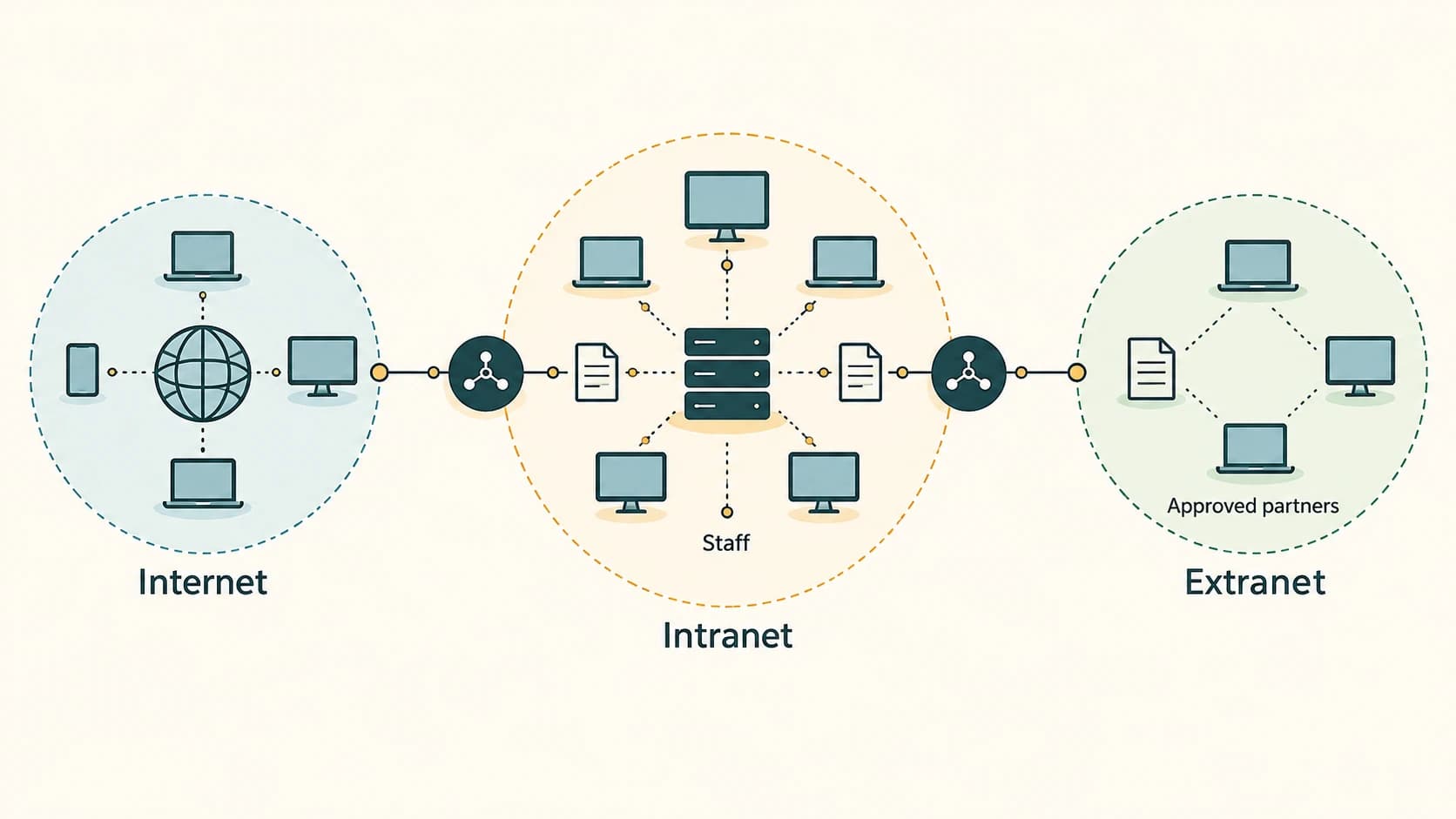
Side-by-side comparison
| Feature | Internet | Intranet | Extranet |
|---|---|---|---|
| Basic idea | Worldwide interconnected networks | Private organizational environment | Selected organizational access for outsiders |
| Typical users | General public and connected organizations | Authorized members/staff | Authorized partners/customers/vendors |
| Control | Distributed among many networks | Organization's access policies | Organization's access policies for external users |
| Example | Public information website | Internal employee circular portal | Secure supplier collaboration portal |
| Must use separate physical wiring? | No | No | No |
Worked examples
Example 1 — Recruitment information: Anybody can read a published exam notice from an official public website. This is an Internet-accessible service; it is not an intranet just because the organization owns the website.
Example 2 — Staff leave management: A bank employee uses a protected internal HR portal. This is a typical intranet service even if reached over a secure remote connection.
Example 3 — Partner collaboration: A contracted maintenance firm receives restricted access to upload inspection records. This is a typical extranet arrangement.
Example 4 — Branch network: Computers in one branch connected by cables form a local network. This alone does not establish whether a particular web portal is an Internet, intranet or extranet resource; access and purpose determine the classification.
Important terms
| Term | Meaning |
|---|---|
| Network | Connected devices sharing data/resources |
| Internet | Worldwide interconnection of networks |
| TCP/IP | Common protocol family for Internet communication |
| Router | Device forwarding data between networks |
| ISP | Internet Service Provider; provides Internet connectivity |
| Intranet | Restricted organizational network/resources |
| Extranet | Controlled organizational access extended to selected outsiders |
| VPN | Virtual Private Network; may support protected remote connectivity |
| Access control | Rules deciding who may see or use a resource |
Common confusions and exam traps
- Internet ≠ WWW: The Internet is the underlying network; the Web is a service that uses it. The next lesson covers this distinction.
- Intranet ≠ offline only: Remote access over the Internet can still reach a private intranet securely.
- Extranet ≠ public to everybody: Only approved outsiders can access protected resources.
- Wi-Fi ≠ Internet: A Wi-Fi connection may exist without Internet access.
- A password is not enough to classify an extranet: A customer login on a public website is not automatically an extranet.
Objective-exam facts to remember
| Clue in a question | Most likely term |
|---|---|
| Worldwide network of interconnected networks | Internet |
| Employee-only internal portal | Intranet |
| Private resource shared with approved external supplier | Extranet |
| Company enabling protected remote access | VPN or authenticated remote access |
| Company supplying Internet connectivity | ISP |
Quick revision
- The Internet connects networks globally.
- The intranet is designed for authorized organizational users.
- The extranet shares selected internal resources with approved outsiders.
- The Web is only one of multiple Internet-based services.
- Public/private access is more useful for classification than the browser or cable used.
Practice questions — CA-06-01
1. The Internet is best described as:
A. A single giant website
B. A worldwide network of interconnected networks
C. A particular web browser
D. An office-only database
2. An employee-only policy portal is typically an:
A. Internet search engine
B. Extranet open to all suppliers
C. Intranet
D. Public social network
3. A vendor can access only a secure maintenance-report portal supplied by an organization. It is a typical:
A. Extranet
B. Public homepage
C. Web crawler
D. Modem
4. Which service is not identical to the World Wide Web?
A. HTML page
B. Website
C. Web browser tab
D. Email transport over the Internet
5. Which term refers to a company supplying Internet connectivity?
A. ISP
B. PDF
C. HTML
D. OCR
6. A private intranet must always:
A. Be completely disconnected from the public Internet
B. Allow only public visitors
C. Be unreachable from outside the office building
D. Restrict access to authorized users/resources
7. A user joins a Wi-Fi network that has no Internet connection. Which statement is correct?
A. No network connection exists
B. Wi-Fi and Internet are identical
C. Local wireless connectivity may work without Internet access
D. The WWW is necessarily available
8. Which concept is most important when distinguishing intranet from extranet?
A. Laptop brand
B. Who is permitted access
C. Whether the page uses a blue theme
D. File extension
9. A bank publishes a page for everyone to read. The page is:
A. Automatically an intranet
B. Automatically an extranet
C. Necessarily an offline resource
D. Publicly accessible web content
10. A VPN is most commonly associated with:
A. Changing a CSV file into PDF
B. Providing protected network connections, including remote access
C. Making all websites truthful
D. Replacing every DNS server
11. Routers mainly help Internet communication by:
A. Forwarding data between networks
B. Converting source code into programs
C. Formatting Word documents
D. Scanning barcodes
12. Which statement is the best general description of an extranet?
A. Any webpage with a login prompt
B. A website only for internal staff
C. An organizational resource selectively shared with approved outsiders
D. The entire worldwide Internet
Answers and explanations — CA-06-01
1. B — A worldwide network of interconnected networks. The Internet interconnects many networks using common communication protocols.
2. C — Intranet. An intranet restricts organizational information and services to authorized members.
3. A — Extranet. Extranets expose selected internal resources to approved external partners.
4. D — Email transport over the Internet. Email can use Internet mail protocols; the Web is another service built over the Internet.
5. A — ISP. ISP stands for Internet Service Provider.
6. D — Restrict access to authorized users/resources. Authenticated remote access can reach an intranet through the Internet; it remains restricted.
7. C — Local wireless connectivity may work without Internet access. Wi-Fi is a wireless network technology; an Internet connection is a separate capability.
8. B — Who is permitted access. Intranet access is mainly for organization members; extranet access extends to approved outsiders.
9. D — Publicly accessible web content. The publisher may be a bank, but general access makes the page a public web resource.
10. B — Providing protected network connections, including remote access. VPN technology can protect remote connections and help authorized users access network resources.
11. A — Forwarding data between networks. Routers make forwarding decisions for data traveling between networks.
12. C — An organizational resource selectively shared with approved outsiders. Controlled sharing with external authorized parties distinguishes a typical extranet.